May, 2024.
Tawny Owls.
Since late Autumn, during the hours of darkness, our garden has come alive with the nocturnal activity of Tawny Owls, (Strix aluco), as they attempt to establish a territory in preparation for breeding. The harsh ‘ke-wick’ cry of the female, closely followed by the ‘too-woo’ reply of the male, together completing the generic call of the owl. Lately, we have also been treated to the nocturnal serenading of the male as he croons his melodious, warbling love-call to attract the female, one of the loveliest of nocturnal sounds.
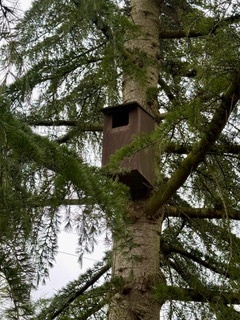
This year, the owls have chosen to nest in a purpose-built Tawny Owl box we have provided, sited close to the house in a large cedar tree in our garden. In previous years, they have bred in one of the Barn Owl boxes we have on site, which are considerably larger than the specially designed Tawny Owl box.
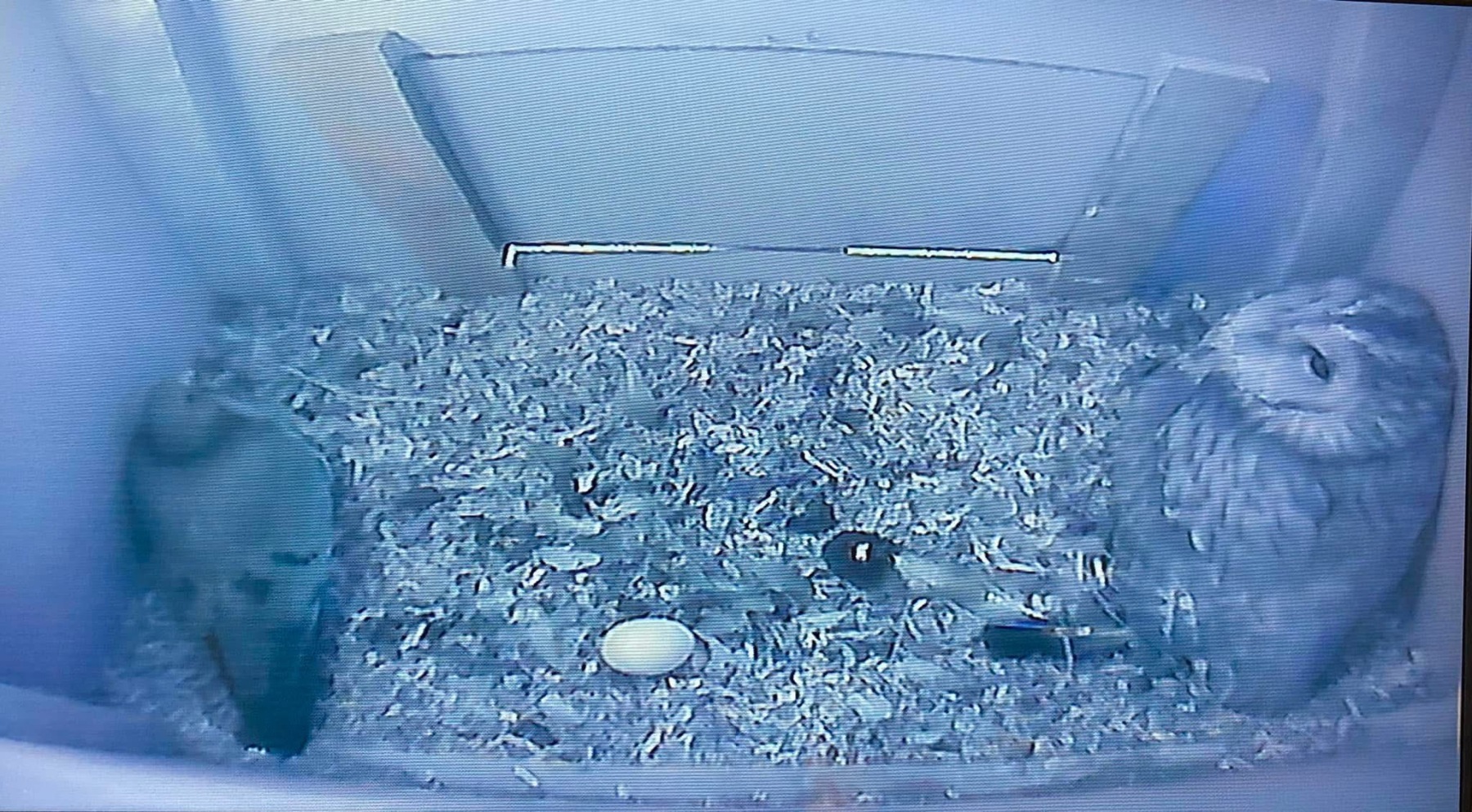
Having nest-box cameras installed, enables us to monitor the activity of the owls when they are inside the nest. It also allows us to observe any other species which may take an interest in occupying the box. Stock Doves, (Columba oenas), will attempt to nest all-year-round in the Barn Owl boxes. Jackdaws, (Coloeus monedula), well known cavity nesters are regular owl-box prospectors, and there is the constant problem of Grey Squirrels, (Sciurus carolinensis), attempting to fill the boxes with twigs and leaves to make their drey.
One year, when the Tawny Owls chose to breed in one of the Barn Owl boxes sited in a Poplar tree in the garden, I had been surprised to note when first switching on the cameras in the early morning, that the nest-box had in occupation both a Tawny Owl and a Stock Dove. Each looked uncomfortable with the other’s presence, huddled against opposing walls, a single egg in the centre of the box between them. A short time earlier, a sitting Stock Dove had been ousted by a Tawny Owl prospecting for a nest site, a few Stock Dove tail feathers, scattered about the nest, were all that remained as proof that a squabble had taken place. The Tawny Owl had gone on to lay her first egg, and we hadn’t anticipated the brave, or extremely fool-hardy return of the Stock Dove now the Tawny Owl was in occupation. The dove made the wise decision to vacate the nest soon after, seemingly without coming to any harm.
Later discussion with a member of the Barn Owl Trust, revealed that they had seen Stock Doves share a nest-box with Barn Owls before, and even had young successfully hatch on one occasion, although the squabs ‘disappeared’ soon after, probably ending up as food for the owlets!
Sadly, this year, the camera in the occupied Tawny Owl box ceased functioning shortly after the female settled in to nest and, not wanting to disturb her once she was in occupation, we had no way of knowing how many eggs were laid, and how the anticipated family of young owls was doing until they began to venture out of the nest box and wander around the tree, a practice known as, ‘branching’.
Tawny Owls lay on average, two to three eggs, asynchronously, every two days or so, with incubation lasting approximately thirty days. Fledging occurs when the young are around five weeks old, when they will enter the ‘branching’ phase, climbing through the branches of the trees around the nest site, with the adults in regular attendance, providing food.
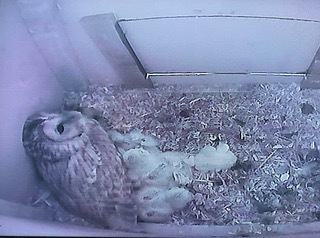
During previous years, with the nest-box cameras in operation, we had been able to monitor what the owls were feeding on. Often, early morning viewing of the live-stream would reveal several voles, mice, shrews and even young rabbits scattered about the nest-box floor, the male having provided for his mate extremely well during the night as she sat her clutch of eggs or brooded newly hatched chicks. The male Tawny Owl takes responsibility as sole provider during the incubation period and early development of the chicks. We would hear him calling to the female from a distance to alert her of his approach, with her excited reply following immediately after, before he returned to the nest-box with prey, dropping it down to the female through the entrance without entering the nest.
The female will only leave the nest for a few minutes each night to stretch and to defecate, which helps to keep the nest site clean. This, and the fact that Tawny owlets leave the nest at around four to five weeks of age, means the nest doesn’t have a chance to become soiled, unlike that of the Barn Owl, where the putrid, malodorous filth left behind after a brood is incredibly unpleasant.
Young Tawny Owls are blind for the first seven to ten days and the female will carefully tear the food into strips before offering it to the hatchlings with great patience and tenderness. At around two weeks of age, their eyes are fully open and they are able to stand.
Around the middle of May, the squeaky, sneeze-like, ‘achoo’ calls of young Tawny Owls became noticeably more audible during the night, suggesting the owlets were exploring the area outside of the box. The constant begging calls made by the owlets to the parents, who would continue to feed their brood for up to three months after they had left the nest, became the nightly accompaniment to the contact calls of the attentive adults.
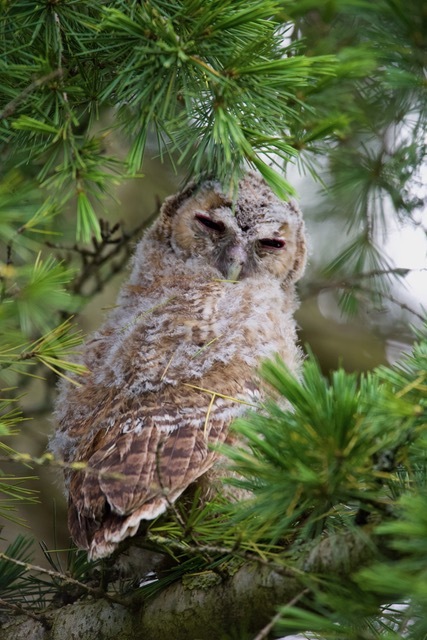
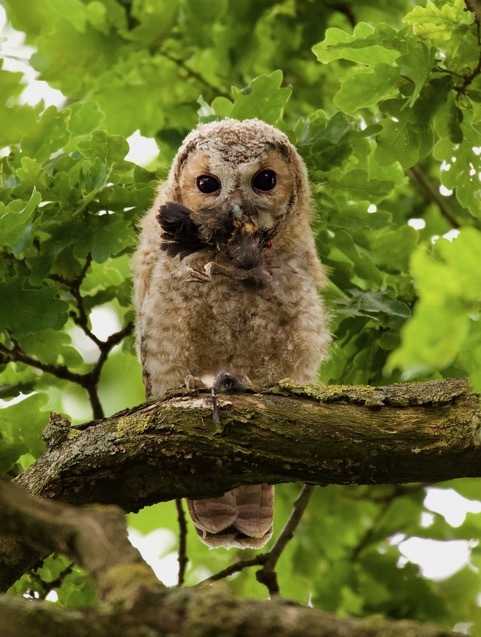
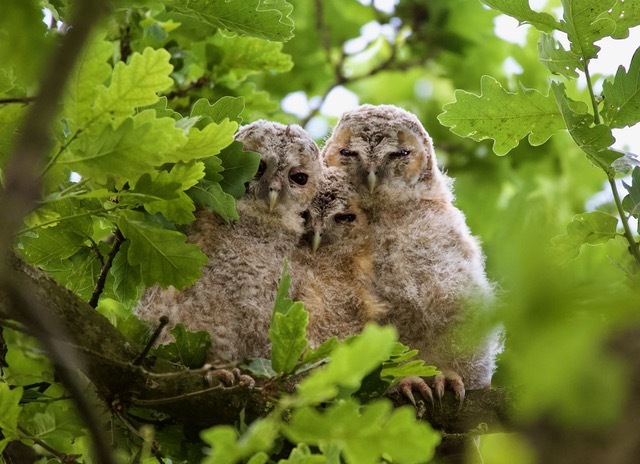
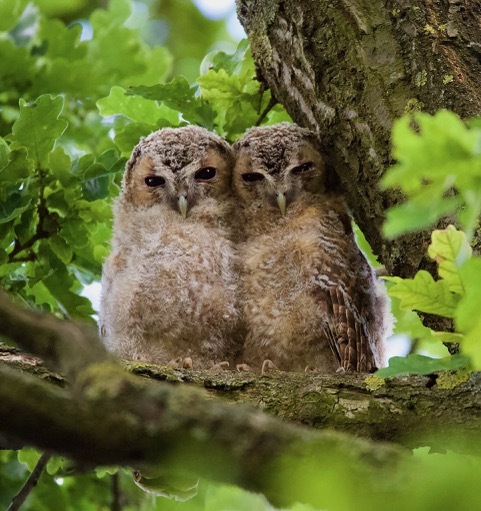
At this stage, the young owlets are still covered in a thick, grey, fluffy down, which, along with their huge, dark eyes, gives them an extremely endearing appearance . However, sharp
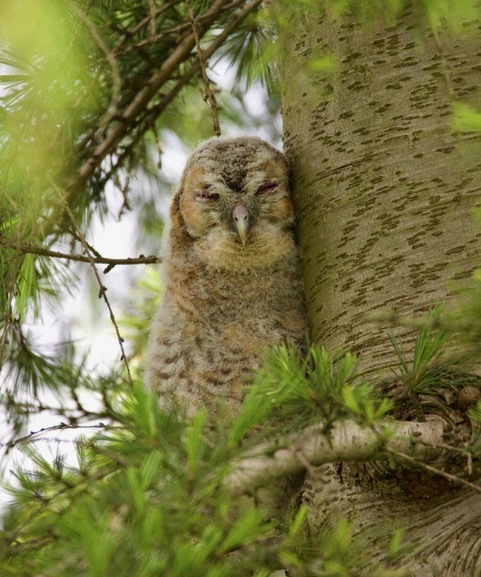
claws and beak, which allow them to wander through the tree boughs, betray the future hunter which hides behind the cute, cuddly facade. Their developing mottled brown wing feathers enable them to flutter between branches as they become more proficient at flight and mean they are incredibly well camouflaged against the tree bark.
During the time when the young owls were exploring the trees in our garden, and roosting away from the nest-box during the daytime, we were able to determine that there was a brood of three young. Previous years had seen them raise as many as four, but three was a healthy brood. The owlets’ new-found spirit of adventure afforded us the opportunity of photographing them whilst they remained in the garden, close to the nest site. It was often difficult to spot their huddled forms, as they roosted during the day, hugging the trunks of the cedars and oaks, or peering down at us through densely emerging foliage from high above. What allowed us to easily locate them however, was the strident alarm calls of Blackbirds, which warned of the hunting activity of the parent Tawny Owls as they picked off the fledglings of smaller birds to feed to their own young. The Blackbirds’ outraged calls provided the constant, discordant theme tune to each new day, and with good reason as, being able to locate the young owls easily, we often found them clutching a fledgling Blackbird, recently delivered by the swiftly retreating parent.
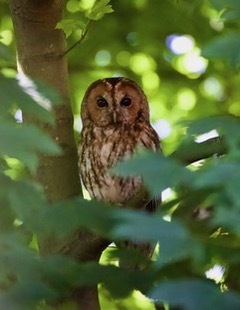
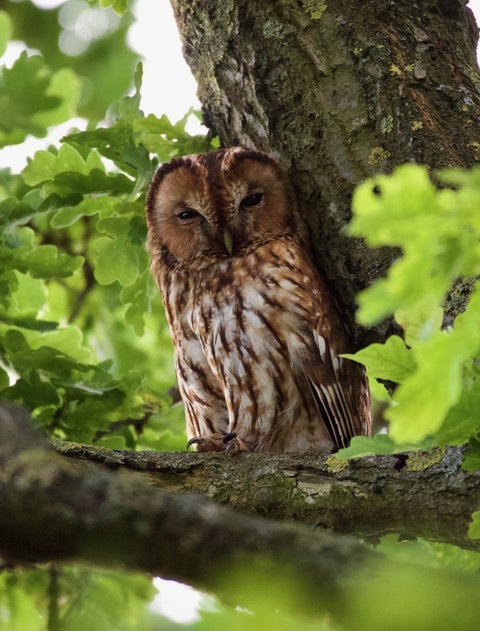
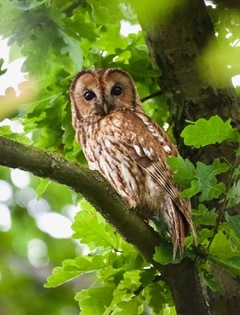
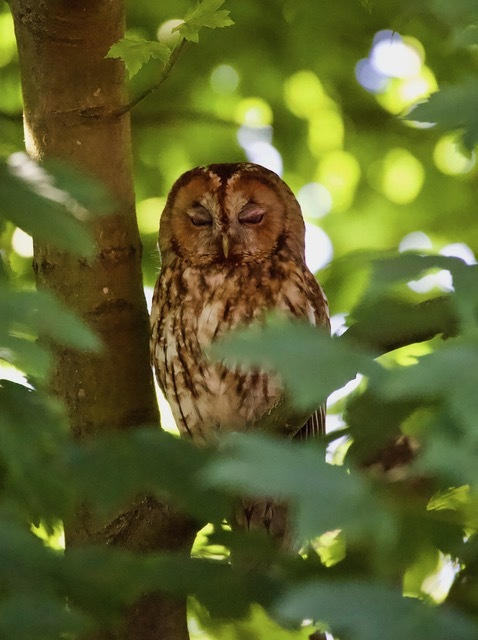
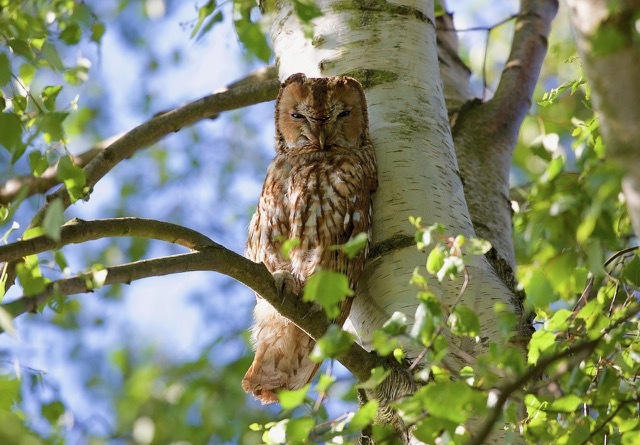
The adult Tawny Owls were often observed during daylight hours too, roosting in the trees close to their young brood. Their half-open, sleep-deprived eyes would follow us around the garden, their heads turned in seemingly impossible rotation as they tracked our movements. Although Tawny Owls have binocular vision, their forward-facing eyes cannot move within their sockets, so they must turn their heads, and are able to do so through 270 degrees, allowing them to look behind them without moving their bodies.
Tawny Owls are known to be fiercely aggressive in the protection of their young, and often, when I was busy with some task in the garden, I would become aware of a pair of glaring eyes fixed on me from the cover of the Hawthorn hedge, or staring from the lime-green foliage of a slender Silver Birch.
British photographer, Eric Hosking, famously lost an eye after being attacked by a Tawny Owl, when attempting to take photographs near a nest. Thankfully, the adult owls never considered us such a threat that they felt roused to launch an attack.
Young Tawny Owls can be vulnerable, often falling from trees, but they are quite competent climbers and are able to make their way back to safety. One fateful night, however, we were awoken by a terrible cacophony of noise coming from the direction of the Cedar tree. We could discern the outraged screeching calls of adult Tawny Owls, along with other anguished cries, and rushed out with torches to try and discover what was causing the disturbance. We came upon a murderous scene, with the two adult Tawny Owls occupied in a prolonged, frenzied attack on a large ginger feral cat, a fearful young owlet watching on in the branches above. The cat appeared to be licking Its lips and there was a small pile of grey down in the grass beneath the tree, but we were unsure whether the cat had taken a fledgling, or if the adults had been able to deter the attacker for long enough to allow the owlet to escape. We hoped it was the latter. Thankfully, the cat scarpered on seeing us, and calm eventually ensued.
During this time of increased development and activity, I became aware that the young Tawny Owls had located the light-trap I had set in order to record the Moths we have in the garden. Their squeaky calls became particularly animated and excited, and peering out through our bedroom window, I noted the calls were coming from a Birch tree which overlooked the trap site. I could just make out the silhouettes of three owlets, Illuminated by the strong mercury vapour light, no doubt eyeing up the juicy moths which were being drawn to the light.
On another occasion, when leaning through an open ground floor window, in order to look for moth activity around the light trap which I had placed against the garage wall, I became aware of an adult Tawny Owl, perching almost by my side on a fence post beneath a row of birch. It was watching my moth trap with great concentration, and was totally oblivious to my presence. As my attention turned to my nocturnal companion, I watched it swoop purposefully down to land on the white sheet beneath the trap, and scoop up a moth before retreating into the dense cover of the oaks opposite. No doubt that would have been the prize moth of the night!
The young owls were a constant and very welcome distraction in our garden throughout the month of May and into June, and always a joy to watch. They even made an appearance on an episode of Springwatch, when a close-up photograph of one of the youngsters was shown at the opening of the program. The show’s researchers had asked permission to use one of my photo’s of a female Muslin Moth, and we had entered into a discussion about the unusual fact that females are not attracted to light nearly as frequently as males and why this might be. Having expected to see a photo of the moth, I was surprised to find they had seen my photo’s of the young Tawny Owls, and decided to run with one of those instead. It seems, cute and fluffy owls win over interesting moths every time!