Botanical Description
The Elecampane Inula helenium is a large, robust and outrageously showy perennial member of the Daisy family (Asteraceae) and is closely related to the Ploughman’s Spikenard Inula conyzae so frequent on local limestone soils.
This imposing plant typically grows from 3 to 6 feet in height, has a spread of 2 to 3 feet, though its impressive, coarse, felt-like basal leaves can each grow to 3 feet in length.
Its yellow flowers have a daisy-like central button of disk florets which produce nectar and pollen, surrounded for show by narrow ray florets about 3 inches in length which in theory help to advertise the flowers to passing insects.
Background to study
In June 2001 a member of the public notified the museum of a population of Elecampane plants growing on waste ground off Hangthwaite Road, Carcroft (SE5409).
Records on file at the former Doncaster museum showed that Samuel Appleby, the celebrated early 19th century Doncaster botanist and nurseryman, noted in 1832 that it occurred ‘On strong clay soil and low warp land below Doncaster.’
The Peter Inchbald’s (senior & junior), both expert botanists, who ran a private school at Adwick Hall in Adwick-le-Street from 1827-1849 knew of it in the Doncaster area but it was feared ‘eradicated’ by 1848.
F.A. Lees (Flora of West Yorkshire 1888) regarded it as ‘now very rare (dying out?) but formerly commoner, being much planted for use for its supposed medicinal properties’.
Interestingly, Lees’ last comment may explain the origins of its current use in the sunken garden and the Walled Garden at St Catherine’s Hall (now hospital), Woodfield Park (SE5600).
As a garden escape, Geoff Wilmore (2000) in his ‘Alien Plants of Yorkshire’, regards it as ‘a scattered or rare escape from cultivation usually on roadsides, formerly apparently more common’. He only notes two sites in south-west Yorkshire, neither of which were recent or local to Doncaster, these being Mayroyd, Hebden Bridge 1834 (Crump & Crossland 1904) and Calder Banks nr, Dewsbury (Naturalist 1958).
Historical evidence which came to light after this study, was from the Herbarium of Margaret Stovin of Wilsic Hall (1756-1846) which contained local specimens collected at Sandbeck and Tickhill in 1797 (Simmons, 1983 and Wilmore et al, 2011).
Since the results of the Phase 1 Ecological Surveys of South Yorkshire made no mention of the plant, neither did the botanical atlas surveys (square bashing) of Doncaster Museum staff and friends in the 1970’s and 1980’s, it was therefore presumed to be locally extinct. This assumption was supported after the extensive botanical studies commissioned by the local Authority in the late 1990s to re-survey some 300+ local Sites of Scientific Interest across the Metropolitan Borough also failed to locate the species.
The enquirer was particularly anxious to know the local conservation status of Elecampane, since the site was proposed for development as an industrial estate.
To directly negotiate for alterations to the proposed development so as to avoid destroying the plants, or to undertake the translocation of the Carcroft plants was not really within the museum’s remit. However, a report on the subject was passed to colleagues in the DMBC Planning Department and Countryside Unit in the hope that appropriate representations could be made and actions taken.
Since it seemed that the plants were in imminent danger of destruction, the suggestion was made that local residents should speak to the people on site with a view to moving the plants out of harm’s way or to ask to remove them to safety in local gardens or allotments.
In fact, what happened was that two members of the DNS, with great difficulty, dug (pick axed!) a plant out of the rock-hard desiccated clay and transferred it to the clay soil in the back garden of 7 Aldcliffe Crescent, Balby (SK5599) where it survived for the best part of 20 years. Whether other plants were salvaged isn’t known.
Although on apparent wasteland, the Carcroft population was growing on the heavy clay soil in the floodplain of the natural course of the river Eaubeck, now embanked, re-routed and classified (in drainage engineering parlance) as a high-level drainer. The plants could therefore have been survivals in a historic landscape (now unrecognisable) and could indeed have been descendants of the plants known by the Inchbald’s of the neighbouring Adwick-le-street in the 1840s.
The Carr Lodge Population
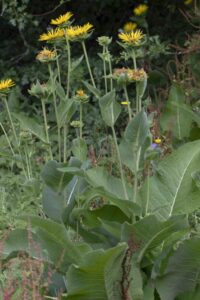
Elecampane – Inula helenium, Carr Lodge, July 14
On 14 July 2026 CAH and Les Coe visited the YWT Carr Lodge Farm, following a path through the spontaneously developing deciduous woodland adjacent to Hall Balk Lane. The land is on very heavy clay soil which typically floods in the winter, leading to deep poaching by heavy cattle, making mobility on foot difficult. In drought conditions the poached land bakes hard, creating treacherous conditions, requiring the visitor to keep to the well warn YWT path. Running parallel to the path is a wayleave (a strip of land largely cleared of trees) beneath overhead electricity cables. Within this linear clearing (at SK580 998) and barely visible from the path, was a monoculture of chest high plants of Elecampane extending over an area of approximately 5 yards by 25 yards. This was an extraordinary and unexpected sight yet barely visible from the YWT path.
Although the origin of this apparently newly discovered Elecampane population is something of a puzzle, discarded garden produce (garden escapes) seems a likely source. However, Appleby, who intimately knew the botany of the Doncaster Carrs, possibly indicates in his 1832 quote of the species occurring on ‘strong clay soil’ and ‘below [south of] Doncaster’ he may have known it occurring naturally here at Carr Lodge.
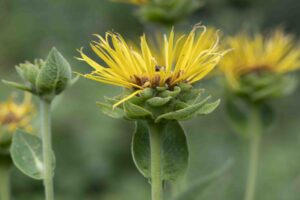
Elecampane – Inula helenium, Carr Lodge, July 14
P.S. This study was based on a file salvaged from the former Doncaster Museum.
References
Appleby, S. (1832) Rare plants in the neighbourhood of Doncaster. Mag. Nat. Hist. 5:558.
Lees, F.A. (1888) The Flora of West Yorkshire. Transactions of the Yorkshire Naturalists’ Union.
Simmons, M. (1993) A Catalogue of the Herbarium of the British Flora collected by Margaret Stovin (1756-1846). Middlesborough Borough Council, Dorman Museum.
Wilmore, G.T.D. (2000) Alien Plants of Yorkshire. Yorkshire Naturalists’ Union. Leeds.
Wilmore, G.T.D. (2011) Lunn, J. & Rodwell, J.S. (eds). The South Yorkshire Plant Atlas.
Yorkshire Naturalists’ Union & The Yorkshire & Humber Ecological Data Trust.
CAH. (25 July 2026)
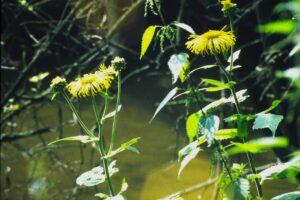
Elecampane – Inula helenium at Roche Abbey, July 1982.