Daw Lane Plantation, Bentley (SE5607; SE5707)
Doncaster Naturalists’ Society Survey 25th May, 1994
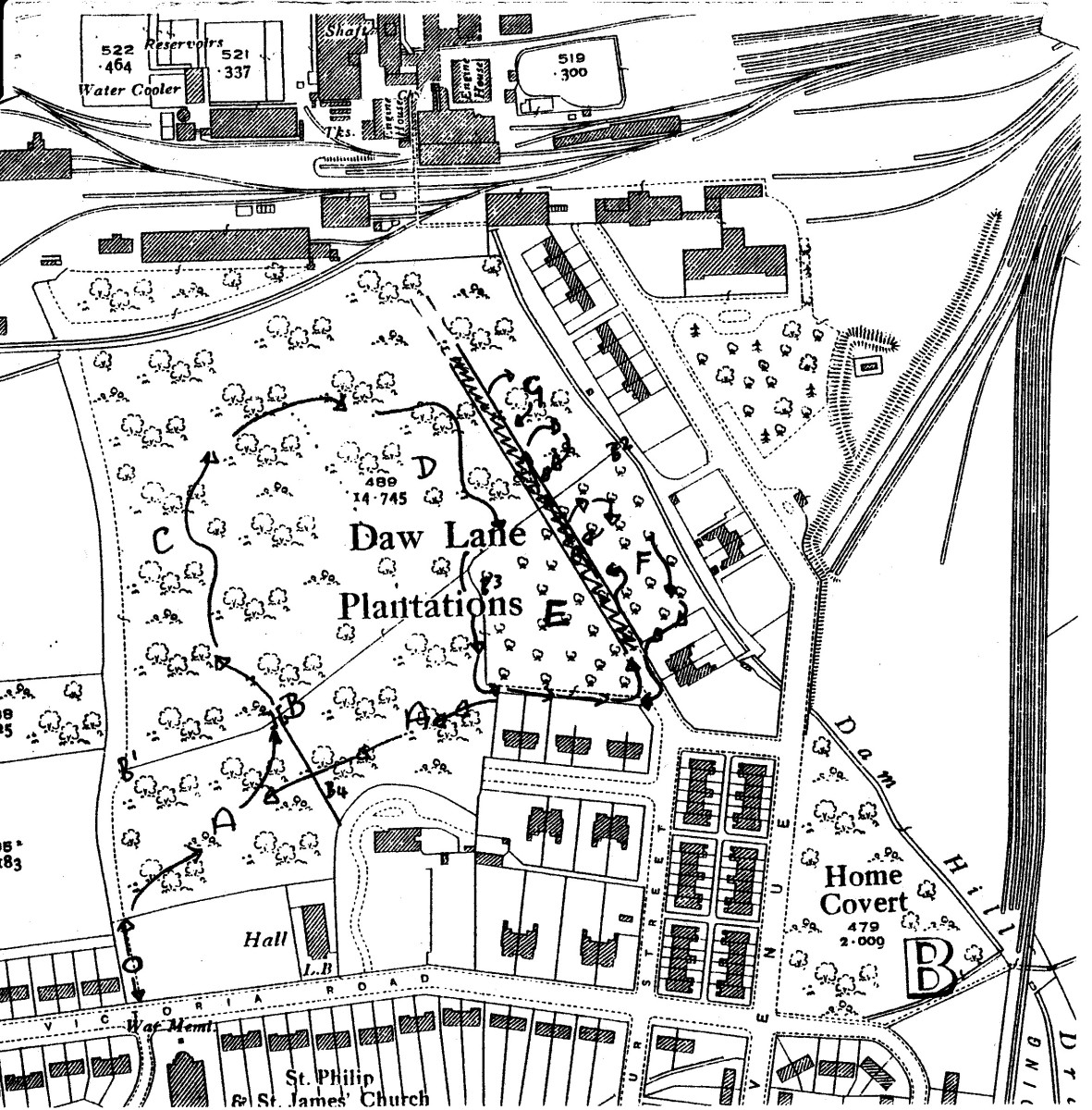
Notes on the geology, drainage, history and plant distribution.
Soil & Geology
This deciduous (oak/ash dominated) woodland is situated on damp silts and clays overlying Sherwood Sandstone.
The soil structure is revealed at the site on the new foot-bridge over the east/west dyke near the Victoria Road entrance.
A small region dominated by bracken and featuring patches of Foxgloves – in the central part of area ‘A’ and the western part of area ‘S’ – may possibly indicate the presence of a relatively dryer, sandier zone.
Drains
A simple ‘V’ shaped deep ditch runs south-west to north-east, (B1 to B2) and joins the Dam Hill Drain on the western boundary of the site. Two short drains enter this main drain from the south; these are (B3) which forms the western boundary of the old Hawthorn ‘Plantation’ and (B4) which runs through the southern part of the wood from the rear of the Nursing Home.
The Drains system (often overgrown with bramble, woody nightshade, etc.) seems to have been dry during the late 1980’s but became wet last year for the first time for many years (pers. Comm. Graham Wass), and on the occasion of our last visit (on 25th May, 1994), water was present throughout the system, reaching a depth of at least 3ft at the western foot bridge.
Damp Woodland
The scarcity and restricted range of aquatic plants is probably due to the effects of the drought years of the 1970’s and 80’s though the survival of Guelder Rose, Common Figwort, Soft Rush, Great Willowherb, Woody Nightshade, Fool’s Water-cress, and Common Starwort indicate the latent wet character of the site.
Historic Changes
The 1930 edition of the 1:2500 scale Ordnance Survey map shows an area of shrub plantation to the north of the houses of ‘Daw Wood’. This has now developed into a remarkable area of ‘even-age’ Hawthorns of considerable girths. A post 1930’s northerly extension of Arthur Street leading down to the Colliery Yard effectively curs in two the Hawthorne Plantation (areas E & F) and cuts through the north-eastern section of the Oak.
/Ash dominated Daw Lane Plantation (areas D & G).
Antiquity
Although Daw Lane Plantation isn’t shown on Thomas Jeffrey’s Map of 1771-2, neither is it listed in the Nature Conservancy’s inventory of Ancient Woodlands in South Yorkshire, its botanical composition strongly suggests that woodland has been present on this site (excluding the Hawthorne Plantation (areas E & F) for much longer than the age of the present population.
Tree Girths
In order to gain some impression as to the age structure of the present canopy-forming tree stock, Derek Allen measured the giths (at chest height) of a sample of 37 mature trees.
On the basis that on average, trees put on about 1” of girth per year in good growing conditions (without competition for light and root-space), and about ½” of girth under conditions of woodland competition, a rough estimate of age ranges can be deduced.
| Species | Girth in inches – measured at chest height (4-5ft) | Total |
| Common Oak | 42;44;47;48;48;49;50;5;51;52;54;60;60;66;73;73;73;75;75;75; | 21 |
| Common Ash | 58;59;60;65;90;92;108; | 7 |
| Sycamore | 54 | 1 |
| Hawthorn (in areas E & F) | 41;50;51;53;56;57;58;59; | 8 |
Flowering Plants
Recording area :-
O = Hedgerows and path (Daw Lane) leading from Victoria Road to wood (SE568070)
A = Ash/Oak high canopy woodland to the south of the main drain (SE568070)
B = Main Drain (recently re-excavated) by the western foot-bridge (SE568070)
C = Ash/Oak high canopy woodland to the north of the main drain (SE568071)
D = Ash/Oak high canopy woodland to the north of the main drain (SE569071)
E = Hawthorn dominated plantation west of Arthur Street (SE570071)
F = Hawthorn dominated plantation east of Arthur Street (SE570071)
G = Ash/Oak high canopy woodland to the east of Arthur Street (SE570071)
*= species present
#= garden escape
| Botanical Name | Vernacular Name | O | A | B | C | D | EF | G | |
| Acer pseudoplatanus | Sycamore | * | * | * | |||||
| Achillea millefolium | Yarrow | * | |||||||
| Aegopodium podagraria | Ground Elder | * | |||||||
| Agrostis stolonifera | Creeping Bent-grass | * | |||||||
| Alopecurus pratensis | Meadow Foxtail-grass | * | |||||||
| Alopecurus geniculatus | Marsh Foxtail-grass | * | |||||||
| Angelica sylvestris | Angelica | * | * | * | * | ||||
| Anisantha sterilis | Barren Brome | * | * | ||||||
| Anthryscus sylvestris | Cow Parsley | * | * | * | * | * | * | ||
| Apium nodiflorum | Fool’s Water-cress | * | |||||||
| Aquilegia vulgaris | Columbine (cultivated) | # | |||||||
| Arctium lappa | Great Burdock | * | * | * | * | * | |||
| Arum maculatum | Wild Arum | * | |||||||
| Artemisia vulgaris | Mugwort | * | * | * | |||||
| Bellis perennis | Daisy | * | * | * | * | ||||
| Brachypodium sylvaticum | False Brome | * | * | * | * | * | |||
| Bromus ramosus | Hairy Brome-grass | * | * | ||||||
| Callitriche stagnalis | Water Starwort | * | |||||||
| Calystegia sepium | Great Bindweed | * | |||||||
| Circaea lutitana | Enchanter’s Nightshade | * | * | * | * | ||||
| Cirsium arvense | Spear Thistle | * | * | ||||||
| Cirsium vulgare | Creeping Thistle | * | * | * | |||||
| Chamerion angustifolium | Rosebay | * | * | * | * | * | * | ||
| Corylus avellana | Hazel | * | |||||||
| Crataegus monogyna | Hawthorn | * | * | * | * | * | * | ||
| Dactylis glomerata | Cock’s-foot Grass | * | * | ||||||
| Digitalis purpureum | Foxglove | * | * | ||||||
| Dryopteris austriaca | Buckler Fern | * | * | * | |||||
| Dryopteris felix-mas | Male Fern | * | * | * | |||||
| Elymus repens | Creeping Couch-grass | * | |||||||
| Endymion non-scriptus | Bluebell | * | * | * | * | * | |||
| Epilobium hirsutum | Great Willowherb | * | * | * | |||||
| Epilobium montanum | Broad-leaved Willowherb | * | |||||||
| Equisetum arvense | Field Horsetail | * | * | ||||||
| Festuca gigantea | Giant Fescue | * | * | * | |||||
| Fraxinus excelsior | Ash | * | * | * | * | * | |||
| Glechoma hederacea | Ground Ivy | * | * | * | * | * | |||
| Galium aparine | Cleavers | * | * | * | * | * | * | ||
| Geranium robertianum | Herb Robert | * | |||||||
| Geum urbanum | Herb Bennet | * | * | * | * | ||||
| Hedera helix | Ivy | * | |||||||
| Heiracleum sphondilium | Hogweed | * | * | * | * | * | * | ||
| Holcus lanatus | Yorkshire Fog | * | * | * | * | ||||
| Ilex aquifolium | Holly | * | * | ||||||
| Juncus effusus | Soft Rush | * | |||||||
| Lamium album | White Dead-nettle | * | * | * | |||||
| Lamium maculatum | Banded Dead-nettle | * | |||||||
| Melandrium rubrum | Red Campion | * | * | * | * | * | |||
| Mercurialis perennis | Dog’s Mercury | * | * | * | * | ||||
| Milum effusum | Wood Millet | * | |||||||
| Moehringia trinerva | Three-nerved Sandwort | * | * | * | * | ||||
| Plantago lanceolata | Ribwort Plantain | * | * | * | |||||
| Plantago major | Rat-tail Plantain | * | * | * | * | * | |||
| Poa annua | Annual Meadow-grass | * | * | * | * | * | |||
| Poa trivialis | Rough Meadow-grass | * | * | * | |||||
| Potentilla anserina | Silverweed | * | * | ||||||
| Potentilla reptans | Creeping Cinquefoil | * | |||||||
| Prunus Avium | Wild Cherry | * | * | * | |||||
| Prunus spinosus | Blackthorn | * | * | ||||||
| Pteridium aquilinum | Bracken | * | * | * | * | ||||
| Quercus petraea | Sessile Oak | * | * | * | |||||
| Quercus robur | Common Oak | * | * | * | * | ||||
| Ranunculus acris | Meadow Buttercup | * | |||||||
| Ranunculus ficaria | Lesser Celandine | * | * | * | * | ||||
| Ranunculus repens | Creeping Buttercup | * | * | * | * | * | * | ||
| Rubus fruticosus | Bramble | * | * | * | * | * | * | * | |
| Rubus idaeus | Raspberry | * | * | ||||||
| Rosa arvensis | Field Rose | * | * | * | |||||
| Rosa canina | Dog Rose | * | * | * | |||||
| Rumex crispus | Curled Dock | * | * | * | |||||
| Rumex obtusifolius | Broad Dock | * | * | * | * | * | * | * | |
| Sambucus nigra | Elder | * | * | * | * | * | * | * | |
| Salix caprea | Goat Willow | * | * | * | |||||
| Salix cinerea | Grey Willow | * | * | ||||||
| Senecio squalidus | Oxford Ragwort | * | |||||||
| Scrophularia nodosa | Common Figwort | * | |||||||
| Solanum dulcamara | Bittersweet | * | |||||||
| Sonchus asper | Prickly Sow-thistle | * | |||||||
| Sonchus oleraceus | Smooth Sow-thistle | * | |||||||
| Stachys sylvatica | Hedge Woundwort | * | * | * | * | ||||
| Tamus communis | Black Bryony | * | |||||||
| Taraxacum officinalis | Dandelion | * | * | * | * | * | * | ||
| Trifolium repens | White Clover | * | * | ||||||
| Tolmea menziesii | Pick-a-back Plant | # | |||||||
| Ulmus glaba | Wych Elm | * | * | * | |||||
| Urtica dioica | Stinging Nettle | * | * | * | * | * | * | * | |
| Viburnum opulus | Guelder Rose | * | |||||||
| Fungi | |
| Polyporus squamosus | Dryad’s Saddle on Sycamore trunk |
| Plant Galls | |
| Biorhiza pallida | ‘Oak Apple’ gall on Common Oak |
| Cynips divisa | ‘Red Pea’ gall on Common Oak |
| Eriophyes macrorhynchs | ‘Nail Gall’ on Sycamore leaves |
| Neuroterus tumefaciens | ‘Current’ gall on Common Oak catkins |
| Birds | |
| Green Woodpecker (singing) | Wood Pigeon (nesting) |
| Turtle Dove (calling) | Swift (overhead) |
| Cuckoo (calling) | Starling (gathering food) |
| Blue Tit (singing) | Blackbird (singing) |
| Song Thrush (singing) | Mistle Thrush |
| Robin (singing) | Dunnock (singing) |
| Wren (calling) | Blackcap (singing) |
| Chiff Chaff (singing) | Willow Warbler (singing) |
| Chaffinch (singing) | Greenfinch (singing) |
| Mammals, Reptiles & Amphibians | |
| None seen & no signs, not even foot-prints or mole hills were found during visit. |
Graham Wass noted that hedgehogs occasionally visit the gardens of adjacent houses, that toads had been found locally, frogs visit and spawn in a pond along Daw Wood, and that 5-6 years ago, a 3ft grass snake had been found in a local garden. Stoat, Weasel and Mole have visited his garden at the end of Arthur Street.
Recorders
Derek Allen; Don & Dorothy Bramley; Colin Howes; Graham Wass.
Compiled by C. A. Howes