Close Encounters With the Purple Hairstreak.
29th June, 2025

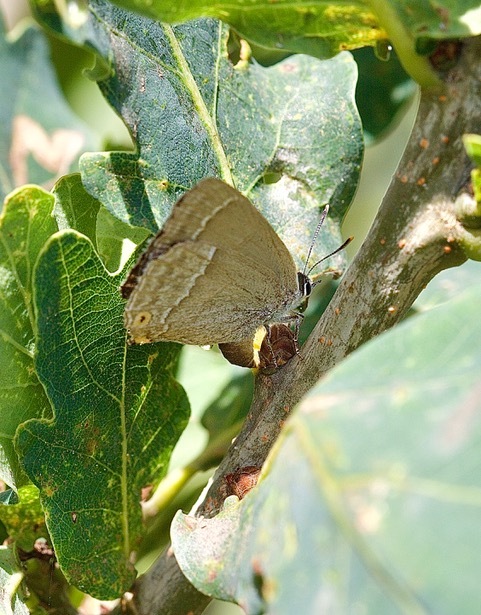
A close encounter with a Purple Hairstreak, (Favonius quercus), is always a joy. It is our commonest Hairstreak and can be seen from the end of June to September in woodlands, parks and hedgerows where Oaks are present.
Measuring approximately 38mm, this attractive, diminutive Butterfly spends most of its time high in the canopy of Oak trees where the adult feeds primarily on honeydew and, as a consequence, it is frequently overlooked.
Whole colonies can sometimes be observed chasing each other in the tree tops, or individuals might be spotted with the use of binoculars, basking on Oak leaves. The best views however, are obtained when they are tempted down from the canopy to seek other sources of fluid, such as nectar, or on very windy days when they might be blown from their lofty perches to bask in warm sunshine on lower vegetation.
The Purple Hairstreak is entirely reliant on Oaks, for both food and reproduction, both our native Sessile Oak, (Quercus petraea), and Pedunculate Oak, (Quercus robur), and the introduced Turkey Oak, (Quercus ceris), and occasionally, the Evergreen Oak, (Quercus ilex).
In and around our garden at Austerfield we are lucky enough to have several young and mature Pedunculate Oaks where we have observed the species. The eggs, resembling miniature, white sea urchins, are laid towards the end of Summer at the base of plump Oak buds and remain dormant over Winter, hatching the following Spring when the buds break. The brown, chunky caterpillars are well camouflaged against the brown Oak buds and burrow into flower buds to feed, reaching adulthood by July.
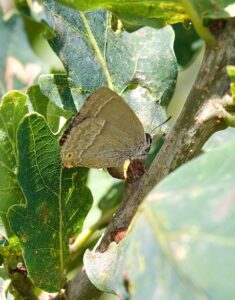
Though it is reported that Purple Hairstreaks prefer to lay their eggs on higher, south-facing branches, I have observed a female ovipositing on a very young Pedunculate Oak at the edge of the drive in our garden, around a meter from the ground.
It is often written that the Purple Hairstreak rarely descends to ground level, but our experience suggests that their terrestrial visits might be much more frequent than previously thought.
On warm Summer evenings, we have observed the butterflies flitting between the tops of young Oaks where they are more easily seen than in the canopy of a mature tree, but we also see them, particularly during a dry spell, when they appear to be attracted to the moist conditions of our polytunnels.
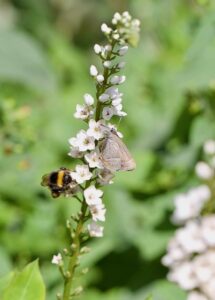
This was the case this morning, when both a male and female were discovered roosting on the polythene of an open-ended polytunnel which benefits from irrigation provided by an overhead spray line. This is a regular occurrence through the Summer months, and affords us the opportunity of close observation of this species.
We have also noticed this species showing considerable interest in the leaves of other tree species in our garden, particularly a large contorted Willow, (Salix tortuosa), and Pineapple Broom, (Cytisus battandieri), but also Silver Birch, (Betula pendula). Close observation of an individual which spent some considerable time, low down amongst foliage in the Pineapple Broom close to our house, seemed to indicate it was taking advantage of the sticky, honeydew substance on the leaves.
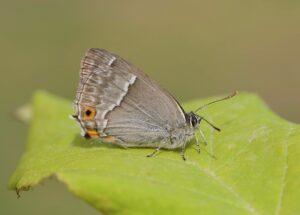
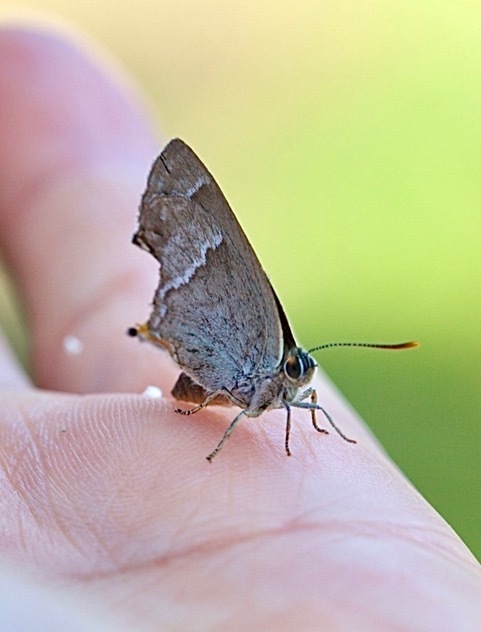
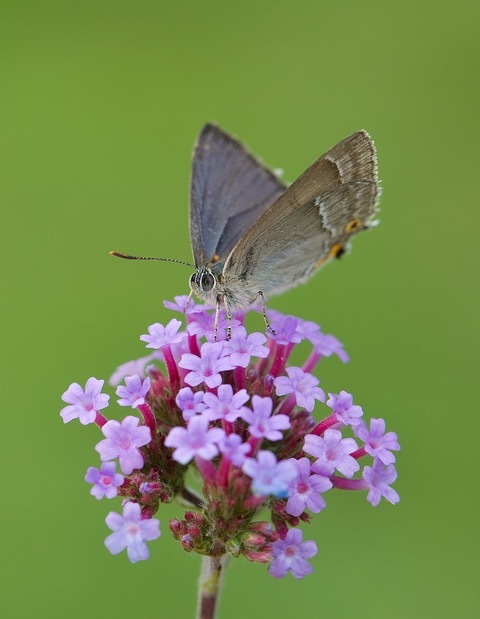
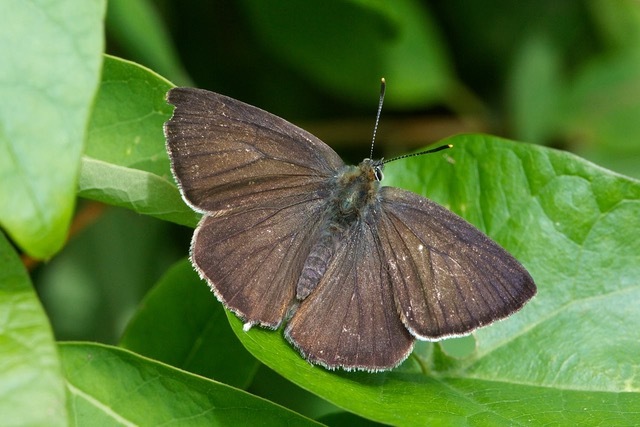
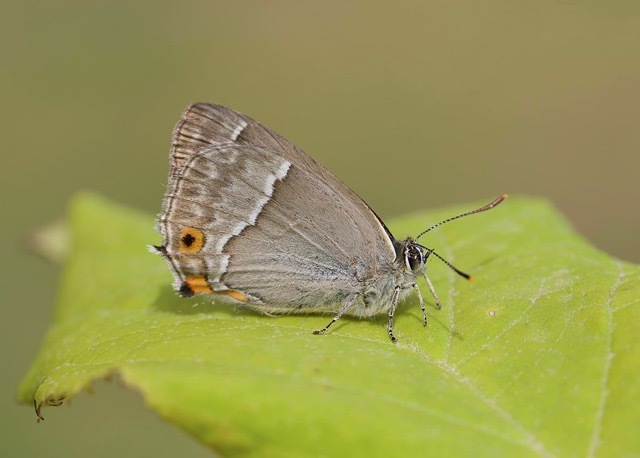
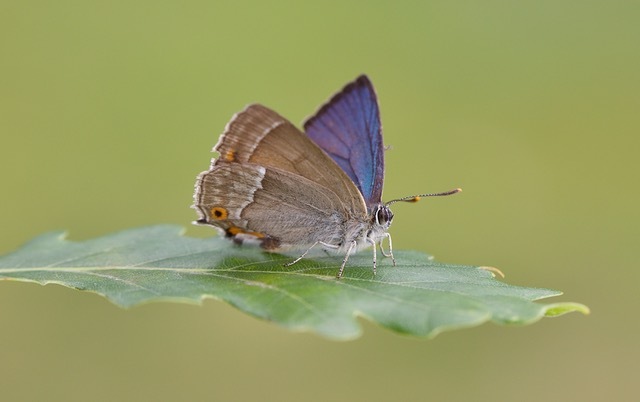
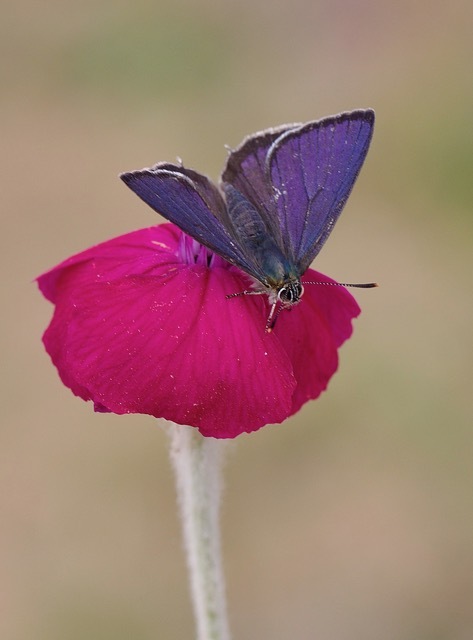
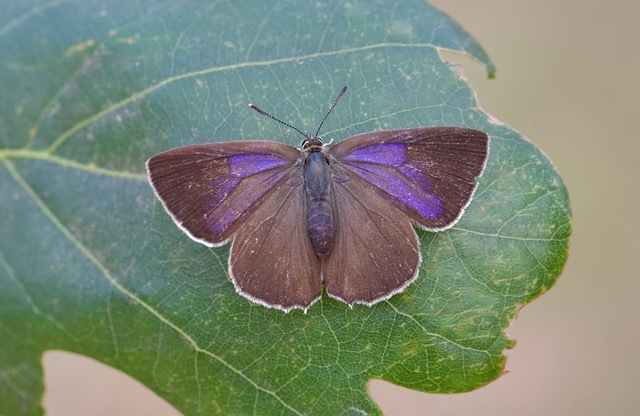
This small butterfly usually rests with its wings closed, with only the lead-grey underwing with the small orange eyespot visible, but when basking in the sun, and with the light shining in a favourable direction, the open wings reveal an iridescent purple sheen, over the whole of the upper wings of the male, and in two patches on the forewings of the female. In a less favourable light, however, they appear uniformly chestnut brown. The hindwings terminate in short tail-like appendages, which resemble antennae which, together with the close proximity of the eyespot, is intended to mimic the head of the Butterfly and act as a decoy for potential predators such as birds and spiders.
When feeding, the Butterfly has a habit of rubbing its wings together, thus animating the ‘tails’, and adding to the illusion that the rear is actually the head of the Butterfly, so increasing the probability that an attack will occur away from the actual head and minimise injury, allowing the Butterfly to survive with only minor wing damage.
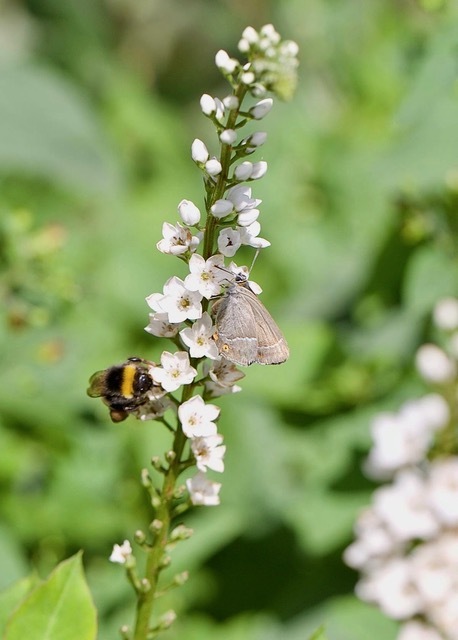
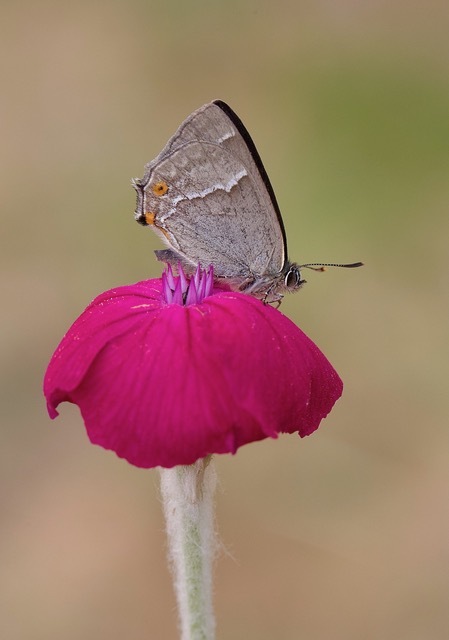
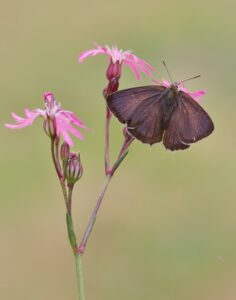
We have occasionally observed Purple Hairstreaks nectaring on garden flowers including Ragwort, Ammi, Lysimachia, and Lychnis. I have also, on a couple of occasions, been surprised to find them amongst the Moths in the Moth trap after being attracted to the UV light.
This beautiful, though secretive little Butterfly, is a most welcome resident in our garden and hopefully will continue to delight us with visits to garden flowers and to polytunnels, so we can admire it in all its glory.