The ‘Garden Centre’ Spider Uloborus plumipes in Yorkshire and adjacent areas.
C.A. Howes
Introduction: The elegant (and not at all scary) little spider Uloborus plumipes, which hangs upside down and motionless in its ‘cat’s cradle’ web, is easily identified by its triangular and lumpy abdomen and pair of long, ornate (plumed) front legs which are characteristically extended forwards (see Figure 1).

With a world distribution extending from the countries of the Mediterranean basin, east to Indo-China and south to Sub-Saharan Africa, it is now, like so many invertebrates, being spread around the globe by the international trade in exotic houseplants. Although introduced into Western Europe and now Britain, its presence in these cooler latitudes is largely restricted to the heated tropical houseplant sections of garden centres, botanic gardens or winter gardens … a kind of ‘greenhouse effect’! Hothouse enthusiasts will be relieved to hear that this ‘Garden Centre Spider’ feeds on tiny midge-sized insects and in enclosed greenhouses and conservatories can be effective in controlling ‘whitefly’ Trialeurodes vaporariorum (Hemiptera).
Colonisation of the UK: This small alien spider first began to be noticed in garden centres in southern England in the early 1990s. By 2000 it had reached South Yorkshire (Howes, 2001a) by 2001 it was established in the Botanic Gardens in Durham and Winter Gardens at Sunderland Museum (Mann, 2002) and by 2006 its northerly progress via the horticulture (exotic house plant) industry had reached Duthy Park Winter Gardens, Aberdeen (Davidson, 2007).
Colonisation of South Yorkshire and adjacent areas: Its occurrence in the Sorby recording area dates from 2000 when a single immature specimen was found living on a potted Coconut Palm purchased in February from the house plant section of the Doncaster branch of the DIY chain, B&Q (then on York Road SE559044) (Howes, 2001a).
Throughout the summer of 2000, visits to other garden and DIY centres in North Nottinghamshire, North Lincolnshire and the Doncaster region failed to locate other specimens, but by 2001 populations were beginning to appear, particularly in the heated tropical house plant sections of garden centres in our region. On 5 August 2001 a fleeting visit just before 6pm closing time to Tickhill Garden Centre, Doncaster (SK603930), encountered a number old and tattered and some new webs at least ten of which were occupied. On 18 August four tiny spiderlings in webs in the foliage of a 5ft Ponytail Palm Beaucarnea nolina were encountered within the central ‘hot-house’ area of Wentworth Garden Centre, Rotherham (SK389976). On 19 August a visit to Hagan’s Garden Centre, Branton, Doncaster (SE633017) located 1 adult and 15 hatchlings occupying webs on a 6ft Ficus alii and another adult was occupying a particularly Jurassic-looking Cicas revoluta. The same day but over the North Lincolnshire (VC54) border at the Epworth Homes and Gardens Centre (SE782040) a well-established population in excess of 120 specimens, including adults and young, was encountered. There were adults, young in all stages of development, occupied and old webs, indicating the population had probably been present for several seasons (Howes, 2001b).
Although the Dukeries Garden Centre [N. Notts. VC57] (SK555745) had been unsuccessfully checked by myself in 2000 and 2001, Howard Williams (2002) found that specimens had moved in by late March 2002.
By the very hot summer of 2006 populations were located at six additional establishments, some of which had proved negative in previous years. At Walker’s Garden Centre, Blaxton, Doncaster (SE665004) none had been fond in 2001 but during the summer of 2006 the tropical plant and cacti section was well populated with occupied webs mainly concentrated in the aluminum structure of the greenhouse roof sections where temperatures were high and as at Epworth, were cushioned from night frosts by bubble-wrap sheeting. At Fosters Garden Centre, Thrybergh, Rotherham (SK467952), also negative in 2001, a visit on 8 September encountered specimens in the enclosed tropical plant section, mainly in gable apexes though some in vegetation of Yuccas. At the B&Q DIY Garden Centre, Queens Road, Sheffield (SK358862) on 20 September at least 5 specimens were occupying webs in gable apexes and metal framework of the glasshouse structure enclosing the tropical houseplant section. Realising that even in chilly Pennine Sheffield, the species could survive in artificially heated and insulated conditions, a hunt through Sheffield’s Yellow Pages and A to Z mapped out an arachnological expedition into the tropical rain-forests of deepest Hallamshire. On 1 October 50 occupied webs were encountered in the tropical houseplant section of Ferndale Nursery and Garden Centre, Coal Aston (SK360797). Just 5 occupied webs were at the chillier Abbeydale Garden Centre, Dore (SK323813). Here, most were clustered in the rather restricted tropical houseplant section but intriguingly, some were opportunistically benefiting from the heat produced by the hot drinks machine in the catering area. Showing that Sheffield Garden Centres were really on the threshold of tolerance for this evidently temperature-sensitive species, visits to Ward’s Nurseries, Eckington Road, Coal Aston (SK378794) and Birley Moor Garden Centre, Mosborough (SK407826) proved negative at least on that occasion. Elsewhere in upland South Yorkshire, visits to Great Mills DIY & Garden Centre, Barnsley (SE351069) and Cannon Hall Garden Centre, Cawthorn (SE272078) on 28 October also proved negative.
The immaculately restored Tropical Palm House at Sheffield’s Botanic Gardens, (SK334 862) proved negative in 2006 but during the Arts Festival on 16 September 2007 a number of tantalisingly unoccupied webs were festooning a huge succulent Euphorbia. But while listening to the chirpy banter of Sheffield artist Joe Scarborough, occupying a pitch in the arid desert ‘biome’ part of the Palm House, I noticed a single immature Uloborus amongst the villainous spines of a tall columnar (but frustratingly un-labelled) cactus.
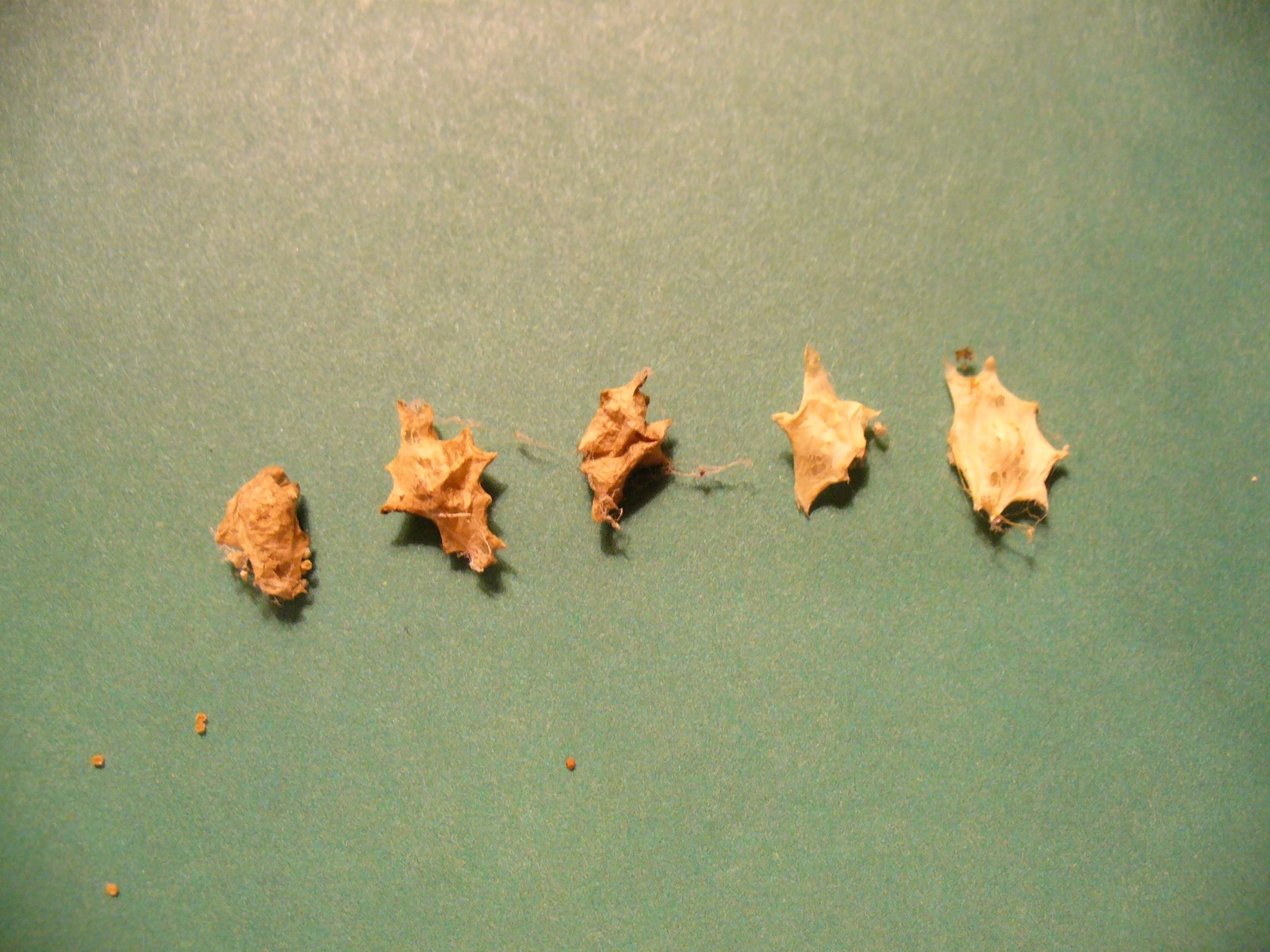
Back in Sunny Donny, Strikes Garden Centre, Crookhill Road, Conisbrough (SK524984) revealed a small number of occupied webs on 28 October 2006. These were confined to an enclosed, over-heated non-plant merchandising section. A visit in November to the B&Q DIY Garden Centre near Junction 3 off the M18 at Balby Carr (SE586005), encountered over 50 occupied webs in the heated greenhouse section. Cleaning work seemed to have reduced this population to fewer than 10 occupied webs in July 2007 but a particular highlight was a series of the curious holly-leaf shaped velum-coloured Uloborus egg cocoons (see figure 2).
The Lidl Supermarket, Balby (SE585014) intriguingly produced a particularly dark specimen (see figure 3) on a consignment of the culinary pot herb ‘Sweet Basil’ on 7 July 2007.

Finally, at Markham Grange Garden Centre, Woodlands (SE521079), which proved negative in August 2001, on 23 September 2007 several old and one occupied web were found on a timber pergola benefiting from the muggy warmth from the adjacent tropical aquarium section.
Progressively, from 2000 to 2007, visits to garden centres and DIY outlets across Yorkshire revealed colonisation at some 47 sites (see Figure 4)

Colonised sites across Yorkshire, largely to the east of the Pennines revealed a widespread distribution extending east to the coast and north to Cleveland (see Figure 5).

However, the particularly cold winters of 2009-20101 and 2010-20112 effectively wiped out many of the previously thriving populations and so it has remained.
[1 The “Big Freeze of 2009-10” was the UK’s eighth-coldest winter on record. 2The Met Office recorded a temperature of -19°C in Topcliffe, North Yorkshire, overnight on 2 December 2010, which was the coldest night in over 100 years for the county].
Possible origins and Plant host preferences: During visits to Yorkshire garden and DIY centres, the Pot-Plant taxa which supported Uloborus specimens and their webs (see table 1) were largely found to have glossy, spear-shaped, palm-like leaves and frequently belonged to monocotyledonous families. Plants with foliage of other forms were generally ignored, even when displayed in close proximity. Although the spiders were likely to have been imported on consignments of Palms and Yuccas from foreign nurseries (European e.g. Spain and the Netherlands), their evident selective propensity to remain with these taxa may suggest their ecological preferences in their native habitats.
Having been imported into garden centres or other retail outlets, spiders are inevitably disbursed by the sale of their support plants. However, specimens frequently ascend to the aluminium supports of the glazed roof structures where they form semi-permanent populations.
| Table 1: Pot-plants supporting Uloborus spiders & webs | ||
| Latin name | Common Name | Height |
| Araucaria heterophylla | Norfolk Island Pine | 6-7 ft. |
| Beaucarnea nolina | Ponytail Palm | 5ft. |
| Cicas revoluta | Sago Palm | 5ft. |
| Cocos nucifera | Coconut Palm | |
| Diefenbachia sp. | Dumb Cane or Leopard Lily. | |
| Dracaena marginata | Dragon Tree | 3-5ft. |
| Dracaena trifasciata (syn = Sansevaria) | Mother-in-Law’s Tongue | |
| Ficus alii | Long-leaf Fig | 6-7 ft. |
| Ficus benjamina | Weeping Fig | 4-5ft |
| Musus acuminate | Dwarf Banana | |
| Yucca alofolia | Spanish Bayonet | |
| Yucca brevifolia | Joshua Tree | |
| Yucca gigantea (syn. = Yucca elephantipes) | Spineless Yucca or Giant Yucca | |
References
Davidson, M. (2007) Uloborus plumipes reaches new latitudes. S.R.S Newsletter 51. In Newsl. Br. Arachnol. Soc. 108:23.
Howes, C. A. (2001a) Uloborus plumipes: A new Yorkshire spider benefiting from the ‘Greenhouse effect’. Bulletin of the Yorkshire Naturalists’ Union, 35: 8-9.
Howes, C. A. (2001b) Uloborus plumipes in Yorkshire and Lincolnshire. British S.R.S Newsletter 41 In Newsl. Br. Arachnol. Soc. 92:7-8.
Mann, M. (2002) Uloborus plumipes in Durham VC 66-A new Durham Record. The Vasculum 87 (1):2.
Williams, H. (2002) Two Nottinghamshire Records. S.R.S Newsletter 44. In Newsl. Br. Arachnol. Soc. 95:10.
See also https://srs.britishspiders.org.uk/portal.php/p/Summary/s/Uloborus+plumipes