Doncaster Scientific Society
Minute Book 1901 – 1906
May 1st, 1901
Annual General Meeting 1901
The Annual General Meeting for the reading of the report & election of officers, was held at the county Court Room, Guild Hall on Wednesday May 1st 1901.
Mr. Culpin (the retiring President) occupied the chair & there were present 19 other members.
The 22nd Annual Report was read by the Hon. Sec. Mr. H. H. Corbett as follows.
Ladies & Gentlemen
Your committee have pleasure in submitting the following report of the progress of your society during the past session.
In some respects, the session has differed from those of past years, & this will affect the report here submitted.
Firstly. In consequence of the alteration in the Rules made at the last General Meeting, the present Session, instead of embracing the whole year, includes only the six months from October 1900 to April 1901.
Consequently, the reports from the various sections are not so full as usual; the summer months being those in which the “field work” of the society is chiefly done.
Secondly, owing to several unpreventable causes, the printed programme issued had to undergo considerable alteration. The winter meetings being as follows.
Session 1900-1901
1900
Wed. Oct 10 – Annual General Meeting
Wed. Oct 24 – Special General Meeting
Wed. Oct 24 – “What is a Species” by H. H. Corbett, M.R.C.S.
Wed. Nov 14 – “Mushrooms & Toadstools” by T. Gibbs (Sheffield)
Wed. Nov 28 – “The Structure of Agates” by E. Moor
Wed. Dec 12 – Short Essays, description & exhibition of objects etc.
1901
Wed. Jan 23 – “Arsenic in Beer, its source & its detection” by M. H. Stiles, F.R.M.S.
Wed. Feb 13 – “Early Man in East Yorkshire” by T. Sheppard, F.G.S. (Hull)
Thur. Feb 28 – Conversazione at the Mansion House
Wed. Mar 13 – “The Furze Plant, with some notes on the origin & function of leaves” by G. Gledhill and
“Topographical Botany of Doncaster” by H. H. Corbett, M.R.C.S.
Wed. Mar 27 – “Our Local Scenery” by H. Culpin
Wed. Apr 10 – “Electricity supplied from a Central Source” by C. A. L. Prussman.
It is a matter for congratulation that notwithstanding the changes in the programme, entailing a change of rendezvous on two occasions, the average attendance at lectures has been higher than ever, being 30.5, compared with 26 last year and 26.7 (the highest former record) in 1897-98.
The subject matter of the Winter Programme has been very varied; the essays have been quite up to the previous standard of excellence & the discussions following the readings have been better sustained than heretofore. Altogether, the session 1900-01 has been one of the best in the history of the society.
As has been already suggested, the change in the date of the Annual Meeting greatly affects the Sectorial work. Nevertheless, many interesting reports have been submitted, of which the following form a short synopsis.
Archaeology
Mr. Jordan has shown numerous flint neoliths, collected near Bridlington. And, attention has been called to the apparently old excavations near Palmer Street.
Botany
Dr. Finnesmore has offered assistance in the compilation of a bit of the Wild Flowers of the district, & it is hoped that the local mosses will be catalogued by him. With Mr. Stiles recording Diatoms & Dromiids, Mr. Corbett, phanerogams & vascular cryptogams, we shall be in a fair way to get the local florala completed. Volunteers for Fungi & Algae would be greatly welcomed.
Geology
The solution of the question suggested by the local gravels, Boulder-clays, Triassic, & Permian Rocks still occupy our small band of Geologists.
Zoology
Some interesting exhibits in this section have been made, notably, a Suricata (Suricata tetradactyla) from the Transvaal, by Mr. Thomas; & a series of the Deaths Head Moth (Acherontia atropos) bred from local larvae, by Mr. Corbett.
Microscopy
The work done in this section has referred chiefly to the Alga flora of the district. Of the Diatomacea a fairly representative list was published in the Naturalist, Nov. 1900.1 This list included 121 spp. & 42 vars., & gave the source of every specimine. Although far from complete, as a first general list for the neighbourhood must be, it is hoped that it will form a basis for further extension. Nearly every fresh gathering furnishes additions.
During the last summer some observations were made on the conjunction of Spirogyra of which some interesting micro-photographs were secured.
More recently, a gathering of Vaucheria in fructification(?) has been examined. The reproduction system in the genus may be well seen by possessors of microscopes during the spring.
It is with much satisfaction that we are able to state that the Museum is now open to the public on Thursday afternoons & evening during the winter. The attendance has been very satisfactory, the number of visitors on the open days from March 7th to April 25th being 421, & an average of more than 52 each day.
The financial state of the society will be seen from the accompanying balance sheet.
The following were elected officers of the society for 1901-2
President – S. Edgar, J.P.
Vice-presidents – H. Culpin & A. Jordan.
Committee – H. Thomas, M. H. Stiles, & E. Gledhill.
Hon. Sec. & Treasurer – H. H. Corbett.
Signed M. H. Stiles, chairman.
Notes
1. “List of Diatoms Found near Doncaster” by M. H. Stiles, F.R.M.S.
Doncaster Scientific Society
Balance Sheet 1900-01
| Receipts | Expenditure | ||
| Subscriptions | Due Treasurer from 1899-00 | 6 11 | |
| 1897-98 (1) – 3/6 | Deed Box (Farr) | 1 3 0 | |
| 1898-99 (2) – 7/0 | Stamps 9 x 5/- + 1 x 7/-6 | 2 12 6 | |
| 1899-1900 (10) – £1 15 0 | Sundries – Ink & envelopes | 5 11 | |
| 1900-01 (67) – £11 14 6 | Lecturer’s expenses | 9 9 | |
| 1901-02 (6) £1 1 0 | Hire of Room | 1 17 0 | |
| £15 1 0 | Lantern expenses 4 x 2/-6 | 10 0 | |
| Printing etc. | |||
| Henderson – £2 | |||
| Bisat – £1:2:0 | |||
| Hepworth – 19/- | 4 1 0 | ||
| Subs to Y.N.U. (2 yrs) | 10 0 | ||
| Mic. Slide cabinet | 2 2 0 | ||
| Expenses of Conversatzione | 17 10 0 | ||
| Caretaker of Guild Hall | 5 0 | ||
| Balance in Bank 1st Sept 1900 | 21 7 4 | Donation to Museum | 5 0 0 |
| Interest to date | 13 1 | Balance in Bank | 17 0 5 |
| 37 1 5 | 37 1 5 |
Audited & found correct 24/3/1902 Signed W. E. Lister
May 8th, 1901
Committee Meeting held at 9 Priory Place 8th May 1901
Present – Mr. Edgar (President) in the chair, Mrs Corbett & Messrs. Thomas, Culpin, Jordan, Bellamy, Gledhill, Cuttriss, & Corbett
The minutes of the last committee meeting were read & confirmed.
The Excursion Programme for the Summer Session was passed.
It was resolved that the letter suggesting an excursion to Blythe on the occasion of a Sale of Work at the Church be laid upon the table.
Mr. Bellamy brought forward a discussion upon an attempt by “Kodac Limited” to form a trade monopoly. The matter was adjourned.
It was resolved that a list of members be printed & circulated among members, along with the Summer Programme.
Signed M. H. Stiles (Chairman)
Committee Meeting held at 9 Priory Place 5th June 1901
Present – Mr. Stiles in the chair, Mrs. Corbett, & Messrs. Jordan & Corbett.
The minutes of the last committee meeting were read & confirmed.
It was proposed by Mr. Stiles, seconded by Mr. Jordan & carried mem. Con.
“That the funds of the Society be deposited in the Post Office Savings Bank, & that the name of the Hon. Sec. & Treasurer be given as the person empowered to make draughts.”
The following nominations for membership were approved
Mrs. Golledge, Rev. R. A. Gatty, Messrs. Johnson, Robinson & Bentley
Signed Thos. Cuttriss, June 24, 1901
Committee Meeting held at 9 Priory Place 26/6/01
Present – Mr. Cuttriss in the chair, Mrs. Corbett & Messrs. Clarkson, Stiles, & Corbett.
The minutes of the last committee meeting were read & confirmed.
The Post Office Savings Bank having refused to allow the Society to open an a/c with them, it was proposed by Mr. Stiles, seconded by Mr. Clarkson, “That the funds of the Society be deposited in the Yorkshire Penny Bank, & that the Hon. Sec. be empowered to make draughts when necessary.”
The nomination of Mr. O. B. Rattenbury was approved.
Signed Saml. Edgar.
Committee Meeting held at 9 Priory Place 3/7/01
Present – Mr. Edgar (President) in the chair, Mrs. Corbett & Messrs. Stiles, Clarkson, Jordan, Gledhill, Cuttriss, Culpin, & Thomas.
The minutes of the last committee meeting were read & confirmed.
It was proposed by Mrs. Corbett & seconded by Mr. Clarkson & carried. That a sub-committee be appointed to try to arrange for a public lecture, by some well known lecturer, during the Winter Session.
Proposed & carried, that the sub-committee consist of Messrs, Jordan, Clarkson & Corbett.
Proposed by Mr. Gledhill & seconded by Mr. Culpin & carried. That the Hon. Sec. make arrangements for a course of not more than four lectures, on Cerguate subjects, to be included in the Winter Programme.
Signed Saml. Edgar.
Committee Meeting held at 9 Priory Place 23/9/01
Present – Mr. Edgar (President) in the chair, Mrs. Corbett & Messrs. Thomas, Stiles, Culpin, Jordan, Bellamy, Gledhill, & Corbett.
The minutes of the last committee meeting were read & confirmed.
It was proposed by Mr. Culpin seconded by Mr. Jordan & carried unanimously, that Dr. Sorby be asked to deliver a lecture before the Society on Feb. 5th, 1902.
It was proposed by Mr. Thomas, seconded by Mr. Stiles, That the subject of Dr. Sorby’s lecture be “English Church Architecture from the Romano-British to the Norman Period.”
An amendment was proposed by Mr. Culpin & seconded by Mr. Corbett, that the subject of the Lecture be “The Microscopical Structure of Rocks & Minerals.”
The amendment was carried.
It was proposed by Mr. Gledhill, seconded by Mr. Bellamy & carried unanimously, that Mrs. Manning of Sheffield be asked to give a lecture on “Insectivorous Plants.”
The following dates were proposed for the coming session.
Presidential Address Oct 9th, 1901
Mrs. Manning’s lecture Nov. 213th, 1901
Conversazione Jan. 23rd, 1902
The Hon. Sec. was instructed to get papers from Mr. Ballan on Architecture, & Mr. Wild on Electric Tramways.
Mr. Bellamy offered a lecture on Stereoscopic Photography.
The following names were submitted for membership.
Miss Wilson & Messrs. Wilson, Eluris, Grace, Ballan, Wild, & the headmaster of the Grammer School
Signed M. H. Stiles.
Winter Session 1901-02
Oct 9, 1901
The first meeting of the session was held at the Mansion House on Wednesday October 9th, 1901
Present – Mr. Edgar (President) in the chair & 34 members & visitors.
Sectional Reports
Archaeology
Mr. Jordan reported that at the Brugh excursion of the Y.N.U. a Roman Spear & a deer antler were discovered.
Botany
Mr. Corbett reported many interesting additions to the local Herbarium, made during the year, several of these being new to V.C.63 among which were the following.
Rubus argentatus, Rubus hystrix, Potamogeton friesii & Potamogeton coloratus.
Geology
Mr. Culpin reported that at the Y.N.U. meeting held at Doncaster on 26/9/01 Mr. Bingley took several interesting geological photographs, copies of which have been presented to our society.
Microscopy
Mr. Stiles reported the finding of Volvox globator at Cusworth & Roche Abbey
The following delegates were elected to attend the Annual Meeting of the Y.N.U. at Wakefield, viz. Messrs. Culpin, Clarkson & Gledhill.
The following new members were elected.
Miss Wilton & Messrs. Elwiss, Wilson, Grace & Ballan.
Mr. Edgar then delivered the Presidential Address.
The accompanying digest is from the Doncaster Gazette.
Education Matters in Doncaster
Reminiscences and Criticisms by Councillor Edgar, J.P.
The first meeting of the Scientific Society for the present winter session, was held at the Mansion House on the 9th inst., when the President, Councillor S. Edgar, J.P., delivered his inaugural address on popular education.
After a few introductory remarks, he said: – I appear before you as an adviser and sympathizer in the great work of education, and to press its importance from a national and individual point of view. It is necessary that I should notice the struggle which led up to our system of national education, and the effects of that struggle in promoting the cause of voluntary and co-operative education by the establishment of numberless societies similar to our own. The education of the masses is an idea that has dawned late upon the world. The ruling classes in this country had always an appreciation of the value of knowledge, and were careful to keep it to themselves, the Universities being only open to the wealthy and to members of the Established Church. The battle for national education in England during the first half of the 19th Century was a terrible uphill fight. Many interests were arrayed against it, both religious and commercial.
The great impetus given to our manufactories by the improvement in machinery called forth a huge amount of child-labour. And to this day it is remembered against the manufacturers that they opposed the Factory Acts, which partially relieved poor children from bondage. But the master difficulty was, and is yet, the religious difficulty. Both State Church and Dissent professed that the people should be educated bur each insisted that their own dogmas should be taught. The extension of the franchise in the boroughs sent a majority into Parliament determined upon passing a measure for national education, and by the perseverance and skill of Mr. Forster a Bill was passed.
Long before the Education Bill became Law, there had been a great movement for adult co-operative education, and under the guidance of Brougham, Erskine, and others, the London Mechanics Institute was established. This was only the beginning of a great number of similar institutions throughout the land. In vain did the Church decry these “hot-beds of schism and secular knowledge.” Once started the people gladly received the learning that could be gained from participating in these Institutes, etc. From these have evolved such societies as ours.
There have been others in Doncaster in past years, and a sketch of the history of two of these will conclude my address. The first historical order was the Doncaster Lyceum. I believe it was founded in the year 1836 by a committee of influential gentlemen. How long it flourished I am unable to say with certainty. I think it is probable it existed some nine or ten years. It was well supported by some of the gentry and tradesmen of the town and neighborhood. Their lectures were held monthly in the new concert room, and were mostly well attended, I believe there was a strong desire amongst members to have the use of the Mansion House for their meetings. I gather this from the report of a lecture by Dr. Lankester, of Campsall. His subject was “The Animal Kingdom.” The lecture was delivered in the room of the Lyceum, and only subscribers could be admitted because of the smallness of the premises, The lecturer regrated that the Town Council should still persist in refusing the use of the Mansion House to such a useful institution, which he said was like casting a slight, if not an insult, on such a respectable portion of the inhabitants as those composing the members of so useful an institution as the Lyceum. On the question of raising funds for building premises for the Lyceum, I gather from a reported speech of the secretary that 337 members’ names had been entered on their books since they began, and the then present number in the year 1838 of subscribing members was 258, of whom 64 were ladies.
At that time they had also a reading room, a library, and museum, and the Society was altogether in a very flourishing condition, so much so that local papers, in reporting the proceedings, always alluded to the Lyceum as “this respectable society.” From what I glean of its history I am afraid it was just a little too respectable to ensure any very lengthened longevity. Like other similar institutions it had its ups and downs. At first if gave very brilliant promise of success, and had the support and patronage of many of the leading townsmen. I have not been able to gather ant positive information as to its decay and final collapse. From an incident which occurred in its history, I fear it was very straight-laced in its orthodoxy. A young gentleman of the name Thorold Wood, from Campsall Hall, read a paper on Phrenology, in which he ventured some unconventional ideas regarding spirit matter, and fatalism. The lecture was able, but the discussion which followed the paper was anything by harmonious, and the treatment he received was not quite respectful, especially from such a respectable society. I don’t know whether the Society quite recovered itself from the shock. But I must leave the subject of the fortunes of the Lyceum to some future investigator, and those of my hearers who would wish to know more about them should consult the files of the “Doncaster Gazette” I the Reference Room of the Free Library.
The Lyceum had run its career before I knew anything about Doncaster, except as a town famous for race-horses and whose patron saint was “St. Leger.” But I can not close this paper without mentioning Doncaster Philosophical Society, with which I was personally connected, and also to which I was very much indebted for the opportunity it afforded me for acquiring much mental improvement and general information. During the twelve years of its existence I was a member and subscriber. It was established on the 27th July 1863. Its promoters held a preliminary meeting in one of the committee rooms of the Plant Railway works. Mr. George Raynor was in the chair, and there were present Frederick Parker, David Small, W. S. Smith, and several others. Mr. John Hawley was appointed president, and all through the existence of the Society was most indefatigable in the promotion of its interests. The Philosophical Society held its meetings in the Old County Court Room of the Guild Hall, It had a very wide circle of subjects, and long, varied, and interesting were the papers which were read and discussed by the members. Every real and imaginable phase of science. Literature, history, and economics was turned inside out and upside down, and investigated with keen and delightful earnestness. Nothing was tabooed accept
Party politics and Theology – the two dangerous rocks which, alas, have proved so fatal to so many laudable enterprises, and which all societies have found it so difficult to steer safely by, because they naturally impinge on nearly every subject interesting to humanity; and they will ever remain a danger until mankind learn to hear both sides of a subject without prejudice or intolerance. But with all the short-comings of the old Philosophical Society, I, who for twelve years participated in all its many advantages, would be ungrateful indeed if I were not to confess my deepest gratitude to that now defunct institution, which gave to me and many of my fellow townsmen the opportunity of much mental improvement.
Alas, the majority of its old members have now crossed that bourne from whence no traveler returns. I count only about a dozen who are left, five of whom are to-day members of the Town Council. Two have passed the Mayoral chair, and three have seats on the Borough Bench of Magistrates. All of these confess their gratitude to the old Alma Mater which gave them the mental stimulus to vault the barriers of class and share in the honour of administering public business.
In now coming to our own Society, which I look upon as the heir-at-law to all the others which have precede it, I congratulate you in falling into so great a heritage, to all the advancement which past ages have made you are the heirs and legal successors, but I would advise that we should not be content with the spoils others have won, but take what they have bequeathed merely as stepping-stones to higher heights of intellectual advancement.
Nature has yet unnumbered secrets to surrender to investigators, the value of which no human mind is able to appraise, and the value of which, great as they may be, do not outweigh the pleasures of research and the training which that research gives to the fibre of the human mind. A great German savant once gave expression to this thought in this way; If God were to offer him in one hand the choice of all knowledge, or in the other hand only the opportunity and ability of research, he should prefer the latter. But no great research can be made without proper opportunity and efficient appliances. The more come-at-able these advantages are the greater will be the chances to progress.
One of the greatest advantages in the centre of any important community is a good museum. In this matter, after much cogitation and wearisome delay. This Borough is now in possession of at least the nucleus of a museum. The Corporation has taken a first step in the matter by providing a room with useful fittings, though not quite adequate to safely encase all the valuable specimens which already are packed within the walls of the little room. It is wonderful how quickly these stores of interesting specimens have accumulated. Most of them are gratuitous presentations from their owners, the most valuable of which is the one presented by the family of the late Mr. John Hawley. This valuable acquisition will preserve the memory of the townsman who was through life an ardent student of Nature and a true friend to the cause of universal education. I trust our Borough will not rest content merely taking this first step but will ere long provide the inhabitants with a building worthy of the town and worthy of the home of art and science.
Ladies and Gentlemen, I am not here to-night as a teacher; I am only a fellow-student, a humble gleaner in the great field of Nature. I can bring not a sheaf, hardly a straw, at most only one grain, and that one grain of encouragement to those already better equipped for the work. Happily, in the present day there is little need to sing dithyrambs to the glory of science and art. Their importance is granted on all hands, and modern nations are contending with each other for the prizes they award. These awards with some are greater military adroitness in producing engines of destruction, with others greater commercial prosperity and social well-being. With the true humanitarian, the great reward is to take the individual in the extension of greater social happiness in the enlargement of the mind, in rising to higher zones of thought; to feel within himself that the human mind hath a principle within itself of perpetual growth. That it is essentially diffusive and made for progress. When such a one treads the geological departments of a museum, he can fancy he hears voices coming from the shores of the dead prehistoric past and vibrating on the shores of the living present, proclaiming the glory of the eternal Restorer, which is ever giving to past life a higher resurrection.
Oct 23rd 1901
An Ordinary Meeting of the Society was held in the County Court Room, Guild Hall on Wednesday Oct 23rd.
Present – Mr. Culpin in the chair & 37 members & visitors.
The minutes of the last meeting were confirmed subject to the addition to them of a resume of Mr. Edgar’s lecture.
Sectional Reports
Archaeology.
Mr. Mapleton exhibited a photograph of the old house in Church Street, recently exposed during alterations to the Grey Hound Inn.
Geology
Mr. Moor exhibited & made remarks upon some specimens of Buccia (?) from Levitt Hagg.
It was announced that at the Annual Meeting of the Y.N.U. Mr. Corbett had been placed upon the Geological Photographs Committee, & he will be glad of help from local photographers.
Zoology
Mr. Gledhill exhibited a Grass Snake recently caught at Sandall, & presented by him to the Museum.
Botany
Mr. Stiles exhibited a curious group of potatoes grown within the remains of an old partially decayed tuber.
Mr. Fairly of Barnsley then delivered his lecture entitled “Why we breathe & how.”
The lecture, which was illustrated by diagrams, was a most interesting & lucid exposition of the phenomena of respiration, & was much enjoyed by the audience.
A discussion followed in which Messrs. Mapleton, Greenslade, Athron, & Moor took part.
A hearty vote of thanks to the lecturer was given on the proposition of Mr. Corbett & seconded by Mr. Stiles.
The following new member was elected. Mr. Wild.
Signed H. Culpin. 13.11.01
Nov. 7th, 1901
A committee Meeting was held at 9 Priory Place on Nov. 7th 1901.
Present – Mr. Stiles in the chair, Mrs. Corbett & Messrs. Bellamy, Clarkson, Culpin, Cuttriss & Corbett.
The minutes of the last committee meeting were read & confirmed.
The following were nominated for membership. Miss F. Shorland & Messrs. Wombell, Jubb, Hunt, Cresbie, & Vaughan.
For the “Short Essay Evening”
Mr. Stiles promised a demonstration of “a new method of illuminating microscopic objects”
Mr. Culpin promised an essay on “Averages”.
Signed Alma Jordan
Nov 13th, 1901
An Ordinary Meeting of the Society was held at the County Court Room, Guild Hall, on Wednesday Nov. 13th, 1901.
Present- Mr. Culpin in the chair & 38 members & visitors….
The minutes of the last meeting were read & confirmed.
Mrs. Manning of Sheffield then delivered a lecture on “Insectivorous Plants”
The lecture, which was illustrated by numerous excellent diagrams, began with a short historical sketch of the science of botany. Plants were first studied chiefly on account of their medical or supposed medical virtues. The old Herbalist’s believed in the law of “signatures”. That is to say, plants which in any way suggested similarity to the different organs of the human body were supposed to have a beneficial effect upon derangements of such organs. Of these, Liver-wort (Hepatica) & Lung-wort (Pulmonaria) are familiar examples.
After this followed the classificatory period of Botany, when the whole science consisted of arranging, defining & naming species. It is only comparatively lately that the third period of Botanical Science has come. This may be termed Phylosophical [sic] Botany, & consists of a study of the why, & how of reputable life.
Among the most interesting & wonderful discoveries of this new botany is the existence of certain plants that have taken to carnivorous habit & have developed specialized organs for the purpose of snaring & digesting minute animals. Although one of these plants, the Venus Flytrap was known to Linus, he did not recognise the fact that the catching of flies was a necessary part of the plants’ economy but concluded it was merely a curious freak of nature. Darwin’s masterly & painstaking experiments on Drosera first firmly established the fact of insect eating plants, & since that time numerous species have been observed & studied.
A description of the methods adopted by most of the different types of carnivorous plants followed. These included, among our British plants, – Bladder wort (Utricularia), Sun-dew (Drosera), Butter-wort (Pinguicula), & Tooth-wort (Lathryea) [sic] & among exotics, Venus Flytrap, hepenthes [sic] & Saracenia [sic]. These descriptions, aided by dried specimines [sic] & diagrams were most interesting, & instructive. Unfortunately, as Mrs. Manning had to return to Sheffield by train, the lecture was brought to a somewhat abrupt close.
A hurried but hearty vote of thanks was given to the lecturer. A discussion followed when the absence of the lecturer was much felt.
The following new members were elected.
Miss F. Shorland & Messrs. Vaughan, Cresbie, Wombell & Hunt.
Signed Geo. B. Bisat
Nov 22nd., 1901
Committee meeting held at 9 Priory Place
Present – Mr. Jordan in the chair, Mrs. Corbett and Messrs. Stiles, Cuttriss, Gledhill, & Corbett.
The minutes of the last committee meeting were read & confirmed.
The following nominations for membership were given in
Messrs. F. A. Jordan, & E. A. Witham.
Signed H, Culpin 30.12.01
Nov 27th., 1901
An ordinary Meeting was held at the County Court Room on Wednesday Nov. 27th.
Present – Mr. Geo, Bisat in the chair, & 35 members & visitors.
The evening was devoted to short essays, etc.
Mr. Culpin read an essay on “Averages” the gist of which went to show that it was mis-leading to apply general averages to particular cases. He specially applied himself to proving the falsity possible in attempting to estimate geological time from averages gained from statistics of surface denudation by rivers.
A discussion followed in which Messrs Mapleton, Clarkson & Corbett took part.
Mr. Williamson read a paper on “Speculation in Science”.
The tendency of this essay was to warn speculators against the dangers of attempting to know the unknowable.
A discussion followed in which Messrs. Mapleton, Clarkson, Moore, Corbett, Culpin & Edgar took part.
Mr. Stiles demonstrated a new system of coloured back-ground illumination of microscopic objects.
Mr. Gledhill read a paper on “Mimics & Shams”.
This was a popular description of several examples of mimicry amongst animals.
Messrs. Edgar, Moore, Clarkson, Vaughan, & Corbett took part in the discussion.
Mr. Jordan exhibited a fragment of pottery, said to have been taken from the Balby Boulder Clay about 40 feet from the surface. The exhibitor said that, granted that the pottery was from the undisturbed clay it proved the existence of pre-glacial man.
Dec 11th., 1901
An ordinary Meeting was held at the County Court Room on Wednesday Dec. 11th 1901
Present – Mr. Edgar, President in the Chair & 48 members & visitors.
Sectional Reports.
Geology.
Mr. Jordan exhibited a boulder of Quartz-porphyrite found by him near Tills, & read a letter from T. Sheppard, F.G.S. stating that the boulder was probably of Scandinavian origin, & that the Boulder Committee of the Y.N.U. would have a “slice” cut from the rock for critical microscopic examination.
Mr. Corbett then read a paper on the “Glacial & Post Glacial Geology of Doncaster.”
The lecture, which was illustrated by lantern slide, some prepared by Mr. Bellamy from maps & diagrams by the lecturer, others lent by Pro. Kendall, attempted to account for the presence of the different rocks in the Balby Till, & for the distribution of the different post-glacial gravels, etc. in the immediate vicinity of Doncaster.
The chief ice-invasion was supposed to have come from the N.E. & to have been composed of Lake District rocks from the Stainmoor Pass route, together with Scottish & possibly Scandinavian rocks. The sheet on its S.W. course had swept the remains of the Yorkshire Dales, with their Carboniferous rocks westward as far as Balby. Lancashire route rocks have probably been picked up from the Calder Moraine.
The post-glacial gravels were accounted for on the assumption of a great Humber (?) Glacial Lake in the Trent & York Vales with an outlet in the time of the great thaw by the Trent & Humber.
A good discussion followed by a vote of thanks to the lecture terminated the meeting.
Signed H. Culpin 19.2.02
Dec 30th., 1901
Committee Meeting held at 9 Priory Place
Present – Mr. Culpin in the Chair, Mrs. Corbett & Messrs. Gledhill, Bellamy, Jordan, & Corbett.
The minutes of the last committee meeting were read and confirmed.
Arrangements for the Conservazione.
The Hon. Sec. to ask either Mr. Hewitt or some other member of Yorkshire Naturalists, Union, to deliver a short lecture, illustrated by lantern slides.
The Conversazione to open at 7.45 p.m.
Concert at 8.0
Lecture at 8.30
Refreshments at 9.0
The catering & Music to be arranged by Mrs. Corbett.
Microscopes to be arranged by Messrs. Stiles & Winter.
Circulars, announcing the meeting, & asking for contributions towards exhibition to be sent out to all members.
Photography to be attended to by Messrs. Gledhill & Halerton (?).
Electrical Apparatus by Mr. Cuttriss
Gas Light novelties by Mr. Edgar
Slide-rule by Mr. Jordan
Micro-lantern by Mr. Gladhill
Prices of admission
Members free – non-members 1/- each.
Mr. Brunskill to be asked to act as Tyler.
Alteration of date of meeting.
Mr. Bellamy’s lecture to be Feb 26th instead of March 19th.
Signed Thos. Cuttriss Jen 20/02
Jan 20th, 1902
A Committee Meeting was held at 9 Priory Place on Monday Jan 20th, 1902
Present – Mr. Cuttriss in the chair, Mrs. Corbett & Messrs. Jordan Gledhill & Corbett.
The minutes of the last Committee Meeting ere read & confirmed.
The Secretary, having read a letter from Dr. Sorby announcing That he (Mr. S.) was ill & unable to keep his appointment with the Society. It was resolved that Dr. Sorby be asked to give his lecture next session & that all members be notified that there will be no meeting of the Society on Feb 5th.
The Following were nominated for membership.
Mrs. & Miss Tench & Miss Bell.
Conversazione arrangements
Exhibits to be in Ball Room.
Refreshments in Saloon
Dark Room in Banqueting Hall
Signed M. H. Stiles Mar 10/02
Jan 23rd., 1902
The Annual Conversazione was held at the Mansion House (Kindly lent by the Mayor, Councillor J. Windell) on Thursday Jan. 23rd., 1902
Except that the numbers were not so great as we should wish, the event was greatly successful.
Only (blank) members & (blank) visitors availed themselves of the chance of a pleasant & instructive meeting.
The account of the soiree is from the Doncaster Chronicle & is good except for the omission of mention of the fine display of Photographs, by members of the Camera Club, that decorated the walls of the Ball Room.
[a newspaper cutting is pasted into the minute book at this point]
Doncaster Scientific Society
Conversazione in the Mansion House
A conversazione and exhibition meeting, promoted by the Doncaster Scientific Society, was held in the Mansion House on Thursday evening of last week. These interesting and instructive gatherings have been held annually for several years past, and may now be looked upon as a well established institution.
The Society is in a flourishing condition, thanks very largely to the scientific enthusiasm of the President (Councillor Edgar), the Honorary Secretary (Mr. H. H. Corbett), and one or two other gentlemen, whose names are well known locally by reason of their devotion to those pursuits the furtherance of which is the object of the association, and the keenness with which their well-directed energy is emulated by the members generally.
There can be no doubt that the custom of holding annual conversazione is a good one, for not only does it seek, and with some success, to interest the general public in the work of the Society, but it promotes a bond of sympathy among the various members, one with the other, in their work, for the prominence given to exhibits of all branches of science naturally has a tendency to interest an individual in the speres of research, besides the one or two, perhaps, which he had marked down for his own, and beyond which he probably would never have strayed without some little stimulus of the kind.
The conversazione took place from 7.30 to 10.30, and between those hours it was well attended. The exhibits were set out in the ball room, and embracing, as they did, nearly every branch of Science were naturally of a very varied character. Specimens zoological, botanical, archaeological, and geological were laid out in well arranged order, well repaid close attention.
In the zoological department Mr. Lee exhibited a very handsome case of foreign butterflies, chiefly Indian. It contained some very beautiful specimens and the collection was nicely arranged. Another interesting exhibit was a good specimen of a stormy petrel, which was picked up dead in Nether Hall road last November. The stormy petrel is not merely a sea bird, but a mid-ocean one; that is to say unlike the gulls that inhabit the cliffs and crags of our coast, it loves the very heart of the trackless waste. It is a far cry from this solitude of its preference to Nether Hall road, and it is a matter for speculation how it came there. The supposition which seems most reasonable id that the bird had been driven thus far out of its ordinary latitudes by adverse winds.
Among things Archaeological, Mr. Jordan exhibited an interesting collection of pre-historic emblems, of the earlier and later stone ages. As usual, there was a good array of microscopes, through which visitors were enabled to see all sorts of interesting objects, living as well as inanimate. There was a capital display of botanical specimens. Indeed, one of the most interesting features of the exhibition were the additions made to the local collection of wild plants, during the past year, which is being preserved at the museum, four or five of the species having been hitherto unrecorded for South Yorkshire. The collection of dried specimens has been formed by Dr. Corbett for the purpose of recording all the wild plants of the Doncaster district. There are such a variety of soils within a radius of a few miles round Doncaster – from the limestone formations characteristic of Hexthorpe, Levitt Hagg, Warmsworth, and Conisbro’, down to the bogs of Thorne – that the district is peculiarly rich in different species of flora. Dr. Corbett has, we believe, already recorded 640 separate species; he has not had time yet to collect the whole of them, but he has discovered their presence in the district.
Mr. Hyde, of the Corporation Schools, also showed a large number of plants and flowers collected by the children of the schools. Mr. Cuttriss exhibited Rontgen ray apparatus, and Geisler and Crook’s tubes for showing various effects of electricity in vacua, while Mr., Bellamy exhibited an apparatus for throwing microscopic objects on to a screen by means of a lantern, and which enabled the common or garden flea to be shown the size of a large rabbit. There was an interesting show of electrical apparatus from the corporation Works, including a new heating electrical apparatus, and among other objects of interest was a pianola sent by Messrs. Archibald Ramsden, and which was manipulated from time to time. The casing had been opened in order to enable visitors to see the ingenious mechanism, the movements of which when the instrument was being operated on were plainly visible.
Exhibits were lent by members as follows:
Microscopes: Messrs. Stiles, Winter, Jorden, Cuttriss, Bisat, Gledhill, ewtc.
View-lantern: Mr. Bellamy
Electrical apparatus: Messrs. Wyld and Cuttriss.
Botanical: Messrs. Hyde and Corbett
Zoological: Messrs. Paterson, Lee, Cooper, Robinson, etc.
Archaeological: Mr. Jordan.
Geological: Messrs. Hyde, Moore and Corbett.
From eight o’clock to half-past there was music in the ball room, vocal solos being given by Miss Allison, and Mt. J. H. Proctor, and a flute solo by Mr. Venus, all three very creditably, while Messrs. Woodhouse, Boddy, Gilbert, Reasbeck, Venus, and H. Moore played very enjoyably three movements from a symphony by Mozart. Mrs. H. B. Moore and Mr. Harry Moore performed the accompaniments.
It must be said that some of the visitors gave anything but a courteous reception to the artistes. Their action was, of course, only thoughtless, and due to the divided interests that the room afforded, but it is not flattering, nor yet ordinarily kind to a performer, who is giving his or her services gratuitously, to walk noisily about the room, and indulge in such very audible conversation as to seriously detract from the pleasure of those who would have preferred to listen to the music in, at any rate, something approaching silence.
At 8.30 an interesting lecture was given, by Mr. Kenneth McLean, of Harrogate, on “Bird Life by the Stream,” which he illustrated with lantern views. In introducing the lecturer, Dr. Corbett, who Presided, took the opportunity to thank the Mayor for the use of the Mansion House, and those who had helped in the exhibition and in the musical programme, for their services. He remarked that although the Society was in a more flourishing condition, and had a larger attendance of members at meetings than ever before, ”much would have more,” and they would be glad to welcome additional members.
After the concert, refreshments were provided in the saloon, and the conversazione came to a close at half-past ten.
Feb 19th., 1902
An Ordinary Meeting of the Society was held at the county Court Room, Guild Hall on Wednesday Feb 19th, 1902
Present – Mr. Culpin in the chair & 35 members & visitors
The minutes of the last meeting were read & confirmed.
Sectional Reports
Zoology.
Mr. Duffy produced a letter from Ca…(?) Tristram (?) in answer to his enquiry respecting a “Toad in Rock” said to have been seen by the Ca…(?). The letter stated that a toad had been found in magnesian Limestone, but the matrix from which it escaped was not seen. The rock was full of cracks & fissures. The toad was dissected & its stomach contained the remains of moths, caterpillars & other insects.
The following new members were elected.
Mrs. Bell & Mr. & Miss Tench.
Mr. Bellamy read a paper on “Stereoscopic Photography” of which the following is a resume.
After stating that Stereoscopic work was always of interest to photographers & others, he showed, by means of two images shown on the screen at the same time, that the two pictures of a Steriogram are not identical, & how & why they differed. Then, by means of coloured glasses in the tinting slots of the lantern, the two sides of a Steriogram were on the screen in different colours, first separately, & then together, showing that when looked at through correspondingly coloured glass, only one coloured view could be seen with each eye. This being a means of seeing only one view with each eye produced the appearance of stereoscopic relief on the screen.
The lecturer next demonstrated the results of wrong separation of lenses, As an example he showed on the screen a stereogram of a Lion, apparently taken from a life size model, but which in reality was taken from a small chimney-piece ornament of not more than four inches in its greatest length.
The reason of transparency prints was also shown by some amusing but graphic slides in the lantern.
The suitability or otherwise of various subjects was explained & shown by means of slides.
More than 150 stereograms, some of which were the property of the lecturer, & others lent by Messrs. Gledhill & Whittingham, were on view together with several Stereoscopes. Many of these were particularly fine & were greatly admired.
A short discussion by Messrs. Gledhill & Stiles & a vote of thanks to Mr. Bellamy terminated the meeting.
Signed Saml. Edgar, chairman.
Mar 10th, 1902
A Committee Meeting was held at 9 Priory Place on Monday Mar 10th.
Present – Mr. Stiles in the chair, Mrs. Corbett, Messrs. Jordan & Corbett.
The following nomination passed committee.
Hon. Mem. Dr. J. M. Wilson
Ordinary Members. Mrs. Bowskill & Mr. Clore
Signed Halliwell Thomas, Chairman
Mar 19th, 1902
An Ordinary Meeting was held at the County Court Room, Guild Hall, on Wednesday March 19th, 1902.
Present – Mr. Edgar (President) in the chair & 34 members & visitors.
The minutes of the last meeting were read & confirmed.
The following new members & Honorary member were elected
Honorary Member Dr. J. Mitchel Wilson
Ordinary Members Mrs. Bowskill & Mr. Clore.
Sectional Reports
Geology
Mr. Corbett exhibited & remarked upon two boulders of Cherts from the Balby Boulder Clay, both specimens contained spicules of Hyalonema parallelle.
Zoology
Mr. Corbett exhibited a melanic variety of Phygalia pedaria recently captured in Wheatly Wood, where the type is common but the melanic form had not before been recorded for the Doncaster district
Mr. Gledhill exhibited & presented to the museum a specimine of the Pheasant ♂. This is without the white ring round the neck & appears to be the true old English type of Phasianus colchicus
Dr. Finnemore (the Rev.) then read a paper on Fossils.
Beginning with the derivation & definition of the meaning of the word “Fossil” he proceeded to describe some of the processes by which organisms are preserved in a fossilized state. The sequence of the stratified rocks was then touched upon together with a description of some of the chief groups of animals & plants characteristic of the different formations. This part of the subject was illustrated by means of both specimines & diagrams.
In conclusion he stated that although a general sequence of forms were found in the different rocks, yet he could see nothing in paleontology to support the theory of descent with modification commonly known as the Darwinian theory.
These latter remarks were the provocative of considerable discussion in which Messrs. Edgar, Corbett, Culpin, Jordan, Stiles, & Moor took part.
On the proposition of Mr. Jordan, seconded by Mr. Culpin & supported by Mr. Stiles, a vote of thanks was unanimously passed to Dr. Finnemore for his interesting lecture.
Signed H. Culpin 26/3/02
Apr 1st, 1902
Committee meeting held at 9 Priory Place
Present – Mr. Thomas in the chair, Mrs. Corbett & Messrs. Bellamy & Corbett.
It was proposed by Mr. Bellamy, seconded by Mrs. Corbett & carried. That Mr. Ballans lecture be advertised in the local papers & that the public be admitted.
Signed Sam. Edgar
[the Annual Meeting 1901-2 report is to be found at the end of the minute book]
Apr 23rd, 1902
Annual Meeting 1901-2 (Report omitted from proper place)
The Annual Meeting for the reception of the Report & Balance Sheet; Election of Officers etc. was held in the county Court Room on Wednesday April 23rd, 1902
In the absence of the President, Mr. Stiles occupied the chair & there were present 20 members.
The Hon. Sec. read the following report, which was adopted.
Ladies & Gentlemen
Your committee, in presenting this report of the present condition of your society, on the completion of its majority year, have great pleasure in being able to state, that continued & increasing success in nearly all departments, marks the year 1901-2.
This being the first report of a complete year under the new regulation, whereby the Annual Meeting is held in April, instead of October; the Societies work during the summer months will first claim attention.
During the “outdoor Session”, seven excursions were arranged, of which five were carried out, one was cancelled, & one was altered, for reasons explained below. Date & particulars of these excursions are as follows.
Monday May 27th (Whit Monday) Brough with Y.N.U.
A party of eight from Doncaster had a most enjoyable day, chiefly geological. Sections were examined of the Boulder Clay with Scandinavian eratics, various interglacial gravels with mammalian remains. Junction of the upper & lower chalk with marl parting & Killoways sand (oolite). In Microscopy, Mr. Stiles made some gatherings from the brackish ditches near the Humber, which on examination were found of much interest; several Diatoms, unrecorded for the East Riding, being found.
Thursday June 13th Campsall & Camps Mount
A party of ten took part in this excursion. By the kindness of Messrs. Bacon, Frank & Yarborough, the parks & both Campsall & Camps Mount were visited. The ancient church of Campsall was examined, & also the Bog at Askern. The most noteworthy matter of scientific interest was the discovery of Geraneum [sic] pyrenaicum in its old station where it was recorded by E. Lancester in 1842; & Scirpus tabemaemontani in the Askern Bog. This species is of maritime habit & is a relic of the time when the sea reached up the Don Valley as far as Doncaster.
Saturday June 29th Conisbro’
Fifteen persons took part in this ramble. By permission of Mr. Chambers, the waste heaps at Cadeby were examined, & many good coal-measure fossils were obtained. During the walk from Cadeby to Sprotbro’, the very rich flora of the Magnesian Limestone soil was noted, the grasses which were in full flower being most noticed. Mr. Culpin described the chief geological features of the district.
Thursday July 11th Scunthorpe & Frodingham
Only six turned out for this excursion. Possibly the extreme heat of the day deterred some. The section of the Lower & Middle Lias were examined & the very abundant fossils were seen. Among these were found a sample of Pentacrinites, not previously noted from Frodingham. On arrival at the sandy district near Appleby, a search was made for pre-historic remains, & among numerous chips & flakes of flint, several good specimines were found , notably a perfect barbed arrowhead, & part of a cinerary urn.
Monday August 5th (Bank Holiday) Medge Hall
For this excursion a party of nine assembled at Medge Hall Station & one more joined at Thorne. The ramble was chiefly distinguished for the various rare & interesting plants found by the canal, & on the edge of the moor. The most noteworthy of these were
Erysium choeranthoides, Lysamachia nummularia, Potamogeton friesii.
Thursday August 15th Lincoln
This excursion was abandoned owing to there being no applications for tickets
Thursday September 12th Pontefract for Wentdale with Y.N.U.
Owing to this excursion having been fixed for the week of the Doncaster Races, & further to some difficulty on the part of the Y.N.U. in getting permission to visit the Brock-o-dale estate. Both date & locale were altered to
September 26th Conisbro’ to Doncaster.
A Report of the meeting from “The Naturalist” is included in our Minute Book
In the various sections of the Society, a considerable amount of work has been done. The reports, as sent in by the respective recorders being as follows.
Archaeology
Mr. Jordan reports – A fragment of need(?) pottery found at Balby Brickworks, was submitted to Professor W. Boyd Dawkins, who referred it to the Middle Ages. Some worked flints have been found in the old earth-works at the end of Charles Street.
Botany
Mr. Corbett reports – The somewhat formidable task of making a complete record of our local flora still goes on, & much progress has been made during the past session, especially among the more critical species. The following species & varieties have been added to the Herbarium during the year.
Ranunculus droutic var godronii gre(?) from Wilby
Geraneum pyrenaicum Burmes fils from Camps Mount
*Rubus argentatus var robustus P.J. Muell from Balby
Rubus Hystrix W & N from Rossington
Myriophyllum verticillatum L. from Loversal
*Potamogeton coloratus Homem from Askern
Potamogeton friesii Rupr. from Medge Hall
Potamogeton pusillus L. from Wilby
Eleocharis selaceus L. from Loversal & Rossington
*Eleocharis tahemalmontani Guel. From Askern
Eleocharis sylvaticus L. from Wheatley
Carex pallescens L. from Edlington
Carex laevigate Sm. From Askern
*Galium erectum from Rossington
Of these, the four species marked with the asterisk are new records for vice county 63.
Geology
Mr. Culpin reports – In addition to the excursions & the lectures mentioned in the general report, the following should be recorded. Specimines have been submitted at meetings of the Society.
By Mr. Moor, Brecria(?) from Levitt Hagg
By Mr. Jordan, Boulder of Quartz porphyrilt found at Tilts
By Mr. Corbett, Chert boulders from Balby Clay, containing spicules of Hyalonemma parallella
Microscopy
Mr. Stiles reports – A steady amount of work has been done in this section, although much more ought to be done with the microscope at the disposal of the Society. Several species or varieties of Diatoms have been added to the recorded list published in “The Naturalist” 18 months ago. More workers are wanted in this department.
The Reading Union
Mr. Clarkson reports – The Reading Union of members of the Society is the outcome of a discussion at the Annual General Meeting of last year. It was then proposed that Messrs. Clarkson, Moor, & White be appointed to promote the formation of a Reading Union, for the purpose of undertaking regular courses of reading in scientific subjects. Circulars were posted to all members of the Society, indicating the methods & objects of the proposed union, and as a result fortnightly meetings for reading & discussion were arranged. The first book taken was Grant Allens “History of the Plants”, which owing to the freshness with which its author deals with ….ical(?) subjects, was found both stimulating & useful.
On the completion of this, a series of special readings were arranged, the subject delt with being “Aims & Scope of Science”, “The age of the World”, “The Origin of Life”, “The Imperfection of the Geological Record”, “Th Antiquity of Man”. The Union is now engaged in reading Professor Milnes Marshall’s “Lectures on the Darwinian Theory”, which it is hoped to complete before then end of the present session. Fifteen meetings have been held during this, the first session, at which the average attendance has been 11. The promoters believe that the Union has been highly useful to the group of members comprising it, & hope for increased numbers & success in the future.
The Winter Session has been in many ways the best on record. Eleven meetings were held. At nine of these lectures were delivered, one was devoted to short essays & one was the Annual Conversazione. The attendance at these meetings has been far higher than in any previous year. The average (exclusive of the Conversazione & Mr. Ballan’s lecture) being 36.75; & inclusive of all meetings being about 47. This gives an average increase of 6.25 on last years attendance, which was then the best.
Of the lectures delivered, all have been of much interest. Special mention should be made of those given by members of other Societies. These were “Why we breathe, & how” by Mr. Farnley of Barnsley; & “Insectivorous Plants” by Mrs. Manning of Sheffield. Both were excellent & encourage your society to further “exchange of pulpits.”
Three of the lectures by members were of great local interest, & attracted large audience. These were, The Presidential Address by Mr. Councillor Edgar, on “Local Educational Matters”, “The Glacial & Post Glacial Geology of Doncaster” by Mr. Corbett, & “Roche Abbey” by Mr. Ballan. This last, which was made a public lecture, drew a crowded house, & well repaid all who heard it. Mr. Ballan had devoted a great amount of time & knowledge to his subject, & consequently his audience learned more about “Roche” in one evening than they had known before.
Numerically your society is stronger than ever. During the year 27 new members have joined, a greater number than in any year since 1882. Death & other causes have removed some. The total roll now is 120.
Financially, we have had a very expensive year, as the Statement of Accounts will show. Nevertheless, we still have a good balance in hand in a solvent position.
After the reading of the report the following officers etc. were elected for the ensuing year.
President – A. Jordan
Vice-presidents – Messrs. Edgar, Cuttriss, & Clarkson
Committee – Mrs. Corbett & Messrs. Moor, Bellamy & Hyde
Hon. Sec. & Treasurer – H. H. Corbett
Recorders of Sections.
Botany – Mr. Corbett
Archaeology – Messrs. Jordan, Mapleton & Ballan
Geology – Messrs. Culpin & grace
Microscopy – Mr. Stiles
Photography – Messrs. Bellamy, Robinson & (????)
Physics – Messrs. Grace, Cuttriss & Thomas(?)
Zoology – Messrs. Corbett & Moor
Museum – Mr. Gledhill
Reading Union – Mr. Clarkson
Scientific Societies Representatives on the Museum Committee – Messrs. Jordan, Stiles, Cuttriss, Crummack, Corbett
New Members – Miss Bell was elected.
The Summer Excursions were discussed
A vote of thanks to the Hon. Sec. was carried unanimously.
Doncaster Scientific Society
Annual Statement of Accounts 1901-2
| Receipts | Expenditure | ||
| Subscriptions | Stamps £5.0.0 | 15 0 0 | |
| 1900-01 (12) £2.2.0 | Envelopes & post cards | 9 6 | |
| 1901-02 (86) £15.1.0 | |||
| 1902-03 (10) £1.15.0 | 18 18 0 | Printing & Advertising | |
| Bisat | |||
| Henderson | |||
| Chronicle | |||
| Gazette | 7 2 3 | ||
| Lecturer’s expenses | 5 8 | ||
| Medge Hall excursion | 3 0 | ||
| Subs to Y.N.U. (2 yrs 1901-03) | 10 0 | ||
| Hire of Room | 1 3 6 | ||
| Conversazione | 3 2 10 | ||
| Reading Union (per A.A.C) | 1 2 2 | ||
| Lantern Evenings | 10 6 | ||
| Caretaker of Guild Hall (Burton) | 5 0 | ||
| Balance in Bank | 17 0 5 | Balance in Bank | 17 0 5 |
| Balance due treasurer | 16 5 | ||
| 36 14 10 | 36 14 10 |
Audited & found correct J. W. Hainsworth 18 April 1902
Apr 29th, 1902
Committee Meeting held at 9 Priory Place
Present – Mr. Jordan (President) in the chair, Mrs. Corbett & Messrs. Cuttriss, Gleadhill, Stiles, Moor, Clarkson, Thomas, Culpin, & Corbett.
The minutes of the previous committee meeting were read & confirmed.
The following excursions programme was approved
Whit Monday – Laughton, Anston, etc.
Thursday June 12th – Kirkstall Abbey
Thursday July 3rd – Roche Abbey
Thursday July 10th – Bawtry with Y.N.U.
Saturday July 21st – Hampole to Doncaster (Mr. Kitson of Hampole to be seen re this excursion)
Saturday Aug. 9th – Conisbro’ & Clifton
Thursday July 10th – Balby (evening excursion)
Nomination of proposed member – Mr. Mahon
Proposed by Mr. Clarkson, seconded by Mr. Stiles
“That a list of members be printed with the Summer Programme.”
Signed Alma Jordan
Jun 19th, 1902
Committee Meeting held at 9 Priory Place
Present – Mr. Jordan (President) in the chair, Mrs. Corbett, Messrs. Gledhill, Moor, Cuttriss, Stiles, & Corbett
Minutes of the last meeting (committee) read & confirmed.
Alteration of date for Roche Abbey excursion altered to 17th July 1902. Proposed by Mr. Stiles, seconded by Mr. Gledhill
The evening excursion to the Brickfield to be altered to 5th July 1902. Party to meet at Balby tram terminus at 6p.m.
Signed A Jordan.
Aug 1st, 1902
Committee Meeting held at 9 Priory Place
Present – Mr. Jordan (President) in the chair, Mrs. Corbett, Messrs. Moor, Clarkson, Cuttriss, & Corbett
Minutes of the last meeting (committee) read & confirmed.
The date of the excursion to Clifton & Edlington was altered to August 10th
The following nominations for membership were approved viz.
Messrs. Whitworth, Phillips, Green, Evans, & Dr. McLean
Winter Programme.
The secretary was instructed to write to the lecture agency re. Mr. Kearton’s lectures.
The secretary was further instructed to endeavour to get a Y.N.U. lecture from one of the following lecturers. Viz. Mr. Kendal, Mr. Taylor or Mr. Sewer Carter
Also to arrange an exchange of lecturers with the York Society.
Also to endeavour to obtain lectures or papers from some of the following members of our society. Viz. Messrs. Evans, Robson, Grace, Cox, Cuttriss, Moor, Gatby, Wyld & English.
Signed H. Culpin 30.9.02
Oct 15th, 1902
Committee Meeting held at 9 Priory Place
Present – Mr. Culpin in the chair, Mrs. Corbett, Messrs. Moor, Gledhill, Clarkson, & Corbett
Minutes of the last meeting (committee) read & confirmed.
The programme for the Winter Session was considered & passed on condition that the Hon. Sec. arrange to fill vacant dates.
The following were proposed as delegates to the Annual Meeting of the Y.N.U. viz. Messrs. Jordan, Culpin & Clarkson.
A sub-committee consisting of Messrs. Stiles, Gledhill & Corbett was formed to decide upon what photographs should be placed in the Societies Albums.
It was recommended that the society become affiliated with the Society for the Protection of Birds.
It was further recommended that the Society purchase a copy of “The Flora of the East Riding”
The following nominations for membership were passed. Mr. & Mrs. Jones & Mr. Gervis.
Signed M. H. Stiles chairman.
Oct 15th, 1902
An ordinary Meeting of the Society was held at the County Court Room, Guild Hall on Wednesday October 15th, 1902
Present – Mr. Jordan (President) in the chair & 42 members & visitors.
The minutes of the last meeting were taken as read.
Sectional Reports.
Botany.
Mr. Corbett called the attention of the members to the recommendation of the committee that a copy of “The Flora of the East Riding” be purchased by the society.
On the proposition of Mr. Culpin, seconded by Mr. Percy, the recommendation was confirmed.
Geology
The geological section was specially reminded of the forthcoming lecture on the Magnesian Limestone by Mr. Dwerryhouse.
Zoology.
The recommendation by the committee that our society should join “The Society for the Protection of Birds” was confirmed.
The following new members were elected. Mr. & Mrs. Jones & Mr. Gervis.
Mr. Cuttriss took the chair while Mr. Jordan delivered his Presidential Address on
“A Glimpse at some places of Prehistoric Interest”.
After some introductory words on the condition of Western European civilization in Neolithic Times, with special reference to the skill of the inhabitants in making stone implements & to the evidence of their possession of some ideas of religion; the lecturer described three places within easy access of Doncaster that are particularly rich in neolithic remains.
Firstly, the so called Danes Dyke at Bridlington.
He argued that from the present appearance of the Dyke & from the geological structure of locality that the Dyke was wholly due to the work of man & was not a natural water course. It was further remarked that the stone implements found at Danes Dyke were identical with those found in Scandinavia.
Hooton Roberts was the next place mentioned.
Here were numerous flints & among them a considerable quantity of pygmy implements. These pygmy implements were supposed to point to a former dwarf race comparable to the pygmies of Central Africa.
Frodingham was the third place mentioned.
Here were many flints to be found differing in workmanship from those of the Wolds of East Yorkshire. Along with them are found pot sheards & burnt bones of horse & Ox, etc.
A very lively discussion followed the reading of the paper in which Messrs. Percy, Stiles, Clarkson, Mapleton. Culpin, Sutton, Moor, Corbett & Evans took part. The chief centre of discussion hung upon the formation of the Danes Dyke & the meaning of the pygmy implements.
A vote of thanks to the lecturer terminated the meeting.
Signed M. H. Stiles (chairman)
Oct 29th, 1902
An Ordinary Meeting of the Society was held in the county Court Room, Guild Hall on Wednesday October 29th, 1902.
Present – Mr. Stiles in the chair & 26 members & friends.
The minutes of the last meeting were read & confirmed.
Sectional Reports.
Botany
The Hon. Sec. placed upon the table the copy of ”The Flora of the East Riding” recently purchased by the Society.
Geology
Some hard(?) specimines of a boulder & volcanic agglomerate, recently found at Finningley were exhibited.
Mr. E Moor then read a paper on M. Rateau’s theory of Terrestrial Formation.
[a blank space is left in the minute book, presumably to add details of this paper at some future date]
Nov 3rd, 1902
Committee Meeting held at 9 Priory Place
Present – Mr. Stiles in the chair, Mrs. Corbett, Messrs. Moor, & Corbett
Minutes of the last meeting (committee) read & confirmed.
It was proposed that for the next meeting of the Society, the large room at the Albany Hotel be secured, & that a special notice be sent to all members.
The following nominations for membership were passed.
Rev. F. G. Scobell, Mrs. F. Gothard, & Mr. & Mrs. Watson
Signed M. H. Stiles
Nov. 12th, 1902
An Ordinary Meeting of the Society was held at the Albany Hotel on Wednesday Nov. 12th, 1902
Present – Mr. Culpin in the chair & 45 members & friends.
Mr. Dwerryhouse, assistant lecturer on Geology at the Yorkshire College, delivered a lecture entitled
“Notes on some recent research into the composition & mode of origin of the Magnesian Limestone.”
The lecture, which was illustrated by means of lantern slides, maps & specimines; commenced with a description of the relationship of the various rocks of which the surface of the Earth is composed, with regard to their stratigraphical order. It was chiefly the formations at the upper part of the Palaeozoic [sic] & the Lower part of the Mesozoic that concerned the question at issue in this lecture.
The older geologists had thought that there was evidence of a great interval of time between the close of the Permian & the beginning of the Triassic systems. Modern research had gone far to break up this idea, & now we believe that the Permian & Triassic formation were conformable. In support of this view sections were shown of the rocks in the vicinity of Stockport, firstly according to Hall & secondly as corrected by Kendall.
The division of Permian rocks in England were described & attention was directed to the great difference between rocks of the same age on the Western & Eastern sides of the Pennine Range. Shortly these may be described as Sandstone & ..glomerate(?) on the West, & Limestone & Marl on the East.
A series of photographs of the Permian escarpment in the Vale of Eden were shown on the screen, & the evidence of movement of the Craven Fault during Permian times from the pebbles contained in the Lower & Upper Brockrams was brought forward. The Lower Brockram contains pebbles of mountain limestone with very few other stones, while the Upper Brockram contains a large percentage of pebbles & angular g=fragments of Quartz.
The great scarcity of Fossils in all the British Rocks of Permian & Triassic ages suggests arid climates & land locked seas & lakes. This theory is strengthened by the frequent deposits of Salt & Gypsum in rocks of this age.
The precise conditions under which these rocks were deposited has been one of the unresolved problems of Geology. A Committee of the British Association has been formed for elucidating the matter. The lecturer, as one of the committee, is beginning with a complete examination of the Quick Sands that are found below the Lower Magnesian Limestone in the neighbourhood of Kippax. The grains of sand are separated into several grades of fineness & the material surrounding the grains is further examined. Many of the quartz grains are found to be sub-pherical & few are sharply angular. This points to blown-sand as the origin of the formation. Some of the grain are covered in Ferric Oxide & others in Kaolin. All these materials might be from the wear & tear of Millstone Grit.
The search will go on with much minuteness throughout the whole of the rocks of the Magnesian Limestone Series & it is hoped that much knowledge of the formation will be the result.
A discussion in which Messrs. Corbett, Stiles, & Culpin took part followed the lecture & a vote of thanks to the lecturer brought the meeting to a close.
Signed Alma Jordan
Nov 26th, 1902
A Meeting of the Society was held in the County Court Room, Guild Hall on Wednesday November 26th 1902.
Present – Mr. Jordan (President) in the chair & 54 members & visitors.
As the lecturer for the evening had to leave for Leeds by 9.26 train all business was deferred until after the lecture.
Mr. Taylor delivered a lecture on “The Life-history & Structure of the Common Garden Snail.”
A series of most excellent lantern slides of dissections etc. was used in illustration. The first of these, a picture of Helix aspersa fully extended was described in detail, & the uses of the muscular foot, the tentacles, mouth, breathing orifice & other parts was explained. The various parts of the shell were named & its structure consisting of three distinct layers, an outer chitinous, epidermal, a mesial consisting of prisines of carbonate of lime, & an inner portion consisting of mother-of-pearl, were mentioned. The outer layer is secretory & serve for the repair of injuries to the shell. The mucus is also secretory & deposits lime for the necessary growth of the shell.
The numerous varieties of texture, colour, & form of the shell were noted & their importance from an evolutional standpoint as marking the development of incipient species was referred to. Among the more extreme cases of variation, were var. Scalariforme in which the whorls of the shell were separate giving it the form of a horn of plenty. (A photograph of this rare form was thrown upon the screen). And the Channel Island variety tenuis. This form is very thin shelled & dwarfed in consequence of the scarcity of carbonate of lime in the soil of the Channel Islands. Adult examples being only about 1/20 the mass of those from a limestone district. Aspersa is probably a recently established species, possibly of Miocene origin. They have not been found as fossils in rocks earlier than the Pliocene deposits.
A map of the World was shown with the range of Aspersa depicted upon it. The natural habitat of the species is in Southern Europe, North Africa & West Europe. In a Eastern direction it comes into competition with its near ally Helix pomatia. Our species being very highly developed & adaptive is a most successful colonist, & has followed the British race to many of the Colonies, notably in America, it is gaining ground & ousting the native molluscs just as European plants & birds, etc. are doing.
The internal anatomy of the species was illustrated by most excellent slides of dissection. These included photographs of the respiratory, arterial, veinous, nervous, reproductive, muscular & digestive systems together with special slides exhibiting the sense organs, teeth, jaws, etc. The nervous system is more centralized than in most molluscs, all the chief ganglia, for special senses, locomotion & nutrition being close together. The tongual plates with its thousands of teeth was shown by means of a photomicrograph & the teeth were described in detail together with their mode of
growth. The membrane in which they are supported growing gradually forward after the manner of a paper nail, & the new teeth coming into use as the old ones are worn out. The eyes, situated at the extremity of the tentacles are of the usual molluscan type, the folic nerve not piercing the retina as is the case in the vertebrate eyes. Experiment has shown that the general surface of the body of the snail has some perception og light. Snails that have had their eyes removed retiring from bright light & seeking shade just as do those in which the eyes are perfect.
Some of the more remarkable habits of the species were referred to. Among these were Hibernation, which is usually made gregariously. Aestivation or Summer sleep a habit common among tropical animals & one which Aspersa has adopted in Australia since its introduction there. The homing instinct, this was first noticed among Mollusca in the common marine species Patella. Observation has determined that our Garden Snail possess the same faculty. Individual specimens having been seen to go on foraging expeditions during the night & return day after day to the same resting place. On these journeys they nearly always describe a figure of 8 going out on one side of the double curve & returning by the other.
Mention was made of the edible qualities of the snail. In many parts of rural England it is a regular article of diet, while many tons are consumed in the Paris markets every day. These are of other species besides aspersa.
The place occupied by the snail in folk-lore & divination was mentioned, & a most instructive & interesting lecture concluded with a description of the curious courtship habits of the animals. Each individual combine both sexes in its self but pairing takes place & cross fertilization is the invariable rule. In the paring use is made of curious little darts which are supposed to excite the erotic passions of the animals. These darts are peculiar to snails & each species has them of different shapes. In the case of some closely allied species for instance, the two common English kinds, H. nemoralis & H. hortensis the only stable distinction is in the form of the love-darts.
A vote of thanks to the lecturer was carried with acclamation as he left the room in order to reach his train.
The other business of the meeting was then proceeded with as follows.
The minutes of the last meeting were read & confirmed.
Sectional Reports
Archaeology
The Hon. Sec. called attention to the Roman Coins recently discovered in the alterations to a shop in High Street. The owner, Mr. Wilton, has presented them to the museum.
Botany
The recorder for the section reported the findings of a large & handsome fungus (Geaster lageniformis Vitt.) [see Geastrum lageniforme an Earthstar] at Cantley. The specimine was gathered by Mrs. Wood, residing at 101 Nelson Street, who showed it to Mr. Clow & he to the recorder. It was sent to Mr. C. Crossland [Charles Crossland (1844-1916) Mycologist] for identification & he reported that the sp. is exceedingly rare, only one previous British record being known.
Zoology
The recorder reported a Storm Petrel having been recently found dead in the Crimpsal. The bird was young & had no doubt been killed by collision with a window in the G. N. Works during migration.
Roebuck Testimonial
The Hon. Sec. read a letter from Mr. Waddington announcing the formation of a committee of members of the Y.N.U. for the purpose of collecting subscriptions from members & associated societies for presenting a testimonial to Mr. N. D. Roebuck on his retiring from the secretaryship of the Union. A proposition that our society subscribes 21/- was carried on the motion of Mr. Corbett & seconded by Mr. Moor.
Election of new members
Mr. F. Gothard was elected a member of the society.
As the date of the next meeting, viz. Dec 10th is also the date of the Annual Meeting of the Y.N.U. it was resolved that the committee should decide upon the advisability or otherwise of altering the date of our meeting.
Signed Alma Jordan.
Dec 1st, 1902
Committee Meeting held at 9 Priory Place
Present – Mr. Stiles in the chair & Mrs. Corbett & Messrs. Cuttriss, Gledhill, & Corbett
The minutes of the last meeting were read & confirmed.
It was proposed & carried, “That as the Annual Meeting of the Y.N.U. is fixed for the 16th inst. The next meeting of this Society be held on the 17th inst.
Books
The Old Red Sandstone [1841], School Botany, & some odd numbers of British Birds, Natural History of Butterflies [1864] offered by Miss Eden for the Library of the Society were accepted with thanks.
It was proposed & carried that “West’s Alga Flora” be found [The Alga-Flora of Yorkshire by West & West, Y.N.U. publications, 1901]
Mr. Gledhill offered to give a reading lamp to the society. The offer was accepted, with thanks.
It was resolved that a reading desk be purchased, Messrs. Stiles, & Corbett to have the matter in hand.
Signed H. Culpin 15.12.02
[this next minute is out of place in the minute book]
Dec 15th, 1902
Committee Meeting held at 9 Priory Place
Present – Mr. Culpin in the chair & Mrs. Corbett & Messrs. Moor, Cuttriss, Stiles, Clarkson, & Corbett
The minutes of the last meeting were read & confirmed.
Proposed & carried, “That the essays, etc. for the next meeting be taken in the following order. Viz.
1. Mr. N. Robinson
2. Mr. E. Moor
3. Mr. Mapleton
4. Mr. Stiles
5. Mr. Culpin (if the time permits)
Signed M. H. Stiles (chairman)
Dec 17th, 1902
An ordinary Meeting of the Society was held at the County Court Room, Guild Hall, on Wednesday Dec. 17th, 1902.
Present – Mr. Jordan, President, in the chair & 33 members & visitors.
The minutes of the last meeting were read & confirmed.
Mr. & Mrs. Jones were elected members of the society.
There were no Sectional Reports
The evening was devoted to short essays & demonstrations by members.
Mr. Robinson read a paper on “A Holiday on a North Sea Trawler,” in which many of the objects interesting to naturalists were described, that may be seen when the waste from the fishing nets is unhawled. Several specimines & a number of drawings, the latter exhibited by means of the lantern, illustrated the lecture.
A discussion in which Messrs. Moor, Gledhill, Jordan, & Stiles joined, followed the treading of the paper.
Mr. E. Moor read an essay in description of the Annual Meeting of the T.N.U. He described the morning excursion along the Humber Foreshore. The Business meeting in the afternoon & the Hull Museum.
A discussion, chiefly on the probable age of some old tobacco pipes in the Hull Museum. Mr. Stiles, Culpin, Jordan, & Corbett took part.
Mr. Mapleton read an account of the life history of the common Gnat, from observations made on some of these insects that he had kept throughout all their stages.
A discussion upon the relation of the Gnat or Mosquito to the bacillus of Malaria, followed in which Messrs. Clarkson, Stiles, Gledhill, Corbett took part, followed.
Mr. Stiles exhibited by means of the Polariscope, specimines of volcanic dust & powdered basalt for comparison.
A vote of thanks to those who had contributed to the programme was proposed by Mr. Clarkson, seconded by Mr. Dufby & carried.
Signed Alma Jordan.
Jan 21st, 1903
A Meeting held at the county Court Room, Guild Hall on Wednesday January 21st, 1903
Present – Mr. Jordan (President) in the chair & 31 members & visitors.
The minutes of the last meeting were read & confirmed
Sectional Reports
Archaeology
Mr. Gledhill exhibited & described some Roman Ampullae found during excavations in the Glasgow Paddocks.
Also, a “Fairy Pipe”, an ancient form of tobacco-pipe, found at the same place.
Botany
Mr. Corbett drew the attention of members to the new Botanical Survey Committee of the Y.N.U. & gave a short sketch of the objects of the Committee.
Mr. Whittaker of Barnsley then read a paper on “Protective Colouration & Mimicry.”
In the first place the lecturer drew attention to the protective colour on broad lines. Desert hunting animals are sand coloured, Arctic species are white, Leaf frequenting insects are green & so forth. But the examples for illustration of the lecture were nearly all taken from insects & bird’s eggs such as are to be found in our own locality.
The first specimine shown was the common Chi Moth (Polia chi) at rest on a bit of mortar. He explains how this was a wall frequenting insect & how its colour harmonized with limestone & mortar. Adopting the hypothesis that a remote ancestor of Chi had been a conspicuous & edible insect, for instance of a scarlet colour, he described how advantageous it would be to any of the prodigy of such an insect should their colour be less conspicuous, & hence less easily seen by those animals that preyed upon them. How such duller coloured moths would have a better chance of surviving & handing down their dull colours to succeeding generations, & how by the constant weeding out of the bright moths & survival of the dull ones the result, in process of time, would be the establishment of a race approximating as closely in colour to their surroundings as does the Chi Moth.
Moths usually rest with their wings closed & closely adpressed to the object upon which they are placed. Hence the upper side in them is protectively coloured. In some species, the hind wings are folded under the forewings & are not seen when at rest. In these only the upper wings are protectively coloured, the hind wings often being white, scarlet, yellow, or blue.
Butterflies on the other hand rest with their wings closed together, the upper surface being hidden & the underside exposed. Therefore, in them the protective colours are confined to the underside. Several examples of Moths & Butterflies at rest in their natural position were exhibited to emphasise these remarks. Larvae are as well if not better protected by their colour & form than the perfect insects. This is especially the case among the tree haunting larvae of Noctuid & Geometrical Moths.
At the same time that some insects are so well protected by their close similarity to their surroundings; others are brilliantly coloured & most conspicuous. As examples among our common insects may be taken, The Cinnabar Moth (Euchelia jacobaea) & the Gold-tailed Moth (Separis auriflua). But the reason for this brilliancy of colour is seen when we find that these insects are nauseous & not eaten by birds etc. Their bright colours are an advertisement of their nastiness. Some species that are not nauseous have gained a reputation for being inedible by imitating the nasty species themselves. A somewhat similar class of mimicry to this is found in the Clear winged Moths that mimic Bees, Hornets & other sting bearing insects.
Passing on to Birds & their eggs, the lecturer showed how as a rule eggs that are exposed on the earth, e.g. Lapwing, Oyster catcher, Snipe etc. harmonise with the colour of the earth while the eggs of the Nightjar that are usually laid on pebbly heaths are like quartzite pebbles. Eggs laid under cover, in holes of trees or rocks etc. are white, being invisible they need no protection. The young of birds that are hatched on the ground are remarkably like sods of earth, e.g. Lapwing, Pheasant, etc.
The lecture was illustrated throughout by particularly good specimines of the species described. Some of the Geometrical larvae mounted upon twigs in their natural positions being so exactly like their surroundings that many who saw them could not tell which was twig & which was caterpillar.
A discussion in which Messrs. Jordan, Stiles, Percy, Green, Mapleton, Clarkson, Gledhill took part, followed on the lecture. The evening concluded with a vote of thanks to Mr. Whittaker for his excellent lecture.
Signed Alma Jordan.
Feb 11th, 1903
A Meeting held at the County Court Room, Guild Hall on Wednesday Feb 11th, 1903
Present – Mr. Jordan (President) in the chair & 37 members and visitors.
The Minutes of the last meeting were read & confirmed.
Sectional Reports
Archaeology
Mr. Jordan exhibited & described two copper tokens.
Botany
Mr. Corbett drew attention to the remarkably early flowering of the Spring Flowers, due to the very mild weather. The following had been found on the 8th inst. Helleborus foetidus, Stellaria media, Tussilago, Senecio vulgaris, Bellis, Taraxacum, Corylus & Daphne laureola.
Mr. S. E. Evans B.A. read a paper on “Some Problems in Bird Life”
[a blank space in the minute book follows, but no details of the lecture is provided]
Feb 18th, 1903
Committee Meeting held at 9 Priory Place
Present – Mr. Stiles in the chair & Mrs. Corbett & Messrs. Moor, Gledhill, & Corbett
The minutes of the last meeting were read & confirmed.
The following new members were proposed, viz. Miss Forest & Messrs. W. A. & B. Cuttriss
The following suggestions for the forthcoming Short Essay night were made,
Mr. Cuttriss on Wireless Telegraphy
Mr. Clarkson on Evolution
Mr. Watson on ?
Signed H. Culpin 24/2/03
Feb 25th, 1903
A Meeting held at the County Court Room, Guild Hall on Wednesday Feb 25th, 1903
Present – Mr. Jordan (President) in the chair & 27 members and visitors.
The Minutes of the last meeting were read & confirmed.
Sectional Reports
Archaeology
Some Roman Coins, recently found during alterations in High Street were exhibited.
The following new members were elected. Miss Forest & Messrs. W. A. & B. Cuttriss
Mr. W. Hewitt, F.E.S. of York gave a lecture on “The Geographical Distribution of Animals”
A discussion followed in which Messrs. Thomas, Jordan, Stiles, Percy, Green, & Phillips took part.
A vote of thanks to the lecturer was proposed by Mr. Culpin. Seconded by Mr. Williamson & carried.
Mar 11th, 1903
A Meeting held at the County Court Room, Guild Hall on Wednesday March 11th, 1903
The evening was devoted to short essays etc.
Mr. Williamson exhibited a series of excellent slides typifying various styles & ages of Ecclesiastical & domestic architecture & read an essay entitled “Trucks with the Past”
Mr. Gledhill read a paper on “Yeast” describing its growth & culture & detailing the important work done in this connection by M. Louis Pasteur.
Mr. Cuttriss described with the help of diagrams the Marconi system of Wireless Telegraphy
Mr. Bellamy exhibited by means of the lantern & described a new photographic lens of great variety of focal change.
Mr. Clarkson read an essay on “Why I am an Evolutionist”
The paper and demonstrations were provocative of much interesting discussion.
Yeast plants were exhibited under microscope by Mr. Stiles.
Votes of thanks to those who took had contributed were passed on the proposition of Mr. Thomas, seconded by Mr. Moor.
Mar 25th, 1903
Committee Meeting held at 9 Priory Place
Present – Mr. Culpin in the chair & Mrs. Corbett & Messrs. Thomas, Clarkson, Jordan, & Cuttriss
The minutes of the last meeting were read & confirmed.
Mr. Stiles proposed & Mr. Cuttriss seconded, that the Soiree be held on the 16th instead of the 9th of April
The arrangements for the Conversazione to be in the hands of the following members
Refreshments – Mrs. Corbett & Mrs. Cuttriss
Microscopes – Messrs. Stile & Winter
Photographs – Messrs. Gledhill & Williamson
Electrical Apparatus – Messrs. Cuttriss & Wyld
Museum Exhibits – Messrs, Corbett & Gledhill
Gas Apparatus – Mr. Wilson
Other exhibits were offered by Messrs. Jordan & Moor
The selection of a lecturer to be left to Messrs. Corbett & Stiles.
Mr. Thomas offered to lecture to his Beeks(?) slides
Mr. Roberts lecture on Norway was suggested.
Programme
Open at 7.0 p.m.
Exhibits to be on view from 7 – 8 p.m.
Refreshments 9.0 p.m.
Concert 8.0 p.m.
Refreshments 9.0 p.m.
Close 10.0 p.m.
Tickets to be 1/- each to non-members. Members free
Circulars announcing the meeting & requesting the co-operation of members to be sent out in good time.
All entertainments to be in the Ball Room
Mr. Bellamy to be asked to manage the lantern
University Extension Lectures
The question of having a course of U. E. Lectures was discussed & it was decided to ventilate (?) the matter with a view of having a course during the early part of the year.
Suggestions were asked for the Summer Excursions.
There was a unanimous desire that York should be visited & that our Society should join the Y.N.U. excursion to Wharncliffe
Signed Alma Jordan
[Two pages have been blank. There appears to be missing reports]
Apr 14th, 1903
Committee Meeting held at 9 Priory Place on Tuesday April 14th, 1903
Present – Mr. Jordan in the chair, Mrs. Corbett & Messrs. Culpin, Stiles, Cuttriss, Gledhill, Hyde, Moor, Clarkson, & Corbett.
The minutes of the last committee meeting were read and confirmed.
It was proposed & carried, that Mr. S. E. Morley(?) be engaged to lecture at the conservazione at a fee of £2.3.0.
Arrangements for the conservazione
Tables to be 1 long at street side of Ball Room
1 at right angles to it at lower-end of room
1 down centre of Saloon
Proposed by Mr. Stiles, seconded by Mr. Hyde, & carried. That the members of the Grammar School Natural History Society be admitted at half price.
The Hon. Sec. to informally thank the Mayor & Artist’s for help in the success of the conversazione
Suggestions for business at the Annual General Meeting
Officers
President – Mr. A. A. Clarkson
Vice Presidents – Messrs. Jordan Stiles & Gledhill
Committee – Mrs. Corbett & Messrs. Culpin, Cuttriss, Bellamy, & Dufty
Recorders of Sections.
Photography – Mr. Williamson to replace Mr. Gordlestone(?)
Archaeology – Mr. Ballan to be omitted
Botany – Miss E. Ross to be added
Microscopy – Mr. Geo. Bisat to be added
Physics – Mr. Grace to be omitted
Representatives on Museum Committee – Messrs. Clarkson & Culpin
Signed H. Culpin 20 April 1903.
Apr 20th, 1903
Committee Meeting held at 9 Priory Place on Tuesday April 14th, 1903
Present – Mr. Culpin in the chair, Mrs. Stiles, Hyde, Cuttriss, Gledhill, & Corbett.
The minutes of the last committee meeting were read and confirmed.
The following notes on the Conservazione for future suggestions were made.
Members present – 50 members & 58 visitors, net cost £3.3.3.
The lecturer to be declared at some time before the date of meeting
Programme to be as follows
Exhibits 1 hour
Lecture 1 hour
Refreshments ½ hour
Concert ¾ hour
Refreshments to be on a long table in the Banqueting Room & volunteers for waiting on guests to be obtained.
Better lighting to be arranged for exhibits
“Please do not Touch” labels to be used.
The draft of Report & Balance Sheet was submitted
Mr. Hawksworth or Mr. Lister to be asked to audit accts.
Summer Excursions
The following places were suggested.
York, Wharncliffe, Ranskill to Gringley, & Mattersey, Finningley, & Blythe
Dates suggested
Whit Monday June 1st Ranskill etc.
Thursday June 18th Finningley
Saturday June 27th Elmsall to Upton etc.
The following names were submitted for membership
Mrs. McKenzie, Mr. Forth, Mr. Gundy & Mr. Metcalf
Signed A. A. Clarkson.
Apr 28th, 1903
Annual General Meeting 1903
This meeting was held in the County Cort Room, Guild Hall on Wednesday April 28th, 1903
Present – Mr. Culpin in the chair & 19 members.
The Hon. Sec. submitted the following Annual Report.
Ladies & Gentlemen.
It is with great satisfaction that your committee are enabled, once more, to place before you a report of the work of the Society, that will compare favourably with any of previous years.
The excursions held during the summer season were better attended than has been the case in former years, & although actual field work is still more confined to a few members than we would wish, yet there is no doubt that others who participate in the excursions, derive great pleasure from them.
The First Excursion was held on Whit Monday, May 19th & was only fitted for cyclists, the place visited being Maltby, Laughton, Dinnington, Anston, Carlton, Blyth, and the smaller villages en route. Considering the long distance to be covered, about 43 miles, & the unsettled weather at the time, the eight members & friends who took part had a most enjoyable day.
Objects of interest to Archaeology were found in the British Earthworks at Laughton, & in churches of Laughton, Carlton, & Blythe.
Geologists had a good opportunity of studying the Magnesian Limestone escarpment in relation to the Coal Measures at Laughton & Dinnington, & the outcrop of the same from below the Lias at Carlton.
The only Microscopist who accompanied the party gathered some interesting Diatomaceous material at Maltby.
Photographers found much for their plates or films in the churches.
The only work done by Zoologists was among the Coleoptera. Two species not being commonly being found viz. Stomis pumicatus & Pristonycha terricola
The Second Excursion to Kirkstall on Thursday June 12th, in which about 20 joined, was wholly of Archaeological interest, the fine views of the Abbey furnishing much material for study & photography.
The Third Excursion, a walk from Hampole to Doncaster. Held on Saturday June 21st although it failed in one of its chief objects, was of much interest.
Archaeologists had an opportunity of examining the Roman Road or Rigg.
Botanists, (& many of walkers on this ramble carried vascular), had a good day among the rich flora of the district, the most interesting item being the re-discovery of the rare Astragalus danicus in the station where it was recorded many years ago.
Geologists had in view the investigation of a quarry near Hampole when fine fossils of Permian age are to be found. In this they failed; but discovered another old working where characteristic fossils were found in fair numbers. These consisted of species of Mya, Axinus, Turbo, etc.
The Fourth Excursion to Roche Abbey on July 3rd was rendered especially interesting to Archaeologists by the presence of Mr. E. H. Ballan, who took a party round & described the meaning of what was to be seen, as only an expert could.
Entomologists had a fairly good time among both Lepidoptera & Coleoptera. The immense numbers of several species of the latter order on flowers being remarkable.
The Fifth Excursion consisted of an evening ramble to Balby Brickyard on Thursday July 10th. This was essentially a Geologists’ evening. The remarkable bed of “Till” was examined & its characteristic boulders were noted. No new records of eratics were made.
The Sixth Excursion in conjunction with the Y.N.U. to Finningley, Bawtry, etc. on Thursday July 16th was spoilt by an unceasing downpour of rain. A report of this excursion has already appeared in “The Naturalist”.
Doncaster Scientific Society
Annual Statement of Accounts
| Receipts | Expenditure | ||
| Subscriptions | Amount due to treasurer 18th April 1902 | 16 5 | |
| 1900-01 (3) | 10 6 | ||
| 1901-02 (15) | 2 12 6 | Stamps | 5 14 0 |
| 1902-03 (89) | 15 4 6 | Printing – Henderson | 3 1 6 |
| 1903-04 (3) | 10 6 | ||
| Reading Union (per A. A. Clarkson) | 1 16 4 | ||
| Flora of West Riding | 5 0 | ||
| Subscriptions | |||
| Soc. Protection of Birds | |||
| Y. N. U. (poll tax on membership roll) x 3 yrs | 1 5 10 | ||
| Y.N.U. Roebuck Testimonial | 1 1 0 | ||
| Lecturers Expenses | 13 6 | ||
| Hire of Rooms | 1 13 6 | ||
| Expenses of Conversazione | 3 3 3 | ||
| Balance in Bank | 17 0 5 | Lantern expenses (R. A. Bellamy) | 12 6 |
| Caretaker at Guild Hall | 5 0 | ||
| Balance due treasurer 21 Apr 1903 | 1 14 10 | Balance at Bank | 17 0 5 |
| 37 13 3 | 37 13 3 |
Examined with the vouchers & found correct J. W. Hainsworth 22/4/03
[Four blank pages follow]
Apr 27th, 1903
Committee Meeting held at 9 Priory Place
Present – Mr. Clarkson, President, in the chair, Mrs. Corbett & Messrs, Stiles, Moor, Culpin, Gledhill, Bellamy, Cuttriss, Thomas, & Corbett.
The minutes of the last meeting were read & confirmed.
It was proposed by Mr. Stiles, seconded by Mr. Gledhill & carried mem. Con. That a report of the transactions of the Society be printed & circulated annually.
The report to be not more than 2 pages, note-paper size.
Mr. D. Archer was nominates for membership
The following Excursion Programme was passed.
June 1st Ranskill for Gringley on the Hill
June 18th Finningley
June 27th South Elmsall for Upton
July 18th Conisbro’
August 13th Blythe
September 3rd Wharncliffe
Evening Rambles
June 4th Wadworth Wood
July 4th Rossington & Finningley
Signed A. A. Clarkson
July 8th, 1903
Committee Meeting held at 9 Priory Place
Present – Mr. Clarkson, President, in the chair, Mrs. Corbett & Messrs, Moor, Culpin, Gledhill, Cuttriss, & Corbett.
The minutes of the last meeting were read & confirmed.
Mr. Firth was nominated for membership
The forthcoming Winter Programme was discussed & the following dates were fixed for meeting & subjects
1903
Oct 14th – Presidential Address by A. A. Clarkson
Oct 28th – Radium by Messrs. Thomas & Cuttriss
Nov 11th – The Secret of the Pyramids by T. W. Plant
Nov 26th – Conversazione (Thornley on Gnats & Malaria)
Dec 9th – The Solar System by J. Cuttriss
1904
Jan 13th – Some Properties of Glass by Mr. Watson
Jan 27th – St. Kilda by Mr. Newstead
Feb 10th – Short Essays etc.
Feb 24th – Plant Diseases by Mr. English
Mar 9th
Mar 23rd
Apr 13th
Apr 27th – Annual Meeting
The following members were suggested for Essays on the short essay night.
Messrs. Crosbie, Phillips, Williamson, Moor, & Mapleton
The next meeting to be held is August 5th
Signed A. A. Clarkson.
Aug 5th, 1903
Committee Meeting held at 9 Priory Place
Present – Mr. Clarkson (President) in the chair, Mrs. Corbett & Messrs, Culpin, Gledhill, Cuttriss, Bellamy, Jordan, & Corbett.
The minutes of the last meeting were read & confirmed.
Proposed by Mr. Culpin, seconded by Mr. Gledhill, That Mr. Destead be engaged to give a lecture, that the public be admitted & that the lecturer’s fee be £2.2. 0.
Proposed bt Mr. Culpin, seconded by Mr. Bellamy, that the charge for admission to non-members be 6d. & that school children be admitted at 3d. each.
Proposed that Messrs. Greenslade, Selby, Robson, McClean & H, Thomas be asked to read papers.
Nominations for membership are as follows
Miss Breeze, Mr. Metcalf & Dr. Selby.
Signed A. A. Clarkson
Winter Session 1903-04
Oct 14th, 1903
A Meeting held at the County Court Room, Guild Hall on Wednesday Oct. 14th
Present – Mr. Clarkson (President) in the chair & 35 members & visitors.
The minutes of the last meeting were taken as read.
Sectional Reports
Botany
Mr. Green exhibited the leaf of a plant that he had found growing near a garden on the Carr. He described the plant as being edible fruit like those of a blackberry.
From Mr. Green’s description of the plant & from the appearance of the leaf, there is no doubt that it is some species of exotic Rubus.
Museum
Mr. Gledhill reported on recent additions to the Museum.
He President then gave his Address on “Local Museums”
The annexed report of the address is from the Doncaster Chronicle Oct 21st, 1903
[a paper cutting is pasted into the minute book at this point]
Doncaster Scientific Society
At the first meeting of the present session the president, Mr. A. A. Clarkson, gave an address on “Local Museums,” of which the following is a digest.
“That, in modern views of education, importance is laid on the knowledge of objects themselves, which should precede and supplement verbal descriptions – reading.
Much mental exertion is misspent because only imperfectly recall or suggest actual existences to the mind. This fact is the fundamental or psychological reason for the “museum,” which may be considered to optimize the past and present of man, and of the earth, thereby illuminating history and affording a compendium of external nature. Because of the more direct human interest local antiquities should have a prominent place in a museum., linking present generations with those past and making history a living thing.
This department of a museum should be easily formed in Doncaster, where so many evidences exist of Roman times. It was pointed out that museums do not exist to satisfy vulgar curiosity, but to provide material for scientific thought, and the educational value of a local museum is so great that it was earnestly hoped the Corporation would in the next extension of the town’s educational facilities provide a building worthy of the Town and adequate to its growing needs. Attention was called to the fact that many objects were now lost by reason of there being no public institution to receive and display.”
A very lively discussion, in which Messrs. Gledhill, Thomas, Corbett, Moor, Jorfdan, Stiles, Green, Bowskill, Mapleton, Watson & Greenslade took part, followed the reading of the address.
As an outcome, it was resolved that a deputation wait upon the Corporation for the purpose of urging upon them the necessity of providing an adequate museum for the town.
Signed A.A. Clarkson.
Oct 19th, 1903
Committee Meeting held at 9 Priory Place
Present – Mr. Clarkson in the chair, & Messrs, Moor, Gledhill, Cuttriss, Stiles, Bellamy, & Corbett.
The minutes of the last meeting were read & confirmed.
With regard to the necessary alterations in the programme, it was proposed by Mr. Stiles, seconded by Mr. Bellamy, carried. That November 25th be devoted to short essays, & that the Conversazione be held on Feb 11th if the Mansion House can be secured for that date, & if Mr. Thornley can come then.
Proposed by Mr. Culpin, seconded by Mr. Stiles & carried. That Mr. Robson be asked to read his essay on the Progress of Scientific Thought, on March 22nd
Proposed that a gummed slip announcing the changes be sent to members, Proposed Mr. Gledhill, seconded by Mr. Moor & carried.
It was proposed by Mr. Stiles, seconded by Mr. Moor, that an effort be made to get reports of meetings in the local press.
In respect to a deputation to the Corporation asking for increased Museum facilities, it was proposed by Mr. Bellamy, seconded by Mr. Moor, That the Museum committee be called & informed of the intention of the Society, that their support be asked, before the deputation be formed.
Proposed new members.
Messrs. Nichols & Wheaman(?)
Signed A. A. Clarkson
Oct 28th, 1903
An ordinary Meeting of the Society was held at the County Court Room. Guild Hall on Wednesday Oct 28th
Present – Mr Clarkson (President) in the chair & about 70 members & visitors.
Messrs. Nicholson & Wheaman(?) were elected members
Sectional Reports
Archaeology
Mr. Jordan exhibited some neolithic implements from the Yorkshire Coast.
Botany
Mr. Corbett mentioned the additions to the list of flowering plant of the district, made during 1903
Photography
Mr. Plant presented a photograph of a gravel pit near Ranskill
Zoology
Mr. Corbett noted the addition to the local collection of Coleoptera during the past session.
Mr. Clarkson read for Mr. Thomas an account of the discovery of Radium
Mr. Cuttriss shewed specimines & described the properties of this new element.
Much interesting discussion in which Messrs. Gledhill, Mapleton, Weston, Stikes, Corbett & Athron joined followed the reading & demonstration.
The following account of the meeting is from the Doncaster Gazette for 6/11/03
[a newspaper cutting is pasted into the minute book at this point]
An Evening with “Radium! At Doncaster
On the evening of the 28th ult. The members of the Doncaster Scientific Society had before them the subject of “Radium,” the recently discovered element which caused so much interest and speculation in the scientific world.
Radium has the properties of heat, electricity, and luminosity, emitting rays which are capable of passing trough solid substances, and has other remarkable peculiarities. The fact that its emanations continuously given forth have appeared not to appreciably affected its bulk, has led to the supposition that its discovery would render necessary the revision of the doctrine of the conservation of energy – difficult as it is to conceive of such a modification.
In an excellent paper prepared by the Rev. Halliwell Thomas, an interesting account of the discovery of “Radium” from an article in “Le Petit Parisien” at the time when Madame Curie, the discoverer, was about to receive recognition at the hand of the French Academy of Science.
This was followed by Mr. Cuttriss with a short paper, packed with information and dealing with more particularly with the physical and chemical properties of Radium and its mode of preparation. Mr. Cuttriss, in his remarks stated that the Pitchblende from which Radium is extracted contains 81 per. cent. of Uranium from the residual of which Radium is extracted. One ton of Pitchblende cost £1000 and as 1 ½ to 2 grains of Radium are all that van be derived from it, the new element can never be cheap.
A piece of Pitchblende was exhibited, and also a photograph made by the invisible rays which are continually being given off by this substance, and which act on the photographic film in a similar manner to the rays of light. Photographs taken through various metals were also exhibited, these having been produced by rays from Bromide of Radium. A small tube of this salt lent by Messrs. Reynolds and Branson, of Leeds, strongly illuminated a fluorescent screen, the light being distinctly visible across the room. The penetrative power of these rays was shown in the illumination of the screen after passing through solid metal of three half-crowns.
The spinthariscope also attracted a good deal of attention, this being a small instrument devised by Sir. William Crookes, F.R.S. by which the rays proceeding from a piece of Radium are made to impinge upon a sensitive screen. The electrons as they fly from the Radium (at a speed of 70.000 miles per second) strike the paper with sufficient force to produce bright sparks which by means of a lens can be seen to be shooting in all directions like stars in a black sky. This action is unceasing and is attended with no apparent diminution of the substance.
Public interest in the scientific discovery was evinced by the excellent attendance, there being an audience of over seventy members.
Signed A. A. Clarkson.
Nov 6th, 1903
Committee Meeting held at 9 Priory Place
Present – Mr. Clarkson in the chair, & Messrs. Culpin, Gledhill, Cuttriss, & Corbett.
The minutes of the last meeting were read & confirmed.
It was proposed that the deputation to the Corporation re improved Museum facilities consist of Messrs. Clarkson, Culpin, Cuttriss, Clanton, Grace & Corbett.
Mr. Gledhill presented a copy of “The Natural History of Repton” to the Society. The same was accepted, with thanks.
The following were nominated for membership.
Mr. Oakley & Dr. McLean.
Signed A. A. Clarkson.
Nov 11th, 1903
An Ordinary Meeting was held at the Albany Hotel on Wednesday 11th November 1903
Present – Mr. Clarkson in the chair & 50 members & visitors.
The minutes of the last meeting were read & confirmed.
Sectional Reports.
Geology
Mr. Corbett call attention to the numerous erratics at Gringley.
Microscopy
Mr. Stiles announced his intention of giving demonstrations of practical microscopy to members during the winter. He also remarked upon the results of the Wharncliffe excursion & the presence of Vaucheria at Edlington.
Museum
Mr. Gledhill announced addition to museum, consisting of a Viper, a Cackis(?) & a Spotted Crake.
Deputation to Corporation
The Hon. Sec. mentioned that the deputation had been received.
New Members
Mr. Oakley & Dr. McLean were elected members of the Society.
Mr. T. W. Plant read a paper entitled “A Theory of the Great Pyramid” of which the following report is taken from the Doncaster Chronicle for Nov. 20th, 1903
Messrs. Clarkson, Thomas, Crawshaw, Smithwhite, Stiles, & Jordan took part in the discussion.
[a newspaper cutting is posted into the minute book at this point]
A Theory of the Great Pyramid
This was the title of an interesting paper read before the Scientific Society on the evening of the 11th inst. By Mr. T. W. Plant.
The essay was a lucid exposition of the theory of Mr. Piazzi Smyth, who after prolonged investigation pronounced the Great Pyramid to have been built under Divine inspiration, and to symbolize many important truths regarding the history and destiny of mankind. The subject was admirably illustrated by some carefully drawn diagrams.
An interesting discussion followed the reading of the paper.
There was a good attendance of members, and Mr. Plant was cordially thanked for his skilful presentation of a celebrated theory.
Signed A. A. Clarkson
[a blank page followed these minutes]
Dec 1st, 1903
Committee Meeting held at 9 Priory Place
Present – Mr. Clarkson (President) in the chair, Mrs. Corbett & Messrs. Jordan, Moor, Bellamy, Cuttriss, & Corbett.
The minutes of the last meeting were read & confirmed.
Messrs. Carlton, Challener, Smithwhite, Simmonds were nominated for membership
The Hon. Sec. was instructed to obtain the use of any of the following rooms for the next meeting. Viz. Danum, Mansion House or Albany.
It was suggested that in the future in balloting new members, the ballot-box should be placed near the door & members should vote as they enter the room.
Signed A. A. Clarkson
Dec 12th, 1903 [the newspaper account has it taking place on the 9th Dec]
An Ordinary Meeting was held at the Mansion House on Wednesday December 11th, 1903
Present – Mr. Clarkson (President) in the chair & about 70 members & visitors.
The minutes of the last meeting were taken as read.
Sectional Reports.
None
New members elected
Messrs. Smithwhite, C. H. Carlton, Challener, & Smithwhite.
Mr. Cuttriss delivered a lecture on “The Evolution of the Solar System”
The lecture, which was full of interesting & instructive matter, was excellently illustrated by lantern slides.
The following digest is from the Doncaster Gazette 18/12/03
[a newspaper cutting is pasted into the minute book at this point]
Doncaster Scientific Society
At the usual fortnightly meeting of this society on Wednesday evening, the 9th inst., an excellent lecture on “The Evolution of the Solar System as revealed by modern astronomy,” was given by Mr. T. Cuttriss.
There was a good attendance of members, about eighty being present. By kind permission of the Mayor (Councillor Spencer), this meeting was held in the Mansion House.
Mr. Cuttriss’s lecture was an able resume of facts and conclusions respecting the contents of space. He explained that the nebulae which constitutes the raw materials of worlds, exist in every part of the heavens within the range of the modern microscope. About 120.000 of these have been observed in varying stages of development; some vast bodies of highly diffused and incandescent matter, others with a greater degree of condensation (spiral in form) in process of becoming worlds and systems of worlds. From the observations of these bodies astronomers inferred the past history of our own planet and solar system, Remarking on the distances in astronomy the lecturer pointed out that we could not get an adequate conception of the distance of the sun from the earth (93 million miles), but even this distance was relatively insignificant to those prevailing in the depths of the Stellar space.
The nearest fixed star, for instance, was distant 20million of million miles and to reach this would occupy three and a half years even if travelling at the speed of light (186.000 miles per second). Or, to vary the illustration, if an orange be placed on the floor of a room to represent the sun, a circle a yard in radius would represent the orbit of the earth, represented by a pin head. A circle of five yards would represent the path of Jupiter and one of ten yards Saturn. Bur supposing we wish to go outside of the solar system and represent, in accordance with the same scale, one of the fixed stars, we should need to go into the mid-Atlantic or to the middle of Europe to fix the point to represent this vastly more distant heavenly body.
In describing in greater detail, the evolution of the solar system, Mr. Cuttriss pointed that Neptune, now distant from the sun three thousand six hundred million miles, was the first body to be flung off from the primeval nebulae. Saturn, with its eight satellites and two rings, was referred to as the most glorious and wonderful sight to be seen in the heavens. The moon was shown to have originally been part of the same mass as the earth and to have broken away from that body after its separation from the nebulae of the solar system.
The opinion was advanced that sun spots were not the cause of bad weather but affected the earth’s magnetic condition very considerably. Mr. Cuttriss referred to the various instruments of astronomical research, notably the telescope, spectroscope and photographic plate, and showed views of the great Yerkes observatory, which possesses the largest refracting telescope in the world. The whole lecture was well illustrated by lantern slides.
During the evening sympathetic references was made to the death of Mr. Herbert Spencer.”
An interesting discussion, somewhat cramped for want of time & a vote of thanks to Mr. Cuttriss, concluded the meeting.
Signed A. A. Clarkson.
Jan 13th, 1904
An Ordinary Meeting of the Society was held at the County Court Room, Guild Hall on Wednesday January 13yth, 1904
Present – Mr. Clarkson (President) in the chair & 28 members & visitors.
The minutes of the last meeting were read & confirmed
The following new member was elected.
Mr. G. Wiles.
Sectional Reports
Geology
Mr. Culpin reported that since the last meeting some very interesting field work had been done by himself & other members of the Geological section.
Firstly. At Balby, between Littlemoor Lane & the G.C. line, a section had been examined which showed the Upper Magnesian Limestone, capped by Bunter Sandstone.
Secondly. At the same place, numerous fossils were found in a bed near the top of the Upper Limestone., & the same bed had been found with its fossils in several exposures about Hexthorpe Flats.
This is the first time that fossils have been found in the Upper Limestone in this locality. The species appear to be identical with those of the fossil bed in the Lower Limestone, & consist of Terebratula elongata, Axinus sp., Mya sp., & Turbo Helenius.
Zoology
Mr. Corbett exhibited a specimine of the December Moth (Poecilocampa populi) taken a few says previously by Mr. Stiles in his shop in Frenchgate.
Mr. Watson delivered a very interesting lecture on “The discovery of the constituent gasses of the Atmosphere”
The following short summary is from the Doncaster Gazette (22/1/04)
[a newspaper cutting is pasted in the minute book at this point]
“An interesting lecture on “The Discovery of the Gasses of the Atmosphere” was given before the members of the Doncaster Scientific Society on Wednesday the 13th inst. By Mr. Robert Watson, Gas Works Manager.
Ina very clear and interesting manner, Mr. Watson summarized the successive investigations by Rutherford, Black, Priestly, Lavoisier, Cavandish, Sir William Ramsay, and Lord Rayleigh, by which our present knowledge of the constituents of the atmosphere has been built up.
The lecture was illustrated by diagrams and experiments and was listened to with marked attention by a good audience. A hearty vote of thanks was accorded to Mr. Watson at the close”
A discussion in which Messrs. Stiles, Athron, Clarkson, Corbett, & Grace took part & a vote of thanks to the lecturer terminated the meeting.
Signed A. A. Clarkson.
Jan 18th, 1904
Committee Meeting held at 9 Priory Place
Present – Mr. Clarkson (President) in the chair, Mrs. Corbett, & Messrs. Stiles. Moor, Cuttriss, Bellamy, & Corbett.
The minutes of the last meeting were read & confirmed.
Re Mr. Newstead’s lecture
It was proposed by Mr. Bellamy, seconded by Mr. Stiles.
That the Guild Hall be hired for the lecture & failing this, that the Dolphin Chambers Room be hired.
It was proposed by Mr. Stiles, seconded by Mr. Bellamy.
That a charge of 6d each be made for non-members & that pupils at school be admitted at 3d each.
It was proposed that hand bills be circulated & that advertisements be sent to the Chronicle & Gazette.
Re the Reading Stand
It was proposed by Mr. Bellamy, seconded by Mr, Cuttriss.
That a Reading desk be purchased before the date of the next lecture, at a cost not to exceed £2. 2s
The following books were purchased for the Society
Viz. The Year Book of Scientific & learned Societies.
The Naturalists Directory
Signed A. A. Clarkson
Feb 3rd, 1904
Committee Meeting held at 9 Priory Place
Present – Mr. Clarkson (President) in the chair, Mrs. Corbett, & Messrs. Cuttriss, Jordan, & Corbett.
The minutes of the last meeting were read & confirmed.
The ???? re Mr. Newstead’s lecture were passed [propositions??]
The following names were passed for membership.
Mrs. Furnival, & Messrs. J. Robinson & French.
The following names were suggested for the next meeting.
Messrs. Harman(?), Jordan, Phillips, & Smithwhite.
Re Conversazione
It was resolved that 50 “Please do not touch” labels be printed.
That the following members be placed upon the special anniversary committee.
Photography, Messrs. Williamson & Plant
Archaeology, Mr. Jordan
Botany, Messrs. Bruze & Ross
Geology, Messrs, Grace & Culpin
Microscopy, Messrs, Stiles, Winter & Bisat.
Physics, Messrs. Watson & Cuttriss.
Zoology, Messrs. Chouler, Phillips & Corbett.
Refreshments, Mrs. Cuttriss & Corbett
Time arrangements
Exhibits 7-8
Lecture 8-9
Refreshments 9.0
Music 9.30
That Mr. Greenslade be asked to undertake the musical arrangements.
Signed A. A. Clarkson.
Feb 10th, 1904
An ordinary Meeting of the Society was held at the County Court Room, Guild Hall on Wednesday Feb. 10th, 1904
Present – Mr. Clarkson (President) in the chair & 50 members & visitors.
The minutes of the last meeting were read & confirmed.
Sectional Reports
Geology
Mr. Culpin reported that the fossil bed in the Upper Magnesian Limestone had been found in several localities.
The delegates to the Annual Meeting of the Y.N.U. gave their report.
Essays
Mr. Culpin read a very interesting account of the changes that have taken place in the course of the Rhone Valley & compared them to similar cases among Yorkshire rivers.
Mr. Smithwhite read a most suggestive essay upon some of the relics of Ancient Egypt, exhibited in the British Museum.
Mr. Jordan read an essay upon the Law of the Mind
All the essays were provocative of a considerable amount of discussion & the writers were thanked for reading them.
The following new members were elected.
Miss Furnival & Messrs. Robinson & French.
Feb 15th, 1904
Conversazione Committee Meeting
Present – Mr. Culpin in the chair, Mrs. Cuttriss, Mrs. Corbett. Miss Breeze, & Messrs. Chouler, Watson, Williamson, Phillips, Stiles, Bisat, Grace, & Corbett.
It was recommended that the rooms at the Mansion House be utilized as follows.
The Banqueting Room for the lecture
The Saloon for the Refreshments
The Ball Room for the Exhibition
The Drawing Room for the Radium, X rays, etc.
It was recommended that Miss Forest arrange the musical programme.
The following arrangements were made for the exhibition.
Archaeology. Mr. Stiles offered Roman coins.
Botany. Wildflowers to be collected, Mr. Darley of Hatfield to be asked to help.
Geology. Messrs. Culpin & Grace to arrange. Local maps & sections to be shown, & erratics & microscope slides from the local deposits to be shown.
Microscopes. About 12 instruments will be on hand.
Photography. Mr. Williamson will arrange.
Physics. Mr. Watson will exhibit a Culoromitea? [Colorimeter?] a Photometer & a Spectroscope.
Zoology. Mr. Chouler offered some exhibits; Mr. Phillips will show a case of local insects.
The tables in the Ball Room to be placed in 3 rows with passage room between them & intervals in the rows.
Microscopes to be on a long table next the wall fronting High Street.
Recommended that small labels for exhibits be provided.
Miss Breeze offered to paint large labels for the different sections.
Signed A. A. Clarkson.
Feb 19th, 1904
A Committee Meeting was held at 9 Priory Place
Present – Mr. Clarkson in the chair, Mrs. Corbett & Messrs. Cuttriss, Stiles, & Corbett.
The minutes of the last meeting were read & confirmed.
It was proposed that Mr. Hart be asked to play the piano at the Conversazione.
It was proposed that Mr. Wesley be secured for the lecture at the Conversazione.
Mr. Cuttriss to be permitted to purchase radium Etc. to the amount of 7/6.
Mr. Stiles to be permitted to obtain microscopic material from Bolton
Mrs. Hasselby was nominated for membership.
Signed A. A. Clarkson
Feb 24th, 1904
A Meeting of the Conversazione Committee was held at 9 Priory Place
Present – Mr. Clarkson in the chair, Mrs. Cuttriss, Mrs. Corbett, Miss Breeze, & Messrs. Cuttriss, Stiles, Jordan, Phillips, Williamson, Watson, Bisat, & Corbett.
The minutes of the last meeting were read & confirmed.
It was proposed by Mr. Cuttriss, seconded by Mr. Stiles & carried.
That the subject of Mr. Wesley’s lecture be “Bark Beetle”.
It was resolved that Mr. Cuttriss be empowered to purchase Radium etc. to the value of 10/6.
It was proposed by Mrs. Corbett, seconded by Mr. Bisat & carried.
That children of members, & of members of the W.G.S.N.H.S. be admitted to the Conversazione at half price (6d.) & that all half price tickets be marked by having one corner cut off.
Signed A. A. Clarkson.
Mar 3rd, 1904
An Ordinary Meeting of the Society was held at The County Court Room, Guild Hall on Wednesday March 3rd, 1904
Present – Mr Clarkson (President) in the chair & 38 members & friends.
The minutes of the last meeting were read & confirmed.
Sectional Reports.
Geology.
Mr. Culpin reported that fossil bed in the Upper Magnesian Limestone had been found in a quarry at Wadworth, He also reported the discovery of a boulder of Whin Sill Dolerite at Cantley.
Mrs. Hasselby was elected a member of the Society.
Dr. English read a paper which was replete with useful information on “Diseases of Plants”. The accompanying report is from the Doncaster Chronicle 18/3/04.
[a newspaper cutting is pasted into the minute book at this point]
“The Doncaster Scientific Society
At the last meeting of this society a paper was read by Dr. English, on “Diseases of Plants.” The paper was full of valuable information respecting the various diseases to which plants are liable, and potato disease dealt with at considerable length. Attention was called to the excellent series of pamphlets issued by the Board of Agriculture and supplied free, and the wish expressed that farmers would avail themselves of the useful information given therein and to protect themselves against the ravages of insect pests. An interesting discussion followed the reading of the paper, and a hearty vote of thanks was accorded to Dr. English.”
The following members took part in the discussion.
Messrs. Clarkson, Moor, Dearden, Chouler, Stiles, Green, Mapleton, Williamson, Percy, Thomas, & Culpin.
Mar 4th, 1904
A meeting of the Conversazione Committee was held at 24 High Street on March 4th, 1904
Present – Mr. Clarkson in the chair, Mrs. Cuttriss & Mrs. Corbett & Messrs. Culpin, Chouler, Cuttriss, Bisat, Stiles, Watson, & Corbett.
The minutes of the last meeting were read & confirmed.
It was resolved that the exhibition be held in the Banqueting Room.
It was resolved on the proposition of Mr. Culpin, seconded by Mr. Chouler. “That the arrangement of labels Etc. be left to a sub-committee to consist of Messrs. Cuttriss, Stiles & Corbett.”
Estimates of space required by exhibitors were taken
Signed A. A. Clarkson
Mar 15th, 1904
A meeting of the Conversazione Committee was held at 9 Priory Place on March 15th, 1904
Present – Mr. Clarkson in the chair, Mrs. Corbett, Miss Breeze & Messrs. Stiles, Jordan, Phillips, Gledhill & Corbett.
Mar 4th, 1904
A meeting of the Conversazione Committee was held at 24 High Street on March 4th, 1904
Present – Mr. Clarkson in the chair, Mrs. Cuttriss & Mrs. Corbett & Messrs. Culpin, Chouler, Cuttriss, Bisat, Stiles, Watson, & Corbett.
The minutes of the last meeting were read & confirmed.
The statement of a/c was passed on the motion of Mr. Stiles, seconded by Mr. Jordan
The following suggestions for the future were made.
The conversazione to be ½ hour longer
All members of the Corporation to have tickets
The price of admission to be 1/6 unless tickets to be purchase beforehand
The programme to be better presented & to be ready one week before the date of the conversazione
The “Section Notices” to be more conspicuous.
Waiters to have refreshments after or before the public.
A plan of the exhibition room & tables to be kept.
Signed H. Culpin 28/2/05
Mar 16th, 1904
Committee Meeting held at 9 Priory Place
Present – Mr. Clarkson in the chair, Mrs. Corbett & Messrs. Stiles, Jordan, Bellamy, Gledhill, & Corbett.
The minutes of the last meeting were read & confirmed.
The following nominations for membership were made.
Viz. The Nupes Trust, Collins & Baxter & Messrs. R. Wilton, & Claxter?
The following suggestions for the summer excursions of the society, were made.
Monday May 23rd Braithwell
Thursday June 9th Hampole & Brodsworth
Saturday June 14th West? Moor (with Sheffield Naturalists)
Thursday July 14th Barnby Dun & Trumflat
Saturday July 23rd Adwick for A….? Quarry
Monday Aug 1st Medge Hall for Thorne Moor
Saturday Aug 13th Asker for Shirly Pool
Evenings
Wadworth. Edlington, Carcroft for Askern, & Cusworth
Signed M. H. Stiles
Mar 22nd, 1904
An ordinary Meeting of the Society was held at the County Court Room, Guild Hall on Tuesday March 22nd, 1904
Present – Mr. Clarkson in the chair, & 41 members & visitors.
Sectional Reports
Geology
Mr. Culpin reported that a section near the top of the escarpment at High Melton, shows the Coal Measure rocks in relation to the Lower Permian Limestone.
Microscopy
Mr. Stiles recorded a gathering of Diatoms from Adwick-le-Street in which Meridion circulare was very abundant.
Archaeology
Mr. Corbett reported a (?????)? British Camp at Cudworth.
Photography
Mr. Corbett called attention to the fact that the photographs in the societies albums were not permanent.
The following new members were elected.
Nupes Trust, Collins & Baxter & Mr. R. Wilton
Dr. Johnson of Bawtry was nominated for membership.
Mr. Robson the read a paper on “The Progress of Scientific Thought”
The paper was chiefly devoted to history of Chemical beliefs & discoveries from the earliest to the next recent times
A discussion in which Messrs, Clarkson, Thomas, Culpin & Stiles took part followed the reading of the paper & a vote of thanks proposed by Mr. Stiles & seconded by Mr. Watson terminated the meeting.
Mar 27th, 1904
Committee Meeting held at 9 Priory Place.
Present – Mr. Clarkson in the chair & Messrs. Culpin, Gledhill, Stiles, Corbett & Mrs. Corbett.
The following suggestions for officers for the society were made.
President – Mr. Stiles
Vice-Presidents – Messrs. Culpin, Cuttriss, Grace, & Clarkson.
Committee – Messrs. Bellamy, Moor, Gledhill, Bisat, Watson, Weaman, Jordan, & Phillips
The following nominations for membership was made.
Dr. F. Johnson of Bawtry
Proposed alteration of Rules
Rule V.
Delete the word “October” & substitute “May” & delete the last sentence.
Rule VI
To be omitted & a new rule added as follows.
“Any member desirous of resigning shall be required to give notice in writing to the Hon. Sec., before the expiration of the financial year (April 30th). Otherwise, he shall be liable for next year’s subscription.
The following alteration in the recorders of Sections were suggested.
Archaeology – omit Mapleton & Ballan
Photography – add Williamson
Physics – substitute Watson for Thomas
Signed A. A. Clarkson
Apr 22nd, 1904
Committee Meeting held at 9 Priory Place.
Present – Mr. Clarkson (President) in the chair, Mrs. Corbett & Messrs. Jordan, Culpin, Cuttriss, Gledhill, Moor, & Corbett.
The minutes of the last meeting were read & confirmed.
The following names were submitted for membership.
Messrs. E. E. Jackson & W. Legatt.
It was proposed by Mr. Culpin, seconded by Mr. Cuttriss, that Mr. Hainsworth be asked to audit the accounts of the society.
The Hon. Sec. read a draft of the Annual Report to be presented to the society at the Annual Meeting
Signed M. H. Stiles
Doncaster Scientific Society
Annual Statement of Accounts
|
Receipts |
Expenditure |
||
| Cash in hand April 1903 |
17 0 5 |
Amount due Treasurer April 1903 |
1 14 10 |
| Subscriptions | Stamps |
5 11 0 |
|
| 1900-01 (2) |
7 0 |
Printing | |
| 1901-02 (4) |
14 0 |
Bisat |
4 14 0 |
| 1902-03 (15) |
2 12 6 |
Henderson |
3 3 0 |
| 1903-04 (101) |
17 13 6 |
Reading Union | |
| 1904-05 (6) |
1 1 0 |
per A. A. Clarkson |
1 2 6 |
| Subscriptions | |||
| Society Protection of Birds |
5 0 |
||
| Y.N.U. |
5 0 |
||
| Y.N.U. Poll tax on mem. Roll (1903) |
10 0 |
||
| Hire of County Court Room |
1 7 0 |
||
| Lantern Expense (R. A. Bellamy) |
5 0 |
||
| Deficit on Mr. Newstead’s lecture |
2 6 0 |
||
| Expenses of Conversazione | |||
| Total £10 2 7 | |||
| Cost to Society |
3 13 7 |
||
| Bank Interest 3 yrs |
16 10 |
Caretaker at Guild Hall (burton) |
5 0 |
| Caretaker at Mansion House (Ellis) |
5 0 |
||
| Balance due Treasurer
26 April 1904 |
6 6 5 |
Cash in Bank April 1904 |
17 17 3 |
|
43 11 8 |
43 11 8 |
Examined & found correct – N Hainsworth 26 April 1904
April 1904
Doncaster Scientific Society
Annual Report 1903-4
Ladies & Gentlemen,
Your committee has pleasure in submitting the following record of the year’s work of the Society & its Sections.
The field meetings held during the summer were eight in number, as under
Whit Monday June 1st – Ranskill for Gringley on the Hill
Thursday June 18th – Rossington to Finningley
Saturday June 27th – South Elmsal [sic] for Upton Beacon
Saturday July 18th – Conisbro’ to Doncaster
Thursday August 13th – Blythe
Thursday Sep 3rd – Wharncliffe Craggs with Y.N.U.
Evening Rambles
Thursday June 4th – Wadworth Wood
Saturday July 4th – Rossington to Finningley
The first excursion to Gringley on the Hill was numerously attended and the weather was all that could be desired.
Archaeologists found much of interest in the Churches of Mattersey & Gringley, & in the mound at the top of the beacon hill at Gringley, the latter having all the appearances of a long barrow.
Geologists examined the numerous large erratic’s at Mattersey & Gringley, but as the party were without heavy hammers, no samples could be obtained.
Botanists found many interesting plants among which were
Ranunculus fluitans & Hyoscyamus niger.
The most notable Entomological feature of the day was the abundance of Euchloe cardamines.
The second Excursion to Rossington & Finningley was chiefly devoted to an enumeration of the species of wild flowers seen en route. Altogether, about 100 spp were seen in flower. A remarkable case of overlapping of Spring & Summer flowers, due to the very cold Spring was the gathering of the Blue Bell (Scilla festale) & the Five Leaved Heath (Erica cinerea) on the same day.
A rather rare longicorn beetle (Saperda populnea) was found on Aspen at Rossington.
The third Ramble from South Elmsal [sic] to Hemsworth via Upton gave the Geologists an opportunity of studying the Permian Escarpment from a point if view that was new to most of them.
The walk from Conisbro’ to Doncaster on July 18th was enjoyed by a considerable number of members. The Geologists visited the Ashfield Brickworks, where fossils of the Coal Measures were obtained. The sector exposed there is probably higher in the series than any other exposure of coal measure rocks in Yorkshire.
Afterwards they obtained fossils of the Lower Magnesian Limestone from what is known among the local hammer-men as Mapleton’s Ridge, Archaeologists visited Conisbro’ Castle.
The Blythe excursion was the worst attended of any during the year, only ten members being present. We have no records of field work from this outing.
A full report of the Wharncliffe Craggs excursion is to be seen in “The Naturalist” for October 1903.
Both the evening rambles were well attended & greatly enjoyed.
The first to Wadsworth was for the purpose of hearing the nightingale. Many of the birds gave evidence of their presence to those familiar with their notes, but not one could be persuaded to give a full song.
The Rossington Ramble covered the same ground as that on June 18th.
The following places & dates are suggested for the Summer of 1904.
Saturday May 14th – West Moor with the Sheffield Naturalists.
Monday May 23rd – Braithwell
Thursday June 9th – Hampole & Brodsworth
Thursday July 14th – Barnby Dun & Townfleet (?)
Saturday July 23rd – Adwick le Street for the Axmas(?) Quarry
Monday August 1st – Medge Hall for Thorne Moor
Saturday August 13th – Askern for Shirley Pool
Evening Ramble
Warmsworth, Edlington, Carcroft for Askern & Cusworth
The Winter Session has been successful, so far as regards the quality of the papers & lectures delivered, the discussions that followed, & the numbers attending. But your committee would suggest that for the future matters of local interest should be more prominent than has been the case heretofore,
The following programme, which owing to different circumstances, had to be altered for that originally issued to members, was carried out.
1903
Oct 14th – Presidential Address “Local Museums” by A. A. Clarkson
Oct 28th – “An evening with Radium” by Messrs. Thomas & Cuttriss
Nov 11th – “A Theory of the Great Pyramid” by Mr. T. W. Plant
Nov 25th – Short Essays, etc.
Dec 12th – “The Evolution of the Solar System” by Mr. Cuttriss.
1904
Jan 13th – “The Discovery of the Composition of the Atmosphere” by Mr. Watson
Jan 27th – “St. Kilda & its Inhabitants” by Mr. Newstead A.L.S etc.
Feb 10th – Short Essays etc.
March 2nd – “Plant Diseases” by Dr. English
March 10th – Annual Conversazione at the Mansion House. Lecture “Bark Beetles” by Mr. S. L. Nusley
March 22nd – “The Progress of Scientific Thought” by Mr. Robson
April 13th – “The Education of the Deaf” by Mr. Greenslade
The average attendance at Ordinary Meetings has been 48.8.
At the public lecture given by Mr. Newstead, there were upwards of 200 persons present.
At the Annual Conversazione there were present 240.
This great increase in attendance is most gratifying.
Your committee would suggest for the future, that readers of papers & lectures should give some idea of the method in which they are giving to treat their subjects, before the printed programme is made up.
Turning to a view of the work done in the several sections of the society, we may, at the onset state that field work in all branches of Natural History has been greatly hampered by the continued wet & cold of the Summer of 1903.
Archaeology
An ancient camp, probably of Neolithic age, has been found in Edlington Wood and a few fragments of flint were picked up in it, but so far, no well defined implements have been found there.
Another much better preserved camp has been, for the first time, noticed at Cudworth. It is hoped that the society will have an opportunity of investigating this during the ensuing summer.
Mr. Jordan writes – The past year has been most successful as regards pre-history archaeology. I have found a flint scraper in the Town Field. This is the first found, in my knowledge, in Doncaster. During the summer on the site on an ancient settlement at Charlston in East Yorkshire, I found the following Flint Implements; 3 scrapers, 2 knives, 1 broken hache [sic], 3 arrow-heads & some other flakes, etc.
Botany
Only one addition has been made to our known local flora during the past year, but as this is not only an addition to the Doncaster district, but also to the West Riding of Yorkshire it is a record. This plant is the Sand Sedge (Carex arenaria) a maritime species, common on sand-dunes by the coast. It has established itself on the sandy ground east of Barnby Dun Station & is rapidly spreading.
Among the critical species of the genus Rubus, a very distinct form R. Argentatus v. robustus was found in a hedgerow near Finningley. This had hitherto only been recorded for Balby so far as Yorkshire is concerned.
Geology.
Mr. Culpin writes – The year has been an interesting one for local geologists. In the course of an examination in December of sections between Balby & Hexthorpe, showing the Trias lying on the Upper Magnesian Limestone, a fossiliferous bed was noticed near the top of the latter. Its presence has since been traced at Wadworth, Hexthorpe Flatts, Newton, Scawthorpe, Woodlands, Burgwallis, Edlington & Askern.
In all the places it forms the topmost, or nearly topmost bed on the eastern edge of the exposure of the Upper Limestone. It probably extended to the West but has been removed by denudation. The fossils contained in it are species of Terebratula, Schyodus, Bakevillia, Mya, & Turbo. Occasional fossils have also been found at other levels in Hexthorpe Flatts.
Sections showing the Trias lying in the Upper Limestone have been found in Hexthorpe Flatts. Near the band-stand & near the cottages at the north-east corner of the Flatts.
Examinations have been made of the escarpment at Cadeby & Melton. This overlooks the Coal Measures & is formed for the most part of a soft sandstone of Carboniferous age capped by Magnesian Limestone.
Microscopy
Mr. Stiles writes – A new departure in connection with this section has been the formation of a class for practical work. Five meetings have been held at which, in addition to other features, the manipulation of the microscope with regard to illumination has been carefully gone into. To this is due in some degree, the greatly improved microscopical display at our last Conversazione. It is proposed to renew this class during next session, & any members wishing to join it will be heartily welcomed.
The field work undertaken was chiefly in connection with the Wharncliffe meeting of the Y.N.U. & resulted in some records for S. W. Yorkshire. Nearer home, several of the lower algae have been found & examined, including Vaucheria sessillis from Broomhouse in Edlington, & Palmella mucora from Hatfield.
That very interesting diatom Meridion circulare has again been found this year in two of its haunts from which for the last two or three years it had disappeared.
Now that greater interest is shown in this section, it is hoped that during the coming summer those possessed of microscopes will make a point of attending the excursions; of collecting material thereat & helping to work out what is thus obtained.
With the microscope we have in the town & neighbourhood, results equal to those of any town in Yorkshire ought to be obtained, if the work is systematically undertaken.
Zoology
The work done in this section has been chiefly among the coleoptera, a local collection being formed for the museum. The most interesting discovery in this connection lies in the debatably territory where geology & recent zoology overlaps. In the part of Halifax Moor, the Elytra beetles are frequently found. Most of these belong to species still inhabiting the moor, but among them are those of the Great Water Beetle (Hydrophilus piceus). A species now confined, so far as Britain is concerned, to the South Eastern Counties & very local & rare there. It is, with one exception, the largest species of beetle inhabiting Britain & is not likely to be overlooked.
Of other notable additions to the collection during the past season, are Stenolophus elegans, Anchomemes ericiti, Acilius fasciculatus, Quedius bryicornis & Mycetoporus splendidus, all new to the Yorkshire list.
Numerically, your society continues to grow, the total roll at present being 135, an increase of 13 on last year. The financial audit is sound even though the last session has been an exceptionally expensive one. The balance due to the treasurer is only very little more than was the case last year. The Statement of accts at the beginning of this report has been audited & found correct by Mr. Hainsworth.
May 2nd, 1904
Committee Meeting at 9 Priory Place.
Present – Mr. Stiles (President) in the chair, Mrs. Corbett & Messrs. Cuttriss, Bisat, Jordan, Bellamy, Watson, Culpin, Grace, Greenslade, & Corbett.
The minutes of the last meeting were read & confirmed.
Summer Excursion Programme
It was proposed by Mr. Culpin, seconded by Mr. Bellamy & carried mem. Con.
That the Askern excursion be altered from Aug 13th to June 25th
The following dates were fixed for the Evening Rambles.
May 26th – Cusworth, meet at Mill Bridge at 6.30 p.m.
June 16th – Wadworth & Edlington
July 7th – Carcroft for Askern
July 30th – Hexthorpe
After some discussion on the subject of notification of meetings, it was proposed that the matter be left to the Secretary & that when he thinks it advisable, 2 or more meetings be announced on one circular.
It was proposed & carried that a list of officers & the Rules of the Society be printed on the Summer Programmes & that a number of the same lists with one side left blank be printed for the use of the Winter Programme.
The following nominations for membership was made.
Mrs. Grace
Signed M. H. Stiles
May 9th, 1904
Committee Meeting at 9 Priory Place.
Present – Mr. Stiles (President) in the chair, Mrs. Corbett & Messrs. Watson, Bellamy, Cuttriss, Culpin, Clarkson, Grace, & Corbett.
The minutes of the last meeting were read & confirmed.
The Summer Programme was discussed and, It was proposed by Mr. Bellamy, seconded by Mr. Culpin & carried mem. con. That the date of the Hexthorpe & Balby ramble be altered to Aug 6th.
It was proposed by Mr. Culpin, seconded by Mr. Cuttriss & carried.
That, in the first paragraph in the printed description of the purpose of the Society, the words “Natural & other” & the final “s” in “Sciences” be deleted, & that the 4th paragraph be altered so as to read “A small reference library & collection of objects have been formed for the use of members. Donations of Books, Slides, Photographs & Specimines will be thankfully received.”
Signed H. Culpin 6th July 04
July 6th, 1904
Committee Meeting at 9 Priory Place.
Present – Mr. Culpin in the chair, Mrs. Corbett & Messrs. Grace, Watson, Moor, & Corbett.
The minutes of the last meeting were read & confirmed.
The following nominations for membership were made, viz
Mrs. Anderson & Mr. E. Jenkinson.
The forthcoming winter programme was discussed, & it was suggested that the Society would be of more use in gathering science, if local & cognate subjects were more numerous in the winter syllabus. In furtherance of this idea, it was suggested that the following subjects be scheduled in the ensuing programme.
Local Geology – Mr. Grace
Local Physical Geography – Mr. Culpin
Local Meteorology – Mr. Watson
Local Botany & Zoology – Mr. Corbett
Mr. Moor suggested a paper on “Lamarckism & Darwinism”
Mr. Grace suggested that Mr. Crabtree be asked to give a paper on “How Doncaster is supplied with water”
It was suggested that there be two evenings devoted to short essays.
Signed A. A. Clarkson
July 25th, 1904
Committee Meeting at 9 Priory Place.
Present – Mr. Clarkson in the chair, Mrs. Corbett & Messrs. Watson, Culpin, Bellamy, Stiles, Cuttriss, & Corbett.
The minutes of the last meeting were read & confirmed.
The following nominations for membership were made, viz
Miss G. Spurr & Miss Clarke
The programme for the ensuing winter session was discussed & the following dsates & subjects were suggested.
1904
Oct 12th – Presidential Address by Mr. Stiles
Oct 26th – How Doncaster gets its Water by Mr. Crabtree
Nov 9th – Local Physical Geography by Mr. H. Culpin
Nov 23rd – Short Essays
Dec 14th – Local Meteorology by Mr. Watson
1905
Jan 11th – [blank] by Mr. Wearden
Jan 25th – Local Geology by Mr. G. Grace
Feb 9th – Conversazione
Feb 22nd – A chat about Beetles by Mr. E. G. Bayford
Mar 8th – Short Essays
May 22nd – [blank]
Apr 12th – Local Botany & Zoology by H. H. Corbett
Apr 26th – Annual Meeting
Sep 23rd, 1904
Committee Meeting at 9 Priory Place.
Present – Mr. Culpin in the chair, Mrs. Corbett & Messrs. Watson, Jordan, Stiles, Cuttriss, & Corbett.
The minutes of the last meeting were read & confirmed.
As neither Mr. Culpin, nor Mr. Watson are able to fulfil their engagements to deliver lectures to the Society during the winter session, it was resolved that Mr. Lowes Carter & Mr. Elliott be asked to take their places.
The following names were suggested to be asked to fill the vacant date (March 22nd) viz Messrs. Cox, Chowler or Roberts.
Miss Anderson was nominated for membership.
The Hon. Sec. was asked to send notices of Mr. Crabtree’s lecture, to all members of Doncaster Corporation.
Signed M. H. Stiles Nov. 29/04
Winter Session 1904-5
Oct 12th, 1904
The First meeting of the session was held at the County Court Room, Guild Hall on Wednesday October 12th, 1904
Present – Mr. Clarkson in the chair & 34 members & visitors.
The minutes of the last meeting were taken as read.
Mr. Stiles (the President) gave an address on the History of the Society from its inception, 25 years ago, up to the present time; & an account of the improvement in Microscopic work during the same period.
[The space below the above minutes has been left blank. No details of Stiles lecture is given]
Oct 26th, 1904
An Ordinary Meeting of the Society was held at the County Court Room, Guild Hall on Wednesday Oct 26/04
Present – Mr Stiles (President) in the chair & 69 members & visitors.
Mr. Crabtree, the Borough Surveyor, read a lecture on “How Doncaster is Supplied with Water”.
The following report is from the “Gazette”
[at this point a newspaper cutting is pasted inti the minute book]
“Doncaster Scientific Society
At a meeting of the above society, held at the Guild Hall on the 26th October, a paper was read “How Doncaster is supplied with water,” by Mr. W. H. Crabtree, M.Inst.C.E., the Borough Surveyor and Waterworks Engineer.
Mr. Stiles, the president of the society, occupied the chair, and introduced the lecturer by a few introductory remarks. The Secretary, Dr. Corbett, on behalf of Mrs. Skipwith, of Loversall, presented to the Society a valuable microscope, and was requested by the members to convey their thanks to the donor.
By the aid of official records, diagrams, charts, and a large cartoon, the history of the Doncaster Waterworks was traced from its commencement in 1703 to the present day. The Thrybergh works were fully described, and the purchase of minerals under the embankment, and certain facts proving the soundness of that embankment were discussed.
The New supply from Langset in conjunction with Sheffield and Rotherham was fully described, and the commercial advantage of obtaining water of the purity and softness available from that source was illustrated. The lecturer estimated the saving of soap alone in a town like Doncaster to equal ¼ lb. per week per inhabitant, or £6,000 per year; in other words, one half the total rents would be saved by the use of softer water.
He described the new works authorized by the Doncaster Corporation Waterworks Act, 1904, and shewed that the total capital for waterworks purposes to which this town was committed was £409,000. The deficiency in the Waterworks Department next year, when the weight of the new capital would be felt, had been estimated at £2,318.
The Corporation had, notwithstanding this deficiency, decided not to raise the scale of water rents, which remains practically as before, except in the case of those compounding for cottage houses. They decided rather than raise the water rents to ask for sanction for an extended period for repayment of loans. Under the special circumstances of the case Parliament sanctioned this.
The work of laying a second main from Thrybergh to Warmsworth had been commenced, and next summer the new supply would be laid direct by this route from Langsett to Doncaster. A distance of 30 miles. The construction of the second main was giving useful employment to 100 men, many of whom would be out of work at the present time, but for this. The advantage of the second pipe line was that the additional service reservoir at Warmsworth need not be proceeded with forthwith.
The net result of the extension of he period orf repayment of the existing loans to 60 years, and of the postponement of the construction of the second service reservoir at Warmsworth was, that the deficiency in Waterworks Department nex year would be reduced from £12,318 to £7, 248.
When the Thrybergh Waterworks were opened the deficiency in the following year was £3,068, so that the financial burden next year, heavy as it will be, compared favourably with that former occasion when the town was practically only half its present size, and proportionally less able to bear the burden; since 1880 the rateable value of Doncaster has increased from £91,000 to £151,000 and the water rents from £3,047 to £11,353. The Doncaster Waterworks, when completed, would supply a population of 70,000 people, which population is not expected to be reached during the next 20 years. Apart from Denaby and Conisborough, which have an independent supply, the present population numbers 46,000.
There was a full attendance and the paper was received with evident interest. The President of the Society (Mr. Stiles) introduced the discussion and directed attention to the desirability of filtration for water for domestic supply. The Rev. Mr. Thomas spoke as to the dangers of lead poisoning, and Mr. A. Jordan as to the quality of the Hexthorpe water and as to its future use.
After a most interesting discussion, a vote of thanks to the lecturer was proposed by the Mayor of Doncaster, who as chairman of the Waterworks Committee was familiar with the subject, and gave interesting reminiscences of the Parliamentary proceedings when the Doncaster Corporation Act of this year was obtained. Mr. Culpin seconded the vote and described the beautiful moorland country from which the water from Langsett is obtained.
Mr. Crabtree in acknowledgment of the vote of thanks, expressed the pleasure it had given him to read the paper, and hoped that it had been of interest to the Society.”
Signed M. H. Stiles
Nov 9th, 1904
An Ordinary Meeting of the Society was held at The County Court Room, Guild Hall on Wednesday November 9th, 1904
Present – Mr. Stiles in the chair & 70 members & visitors.
The minutes of the last meeting were read & confirmed.
Sectional Reports
Geology.
Mr. Corbett exhibited & described a piece of Mica-Schist with garnets from the Balby Boulder Clay Museum.
Museum
Mr. Gledhill reported on additions to & attendance at the museum.
Mr. Bayford delivered his lecture entitled “A Chat about Beetles”
By means of dichotomous tables, the point of difference whereby a beetle may be distinguished from all other animals were shown. The habits of different species were described. Their life history & their use or otherwise to man.
The lecture was illustrated by lantern slides showing dissection of beetles. Beetles in their natural surroundings, good localities for beetles etc.
After some questions & comments by members, a vote of thanks to the lecturer terminated the meeting.
Nov 23rd, 1904
An Ordinary Meeting of the Society held at the County Court Room, Guild Hall on Wednesday November 23rd, 1904
Present – Mr. Stiles in the chair & 42 members & visitors.
Sectional Reports
Geology
Mr. Culpin described the interesting sections recently exposed at Cadby during the construction of the Dearne Valley Railway. The section shows the relation of the basement beds of the Magnesian Limestone series to the Coal Measure. Fossils were found in several beds of the Permian Rocks, & a bed of Marly Clay in the Coal Measure was full of fossil shells, the species being at present not known.
The following short essays were read.
Mr. Culpin – “The Cusworth Fault”
He described the tracing out of the line of fault, which had been carried out by himself & Mr. Grace. The relation of the fault to those marked on the Ordinance map, & the probable line when the break occurred together with the amount of virtual displacement.
Mr. Stiles – “Gold (?) in Sheep’s teeth”
Mr. Stiles referred to the startling announcements that had appeared in some newspapers a few months ago about gold being found on the teeth of sheep that had grazed in certain districts. He then showed the jaw of a locally fed sheep with the apparent gold upon it. Mr. Dufty had given him the jaw.
Investigation showed that the metallic appearance was due to an optical effect similar to that which produces the random colours in soap bubbles, etc.
A discussion followed in which Messrs. Oakley, Dufty, Cuttriss & Moor took part.
An Essay by Mr. Evans on “Some Colour Problems in Nature” was read by Mr. Clarkson.
The essay in chief referred to albinism & heredity of colour peculiarities. A considerable discussion followed in which Messrs. Corbett, Thomas, Oakley, Moor, & Legatt joined.
Mr. Corbett read “A Field Naturalists notes on the year 1904.”
The essay referred to the great difference between the years 1903 -4, in weather, and to the observed effects on bird, insect & plant life.
In the discussion that followed, Messrs. Oakley, Legatt, Ferguson, Moor, & Stiles joined.
A vote of thanks to the essayist was proposed by Mr. Golledly(?)
Signed M. H. Stiles.
Nov 29th, 1904
A Committee Meeting was held at 9 Priory Place
Present – Mr. Stiles (President) in the chair & Messrs. Bisat, Watson, Jordan, Bellamy, Culpin, Greenslade, Corbett & Cuttriss.
The minutes of the last meeting were read & confirmed.
The following ladies were nominated for membership viz.
Mrs. Jordan, & Miss Shirland.
It was proposed that three delegates to the Annual Meeting of the Y.N.U. be chosen from the following.
Messrs. Culpin, Watson, Grace, Greenslade, & Jordan.
The Hon. Sec. announced that the Mansion House Committee had granted the use of the Mansion House for the Annual Conversazione on Thursday Feb 9th, 1905.
It was proposed by Mr. Culpin, seconded by Mr. Watson & carried mem. con.,
That the Yorkshire Naturalists Union be invited to hold their Annual Meeting for 1905 at Doncaster, preferably in October.
Signed M. H. Stiles
Dec 7th, 1904
An Ordinary Meeting of the Society held at the County Court Room, Guild Hall on Wednesday December 7th, 1904
Present – Mr. Stiles (President) in the chair & 43 members & visitors.
The minutes of the last meeting were read & confirmed.
The following new members were elected. Viz Mrs. Jordan & Miss Shorland
Mr. Elliott of Blyth delivered a lecture on the “Fertilization of Flowers”.
A vote of thanks was proposed to the lecturer by Mr. Stiles.
Signed M. H. Stiles.
Dec 13th, 1904
A Committee Meeting was held at 9 Priory Place
Present – Mr. Stiles (President) in the chair, Mrs. Corbett & Messrs. Culpin, Clarkson, Jordan, Cuttriss, & Corbett
The minutes of the last meeting were read & confirmed.
It was proposed by Mr. Stiles, seconded by Mr. Cuttriss & carried.
That Mr. Watson be asked to deliver a lecture on “The Future of Gas” on the open date Jan 11th.
It was proposed that the Society be represented at Mr. Gleadhill’s funeral & that a letter of Condolence be sent to Mrs. Gleadhill.
The Hon. Sec. was requested to get the support of other S. W. Riding societies to get the date of the Cudworth Y.N.U. Excursion altered from Saturday to Thursday.
Signed M. H. Stiles
1905
Jan 11th, 1905
An Ordinary Meeting of the Society held at the County Court Room, Guild Hall on Wednesday January 11th, 1905
Present – Mr. Stiles (President) in the chair & 37 members & visitors.
The minutes of the last meeting were read & confirmed.
Mr. Corbett delivered a lecture on “The Flora of the Neighbourhood of Doncaster, its distribution & its causes.”
The following is a synopsis of the matter of the lecture.
The district. Bounded on the west by the Magnesian Limestone, on the north by the dividing line of Don & Aire watersheds & from the south west to north east by the county boundary.
The rivers of the district are Went & Don forming part of the Don basin, & Torne & Idle forming part of the Trent basin.
Altitude. Highest in the west (464 at Foredoles) down to sea level.
Soils. The whole of the district is situated upon two geological formations. Permian in the west & Trias in the east. The soils are of two classes.
Dry on the limestone & on the sand & gravels, & wet on the clay & peat.
These different soils support widely different florulas.
The different associations of plants from the different soils were exhibited by specimines & some of the more interesting were briefly described.
The effect of mans agency in altering the flora of a district was illustrated by the gradual extinction of some of the native plants & the substitution of alien colonists.
After some discussion & a series of questions to which the lecturer replied.
A vote of thanks brought the meeting to a close.
Signed M. H. Stiles
Jan 23rd, 1905
A Committee Meeting was held at 9 Priory Place
Present – Mr. Stiles (President) in the chair, Mrs. Corbett & Messrs. Culpin, Cuttriss, Bisat, & Corbett
The minutes of the last meeting were read & confirmed.
The date arranged for the Annual Conversazione , viz Feb 9th being the date of one of Messrs. Booths Concerts, it was resolved that the meeting be held on some other date, to be arranged by the President & Hon. Sec.
Signed M. H. Stiles
Jan 23rd, 1905
An Ordinary Meeting of the Society held at the County Court Room, Guild Hall on Wednesday January 23rd 1905
Present – Mr. Stiles (President) in the chair & 60 members & visitors.
The minutes of the last meeting were read & confirmed.
Sectional Reports
Geology
Mr. Corbett exhibited & described a hand specimine & a micro-slide of the hard rock from the Permian at Cadeby. The microscope revealed the presence of a Bryozovian Zoology.
Mr. Corbett exhibited the only recorded British specimine of Sirex juvencus (nee noctilio) captured in Doncaster last summer.
Mr. Roberts delivered a lecture on his tour in the Mediterranean & Egypt.
The lecture was profusely illustrated by most excellent slides. Those of the ancient ruins of the Nile Valley being especially interesting.
Unfortunately, the length of the lecture precluded any discussion which might have followed.
A vote of thanks to the lecturer brought the evening to a close.
Signed M. H. Stiles
Feb 27th, 1905
A meeting of the Soiree Committee was held at 9 Priory Place on Monday February 27th, 1905
Present – Mr. Culpin in the chair, Mrs. Corbett , Mrs. Grace, Mrs. Culpin, Miss Breeze & & Messrs. Stiles, Jenkinson, Phillips, Moor, Greenslade, Cuttriss, Bisat, Jordan, & Corbett
The minutes of the last meeting were read & confirmed.
It was proposed by Mr. Stiles, seconded by Mrs. Corbett & carried
That the times suggested by the committee be adhered to, with the exception that the refreshments be served immediately after the lecture.
It was resolved that last year’s sub-committee for the arrangements of the tables, etc. be re-elected. Viz Messrs. Stiles, Cuttriss & Corbett.
The following were the suggestions & offers of exhibits.
Archaeology. Material from Museum
Botany. Fresh wild flowers & Mr. Stiles herbarium
Geology. Specimines of fossiliferous rocks from Cadeby & collection from Balby Clay in Museum
Microscopy. As last year
Physics. Mr. Cuttriss to be allowed to spend £1 in material.
Zoology. Mr. Jenkinson, local insects & eggs. Mr. Hewitt to be asked to exhibit eggs.
Work & Nature Study exhibition from Institute for the Deaf offered by Mr. Greenslade.
It was resolved that invitations be sent to kindred societies as last year, & that all the members of the Corporation also be invited.
Mrs. Corbett & Mrs. Grace to arrange music.
The following to be asked to play. Miss Jackson, Miss Armor & Mrs. Hart
Mr. Bowskill to be asked to be Tyler.
Signed M. H. Stiles (President).
Mar 8th, 1905
A meeting of the Society was held at the County Court Room, Guild Hall on Wednesday March 8th, 1905
Present – Mr. Stiles (President) in the chair & 35 members & visitors.
A lecture on “The Geological History of the Don Valley” was delivered by the Reverend W. L. Clarke, F.G.S. of Mirfield.
The lecture, which was one of the best ever given before our Society, began by a description of the course of the Don & a demonstration of the fact that its present course was far different from its original one. The theory of River Capture was then explained & its causes viz. Steepness of slope, area of catchment, & varying hardness of rocks traversed, were explained.
Valley obstruction by glaciers, ice sheets, & moraine shaft(?) were then shown to have their place in a river’s history. These main agents in modifying the course of rivers were then applied to the particular rivers in question, namely Don, Dearne & Rother, until all the many, & to the uninitiated, unexplained windings of the streams were loudly explained.
The glacial History of the Don followed, the lecturer showing how the river course had been damned by the ice & moraine, & how glacial lakes with overflow valleys had, from time to time, occupied various parts of the Don’s course.
The whole lecture was most clearly illustrated by means of diagrams specifically prepared by the lecturer.
A discussion, in which Messrs. Corbett, Culpin, Ferguson, & Moor took part, followed & a hearty vote of thanks to Mr. Carter brought from him a reply to the discussion which of itself was a good lecture.
The only drawback to the meeting was the smallness of the audience.
Signed M. H. Stiles (President)
Mar 13th, 1905
A meeting of the Soiree Committee was held at 9 Priory Place.
Present – Mr. Stiles (President) in the chair, Mrs. Corbett & Messrs. Bisat, Jenkinson, Bellamy, Culpin, Corbett, Greenslade, Cuttriss & Watson.
The minutes of the last meeting were read & confirmed.
Mrs. Grace’s offer of specimines of plants collected on the excursions of the society were accepted for exhibition.
The following estimates of space, etc. required for exhibits were given.
Mr. Jenkinson, about 14’ x 2’ for Zoological specimines
Mr. Greenslade, about 20’ table for pupil’s work
Mr. Watson, about 6’ for Coal by-products
After much discussion, it was resolved that the preliminary notice of the Conversazione be printed on quarto sheets.
Messrs. Stiles, Bisat, & Corbett were appointed a sub-committee to get out the preliminary notice.
Signed H. Culpin.

A Committee Meeting was held at 9 Priory Place.
Present – Mr. Stiles (President) in the chair, Mrs. Corbett & Messrs. Bisat, Bellamy, Culpin, Corbett, Greenslade, & Watson.
The following nomination for membership was passed.
Misses. Nodes, & Popplewell & Mr. E. Walker.
Signed H. Culpin.
Mar 22nd, 1905
An Ordinary Meeting of the Society held at the County Court Room, Guild Hall on Wednesday January 23rd 1905
Present – Mr. Stiles (President) in the chair & 40 members & visitors.
The minutes of the last meeting were read & confirmed.
The following new members were elected viz. Misses Nodes & Popplewell & Mr. E. Walker.
Sectional Reports
Microscopy.
Mr. Stiles exhibited Batrachospermum moniliforme from Cusworth, where he had found the plant in abundance.
Two short essays were then read by members.
First, “On the Connection between Body & Mind” by Miss Breeze.
This essay which was well written & contained much controversial matter did not meet with the amount of discussion that it merited. Miss Breeze had opened a new door in being the first lady member to read a paper before the Society.
Messrs. Oakley, Green, Moor, Culpin, Jordan Stoke, and Miss Breeze replied.
Second, “The Birds of the Crumpsal” by Mr. Phillips.
This essay was compiled from notes & observations made by the essayist during his spare time in the breakfast ¾ hours at the G. M. Works
About 50 spp. of birds had been noted on the Crumpsal & Mr. Philips had made many very close & interesting observations with regard to their times of arrival, nesting habits, etc. He is to be congratulated on his first communication to this Society.
A discussion in which Messrs. Vaughn, Corbett, Moor, Culpin, Ferguson & Green took part, followed.
A Vote of thanks to the essayist closed the meeting.
Signed M. H. Stiles.
Mar 28th, 1905
A Committee Meeting was held at 9 Priory Place
Present – Mr. Culpin in the chair, Mrs. Corbett, Mrs. Grace & Messrs. Greenslade, Watson, Bisat, Cuttriss, & Corbett
The minutes of the last meeting were read & confirmed.
The following nominations foe membership were passed.
Miss Cobban & Mr. Bingham.
It was resolved that the question of the ownership & use of the accumulated funds from the former courses of University Extension Lectures, be postponed until the next meeting of the committee.
Signed M. H. Stiles.
Apr 12th, 1905
An Ordinary Meeting of the Society held at the County Court Room, Guild Hall on Wednesday April 12th, 1905
Present – Mr. Stiles (President) in the chair & 34members & visitors.
The minutes of the last meeting were read & confirmed.
The following new members were elected viz. Miss Cobban & Mr. Bingham.
Sectional Reports
Archaeology
Mr. Jordan described a curious tombstone & epitaph .
Mr. Corbett reported that a Norman Capital from the Magdaline Abbey is in a garden in Carr House Road.
Microscopy
Mr. Stiles reported the discovery of the fresh-water alga Draparnaldia glomerata Ag. At Cusworth
Mr. Corbett delivered a lecture on “The Local Fauna”.
He said that to simply give a bit of all the species of our district would be beyond his powers & would more than occupy the whole evening. He therefore restricted his remarks to those groups with which he was most familiar. Viz Mammals, Birds & some Insects.
Reference was made to the havoc wrought by game keepers & what are called “Sportsmen” among the vertebrates & the evil effects of destroying such useful animals as weasels, owls, & hawks, was pointed out.
With regard to the insects, the general average of local species was shown to be rather Southern than Northern. The curious phenomenon of melanian was described & a series of melanic insects from the district was exhibited.
Signed G. H. Greenslade 11-10-05
Apr 17th, 1905
A Committee Meeting was held at 9 Priory Place
Present – Mr. Stiles (President) in the chair, Mrs. Corbett & Messrs. Bisat, Watson, Cuttriss, Culpin, Greenslade & Corbett
The minutes of the last meeting were read & confirmed.
University Extension Fund.
It was proposed by Mr. Stiles, seconded by Mr. Culpin & carried mem con
“That the subsidy from the fund, to be devoted to the deficit on the last course of University Extension Lectures, be increased from £5 to £10.
The Secretaries report of the expenses etc. of the Conversazione was accepted & passed.
The following suggestions for the future was made.
Tickets to be on sale at shops.
Refreshments to be served in both Ball Room & Saloon.
A Plan of the Banqueting Room to be made.
Advertisements to be in the local press.
Better reports to be got
Votes of thanks were passed; to Mrs. Greenslade for typing labels etc. & to all those who assisted at the Conversazione.
Officers of the Society for 1905-6
The following were suggested
President – Mr. Greenslade
Vice-Presidents – Messrs. Cuttriss, Grace, Stiles, & Culpin
Committee – Messrs. Bisat & Watson, with the addition of 4 elected from the following.
Messrs. Jordan, Phillips, Vaughn, Athron, & Robson.
It was proposed that Mr. Hainsworth be asked to audit the accounts.
Signed M. H. Stiles.
Apr 25th, 1905
A Committee Meeting was held at 9 Priory Place
Present – Mr. Stiles (President) in the chair, Mrs. Corbett & Messrs. Bisat, Watson, Greenslade, Cuttriss, & Corbett
The minutes of the last meeting were read & confirmed.
The Secretary read the draft report & statement of acts. These were passed.
The following nominations for membership were passed
Messrs. Robinson, Clayton & Murfan
Signed G. H. Greenslade 1-5-05
Doncaster Scientific Society
Annual Statement of Accounts
Session 1904-5
| Receipts | Payments | |||
| £ s d | £ s d | £ s d | ||
| Cash in Bank April 1904 | 17 17 3 | Stamps | 6 1 0 | |
| Less amount due treasurer | 3 6 5 | Printing & stationary | 6 7 8 | |
| 14 10 9 | ||||
| Subscriptions | Lecture expenses | 17 8 | ||
| 1900-1 (1) | 3 6 | |||
| 1901-2 (3) | 10 6 | Lanter | 17 6 | |
| 1902-3 (8) | 1 8 0 | |||
| 1903-4 (18) | 3 3 0 | Hire of room & attendance | 1 18 0 | |
| 1904-5 (101) | 17 13 6 | |||
| 1905-6 (7) | 1 4 6 | Subs. to other societies | 1 1 0 | |
| 24 3 0 | ||||
| Reading Desk | 1 7 8 | |||
| Note: Subs. due but not yet paid 1904-5 (25) £4 7 6 |
Cash in Bank Mar 31 1905 less due treasurer | 16 4 4 | ||
| Bank Interest 1904 | 5 2 | |||
| 38 18 11 | 38 18 11 |
Examined & found correct W. Hainsworth 26th April 1905
Doncaster Scientific Society
Annual Report 1904-5
Ladies & Gentlemen
Your committee have pleasure in presenting the following report of the work of your society during the past year & of congratulating you on a period of continued progress.
The field meetings held during the summer were few in number, The attendance of members and friends was greater than in any previous year & some useful work was on many occasions accomplished.
The dates & places visited were as follows.
Saturday May 14th West Moor & Armthorpe, with the Sheffield Naturalists Society.
Monday May 23rd (Whit Monday) Braithwell & Maltby Wood
Thursday June 9th Hampole * Brodsworth
Saturday June 25th Askern
Thursday July 14th Barnby Dun for Trumfleet
Saturday July 23rd Adwick le Street
Monday August 1st (Bank Holiday) Medge Hall & Thorne Moor
Evening Rambles
Thursday May 26th Cusworth
Thursday June 16th Wadworth & Edlington
Thursday July 7th Carcroft & Askern
Saturday August 6th Hexthorpe & Balby
The first excursion to West Moor & Armthorpe was organized by the Sheffield Naturalists Society for the purpose of seeing some of the local plants that grow in the district. The date of the ramble was too early for many of these, but the visitors had the pleasure of seeing Genista angelica, Cerastium quartemelium, Carum carvi, & Pyrola minor the latter not in flower.
The second excursion on Whit Monday to Braithwell for Maltby Wood; permission to enter the wood having been kindly granted by the Earl of Scarbro’, was well attended & although the day was rather cold, both botanists & entomologists had a fairly good day, some good beetles being taken in Maltby Wood, including Rhagium inquisitis & Polydrusus cervinus.
The third excursion to Hampole & Brodsworth was interesting to geologists, as it gave them an opportunity of examining the Contorted Upper Magnesian Limestone on the Gt. N. Ry. Cutting near Hampole. Some photographs of the sector were taken by Mr. Plant. Some of the botanical members had the pleasure of finding the pretty & rare Glycophyllus danicus in an unrecorded station near Brodsworth.
The fourth excursion, Askern for Shirley Pool, was rather spoilt by permission to visit Shirley being refused. But a ramble round Askern is always of interest & profit to naturalists; & while the geologists found plenty of matter for study in the steeply inclined magnesian limestone, & the fault & the gravel pit nearby; the botanists found many local plants, most conspicuous among them was Crepis taraxacifolia which flourishes in its only S. Y. Riding locally at Askern. Entomologists found the ditches & pools rich in aquatic insects.
The fifth excursion from Barnby Dun by Trumfleet to Askern was of a very interesting nature until the vicinity of Askern was reached.
The sixth excursion to Adwick le Street was arranged for the purpose of visiting a quarry where large examples of the Permian fossil Axinus dubius were found. The weather was rather wet but nevertheless those who followed the guide to the quarry, which by the bye would have been better reached from Hampole, had the fortune to find the desired object in large numbers.
The seventh excursion on August Bank Holiday to Medge Hall was to one of the most interesting localities in or district for all kinds of nature students except geologists. Botanists had a most interesting day among marsh & bog plants, Cinnamon palustre, Drosera rotundifolia, Peucedanum palustre, Butomus umbellatus & many others being found. The coleopterists had some good finds also, among which Nanophys lythri, Anthophagre nigricornis & Cicinella ocellata are worthy of note.
The evening rambles were all much enjoyed & well attended.
The first, Brough to Cusworth Park, by kind permission of Lady J. Batty Wrightson, gave an opportunity of examining the British Camp in the park & the fault that has engaged much of the attention of local geologists of late.
The second to Wadsworth & Edlington Woods gave geologists a sight of the Edlington fault & the fossiliferous lower magnesian limestone; while the botanists found some remarkable monstrosities of the inflorescence of Geum rivale, the flowers instead of being on long nutant pedicles, were sessile & much increased in size & number of petals.
The third from Carcroft to Askern was a very pleasant ramble though not proactive of any “finds”.
The fourth, Hexthorpe & Balby was chiefly geological & had for its objects, the examination of exposures of the Bunter Sandstone in relation to the Upper Magnesian Limestone. The fossil bed of the Upper Limestone & the far famed Balby Till.
The winter session has been very satisfactory, though, as seems to be inevitable the case, some alterations from the original programme had to be made.
In accordance with an expressed wish in the last Annual Report, more evenings were devoted to local matters than had been the case heretofore. Your committee feel sure that the move has been the right one from all points of view.
The Programme as carried out, was
1904
Wednesday Oct 12th. Presidential Address on the History of the Society & the Improvements in Microscopy during the last 25 years by M. H. Stiles F.R.M.S.
Wednesday Oct 26th How Doncaster is Supplied with Water by W. H. R. Crabtree M.I.C.E.
Wednesday Nov 9th A Chat about Beetles by E. G. Bayford
Wednesday Nov 23rd Short Essays
Wednesday Dec 7th The Fertilization of Flowers by C. B. Elliott
1905
Wednesday Jan 11th Our Local Flora by H. H. Corbett M.R.C.S.
Wednesday Jan 25th Egypt & the Mediterranean by W. Roberts
Wednesday Feb 2nd Local Geology by G. Grace B.Sc.
Wednesday March 8th The Geological History of the Don Valley by Re. W. L. Carter F.G.S.
Wednesday March 22nd Short Essays
Thursday April 6th Annual Conversazione
Wednesday April 12th Our Local Fauna by H. H. Corbett M.R.C.S.
The meetings have been well attended, the average numbers for Ordinary meetings being 47.4; while there were about 230 persons present at the Conversazione.
It is somewhat invidious to pick out some of the lectures for special praise, but we may say that all those devoted to local items were of great interest & most instructive. That Mr. Carter being one of the best lecture ever delivered before our society.
With regard to the short essays, they were all interesting & Miss Breeze is to be congratulated as the first lady member to read a paper before our society. May her example be followed.
In numerical strength we continue to increase. The membership role now reaches 140. Twenty five new members have joined during the year.
The financial position of the society is also good as the statement of accounts will show.
Of the work done in the different sections during this year the following reports from recorders will speak.
Signed M. H. Stiles April 26th 1905
May 1st, 1905
Committee Meeting held at 9 Priory Place
Present – Mr. Greenslade (President) in the chair & Mrs Corbett, Messrs. Culpin, Bisar, Moor, Jordan, Cuttriss, & Corbett.
The Hon. Sec. submitted a proposed programme of excursions for the forthcoming season, & this was adopted by the committee.
Signed M. H. Stiles (Chairman) June 5/05
Jun 6th, 1905
Committee Meeting held at 2 Frenchgate
Present – Mr. Stiles (Vice-President) in the chair, Mrs. Corbett & Messrs. Bisat, Culpin, Phillips & Corbett
The minutes of the last meeting were read & confirmed.
It was decided to alter the date of the Balby ramble from May 27th to Saturday June 17th.
With regard to Mr. Corbett’s suggestion of a second visit of the Society to Frodingham, it was proposed that the Hon. Sec. make arrangements with Mr. Cobban if practical
The following nominations for membership were passed.
Mr. & Mrs. Kirllvers, & Mr. J. & miss Beetham
Signed H. Culpin
Aug 15th, 1905
Committee Meeting held at 9 Priory Place
Present – Mr. Culpin in the chair, Mrs. Corbett & Messrs. Bisat, Moor, Phillips, Jordan, Stiles, Vaughan, & Corbett.
The minutes of the last meeting were read & confirmed.
Miss Windle & Mr. Pigott were nominated for membership.
Winter Programme
The following dates & subjects were adopted.
Oct 11th Presidential Address by Mr. Greenslade
Oct 25th Dispersal of Seeds by Mr. Corbett
Nov 8th Measurement of Light by Mr. Watson
Nov 22nd The Wonders of the Telescope by Mr. W. Whitfield M.A. Cont
Dec 13th Dr. Wilson
Jan 10th Short Essays
Jan 24th Purification & Dispersal of Sewage by F. O. Kirby
Feb 14th The New Forest by Mr. Phillips
Feb 28th Short Essays
Mar 14th
Mar 28th Old Doncaster by Mr. Jordan
Apr 12th Conversazione
April 25th Annual Meeting
The following names were suggested for filling the vacancies
Messrs. Clarkson, Carlton, Selby, Cuttriss, Jordan Jnr, Culpin, Stiles, Watson.
Signed G. H. Greenslade 20-9-05
Sep 20th, 1905
Committee Meeting held at 9 Priory Place
Present – Mr. Greenslade (President) in the chair, Mrs. Corbett & Messrs. Jordan, Bisat, Phillips, Watson, Cuttriss, Culpin, & Corbett.
The minutes of the last committee meeting were read & confirmed.
The Winter Programme was discussed & the following names were suggested for filling the vacant dates.
Dr. J. M. Watson, Mr. Grace, Mr. Abbott & Mr. Kirby
The secretary was instructed to obtain further particulars of lectures from thew Royal Met. Soc., & to write to Mr. H. Wader re. a lecture t the Conversazione.
It was proposed by Mr. Culpin, seconded by Mr. Watson & carried.
That a note of Library, Museum etc. be printed in the programme as was done in 1902-3
It was proposed by Mrs. Corbett,, seconded by Mr. Bisat & carried.
That leaflet lists of the Societies Book be printed.
Signed G. H. Greenslade.
Oct 26th, 1905
Committee Meeting held at 9 Priory Place
Present – Mr. Greenslade (President) in the chair, Mrs. Corbett & Messrs. Culpin, Phillips, Vaughan, Watson, Cuttriss & Corbett
The minutes of the last committee meeting were read & confirmed.
The draft programme for the winter session was passed, subject to the vacant dates being filled up.
It was resolved that Mr. Pawson of Headingley be asked to lecture at the Conversazione.
The following nominations for membership were passed.
Mr. Kirby, & Mr. F. J. Clark
After some discussion with regard to the place of meeting for the society, it was resolved that enquiries be made as to accommodation, price etc. of the Danum Rooms.
Signed G. H. Greenslade. 17-10-05
Oct 11th, 1905
The first meeting of the Winter Session 1905-6 was held at the County Court Room, Guild Hall on Wednesday October 11th, 1905
Present – Mr. Greenslade (President) in the chair, & 33 members & visitors.
The minutes of the last meeting were read & confirmed.
The following new members were elected, Miss Windle & Mr. Kirby.
Sectional Reports
Botany.
The recorder reported two species of flowering plants added to the local list during the past session. Viz.
Onobrychris sativa found at Cadby by Mr. Culpin.
Serratula tinctoria found at Bently by Dr. Selby
Microscopy
The recorder reported on a diatomaceous gathering from Askern. The majority of the species being parasites on a Zygnema.
Zoology
The recorder reported the capture of a very rare beetle, Stenolophus elegans at Thorne.
The President then gave his inaugural address on “The Purpose & Aims of Scientific Societies”.
A report of the lecture from “The Doncaster Chronicle” 20/10/05 is included in these minutes.
In the discussion that followed the following members took part.
Messrs, Thomas, Stiles, Culpin, Watson, Jordan, Gyles, Corbett & Moor.
A vote of thanks proposed by Mr. Culpin, seconded by Mr. Thomas was carried unanimously.
Signed G. H. Greenslade 25.10.05
Doncaster Scientific Society
Opening Meeting
The first meeting of this Society for the Winter Session, 1905-6 was held in the County Court Room, Guild Hall, at 8 p.m., on the 11th inst., when the president, Mr. G. H. Greenslade, of the Yorkshire Institution for the Deaf and Dumb, took the chair, and delivered his presidential address.
The first part of the meeting was taken up by the ordinary business of the Society. Among records worthy of note by reporters of the sections were –
Botany. – Two plants hitherto not recorded for the district had been found during the summer, viz., Serratula tinctoria, discovered at Bently by Dr. Selby, and Onobrychris sativa, discovered at Cadbey, by Mr. Culpin.
Zoology. – The Recorder reported the finding a very rare beetle, Stenolophus eligans, at Thorne. This insect usually inhabits salt marshes on the coast, and has very seldom been found except in the south of England.
The President stated that the purpose of that and kindred societies ought to be the betterment, mentally, morally, and physically, of the race. Such societies afforded a means of continuing that self-education which alone was real, of acquiring culture and mental discipline, and such knowledge that they might live happier and more healthier lives.
The study of beetles and crawling things, of life in all phases of physics, chemistry, geology, microscopy, all within the scope of that Society, were not the end but the means – the end being the enabling of man. It has been said that God made the country and man made the town. The purpose of such societies should be to inspire into the town dweller a love of the country and the beauties of nature, the necessity of fresh, pure air; the results of underfeeding and overwork and danger of foul air in close and overcrowded rooms.
Child care and education of public responsibility in such essentials as water, cleansing, Lighting and ventilation of public and private buildings should come within the scope of such societies, they had precedent for this in the records of the British Association. He noted with pleasure the predominance of matters of homely and vital interest to man himself in the papers for the current session. From science they were learning more and more what environments would best promote man’s bodily welfare and prolong his life. Their goal should be mental and bodily fitness, and studies and recreations conspired to that end. Much of their education was acquired by intercourse with others; a large mass of human pleasure and knowledge was mixed up with sociability. It was impossible to go into the country with a botanist or geologist without learning some new fact. Perhaps next to the choice of a pleasing occupation was the choice of recreation, which, if suitable, would do much to recuperate that bodily and mental activity upon which success depended in every walk of life. Such societies as theirs afforded a wide choice of subjects, many of which involved out-door exercise, and it was matter for regret that more young men did not avail themselves of the fascinations found within them. That and similar societies might probably be looked upon as the offspring of the world-famous British Association, which was founded with the object of bringing together men eminent in the several departments of science to assist the progress of discovery and diffuse over the civilized world the results of scientific research. R=The founder of that Society – Sir David Brewster – was born in York. Of that Association they were humble imitators and disciples, their design being to draw inside their purpose not only men and women who possessed scientific knowledge and training, but also the non-scientific. The only qualifications in addition to a modest subscription was a desire to know and the will to investigate. Such a society afforded – indeed compelled – the cultivation of powers of observation, deduction, imagination, and memory: originality and self-reliance were fostered, and the student set on the road towards knowing that “something was everything,” supposed to be part of the equipment of the modern man and woman. If they could instil into others the same spirit that permeated themselves of love and reverence for the things of creation, and through them for the Creator, then their labour would not have been in vain.
Were they content with the status and condition of a large section of the community? In recent years a large percentage of recruits for military purposes had proved unfit, and a strong committee was formed to inquire into the matter. In 1878 the British Association appointed a committee whose labours extended from 1878 to 1883, for the purpose of the height, weight, and their physical characters of the inhabitants of the British Isles. During that period facts relating to 53,000 [persons of both] sexes were collected. The report showed that the average stature of boys between the ages of eleven and twelve at public schools was 54.98 inches while of boys of the same age at industrial schools it was only 50.02. The difference in the two extreme classes of adults was not so great, being only 3 ½ inches. It was matter for regret that periodic census for measurements had not been taken for purposes of comparison. Some of the causes for rejection of recruits were want of physical development, defective vision, disease of heart and bad dentition. There was need for the dentist in the schools, and he thought the time had come when the State should provide the needful professional services, and that a few pounds should not be considered in comparison with the efficiency of a nation. The doctor was also needed for eyes and ears. In our big towns the air was usually so full of impurities that people were loth to ventilate their houses. Bad drainage and overcrowding were matters of importance. In the great towns many children were regularly sent to school hungry. The children must be fed, and where necessary he would place responsibility on the public bodies with power to recover costs from the parents, It was more than sentiment – it was a conflict between economy – so called and the future life and efficiency of the nation. Museums were a natural corollary to the life of such societies. They formed object lessons in the history of the earth, and were all books destroyed scientific men of to-day would be able from the collections in the great museums of the world to re-write a natural history of the earth. Their Society had a museum in that building available for members. In their exploring excursions in the summer, knowledge could be acquired without conscious effort. Geology was a science of observation and deduction from data compiled by air, frost, rivers, and seas. Botany did not consist merely of substituting Latin names for English. He would suggest that English names for our flowers were more attractive than their Latin cognates, and the latter should be subservient to the English.
Education in matters of food, dress, and laws of health was necessary for our children. Heredity, the drifting of rural population into town and their extinction there; current discoveries and scientific thought, dialect and folk-lore, the origin and history of words were subjects which we he wight [sic] suggest to them. A cool unbiased lecture on the scientific aspect of the drink question be some medical member would be worthy of encouragement. The tobacco habit should be included among the deteriorating influences upon our race, Stagnation of growth, of mental development, muscular lethargy, and heart troubles in a greater or less degree resulted from the effects of tobacco. The law should forbid the sale of cigarettes in sweet shops and automatic machines. Tobacco was an excellent insecticide. As regards food, white bread, cheap jame, and tinned foods helped to lower the physique of the people.
Discussion followed, in which Messrs. H. Thomas, Stiles, Culpin, Watson, and Jordan, and Councillor Gyles and Dr. Corbett took part.
Oct 17th, 1905
Committee meeting held at 9 Priory Place.
Present – Mr. Greenslade (President) in the chair, Mrs. Corbett & Messrs. Bisat, Stiles, Jordan, Culpin, Vaughan, & Corbett.
The minutes of the last committee meeting were read and confirmed.
The following nominations for membership were passed.
Mrs. Jackson, Miss Allender, & Messrs. Morton, Susan, Gyles, Pigott, Sundbergh, & F. J. Clarke
A letter from the Town Clerk, stating that the Mansion House Committee had refused the use of the Mansion House, for the Scientific Society’s Annual Conversazione, was read.
It was proposed by Mr. Stiles, seconded by Mr. Culpin, & carried after some discussion, that the Hon. Sec. be instructed to make a second application for the use of the Mansion House.
It was resolved that the Conversazione be held either March 22nd or 29th if possible.
Signed G. H. Greenslade. 30.10.05

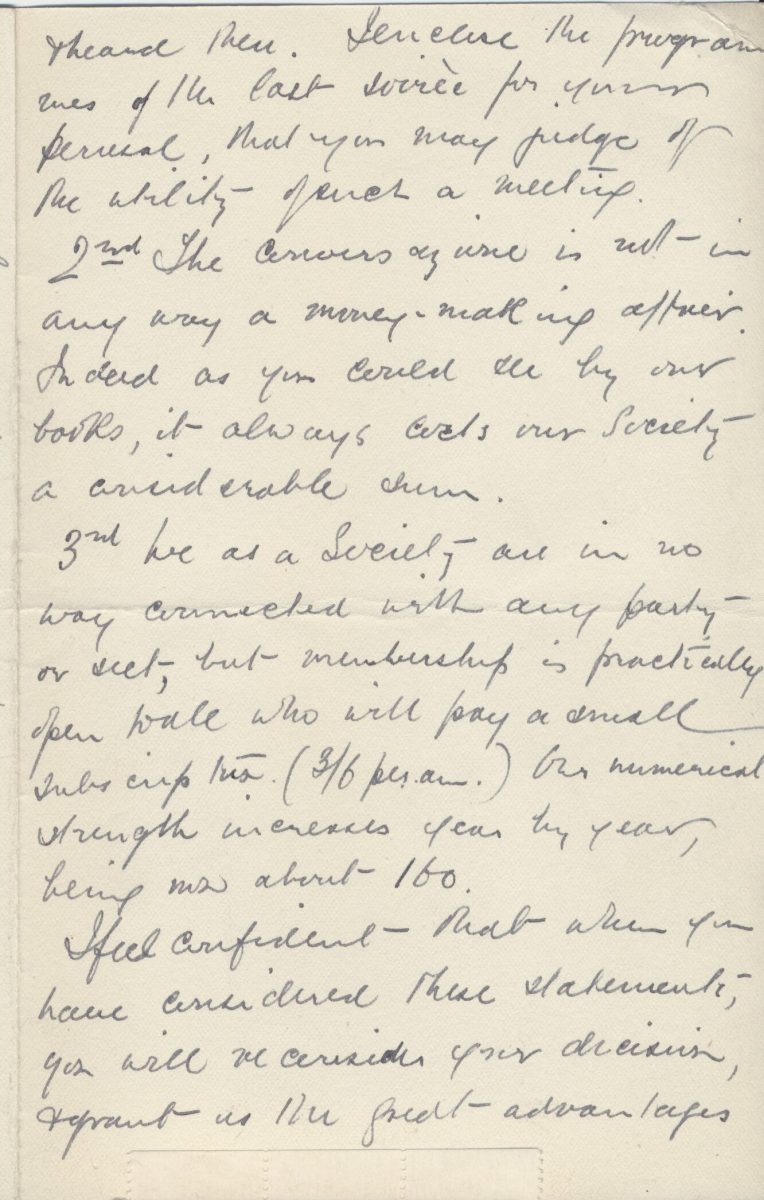
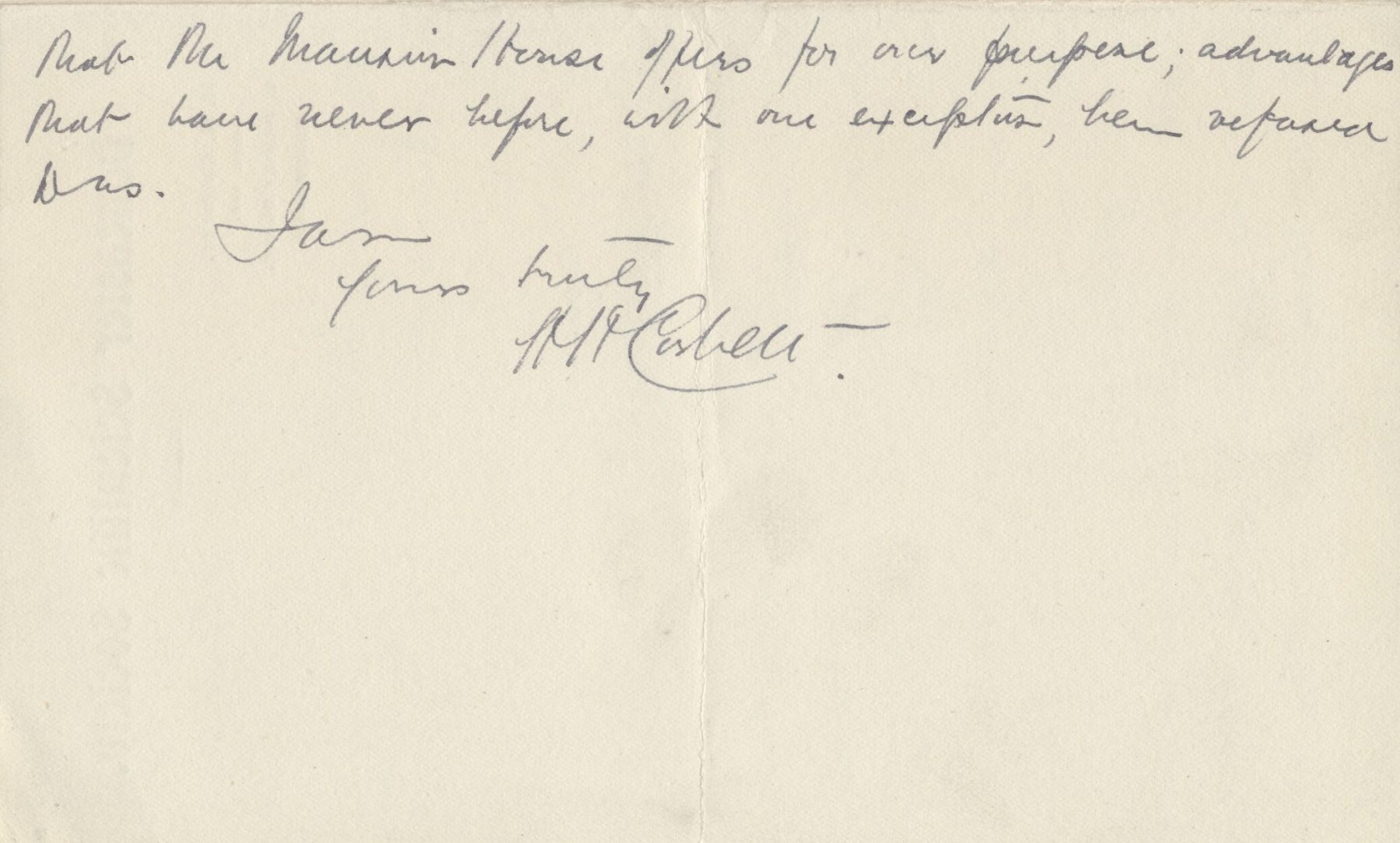
Oct 25th, 1905
An Ordinary Meeting of the Society was held in the Science Room, Guild Hall on Wednesday Oct 25th, 1905
Present – Mr. Greenslade (President) in the chair * 54 members & visitors.
The minutes of the last meeting were read & confirmed.
The following new ,embers were elected.
Mrs. Jackson, Miss Allender, & Messrs. Morton, Suson, Gyles, Sandbergh, Pigott, & Clarke
Sectional Reports
Archaeology.
It was reported that some Neolithic Implements had been found in Wheatley.
Mr. Corbett delivered a lecture on “The Dispersal of Seeds”
The following report of the meeting & lecture is from the Doncaster Chronicle.
[A newspaper cutting is pasted into the minute book at this point]
Friday, November 3, 1905
Doncaster Scientific Society.
The fortnightly meeting of this Society was held in the Science Room, in the Guild Hall Yard, on Wednesday evening of last week.
Dr. Corbett reported that two flint arrow heads and a stone axe had been found in Wheatley.
The chair was then taken by the President (Mr. G. H. Greenslade), and Dr. Corbett, of Priory Place, delivered a most interesting lecture on “The dispersal of seeds.”
Dr. Corbett stated that it must be patent to all who were in the habit of walking in the country and keeping their eyes open how very completely occupied the whole land surface was with vegetation of one form or another. In the immediate neighbourhood of Doncaster they had at present two new railway lines undergoing construction, and the soil had not settled before something began to grow upon it. He wished to draw their attention to a few of the various methods by which plants reached new stations and succeeded in occupying them.
Plants had various ways and means which from stress of circumstances they found it advisable to develop for the purpose of perpetuating their species. The agents which assisted in the dispersal of seeds he would divide into two chasses – animate and inanimate.
Animate – living bodies of any kind, which assisted voluntarily and involuntarily.
Inanimate – wind and water.
He would take these different systems of dispersal one by one, some of which he could illustrate by specimens. Plants could not be classified by the means adopted for their seed dispersal, as widely different species adopted similar methods and plants closely related adopted very different means.
If they examine the seeds of such plants as sedges, pond weeds, and water lilies, which led an aquatic or semi-aquatic life, they would find the fruits did not split open to shed the seed. They had a permanent covering to the seeds; and secondly, it would be found that the outside portion of the fruit which covered the seeds was very thick, and either very dense or heavy or impermeable and spongy. The object was that the heavy seed fell to the bottom and germinated there, whilst the others were floated down the stream to “fresh fields and pastures new.”
The cocoanut, one of the largest seeds which Nature produced, was one of these water-borne seeds. The Cocoanut fruit had an external coat of fibrous tissue, one to three inches thick, practically impervious to water, and within that the large seed known as the cocoanut. That external coat of the fruit of the coconut not only formed a most effective float, but also acted as an excellent buffer. The cocoanut seed was borne long distances, from island to island, until it had the good fortune to be stranded upon some land or coral reef where it could germinate on the deposit of soil or guano to be found there. Precisely the same thing occurred, though not in the same degree, with our water lilies. The lecturer then illustrated on the blackboard the growth of the plant popularly called water crowsfoot, showing how the flowers were kept above water until fertilized, then as the seed was ready for germination the stem altered its position and sank into the water.
Seed dispersal by means of wind was more varied than by means of water. They must all be familiar with a great number of seeds floating in the air, such as thistle down, willow herb, and many others. Floating seeds might divide into two great groups – first, those that floated by means of processes like wings; and, secondly, those that floated by something like a parachute. A familiar example of the winged method was the fruit of the maple or sycamore, where the seed was contained in the heavy part where the fruit was joined to the stem – two little seeds together tightly enclosed in the carpel. Such winged seeds as these (samaras) were characteristic of tall-growing timber trees, as the elm, ash, and maple or sycamore, and formed a very satisfactory method of disposal. In such plants being firmly attached to the trees on which they grew it took a strong gale to blow them off, and they would thus be distributed to better advantage than if they fell close to the parent tree. He did not mean the samara of the elm and the maple were alike in form, but only in function. They would find the same sort of arrangement in the cow parsnip of the angelica, but generally this class of seeds was limited to timber trees.
The parachute method differed from the winged method, it being more characteristic of low growing plants, and was a more efficient means of distributing than the winged method. The best form was that known to botanists as pappus, and the true pappus could only be found in the compositae of which order the dandelion, thistle, and chrysanthemum were representatives. In cold and temperate regions this class of plants was more in evidence than any other class of flowering plants. Each head of a composite flower, such as the chrysanthemum, had probably two or three hundred flowers crowded together, A rough sketch showing the different parts of a composite flower was then sketched on the blackboard to illustrate the fact that the floating apparatus was really a modified calyx. The lecturer then showed a fruit of the common goat’s beard, with its fine hairs and meshwork. In the masses of thistle down which could be seen floating in the air on fine days about this time of the year they would often find a great number of parachutes with a smaller number of seeds attached – the seeds that had not been fertilized or fully grown helping to carry those which had. When pappus landed on the soil the impact was enough to detach the floating part and leave the seed in the soil where they would germinate if conditions were suitable. Thousands, however, never met with suitable places. A specimen of the willow herb was shown, illustrating the great apparent waste, which went on throughout Nature, and the small amount of seed which arrived at places suitable for germination.
Another example of the class of parachute distribution was the common wild clematis, which had gained the title of “Old man’s beard,” from its grey development of wooly hairy seed, The other method of seed dispersal was by the agency of animals, either voluntarily or involuntarily. If they had paid a visit to Edlington Wood during the late summer and had been tempted to go some distance from the paths their garments would have been found sprinkled with small fruits attached with stiff hooked hairs. The burdock was one of these seeds which was distributed by animals. The ancestor burdock was probably distributed at some period by a parachute arrangement, the remains of the pappus still being found in the seeds. Seeds were often distributed by wading and swimming birds, ducks, and such like, in the mud which adhered to their feet and legs.
Passing from involuntary to voluntary carriers of seed, many plants attracted birds or animals by their brilliant and showy fruits. When a bird tore open the hip of a rose it found inside very thick woody fruits, covered with hard bristles; it would then rub its beak on the bark of a tree and drop the fruits below. In the case of the tew tree the fruit is gummy, and the birds wipe their beaks and shake their heads and so distribute the seeds, Fruits were also w=eaten by birds and the seeds excreted, and if dropped on suitable soil would be distributed in that way. The nuts and similar fruits with hard coated shells were distributed by squirrels and dormice. Examples of seed dispersal by mechanical arrangement in the parent plant were shown. The fruits of the wild violets or pansies when nearly ripe, split open into three divisions, each one containing a double row of seeds. In the case of the violets, instead of contraction causing them to shoot outwards, as in the cranes bills, it caused the arched sides to gradually come together until the seeds were squeezed till they were shot a considerable distance, A similar process took place in the wild hyacinth. The seed of the poppy was distributed through a number of small openings in the poppy head and was shaken out by the wind and not by the heads drooping down. The means of seed distribution was almost as varied as the plants themselves. The methods were simply the result of adaptation to the environment of the plants and the huge amount of seed developed by many plants was the only chance of perpetrating their species.
Discussions followed in which Dr, Selby and Messrs. Stiles, Culpin, Thomas and Moor took part.
Signed G. H. Greenslade 8.11.05
Oct 30th, 1905
A committee Meeting was held at 9 Priory Place
Present – Mr. Greenslade in the chair, Mrs. Corbett & Messrs. Bisat, Phillips, Culpin, & Corbett.
The minutes of the last meeting were read & confirmed.
The following nominations for membership were approved.
Miss Woodhouse, Mrs. Phillips. Messrs. Brindell, Lenchell(?), & Bearden.
It was resolved that the hire of the Science Room be paid if required.
It was also resolved that a Short Essay Night be included in the current programme.
Signed G. H. Greenslade 8.1.06
Nov 8th, 1905
An Ordinary Meeting of the Society was held at the County Court Room, Guild Hall on Wednesday November 8th, 1905
Present – Mr. Greenslade (President) in the chair & 44 members & visitors.
The minutes of the mast meeting were read & confirmed.
The following new members were elected.
Miss Woodhouse & Messrs. Birchall & H. Wearden.
Sectional Reports
Botany
The recorder exhibited a dried specimine of a plant found at Medge Hall & of which he did not know the name.
Geology
The recorder called attention to the geological rambles that are held nearly every Saturday & also on the day following Saturday & invited any members interested to join.
Zoology
The recorder exhibited a large spider (Mygall sp.?) found among bananas.
Mr. Watson delivered a lecture on “The Measurement of Illumination”.
The following report is from The Doncaster Gazette Nov. 17th, 1905
[A newspaper cutting is pasted into the minute book at this point]
Doncaster Scientific Society
The fortnightly meeting of this society was held in the County Court Room at the Guild Hall on the 8th inst. The hon. sec., Dr. Corbett, submitted a plant which had been found by him at Medge Hall, which was unknown to him. A large spider was shown which had been found in a crate of bananas, and which Mr. Locke of North Street, had presented to the museum.
Mr. Culpin was congratulated on his election on the Council of the Yorkshire Geological Society.
Mr. Wilson gave a very interesting lecture on “The Measurement of Illumination.” And demonstrated by means of apparatus how the measurement of the different powers of illumination was obtained.
He traced the different improvements in lighting that had been effected from pieces of wood, torches and candles, to incandescent gas and electric arc lamps of the present day.
The lecturer illustrated on black board the methods of testing where the spermaceti candle was used as the standard. This was our English standard from which we got the terms, sixteen candle power, thirty candle power, etc. In France the carcel, a colza lamp, equal to about 9 ½ candles, was the standard. The Pentaign air lamp was equal to ten English candles, was almost invariably accurate, and the test could be performed in a much shorter time than by the English sperm candle. That was the method in use at the Doncaster Gas Works.
Mr. Watson explained how the light diminished as the distance from the burner increased; that a yellow light seemed to be better for the eyes than a coloured one, that rooms papered light colours and streets which had buildings painted a white received the greatest benefit from the illuminant used, and that it was better to have a greater number of small lights than a smaller number of more powerful lights at proportionately further distance apart.
Discussion followed in which the President, Dr. Selby and Messrs. Stiles, Wearden and others took part.
Signed G. H. Greenslade 22.11.05
Nov 22nd, 1905
An Ordinary Meeting of the Society was held in the County Court Room, Guild Hall on Wednesday Nov 22nd, 1905
Present – Mr. Greenslade (President) in the chair & 54 members & visitors.
The minutes of the last meeting were read & confirmed.
Sectional Reports.
Archaeology
Mr. Jordan reported finding some fragments of Roman Pottery in the Town Field.
Geology
Mr. Culpin drew attention to the numerous interesting sections now being exposed in the construction of the new railways in the neighbourhood.
Mr. Greenslade exhibited some fossil wood from the Lias at Frodingham.
Zoology
Mr. Corbett exhibited Plenstichus picimanus a beetle, very rare in Yorkshire, recently taken in Edlington Wood.
Mr. M. W. Whitfield MA. Cantab. delivered a lecture entitled &The Wonders of the Telescope”
The discussion that followed, in which Messrs. Stiles, Culpin, & Corbett took part, turned chiefly on the question of the causation of the so called lunar craters.
The annexed report of the meeting is taken from the Doncaster Gazette.
Signed G. H. Greenslade 13.12.05
[A newspaper cutting is pasted into the minute book at this point]
Doncaster Scientific Society
The Wonders of the Telescope
The fortnightly meeting of this Society was held in the County Court Room, Guild Hall on the 22nd of November, at 8 p.m., when Mr. M. W. Whitfield, M.A. Cantab (of London), lectured on “The Wonders of the Telescope.” This was illustrated by lantern slides.
“The lecturer stated that about the middle of the last century astronomy appeared to be reaching the limit of its powers. Telescopes had been constructed of a capacity that seemed not likely to be exceeded in the future. The masses, motions and distances of the sum and planets had been determined with great exactness, and it only remained for the astronomers of the future to render these determinations still more accurately by the increasing labour of many years.
But with regard to the constitution of the heavenly bodies nothing was known, nor did it appear likely that anything could be discovered, but shortly after this period a new method of investigation placed enormous powers in the hands of the observer. This was the method of spectrum analysis.
When the light of the sun was passed through a prism it was resolved into a broad band of many colours. This band was observed not to be continuous, but to be interrupted in many places by a number of dark lines.
On passing the light from the highly heated vapours of various substances through the prism, this was found not to be spread out in the same way, but to show a number of narrow bright lines which always preserved the same position for the same element. Iron, for instance, gave several hundred bright lines.
On comparing the bright lines in the spectrum of iron with the dark lines in the spectrum of the sun, it was noticed that those of the iron spectrum coincided exactly with a corresponding number of those in the sun’s spectrum, thus rendering it highly probable that this element must be found in some relation with the constitution of sunlight.
After time it was discovered that when continuous spectrum from a highly heated source was viewed through the cooler, but still highly heated vapour of an element like iron, dark lines were seen in place of the bright line observed when that element was viewed by itself. Thus, it was seen that the dark lines in the sun’s spectrum were caused by the bright light of the sun’s photosphere being viewed through a stratum of the vapours of various elements, and it only remained to determine the nature of these elements.
So, it came about that iron, nickel calcium, manganese, sodium, zinc, and many other terrestrial elements were found to exist on the sun in a state of vapour. Certain lines were found in the sun’s spectrum which corresponded to those of no known terrestrial substance. These were assigned to a substance termed helium. Many years afterwards, helium was found by Sir William Ramsay to exist in a rare mineral named clevite.
Another remarkable extension of the powers of the astronomer was afforded by the application of Photography to the observation of the heavenly bodies, By this means, stars, nebulae and details of celestial structures have been discovered which no improvement of the ordinary telescope will ever render visible.
A most important application of the spectroscope is that of determining the speed of approach to the earth or recession from it, through the shifting of the lines of the spectrum caused by the movement in the line of sight on the part of the object observed. Hence, numerous dark stars have been discovered by the motions they cause in bright companion stars. It has even been found possible to calculate the masses and movements of objects whose distances are too far away to be known.
The slides shown by the lecturer included some of the curious spiral and other nebulae in which condensations of nebulae matter into stars appeared in various stages of development.
The solar prominences, sun spots, and corona also received attention, the complete history of a solar outbreak being shown, a tremendous eruption of hydrogen flame being traced from its commencement to its culmination at a height of 120,000 miles, and its complete disappearance in slightly over two hours.
The surface of the moon was shown in several slides, indicating the vast mountain rings, huge chasms and land-slips, isolated mountains, and serrated ranges. The planets were shown in the usual order, and the meteoric origin of Saturn’s rings was demonstrated.
The lecturer concluded with views of the Leonid meteors and some of the larger comets.”
Committee Meeting held after the above meeting nominated for membership passed.
Viz Miss Cook & Mr. Brundell
Signed G. H. Greenslade 8.1.06
[a newspaper cutting is pasted into the minute book at this point]
Doncaster Scientific Society
A meeting of this Society was held in the County Court Room, Guild Hall at 8 p.m. on the 13th inst. The President, Mr. G. H. Greenslade, was in the chair.
Mr. Culpin, the recorder of the geological section, remarked that the new railway which is crossing the London and Thorne roads offered a good field for investigation to students of geology.
The lecture for the evening was by Dr. J. Mitchell Wilson, of Beverley, the Medical Officer of Health for the East Riding of Yorkshire, and one of the founders of the Doncaster Scientific Society. The subject, “The solvent power of water,” was one which the lecturer made very interesting.
Dr. Wilson said he was glad to see the Society in such a flourishing state, which was no doubt due to the worthy gentleman who acted as secretary. Since his removal into the East Riding the question of water supply had been constantly before him. There was a great difference between the water of Doncaster – which contained very little chalk – and the water in the East Riding, which contained a great deal.
As regards the solvent power of water they could see what had been done in the neighbourhood of Conisbro’ – how the river had made its way through the magnesian limestone. In the Niagara, water had made its way and cut a narrow gorge into the solid rock. Again, on the East Coast of Yorkshire, the water in the German Ocean was carrying away some of the cliffs between Spurn Point and Bridlington. Even granite, when exposed to rain for a long period, was dissolved. Water was the greatest solvent known; they were told that no rock could withstand its power. They were all familiar with the fact that heat caused water to evaporate. In the tropical seas the rainfall was excessive. Snow and rain, it would be found, always contained dust, ammonia, and other bodies which were in the air. The lime or hardness in water could be taken from it by boiling, by adding lime or soap solution. Soda was used in washing for this purpose. Many years ago, Professor Clark, of Aberdeen, found by experiment that by adding lime to water which already contained that substance, causing the water to be hard, the lime would combine with that already in the water and both go down to the bottom of the vessel.
In a dry season, well water would be found to contain more than usual quantity of chalk. The wells which contained sulphur were usually shallow, this water being very pure though often very hard. Nitrates in water was generally a warning that organic matter was present. Lead was found in some water, such waters being very soft. He did not consider water which contained lead suitable for drinking purposes. The people of Doncaster and the East Riding had very little to fear from lead poisoning in their water.
The water supply should be obtained from a source free from all unsuitable contamination of the soil. The lecturer showed by experiment the difference of the hardness of water, that from Beverly district being particularly hard and requiring a large quantity of soap solution before a lather could be produced. Water from the same source, having been previously boiled, did not require anything like the quantity of soap solution to produce the same result.
Discussion followed, in which Messrs. Stiles, Culpin, Watson, Thomas, Dr. English, and others took part.
A vote of thanks was proposed to the lecturer, and Dr. Corbett seconding, recollected the small meetings they had in the early days, and though some had left, still many of the good ones remained. It gave him great pleasure to see an old member of the Society coming among them and finding them doing so well.
Dec 13th, 1905
A Committee Meeting was held at the County Court Room, Guild Hall, on Wednesday Dec. 13th, 1905
The following nominations were passed.
Messrs. Child, & Denison
It was resolved that Mr. Watson’s invitation to the members to visit the Gas Works be accepted, with thanks, & that the date for the visit be Saturday January 13th & Thursday January 18th.
Signed G. H. Greenslade 8.1.06
Jan 8th, 1906
A Committee Meeting held at 9 Priory Place
Present – Mr. Greenslade (President) in the chair, Mrs. Corbett & messrs. Stiles, Vaughan, Watson, Cuttriss, & Corbett.
It was resolved that as the 24th inst. is the day for the Parliamentary election in the Doncaster Division, the next meeting of the society be altered from that date to the 31st inst.
Messrs. Cuttriss & Corbett were deputed to meet the Mayor, in order to arrange a date for the Annual Conversazione.
It was resolved that either the Feb 21st of March 21st be the date for a “Short Essay Night”.
Signed G. H. Greenslade 7.2.06
An account of the visit of the Doncaster Scientific Society to the Gas Works 13th January 1906
[a very large newspaper cutting is pasted into the minute book at this point]
How ….. makes a profit. [cutting damaged]
The remedy for Poor Lights
The recent Improvements
On Saturday afternoon last, a number of the members of the Doncaster Scientific Society paid a visit to the Doncaster Gas Works, where, with Mr. R. Watson, the manager, as the able cicerone, they spent an interesting and profitable time, being shown the process of making gas and all the lately introduced improvements. Alderman Wainwright, Chairman of the Gas Committee, was to have been present, but wrote stating that important Corporation work kept him from attending.
At the close of the inspection, Mr. G. H. Greenslade (President of the Scientific Society) proposed a vote of thanks to Mr. Watson, and this was heartily accorded. Not all the members were able to be present, and so the remainder, with a few friends, visited yesterday (Thursday) afternoon.
The Doncaster Gas Works were built in 1827, the Doncaster Corporation being at that time part owners. Gas was first used in Doncaster in 1814. There are no records of the amount consumed before 1850, but we know that between 1840 and 1850 the price per 1,000 cubic feet was 12s. 6d., as compared with 2s. 6d. today, and the probability of a less price within the course of the present year.
In 1850 the output per year was about 13,000,000 feet; in 1862, about 37,000,000; in 1880 about 66,000,000; in 1890, 103.000.000; in 1900, 179,000,000; in 1905, 204,000,000; and there is every reason to believe that during this year the amount will rise to 250,000,000. In view of this rapidly increasing demand and surety of its continuation Mr. Watson shortly after his appointment as manager in 1902, placed before the Corporation the desirability of improved apparatus, such as was in use in many other towns, and the Corporation, with that keen desire for the advancement of the town which has characterized most of their doings during recent years then gave the subject earnest consideration.
Mature deliberation decided them to embark on the enterprise. They granted the manager the use of £10,000, which gas been used to such good purpose as to have reduced the cost of the manufacture of gas from 2s. 2d. per 1,000 in 1902 to 1s. 7d. in 1905, and to increase the gross profits from £3,948 in 1902 to £7.669 in 1905. The improvements undertaken were commenced about two years ago and completed a couple of months since.
The first feature of the improvements is in the landing of coal from the canal. Under the old order the coal used to be hoisted up by means of half-ton trucks. A coal elevator has superseded that arrangement, and an overhead conveyor takes the coal over an automatic weighing and registering machine, into the coal store, where it is deposited. The store was built twelve months ago. Everything now is practically in duplicate, another conveyor carrying coal to the other side of the retort house. The coal is broken into sizes required and again elevated from the pit in the store to a position above the retorts, where the gas is made, and dropped into a hopper, whence again it is deposited into a hopper running along the floor opposite the mouths of the retorts into which it is placed by means of a charge scoop at the rate of 3 ¼ cwt. at a time. The coal is left in the retorts for six hours until all the volatile matter has been driven into the pipes overhead, and the residual coke is scooped out of the retorts on to a chain conveyor, which takes the coke into the yard.
The conveyor takes the place of the old barrow and shovel system, which made the work at times of an exceedingly laborious description. The conveyor carries the coke upward to a coke breaker, whence it goes into the revolving screen, where it is split up into its various sizes, and finally into hoppers from which, by means of a sliding door, carts standing ……
[top of the cutting is damaged]
The retorts are heated by the regeneration system of firing, to describe which in detail we shall not attempt, suffice to say that there is no waste heat or gas, whereas under the old system of burning the coal directly by the flames from the coke there was no end of wastage in this direction.
One of the benefits of the regenerative system is that whereas 40 per cent of the coke made was used under the old system for heating purposes, now only 25 per cent is used. Number 1, or the old retort, has been modernized. It is used only for auxiliary purposes, and at the present time only half is going. When the time comes – and it is considered within measurable distance – No 2 retort will be lengthened, as there is no room to add the necessary storage and apparatus to No 1.
The same stoking machinery, elevator and conveyor will serve any extensions that may be made, and what will have to be spent will be upon the retorts alone. Both machinery and retorts would have to be altered if an extension scheme were carried out in connection with the old retort houses.
In view of all these improvements one naturally wonders if there has not been a commensurate decrease in the amount of manual labour needed, but the output has increased to such an extent that the Doncaster Gas Works have not had to send one man into the ranks of the unemployed. There has been an increase in the output of 11 per cent on the last three years, and the staff of 100 hands still remains as three years ago, so that the improving of the works, the increasing of the output, and the swelling of the revenue, have been achieved without any lobourer loosing his hire. About 20.000 tons of coal are used during the year.
To return to the gas making process; When gas leaves the retort house it contains impurities in the way of gas and water vapour, carbon of oxide, sulphurated hydrogen, ammonia, cyanogen, etc. and for the removal of each one of these there is a separate apparatus. The gas and water vapour are condensed into liquid and what is known as the washer and scrubber removes other impurities. The apparatus in the neat little engine room exhausts the gas from the retorts as it is being made and sends it to the various portions of the purifying plant and thence into the storage holders. Recently there have been adopted the Derby process of naphalene removal, and a new washer and scrubber for taking the ammonia away. The purifiers consist of four huge square boxes in which oxide of iron is used for purifying and removing the whole of the sulphurated hydrogen. The ammonia thrown off is taken in the shape of ammoniacal liquor into the sulphate of ammonia house, where the ammonia is feed from the liquor and treated with sulphuric acid to make sulphate of ammonia, of which the Corporation sells for fertilizing purposes somewhat of 200 tins per year.
And now we arrive at a point in our peregrination which appeals most strongly to the mind that is nice about that which is piquantly novel – the house where is registered the amount of gas made and which contains what is known as the station meter. It is explained that the weight of the metal in the large gas holder possess sufficient pressure to drive the gas along the mains into the town and other places where it is in use. In the daytime naturally the pressure is at its greatest, so in order to relieve the holder a cunning device has been adopted. By a system of weights, the pressure was regulated, but that proved not so satisfactory as the manager would prefer. Often late at night, usually about the hour of eleven, the lone bachelor having a few moments with his favourite book before turning in, the busy housewife following out in its full literal sense, the spirit of the adage “it’s never too late to mend,” and others occupied late, would be startled by a sudden jumping of the light by which they were enabled to follow their occupation. That was when one of the weights was removed in order to regulate pressure upon the gas. The sudden jump or flicker of the gas light has been obviated by the substitution for the weights of the tank of water, above the station meter, from which a stream slowly flowing through a tube during a given time the process of regulating the pressure is made so easy and gradual that the light is not in the least affected.
Beyond this truly interesting department, above the offices, are the chemical laboratory, where the qualities of gas are tested and other similar experiments carried out; and the photometry where mainly the quality of light is gauged.
And coming to the quality of light reminds us of an oft repeated cry that the light given by the gas in the town has of late been unsatisfactory. The manager at once hastes to explain. It is curious that after the gas has been purged of its impurities, it still remains a mixture – a mixture of gasses, which goes into the holders. In this mixture – we prefer to call it gas – there is only 3 ¼ to 4 per cent. of lighting power; the rest is heating power. Gas is being increasingly used for incandescent burners, gas fires, engines, cookers, etc. which all need the heating power; and decreasingly used for flat burners, which need the lighting power. Only 20 per cent. of the gas used is needed for the flat flame, and if all would use the incandescent burner it would be necessary to use only heating gas, and heating gas is produced more cheaply that candle power gas, so that by compelling the Corporation to produce a full quality of lighting gas, the users of flat burners are penalizing those who use the incandescent. In other words, the flat flame is not only paying more but making others pay more because they have to pay for the candle power gas which, as before said, costs more than heating power gas.
It is necessary to keep up a high grade gas in order to overcome the difficulties made by those consumers who will have the old flat flame burners. However, the Gas Works staff can easily put right all those users of flat burners who complain of the poorness of their light. It is simply a matter of the burner used, and if dissatisfied consumers call at the Gas Works they can be supplied free with the Brays economizer burner, which makes for a much better light than many ordinary burners in use. It is pointed out, however, that for the same price, one penny, the same amount of gas will give light to the extent of 627 candle power with an ordinary incandescent burner, in contrast with 102 candle power with Bray’s ordinary No. 4 flat flame. Verily the smoky, stinky, heated, dusty atmosphere of the Gas Works is full of instruction and interest.
Jan 10th, 1906
An Ordinary Meeting of the Society was held at the County Court Room, Guild Hall on Wednesday January 10th 1906
Present – Mr. Greenslade (President) in the chair and 30 members & visitors.
The minutes of the last meeting were read & confirmed.
The following new members were elected.
Viz Messrs. Child & Denison.
Mr. Kirby delivered a lecture on “Sewage Purification & Disposal”
The following account of the meeting is taken from the Doncaster Gazette (19/1/06)
Signed G. H. Greenslade 31.1.06
[a newspaper cutting is pasted into the minute book at this point]
Doncaster Scientific Society
Sewage Disposal
A meeting of this Society was held in the County Court Room, Guild Hall, on the evening of the 10th inst. When the chair was taken by the President, Mr. G. H. Greenslade.
Mr. F. O. Kirby, M. Sc. (of the Borough Surveyor’s office, Doncaster, read a paper on “Sewage Purification and Disposal.”
He gave a most instructive paper, dealing with the various methods of sewage disposal – by irrigation, chemical treatment, and by bacteria. The lecture was illustrated by lantern slides. The Doncaster Corporation has sewage farms of 278 acres at Sandall and 100 acres in the Low Pastures. It was considered that in a clay soil one acre would deal with the sewage of 250 people, whilst sandy soil would take sewage from as many as 1,000 people. The Doncaster Sewage farms should, therefore, be very efficient, seeing that they took sewage from only about 100 people to the acre.
Discussion followed in which the President, Messrs. Johnson, Stiles, Jordan, Councilor Gyles, Dr, Corbett and Mr. Grace took part. The President said they would all recollect Mr. Kirby’s late respected chief, Mr. Crabtree, who had lectured before them, and he could not let the opportunity pass without paying some tribute of respect to Mr. Crabtree. The Corporation had always been willing to let their officials lecture before the members of their Society, and they only recently had the pleasure of hearing Mr. Watson lecture on “The Measurement of Illumination.”
Mr. Kirby was thanked for his excellent paper.
Feb 12th, 1906
A Meeting of the Soiree Committee was held at 9 Priory Place on Monday 12/2/06
Present – Mr. Greenslade in the chair, Mrs. Corbett, Mrs. Culpin, Miss Windle, & Messrs Phillips, Watson, Jordan, Culpin, Bisat, Cuttriss, Stiles, & Corbett.
The Programme for the Soiree was discussed.
It was suggested that there be an exhibit of lantern slides on an illuminated screen.
Mr. Cuttriss was allowed to spend 25/- on apparatus etc.
Refreshments to be served during the whole evening
Inspector Dolan to act as Tyler.
Mr. Culpin’s offer of the loan of Calculating machines was accepted
Proposed by Mr. Culpin, seconded by Mr. Watson that the arrangement of the Mansion House & Programme be left to a sub-committee consisting of the President, Secretary, Assistant Secretary, & Mr. Stiles, Bisat & Cuttriss.
Proposed by Mr. Culpin, seconded by Mr. Corbett that Mr. Stiles be authorized to obtain a frame for the exhibition of lantern slides.
Signed G. H. Greenslade 26. 2. 06
Feb 14th, 1906
An Ordinary Meeting of the Society was held at the county Court Room, Guild Hall.
Present – Mr. Greenslade (President) in the chair & 48 members & visitors.
The minutes of the last meeting were read & confirmed.
Mr. Corbett reported on some Lias Ammonites from Frodingham, presented to the Museum by Mr. Greenslade.
Mr. Phillips read a paper on “Local Birds.”
The paper gave evidence of much painstaking study of the habits of our local birds on the part of the lecturer.
The lecture was illustrated by good photo slides & bird drawings.
Messrs. Vaughn, Evans, Turner & Greenslade took part in the discussion.
Feb 28th, 1906
An Ordinary Meeting of the Society was held at the County Court Room, Guild Hall.
Present – Mr. Greenslade (President) in the chair & 48 members & visitors.
Sectional Reports
Geology
Mr. Culpin reported that Boulder Clay with distant borne erratic’s had been found at Wadsworth on the new railway.
Mr. Corbett reported some mammalian bones found in the cutting of the Dearne Valley Railway near Conisbro’
Two new members were elected . viz Miss Faucet, Mrs. Robson, & Messrs. Turner, Hodgeson & Banyard (?)
A letter from Mr. Sheppard was read, stating that he had had a facsimile of the Roman Boach found at Wadworth made for the Doncaster Museum.
Mr. Culpin gave a very interesting lecture on “The Churches of the District,” which was illustrated by numerous excellent slides, the work of several members.
[a newspaper cutting is pasted into the minute book at this point]
“At a meeting of the above Society in the county Court Room, Guild Hall, last week, Mr. H. Culpin gave an excellent paper on “The Churches of the District,” which was illustrated by lantern. The lecture was most interesting, the different stages of architecture being pointed out very clearly by Mr. Culpin. There were few examples of the Saxon style of architecture round Doncaster, but the district was rich in Norman architecture. Mr. Culpin was thanked for his paper, The President, Dr. Corbett, Messrs. Watson, Jordan and others took part in the discussion.”
Signed G. H/. Greenslade 28.3.06
Feb 26th, 1906
A Meeting of the Soiree Committee was held at 9 Priory Place on Monday Feb. 26th, 1906
Present – Mr. Greenslade (President) in the chair, Mrs. Grace & Mrs. Corbett, Miss Smith & Messrs. Bisat, Watson, Culpin, Jordan Jnr, Cuttriss, Stiles, & Corbett.
The minutes of the last meeting were read & confirmed.
It was proposed that Photographs be exhibited on the ledges in front of the windows.
That a micro-lamp be Purchased for the Societies Microscope.
That Mrs. Moor be engaged for the whole of Thursday March 1st & Friday March 2nd, to fetch & return exhibition material.
Signed G. H. Greenslade 5. 3. 06
[a loose newspaper cutting is to be found in the minute book at this point; and also a copy of the 1906 Annual Conversazione Programme]


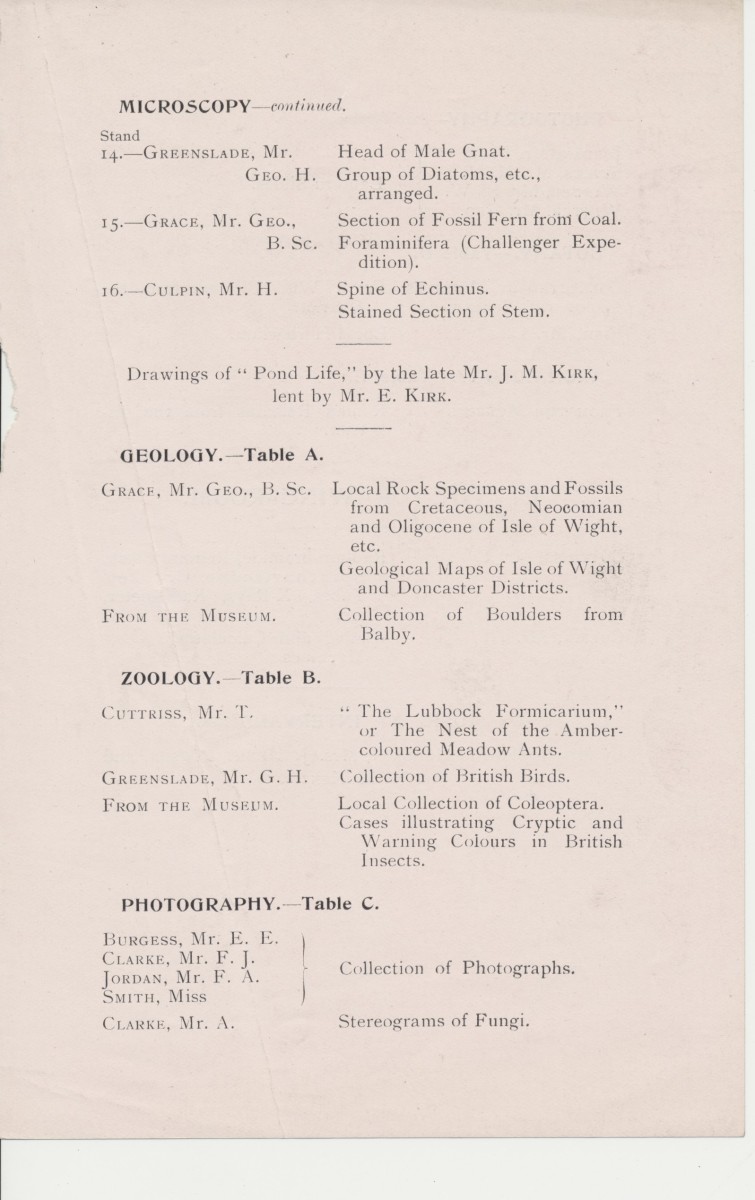
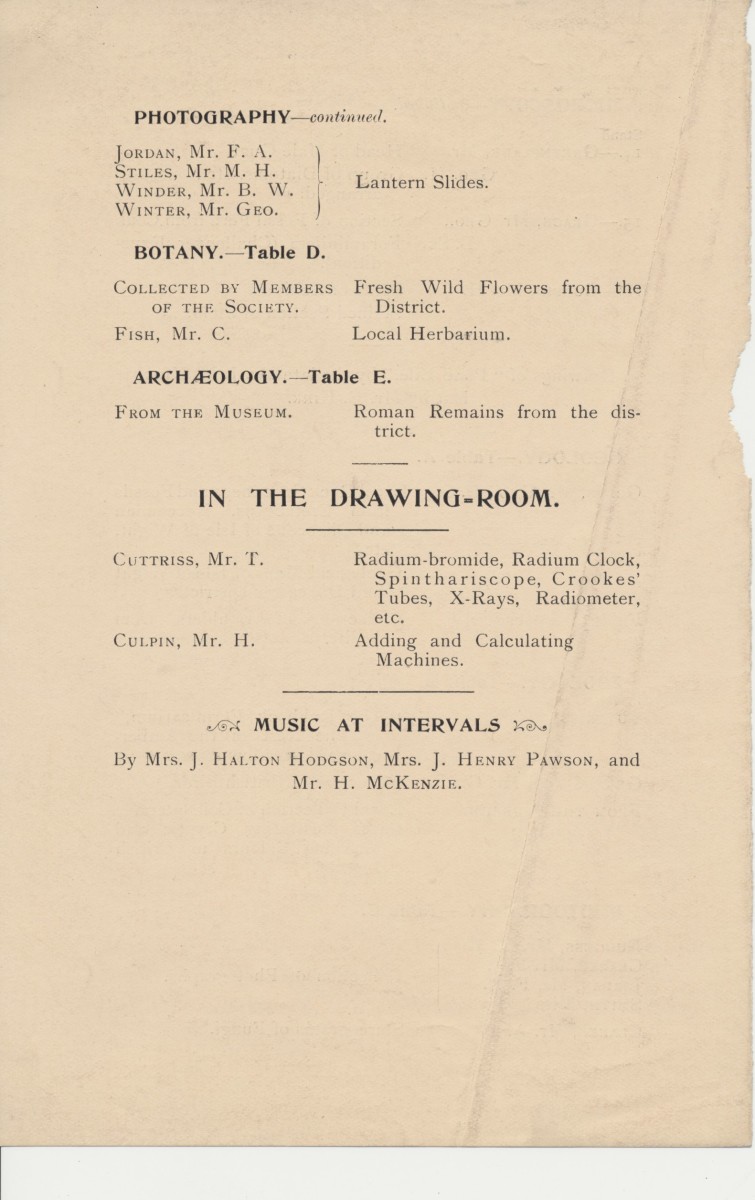
The Annual Conversazione – 1st March 1906
The Annual Conversazione of that most flourishing body, the Doncaster Scientific Society, was held, by kind permission of the Mayor and the Mansion House Committee, at the Mansion House on Thursday evening March 1st.
Energetic members of the Society had devoted much time and knowledge during the earlier part of the day; and indeed for many days previously, to the arrangement of the exhibition which always forms an attractive part of these yearly functions, and when the guests began to arrive at 7 o’clock, they found tables in the banqueting room covered with much to interest them. Microscopes under the management of Messrs. Stiles, Winter and Bisat were used to show the lower forms of life that would be treated of in the lecture of the evening. Besides such objects were many others of great beauty and interest.
The table devoted to the Geological section had a good collection of the rocks of the far famed Balby Boulder Clay: and also some good collections of fossils from the newer Mesozoic rocks of the South of England and the Isle of Wight. Maps and sections also showed the structure of the last named most interesting little island.
In the zoological section an exhibit of great interest was a nest of the yellow ant (Formica flava) shown by Mr. Cuttriss in which the habits of these most intelligent insects could be seen; queen, workers, eggs, larvae, etc., all alive and mostly in active movement.
A fine collection of British birds shown by Mr. Greenslade and a good local collection of beetles, containing about 600 different species, all from the Doncaster district, the property of the Museum, also attracted much notice.
Another exhibit in this department which aroused much admiring interest and wonder was the cases of insects showing protection from similarity to their surroundings or on the other hand, showing conspicuous colours and markings in such species as were distasteful or poisonous to insect eating birds and other animals.
All round the room were arranged some most beautiful drawings of the lower forms of animal life. These were the work of that well know Doncaster naturalist, the late John Kirk, and were kindly lent by his brother.
The show of fresh gathered wild flowers had naturally suffered from the earliness of the date and the frosts and snows of the past week. Paucity of fresh material was counterbalanced by the well preserved, dry specimens of plants shown by Mr. Fish.
In archaeology, interesting local relics of stone, bronze, Roman periods were exhibited, Prominent among the latter was a model of a remarkably fine Roman Fibula or Boach, the original of which is in the Hull Museum.
The Photographic section was well represented, firstly by a very fine assortment of lantern slides shown at the end of the room on an illuminated screen, and secondly by numerous beautiful artistic photos placed in the window recesses, Miss Smith and Messrs. Jordan and Burgess were chiefly responsible for this show.
The department of Physics had some very attractive material on view. Foremost among these were calculating machines from the G.N.R. offices, These wonderful mechanical marvels will do abstruce sums in arithmetic almost as quickly as the problem to be sorted can be stated. Mr. Cuttriss had, as usual, a good show of electrical and radio-active apparatus. These were for the most part shown in the darkened drawing room.
Refreshments were served during the whole evening in the saloon, and were under the management of Mrs. Corbett and Mrs. Cuttriss, assisted by several other ladies. Music was rendered by Mesdames Grace, Culpin and Pawson, and Mr. McKenzie.
Undoubtedly the greatest feature of a most enjoyable evening was the lecture by Mr. Harold Wager, F.R.S., on “The Borderland between Plant and Animal Life.” Mr. Wager is to the forefront of those leaders of biological science who have made the structure and functions of the cell their chief study, He is, moreover, endowed with that most useful trait in a lecture – the power of making himself clear to the unscientific among his audience. Having recounted the discoveries of the cellular structure of both vegetable and animal organisms, he took as his subject a lowly form of living cell called Engloena, and in a most convincing and lucid manner, demonstrated that it is as much vegetable as animal, and as much animal as vegetable. By means of tables he showed that what is true of Engloena is true of many other unicellular organisms. Some approach the animal and some the plant, but to draw a hard and fast line between the two is impossible.
The lecture was listened to by an audience who were at one with the lecturer from beginning to end. The lantern was used to show the results of many very ingenious experiments carried out by the lecturer for the purpose of finding out all that could be found regarding the nature and habits of Engloena, and these seemed to emphasis the lecturer’s remarks in a most helpful manner. Indeed, it may safely be said that the most scientific among the hearers learned much and the most unscientific understood much.
At the conclusion of the lecture a vote of thanks, proposed by Mr. Stiles, and seconded by Mr. Corbett, was carried with acclamation.
April 18th, 1906
A Committee Meeting was held at 9 Priory Place
Present – Mr. Stiles in the chair, Mrs. Corbett & Messrs. Bisat, Vaughan, Phillips, Jordan, Culpin, & Corbett.
The Hon, Sec. presented a draft of his Annual Report, which after some emendation was passed, on the proposition of Mr. Culpin, seconded by Mr. Cuttriss.
The following were suggested as officers for next session.
President. Mr. Watson (proposed by Mr. Stiles, Seconded by Mr. Culpin)
Vice Presidents. Mr. Greenslade & Mr. Bisat.
Committee. Messrs. Culpin, Grace, Moor, & Golledge (3 vacancies)
Recorders
Archaeology – Mr. Jordan
Botany – Mrs. Grace & Drs. Corbett & Selby.
Geology – Messrs. Culpin & Grace
Microscopy – Messrs. Stiles & Bisat.
Photography – Miss Smith & Mr. F. A. Jordan
Physics – Messrs. Cuttriss & Watson.
Zoology – Messrs. Corbett, Moor, & Phillips.
Museum – Mr. Moor
The representatives on the Museum Committee to be elected after the election of the President.
Signed H. Culpin 30.IV. 06
[end of the Minute Book]