Minute Book 5. (1906-1913)
This minute book, as the label inside the front cover shows, was purchased from
Eleph G. Bisat,
Commercial Printer and Stationer, and Account Book Manufacturer.
5 Barter Gate, Doncaster.
The front cover is titled Minute Book
It consists of, in the first section, each page being tagged with alphabetical letters, AB, CD, EF, etc.
The pages following are numbered 1 to 359.
There is a blank front and rear page.
The pages measure 9 1/2 x 7 inches
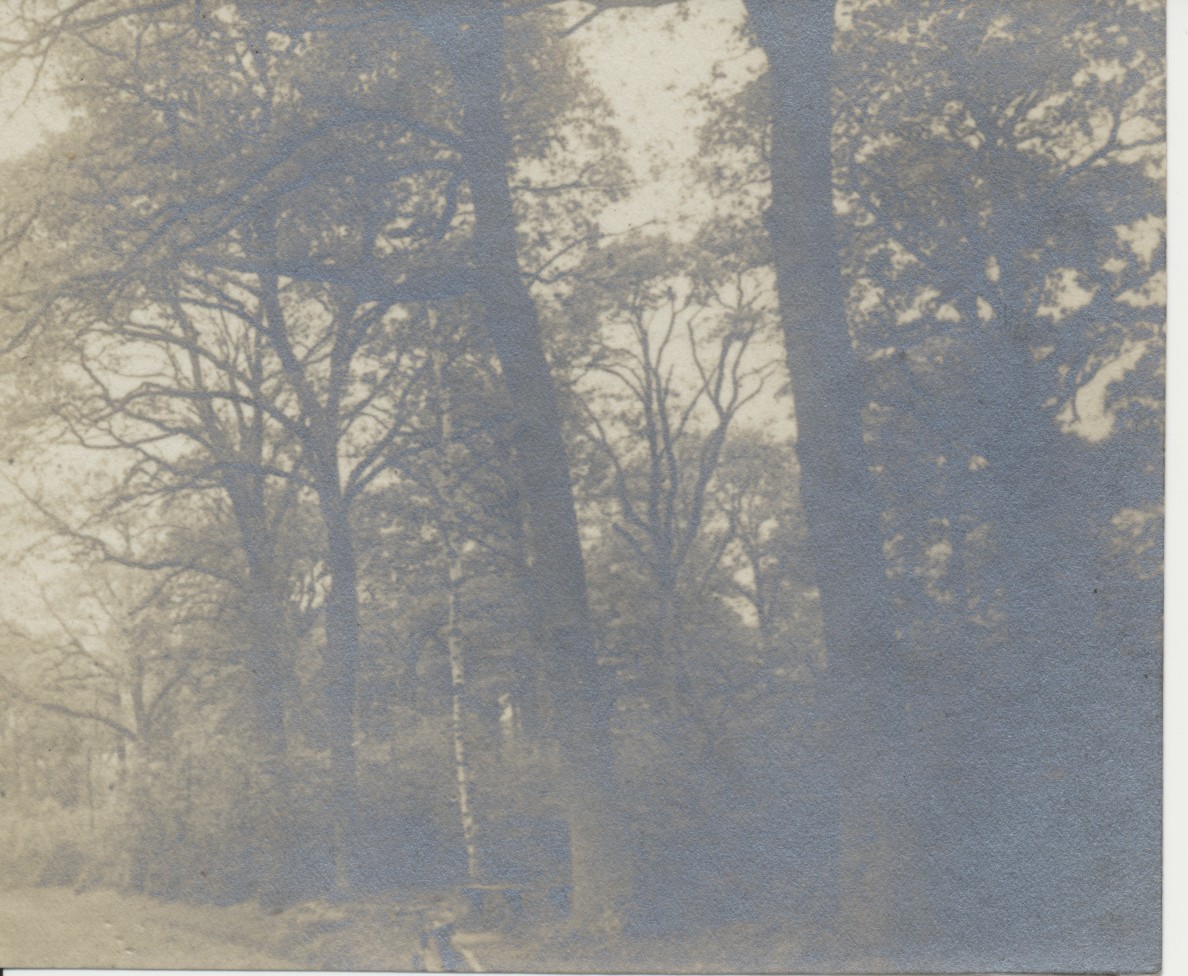
Contained inside the frontispiece are three black & white photos showing a tree lined unpaved road.
Each photo measuring approx. 4 1/2 x 3 1/2 inches.
On the back of each photo is inscribed “Sandal Beat May 14/12”


Also, a flyer for the 1912 Annual Conversazione.

Report of the excavations in Silver Street, Doncaster
Page 1
Doncaster Scientific Society
Annual Statement of Accounts
Session 1905-6
|
Receipts |
£ s d |
Payments |
£ s d |
| Cash in Bank April 1st 1905 Less amount due to treasurer |
16 4 4 |
||
| Stamps |
7 4 0 |
||
| Subscriptions | Printing & stationary | ||
| 1904-5 (16) |
2 16 0 |
Henderson |
3 15 10 |
| 1905-6 (135) |
28 12 6 |
Bisat |
3 7 6 |
| 1906-7 (9) |
1 11 6 |
P. Cant | 6 |
| Note | Lantern |
15 0 |
|
| Subscriptions due but not yet paid | |||
| 1904-5 (7) | Carriage of goods |
1 6 |
|
| 1905-6 (13) | |||
| Marriotts Lecture |
4 19 0 |
||
| Bank Interest 1905 |
5 5 |
Frodingham excursion |
4 10 |
| Conversazione |
6 7 1 |
||
| Hire of room |
1 13 0 |
||
| Subscriptions to other Societies |
1 2 6 |
||
| Cash in Bank 2nd April 1906 less amount due to treasurer |
14 11 5 |
||
|
44 9 9 |
44 9 9 |
Examined J. W. Hainsworth 24/4/06
Page 2
Doncaster Scientific Society
Annual Report 1906
Ladies & Gentlemen
Your committee are pleased to be able once again, to congratulate you on a satisfactory & progressive year.
The field meetings held during the Summer Session were twelve, as follows.
May 25th Thursday. Frodingham
May 27th Saturday. Askern with Sheffield Natural History Society.
June 1st Thursday evening. Wilby & Cantley
June 12th Monday. Rossington, Wadworth & Edlington
June 15th Thursday evening. Conisbro’, Cadbey & Sprotbro’
June 24th Saturday. Conisbro’, Hooton Roberts & Braithwell
July 6th Thursday evening. Balby, Loversal & Edlington
July 13th Thursday. Rossington
July 15th Saturday evening. Balby
July 22nd Saturday. Hampole, Skelbrook, Hampole, etc.
July 29th Saturday evening. Bently & Scawthorpe
Aug Monday. Kirk Smeaton
Although the number of excursions was more than usual, there were no falling off in attendance, the average being just over 16 for all rambles, & averages for different days being –
Bank Holidays – 14.0
Thursday afternoon – 18.5
Thursday evenings – 14.0
Saturday afternoons – 21.6
Saturday evenings – 11.0
The Saturday afternoon averages in increased by the inclusion of 14 visitors from Sheffield at the Askern ramble.
Altogether 40 members have attended one or more of the rambles.
The excursions are greatly enjoyed & during the past year much useful field work resulted from them, especially in the sectors of Zoology and Geology.
The programme for the Winter Session, as usual, had to be somewhat modified, from that originally sent to members. As actually carried out the meeting dates were –
Oct 11th – Presidential Address. “Scientific Societies, their Purpose & Scope” G. H. Greenslade.
Oct 26th – “The Dispersal of Seeds” by H. H. Corbett
Nov 8th – “The Measurement of Illumination” by Mr. Watson
Nov 22nd – “The Wonders of the Telescope by M. W. Whitfield
Dec 13th – “The Solvent Power of Water” by J. M. Wilson
Jan 10th – “Sewage Purification & Disposal” by F. O. Kirby
Jan 24th – Short Essays
Feb 14th – “Some Local Birds” by G. W. Phillips
Feb 28th – “Churches of the District” by H. Culpin
Mar 1st – Conversazione lecture “The Borderland between Plant and Animal Life” by H. Wager
Mar 14th – “Weather Forecasting” by W. Marriott
Mar 28th – “Old Doncaster” by A. Jordan
While many lectures were quite up to the high standard to which tour society has attained, some were disappointing.
The attendance at lectures etc., has been good. The average (exclusive of the Conversazione and Mr. Marriotts Lecture, at which the numbers present were 240 & 120 respectively) being 46.1.
The numerical strength & growth of your society is one of the most satisfactory features of this report. The membership having more than doubled during the last decade. And during the present Societies Year the growth has been greater that before, as the following table shows.
Total membership, end of Session 1904-5 – 140
Total membership, end of Session 1905-6 – 164
New members 1905-6 – 42
Members lost- lapsed 2, resigned 8, left district 8: Total 18
Total number gained during past session 24
The Financial Statement included with this report shows an adverse balance on the years working. This is due to the great loss on the lecture on Weather Forecasting.
In the various Sections of the Society a large amount of useful work has been done, as the leaders reports will show. We should, however, be much pleased to see more done in the future than has been the case in the past.
Archaeology
No report has been furnished by the recorders, but it is worthy of note that a fine Neolithic Celt was obtained at the Frodingham excursion & is now in the museum.
[no record of this excursion appears in the previous minute book]
Botany
There is but little to record in the phanerogamic section of this subject. During the summer excursions some members took note of plants found in flower. Nothing new was recorded except Onobrychis sativa at Cadeby, found by Mr. Culpin. Dr. Selby also discovered a station for Serratula tinctoria, Cryptogamic botany will be included in the microscopy report.
Geology
To local geologists, the year has been an eventful one; the section exposed in the cuttings et., of the Dearne Valley Ry. & the South Yorkshire Joint Ry., having provided fruitful opportunities of observation.
(a) On the Dearne Valley Ry. the cuttings & the excavations for the bridge foundations, going eastward from the Anthracornya Philippi beds at Cadeby have shown
(1) Faulted & cliff-slipped Permian limestone on the north side of the Don.
(2) Sinkings on both sides of the river bed into about 30ft of Carboniferous blue shales, covered in the earth sides by a sandy alluvium about 15ft thick at the top of the slope, & a few inches thick near the river.
(3) Undulations in the marine Permian limestone on the east of the Conisbro’ road, with thin bedded limestone in the Synclines; large masses of perished limestone in thick fissures & sills; and dry valleys with alluvium covering the limestone, in which were found bones of Rhinoceros & an antler of Cervus.
(4) Intermediate Marls & topper limestone near the Warmsworth to Edlington Road.
(5) Bunter Sand in the valley below Alverley.
(6) Intermediate Marls with Gypsum & topper limestone, between St Catherine’s Well & Potteric Carr.
(7) A fringe of Bunter Sand on the slope into Potteric Carr where the Loversal footpath crosses the railway.
(b) On the South Yorkshire Joint Ry., going south & then south west from Sandal junction, there have been exposures of
(1) Bunter Sand near the Barnsley Dun Road.
(2) A remarkable section of finely laminated clay, topped with gravel, & impinging on a bank of Bunter Sand, at Shaw Wood.
(3) Gravels & sand on the south of the Armthorpe road, showing very irregular & reversed current bedding, with occasional sand filled fissures.
(4) Bunter Sand topped with gravel at Rose Hill.
(5) Beds of Boulder Clay near Wadsworth with Magnesian Limestone, & a sprinkling of large Carboniferous Limestone & grit boulders, together with Lake District Ashes(?) etc.
(6) Lake District Erratics have been notified from the neighbourhood of Sandal, Tickhill, & Butterbusk farm near Conisbro’.
Microscopy
The work done in this section during the past session included the enumeration of species of Diatoms found at Askern (in the bog pond) , & at Ilkley during a visit paid by the recorder in September last.
Of those found at Askern, 23 had not been previously recorded for the district & 11 were new to the Doncaster list, published in “The Naturalist” for Nov. 1900. The gathering also contained a form of Fragilaria capucina which was a departure from the normal type. & which is not included in ‘Van Heurch’s Diatomaceae’ [A Treatise on the Diatomaceae 1896 by Henri Ferdinand van Heurck]. Both the Askern & the Ilkley lists are published in “The Naturalist” April 1906.
That very beautiful diatom, Meridion circulare has been met with in abundance at Scawthorpe in a ditch on the south side of the road. It is a fact worthy of note, that most of the localities for this species are on Limestone soil.
An interesting discovery connected with this department was made a few weeks ago by Dr, Corbett. Attached to plants of Ranunculus lenormandi, were numerous brown lenticular shaped bodies, clinging to each other & to the plant by means of hooked procerses(?) round their margins. These eventually proved to be the Statoblasts of Lophopus crystallinus. Aided by the warmth of his aquarium they were soon hatched & we had the pleasure of seeing this most interesting & beautiful Polyzeon in very perfect condition.
This incident affords evidence of how one section may render material aid to another, & it is to be hoped that at the coming summer excursions, members will bear this in mind, & do what they can to help the workers in other departments.
Zoology
In this section I am glad to report, that there has been better work done in Ornithology than has been the case for many years. J. W. Phillips has noted & in many cases photographed breeding sites of Kingfisher, Little Grebe, Black-headed Gull, & many common species.
The discovery of a well established Heronry at Rossington is most interesting, & shows how easy it is to miss auspicious local creatures of nature.
Entomology has had several disciples among our members, Coleoptera being more collected than other orders. Among such an extreme group, new records for the district are frequent. Perhaps the most interesting during the past year was Pleualichus premanus at Edlington. A marked feature of the insect of the past session was the great abundance of hibernated noctual larval during the spring, & the consequent abundance of imagoes during summer.
Those who “sufared” during July must have been struck with the enormous numbers of such species as Tryphaena primula, Aplicta nebulera, Tylophasia monoglypha, etc.
Signed Rob Warson 24/4/07
[page 11]
Doncaster Scientific Society
Annual General Meeting April 25th, 1906
Present Mr. Greenslade (president in the chair & 20 members.
The foregoing Report & Statement of account were read & passed.
The following new members were elected.
Mrs.’s. H. Brundell, P. Brundell, & McKenzie.
The Misses Black, Brundell, Castle, & Eggleshaw.
Messrs. Burdett & Herrenby & the Rev. F. S. Jennings.
The following officers were elected for the year 1906-7
President – Mr. Warson
Vice-Presidents – Messrs. Greenslade & Bisat
Committee – Messrs. Culpin, Grace, & Golledge
Hon Sec & Treasurer – Mr. Corbett
Assistant Sec. – Mrs. Corbett
The recorders for sections were re-elected with the following additions.
Botany – Dr. Selby
Physics – Mr. Gules
Votes of thanks were passed to retiring officers & to Messrs. Bellamy & Sa…. (?) for lantern & reports
[p. 12]
April 30th, 1906
Committee Meeting held at 9 Priory Place
Present – Mr. Stiles in the chair, Mrs. Corbett & Messrs. Bisat, Golledge, Culpin, Jordan, Greenslade, Grace & Corbett.
The minutes of the last committee meeting were read & confirmed.
The summer programme was discussed & the dates & localities of excursions were fixed as per the following list. [no list shown]
It was decided that the programme be made similar to those issued last year.
Signed Rob’ Watson.
[p. 13]
May 22nd, 1906
Committee Meeting held at 9 Priory Place
Present – Mr. Watson, President in the chair, Mrs. Corbett & Messrs. Golledge, Phillips, Grace, Vaughan, & Corbett.
The minutes of the last committee meeting were read & confirmed.
It was proposed by Mr. Corbett, seconded by Mr. Golledge & carried mem con
“That such geological maps as the geological section requires, be purchased to the value of thirty shillings.”
Signed H Culpin.
June 18th, 1906
Committee Meeting held at 9 Priory Place
Present – Mr. Culpin in the chair, Messrs. Jordan, Bisat, Grace, Cuttriss, Stiles & Corbett.
The minutes of the last committee meeting were read & confirmed.
A complaint having been made with regard to the bad manners of members at excursions & Mr. Stiles having offered to interview the delinquent. He (Mr. Stiles) was thanked for his offer & requested to tender the current year’s subscription to the undesirable member & ask him to resign his membership.
[p. 14]
Mr. Stiles was asked to write to the Leeds University for further information about University Extension Lectures.
Signed Rob’ Watson.
July 17th, 1906
Committee Meeting held at 9 Priory Place
Present – Mr. Watson, President in the chair, Mrs. Corbett & Messrs. Grace, Culpin, Golledge, & Corbett.
The minutes of the last committee meeting were read & confirmed.
The following names were prosed for membership.
Miss Sheppard, Messrs. Laughton & Wood.
Signed M. H. Stiles.za
July 20th, 1906
Committee Meeting held at 9 Priory Place
Present – Mr. Stiles in the chair, Mrs. Corbett & Messrs. Golledge, Phillips, Bisat, Grace, Culpin, & Corbett.
The minutes of the last committee meeting were read & confirmed.
It was resolved that the Scrooby excursion stand.
Winter Session
It was suggested that a recorder from each section be asked to take one evening in the following winter programme, with subjects relating to their sections & of local interest.
[p. 15]
University Extension Lectures.
Proposed by Mrs. Corbett, seconded by Mr. Stiles.
That the matter be postponed for a year.
Signed Rob’ Watson 4 September ‘06
Sept. 4th, 1906
Committee Meeting held at 9 Priory Place
Present – Mr. Watson, President in the chair, Mrs. Corbett & Messrs. Golledge, Phillips, Vaughan, Cuttriss, Stiles & Corbett.
The minutes of the last committee meeting were read & confirmed.
Winter Programme
It was suggested that Recorders of sections should undertake to give papers or lectures on subjects connected with their departments. The following offered their services in this connection.
Physics – Mr. Watson
Zoology – Mr. Corbett
Microscopy – Mr. Stiles
It was resolved that Geology be asked for from either Mr. Culpin or Mr. Grace & Photography from Mr. F. A. Jordan.
[p. 16]
The Barnsley Naturalists’ Society having asked for an exchange of lecturers, it was resolved that Mr. Whitaker be asked to lecture here & that the Society endeavor to send a lecturer to Barnsley
The date of meetings for the session were fixed as follows.
Oct 10, Nov 14, 28, Dec 12, Jan 9, 23, Feb 13, 27, Mar 13, 27, April 10, 24.
Subject to the substitution of a convenient Thursday for the Conversazione.
It was resolved that a Y.N. U. lecture be arranged, Mr. Cash to be the lecturer if obtainable.
That the second “Shirt Essay” evening be given to the ladies.
That papers or lectures be asked for from some of the following members, to fill the vacant dates, viz Dr. McLean, Mr. Thomas, Mr. Bingham, Mr. Burdett, Thos Vaughan, .. Rayner.
Signed Rob’ Watson 2 Oct 06
[p.17]
Oct 2nd, 1906
Committee Meeting held at 9 Priory Place
Present – Mr. Watson, (President) in the chair, Mrs. Corbett & Messrs. Bisat, Golledge, Vaughan, Phillipos, Stiles, Cuttriss & Corbett.
The minutes of the last committee meeting were read & confirmed.
The Hon. Sec. having stated that the County Court Room was not available for the societies meeting on Oct 24th, It was resolved that he be empowered to arrange to hire any convenient room that could be obtained.
It was resolved that Mr. S. Bagshaw be engaged as lanternist for the session.
[p. 18]
Winter Session 1906-7
Oct 10th, 1906
The first meeting of the session was held in the County Court Room, Guild Hall, on Wednesday October 10th, 1906
Present – Mr. Watson (President) in the chair and 53 members & visitors.
Sectional Reports.
Botany
The recorder drew attention to the great number of flowering plants that are till at this late season, in flower. At Medge Hall on the 4th inst. he had seen 64 spp.
Zoology
Mr. Phillips recorded the discovery of a heronry at Rossington.
Mr. Corbett recorded the very rare & doubtfully mature beetle Carpophilus sexpustulatus from Edlington Wood (E.G.B.) & Sandal Bear (H.H.C.)
Mr. Waton delivered his Presidential Address of which the following report is taken from the Doncaster Gazette (19.10.06)
“Doncaster Weather” and Health
Some interesting information.
At the opening of the Doncaster Scientific Society’s winter session last week, Mr. R. Watson delivered his Presidential Address and presented an interesting paper on local meteorology.
During his general remarks dealing with the ramifications of the Society, the President regretted that the science of chemistry did not seem to be much in favour with the general student, seeing what a very important part it played in almost every industry.
Here, in the Doncaster Technical School, some provision was made for instruction in chemistry – elementary it might be; nevertheless, useful as a start. There had been, however, very little response on the part of the students. He gathered that last year the average attendance at the chemical class was six 0 so small a number that it had been considered advisable to drop the class, and this winter the prospectus contained nothing that might afford the faintest notion that such a subject as chemistry existed.
It was deplorable, and one could not but wish on behalf of this Society, which knew something of the value of chemistry, that it would draw public attention to the small degree of encouragement given to the work of the Technical Instruction Committee and the Principal in this connection.
Chemistry might be considered dry, and it certainly required much study and work, but troublesome or not, the economic value of the science made it worth the while of technological students to include at least the elements of the science, with perhaps a little physics, in the programme of their studies.
Coming to the subject proper – local meteorology – the President said that, as they were all aware, the physical conditions which produced “weather” were not, as yet, thoroughly understood. While the main causes of the movement of air, the evaporation of water, the formation of cloud, and the downfall of rain were not unknown, the full influence of solar heat, and the precise physical effect of land and water had still to be determined before any definite rules could be formulated for the guidance of weather prophets.
Sufficient success had been achieved in the ordinary way to enable the Meteorological Council to issue tolerably correct forecasts of weather 24 hours in advance, and if these were not uniformly correct, the meteorologists were not so much to blame as the insufficient information with which they had to work. Comprehensive data could be obtained only from a large number of stations of observation, and with some of these permanently placed in mid-Atlantic. The percentage of successful forecasts during the year 1905 was as high as 83, of which 56 per cent were complete.
For the North East of England, which includes the Doncaster locality, the per centage was as high as 92, 55 being complete successes and 33 partial.
Apart from the difficulty of determining the exact course a cyclone, or other disturbance, would take in passing over the country, forecasts might obviously be upset for any particular place by the mere irregularity of the surface of the ground, and in the district known as the North East of England (running from the Cheviots to the West) was ample room for variation. That variations did exist, and in comparatively small areas too, could be noted in a single contrast.
Take, for example, York, Doncaster and Lincoln. The rainfall during June last was respectively 1.37 inches falling in 14 days, 2.02 inches in 11 days, and 1.92 inches in 9 days. The subject, continued the speaker, had its utilitarian side, and might, too, have possibilities beyond present thought.
The observation of meteorological surveys as to degrees of change of temperature and barometric pressure of wind and rain and humidity, had a useful application in our knowledge of life and health, and the production and cultivation of foods and the like.
He had lately been devoting a little attention to some records of the weather and which this town of Doncaster was blessed. He assumed it was blessed, for Miller in his “History of Doncaster,” published in the year 1804, said that the climate of the town was “generally speaking, more temperate and equal than that of most other parts of the land” – indeed, he went further, and said “For the greater part of the year the people I no part of the world can experience more comfort or be more happily situated than the inhabitants of this district.” After dealing in an interesting manner with wind and rainfall, Mr. Watson went on to say: “Humidity has an important bearing on the question of health and upon one’s physical feeling generally. I should have been glad to include figures of the relative humidity of the Doncaster district but unfortunately have not been able to get sufficient data.
Some slight reference to a few observations, however, may be of interest. Let me first say that moisture in the air is always necessary. As Professor Tyndal said years ago, the removal of vapour from the air for a single summer night would mean the destruction of every plant by frost, and its permanent removal would be followed by a glacial period. At the same time one can have too much of a good thing.
The whole question is one of relation. The extremes of moisture are inconvenient, and one prefers a decided tendency to climate dryness. An excessive amount of moisture tends to check perspiration, enervates the system, and produces depression of spirits. It is said, too, that air saturated with aqueous vapour at 60 degrees Fahrenheit, contains 2 per cent, by bulk of water, and reduces the percentages of atmospheric oxygen by 0.4 per cent, so lessening the proportion of the very necessary principle of life.
I have said that it has been difficult to get figures of the relative humidity of the Doncaster district, but as I have already referred to York and Lincoln for the month of June, it may be useful to mention that the average per centage of humidity for these two places was respectfully 77 per cent. And 82 per cent., the rainfall being 1.37 and 2.02 for that month. I believe anything from 53 to 72 per cent. may be considered agreeable.
Some three or four years back, having then recently removed from Lee Valley to this town, I was curious enough to test the relative humidity of the two places, andhad 8 days’ observations taken during the month of August, 1903. The average of the 8 days was, for Doncaster, 72 per cent. of moisture, and that for the Lee Valley 87 per cent. – showing that this district for the week in question, at any rate, was blessed with some 11 ¼ per cent. less moisture than that in which I had previously been living. I had been led to expect this from my physical feelings.
Notwithstanding this fact, complaints are frequently made of the relaxing effect of Doncaster air in the summer, although probably the comparison is made with that of higher ground, such as the Derbyshire and Yorkshire moors, the whole question being one of relation. Sooner or later we shall get better understanding of the laws governing climatic conditions, and our prognostications should, by degrees, be more exact.
We, at any rate, are getting past the time when forecasts could be spoken of as the Danes spoke of the almanacs – “Man makes the almanacs, but God the weather.”
In the subsequent discussion, the Rev. H. Thomas, Mr. G. Greenslade, Dr. Corbett, Mr. Cuttriss, Mr. Golledge, Mrs. Golledge, Mr. Plant, and Mr. Vaughan took part.
End of cutting
A vote of thanks to the lecturer was carried mem. con. on the proposition of Mr. Greenslade.
Signed Rob Watson
Oct 24th, 1906
An Ordinary Meeting of the Society was held at the New Science Room, Guild Hall, on Wednesday October 24th, 1906
Present – Mr. Watson (President) in the chair and about 100 members and visitors.
The minutes of the last meeting were read & confirmed.
Sectional Reports
Geology
Mr. Culpin showed some characteristic zonal fossils from the Carboniferous Limestone of (blank)
The specimens exhibited were (blank)
Mr. Whittaker of Barnsley delivered a lecture on “Bats, their Structure & Senses.”
After describing the skeletal & external anatomy of bats, the lecturer described numerous original experiments that he had conducted with a view to show which of the five senses were the more important to the bats. The general result was that Tactile Sense far overshadows all the others in these animals. Sight being only of little importance.
Many photo-lantern slides in illustration of the lecture were shown, & specimens of all the different species of bats, known to inhabit Yorkshire were exhibited besides some from other parts of England.
After some discussion by Messrs. Greenslade, Evans, & Watson, a vote of thanks was carried mem. con. To the lecturer.
Committee Meeting at the same date & place as the above.
Present – Messrs. Watson, Culpin, Greenslade, Golledge, Stiles, Cuyyriss, Corbett & Mrs. Corbett
The following nominations for membership were passed.
Misses. Davis, Linch, Sothern, & Williams, Messrs. Jaques & Hansen.
Signed Rob. Watson
Nov. 14th, 1906
An Ordinary Meeting of the Society was held in the New Science Room, Guild Hall, on Wednesday Nov. 14th.
Present – Mr. Watson (President) in the chair & 50 members & visitors.
The minutes of the last meeting were read & confirmed.
The following new members were elected.
Viz, Misses Davies & Messrs. Jaques & Hanson
A letter from the Town Clerk. Announcing that the Society were granted the use of the Mansion House for the Annual Conversazione on Jan 24th, 1907, was read.
Sectional Reports
Geology
Mr. Culpin drew attention to the good exposures of the Upper Permian Marls to be seen on the new railway near Tickhill.
The Revd. H. Thomas delivered a lecture on “The Giant Causeway & the Basalts of Antrim.”
The following report is from “The Gazette”
[a newspaper cutting is pasted into the minute book at this point]
Doncaster Scientific Society
On Wednesday evening the Rev. H. Thomas, Doncaster, delivered a lecture on the Giant’s Causeway and the Basalts of Antrim,” to the members of the Doncaster Scientific Society, in the new science room at the Guild Hall.
The lecturer dealt with the geology and scenery of that district in a very thorough and interesting manner. Volcanic rocks, said the lecturer, spread over eleven twelfths of Antrim. Near Shanes Castle were basalt columns of lignite. The lecture was illustrated with lantern views, showing the beautiful scenery and regular formation of rocks in different parts of the country. Shanes Castle, Garron Tower, Giant’s Causeway near the shore, Lord Antrim’s Parlour, the Wishing Chair, Giants Well, and Dunmore Castle were some of the views; and scenery in other parts of Ireland, including Connemara, Warren Point, County Down, Cathedral at Londonderry, mountains in Donegal, Glencar waterfall near Sligo, King John’s Castle, Liberty Stone, Limerick, were also shown.
From Larne to Ballycastle was a beautiful country to cycle over. He advised tourists to keep near the coast. The scenery was very beautiful when they could get to see it, but when he was there it rained three days out of four.
Mr. Culpin said they did not need to go far out of South Yorkshire to find volcanic rocks. Very fine examples of volcanic rocks were to be found in Derbyshire, but he did not think there was anything there comparable to the Giant’s Causeway. Dr. Corbett, the president, and others joined in the discussion as to how the columns had been formed. The lecturer was most heartily thanked for his instructive and interesting lecture.
[end of cutting]
Signed Rob. Watson
Nov. 28th, 1906
An Ordinary Meeting of the Society was held in the New Science Room, Guild Hall, on Wednesday Nov. 28th.
Present – Mr. Watson (President) in the chair & 50 members & visitors.
The minutes of the last meeting were read & confirmed.
Sectional Reports
Geology
Mr. Culpin recorded the finding of a Boulder of Carboniferous Limestone near Tickhill, which contained some interesting Brachiopods, These have been named by (blank) Hind & the locality of the boulder is referred, by him to the neighbourhood of Harrogate.
Zoology
Mr. Corbett exhibited some (illegible) from the greenhouse at Beechfield, where they were abundant. The species was not determined.
Museum
Mr. Moor reported that a collection of shells had been deposited in the museum, the loan of Mrs. H. Brundell
The Rev’d. H. Thomas introduced a discussion, arising from some remarks on his lecture delivered at the last meeting, on the nature of ligaits(?)
The following new member was elected.
Miss Ponting
Dr. McLean delivered a lecture on “The Origin, Objects & Pleasures of Science.”
The annexed report is from “The Gazette”
[a newspaper cutting is pasted into the minute book at this point]
Doncaster Scientific Society
An ordinary meeting of this society was held in the New Science Room, Guild Hall, on Wednesday of last week, when a lecture was delivered by Mr. C. J. R. McLean, M.D., etc. on “The origin, objects, and pleasures of Science.”
The lecturer said science began after the creation, and scientific knowledge increased more rapidly after the fall of man. By the varieties in mode of building, clothing, and mode of transport from place to place, they were able to trace man’s history; man’s advances could be traced from the earliest times. Man and man alone had the power of arranging his ideas. Science, especially during the last few years, had made rapid progress. There was an advantage in acquiring knowledge, both for its usefulness and its own sake.
When they saw a new machine, they wished to know something more about it, as to how it was made, its uses, etc. Some of the more important branches of philosophy required a great deal of time. The lecturer then drew attention to the blackboard, on which were shown, in diagram form, the different sciences arranged in three groups – mathematics, arithmetic, and geometry were at the head of the list.
Arithmetic, he said, was perhaps one of the oldest and most useful, and said to be one of the most simple of sciences. With that, however, he could hardly agree. The Arabs first brought a knowledge of this science to Europe. Algebra was particularly useful to astronomers. Natural philosophy treated of the properties of existing substances, and was learnt by observation and experiment, and not discovered by means of reason.
Natural philosophy consisted of two great branches – mechanical and non-mechanical. Chemistry, anatomy, medicine and surgery, zoology, bacteriology, and many other sciences could be mentioned, many of which ran into one another. Education, experiment, and experience were necessary for success. Nature very often gave the best possible lessons in science, taking for example the regular hexagonal cells made by the bees in their honeycombs.
The strength and lightness of tubular bodies was probably first learned from noticing bones of animals and hollow quills in the feathers of birds. What pleasure was given to many people in the elementary studies of plants, in watching the development of buds, in noticing the opening and closing of flowers! How useful was a knowledge of botany to the traveller! Many of the families of plants were of great service to man. There was no doubt large sums of money had been wasted in searching for coal where no coal existed. Here the science of geology was useful. Bacteriology was one of the more modern sciences. Tubes showing bacteria (dead), were exhibited to the members. The pleasures of science could make their lives more agreeable and better.
Discussion followed, in which the President, Dr. Corbett, Messrs. Thomas, Culpin, Stiles, and others joined. A vote of thanks was proposed to the lecturer by Dr. Corbett, seconded by Mr. Stiles and carried unanimously.
[end of cutting]
Signed Rob’ Watson
Nov 28th, 1906
Committee Meeting
The following nominations were passed.
Messrs., Brewer, Nicholson, M.P., & Winter.
Signed Rob’ Watson
Dec 12th, 1906
An Ordinary Meeting of the Society was held at the New Science Room, Guild Hall, on Wednesday 12.12.06
Present – Mr. Watson (President) in the chair & 50 members & visitors.
The minutes of the last meeting were read & confirmed
The following new members were elected.
Viz Messrs. Brewer, Nicholson, M.P., & W. Nicholson
The evening was devoted to short essays, & perhaps it shows which section of the society is the most active at present; all the essays read, being on Geological subjects.
Mr. W. S. Bisat read a very interesting pap[er on ‘The Fossil Fauna of Magnesian Limestone’.
Firstly, having described the local development & characteristics of the Permian rocks, he proceeded to describe the great advance that has been made during the last few years in our knowledge of the fossils in them. These are found chiefly in two zones. One at the base of Lower & the other at the top of the Upper Limestone.
The lower bed is much richer in species & is exposed in many quarries & cuttings. One of the newest beds heretofore exposed is in the coal sinking at Brodsworth. Specimens illustrating Nupaper(?) were shown from the Brodsworth pit & other places. The species included
Gasteropoda Trula helicusses (?),
Lamiellibranchiata – Mytilus striatin, Balkurdlia, Schyodus dubius
Brachopoda. Terebratula elongata, Boductus horudus
Bryozoa
From the upper fossil bed only about 58spp have been obtained, & these seem to be all present also in the lower bed.
Mr. Corbett followed with a paper on “The Lowest Permian beds in the Ashfield Brickworks, Conisbro’”
After drawing attention to the evidence of greatly altered condition prevailing when the Carboniferous & Permian Rocks were laid down: the essayist described a bed of gravel & sand at the base of the Permian. The bed is divisible into 3 portions, being from below upwards.
1st course gravel & sand3’
2nd Fine sand 4”
3rd course sand & gravel
The contained pebbles in the gravels seem to be all derived from Millstone Grit & Lower Coal Measures. The smaller sandy portion being rounded quartz, wind blown. The fine sand is also wind blown & contains a large quantity of very minute acicular crystals of felspar?
He could offer no suggestion to account for the presence of this mineral in a blown sand deposit.
The discussion on the above two papers was taken together. In this Messrs. Culpin, Greenslade, Stiles, & Watson took part & Mr. Bisat was much congratulated on his first essay.
The third essay was by Mr. Golledge on “Ten minutes with a piece of coal.”
The essayist described how he had first been attracted to the study of Geology by seeing a bit of fossil plant in the coal in his cellar. He then described the process of the formation of coal & the vegetable remains to be found in it. Some instructive diagrams being used for this paper.
A very interesting discussion followed the reading of this paper, in which Mrs. Golledge & Messrs. Thomas, Culpin, Ferguson, Greenslade, Corbett & Watson took part.
The forth essay was by Mr. Stiles & was entitled “A geological Surprise.”
The surprise was a very abundant deposit of stalactite salt NaCl which accumulates on the roofs of some of the buildings (????) roof at the South Kirby Colliery. Mr. Stiles showed chemical experiments to estimate the purity of the deposit & had prepared a good sample of “table salt” from it. This was exhibited as also was the new material.
The subject which was of much interest geologically though probably not commercially should have aroused more discussion had it not been almost crowded out by the previous essays & discussions.
Miss Cook & Messrs. Culpin & Corbett spoke to the essay.
Votes of thanks to all essayists concluded a very interesting evening.
Signed Rob’ Watson 9/1/07
Jan 2nd, 1907
Committee Meeting held at 9 Priory Place
Present – Mr. Watson (President) in the chair, Mrs. Corbett & Messrs. Golledge, Cuttriss, Stiles, & Corbett.
The minutes of the last meeting were read & confirmed.
The arrangement for the forthcoming soiree were discussed, & it was proposed
That the committee compile lists of persons likely to be interested in the soiree & send to the secretary.
That Mr. Stiles arranges for a rehearsal of the microscopic show.
That the press men be asked to come early, that they may be shown round.
That the President receive guests from 7 – 8
That the lecture be of 45 minutes duration.
That Mr. Sheppard be asked to lecture on “The Romans in the Humber District.”
It was suggested by the President, that local antiquities be made a special show & that a letter asking for contributions be inserted in the Chronicle & the Gazette.
Mr. Greenslade offered a collection of Marine shells & an exhibition of the art of glass blowing.
Mr. Watson offered a series of manuals from Peat to Anthracite.
The case of Cryptic etc. …. In insects to be exhibited
Lantern slides to be shown as last year.
Mr. Stiles offered to obtain, if possible, 3 color(?) photography from the Rolograph Co.
An exhibition of Meteorological Instruments to be obtained from Messrs. Reynolds & Branson.
Mr. Raynor to be seen re. electric exhibit.
Mr. Culpin to be seen re. lilor sewing machine.
A notice to be sent to all members whose subscriptions are due, telling them that they must pay in order to get soiree tickets.
The following to be added to the Soiree Committee.
Misses Nodes, Cook, Davis, Mrs. McKenzie & Mr. Raynor
Jan 7th, 1907
A Meeting of the Soiree Committee was held at 9 Priory Place
Present – Mr. Watson (President) in the chair & Mmes. Grace, Cuttriss, Corbett, Miss Woodhouse, Messrs. Golledge, Bisat, Culpin, Vaughan, Stiles, Grace, & Corbett.
It was reported that Mr. Greenslade had secured the glass blowing exhibit.
That Mr. W. Roberts had promised some lantern slides.
Mr. W. S. Bisat was added to the committee
It was resolved that if Mr. Sheppard cannot lecture, Dr. Woodhead be asked.
Signed Rob’ Watson 16/1/07
Jan 16th, 1907
A Meeting of the Soiree Committee was held at 9 Priory Place
Present – Mr. Watson (President) in the chair & Mmes. Culpin, Corbett, Misses Cook, Davis, Woodhouse, & Messrs. Golledge, Moor, Phillips, Culpin, Bisat, Bisat, Jordan, Stiles, & Corbett.
The minutes of the last meeting were read & confirmed.
The final arrangements for the soiree were discussed & the Cremation D….(?) Tiellet(?) accepted & the China from Tickhill refused.
Signed Rob’ Watson 4/2/07
Jan 9th, 1907
An Ordinary Meeting of the Society was held at the New Science Room, Guild Hall, on Wednesday Jan 9th, 1907
Present – Mr. Watson (President) in the chair & 35 members & visitors.
The minutes of the last meeting were read & confirmed
Sectional Reports
Archaeology
The secretary drew the attention of the archaeological section to the old plays that are acted every Christmas & 29th of May at Wadworth & suggested that reports or photographs should be obtained.
Zoology
The recorder reported finding a mollusk (…?) in the greenhouses at Beechfield, & which was unknown to him.
Mr. Cash of Halifax delivered a Y.N.U. Lecture on “The Fossil Plants of the Yorkshire Coalfield.”
The lecture was profusely illustrated by lantern slides, these being photographs of actual specimens of fossil plants. Many of them, from the famous “Halifax Hard Bed” showed the minute internal structure of the plants as well as if they were freshly cut sections.
The lecturer explained how useful these fossils were in showing the phylogeny of some of our recent plants. At the same time he warned students of the subject against the fault of naming new or supposed new species from insufficient material. Before the true relationship of these ancient plants could be made out much care was required in comparing specimine with specimine, in order to avoid the frequent error on naming a distinct species etc. what were really only different parts, or states of the same plant. He also laid stress on the importance of collecting all available fossils & keeping exact records of the horizon whence they came.
These should be submitted to some authority in Paleobotany e.g. Mr. Jidson, & from them very important results might accrue.
Messrs. Watson, Culpin, & Corbett took part in the subsequent discussion.
A vote of thanks to the lecturer was carried mem. con.
Signed Rob’ Watson 13/2/07
Feb 4th, 1907
Committee Meeting held at 9 Priory Place
The following nominations were passed.
Miss Butler, Messrs. Bunting, Davis, Corbett, Shaw, Stiles, Wright, Winter & Whitaker.
Signed G. H. Greenslade 25-3-07
Feb 13th, 1907
An Ordinary Meeting of the Society was held at the New Science Room, Guild Hall, on Wednesday Feb 13th, 1907
Present – Mr. Watson (President) in the chair & 35 members & visitors.
The minutes of the last meeting were read & confirmed
The following new members were elected.
Ordinary Members
Miss Butler, Messrs. Bunting, Revd. Davis, H. V. Corbett, Shaw, H. W. Stiles, Wright & A. E. Winter
Honorary Members
Messrs. Crossland, Bayford, Kindall, Porritt, Sheppard, & Taylor
Mr. Culpin delivered a lecture on “Local Rocks recently exposed” of which the following report from “The Doncaster Chronicle” is taken.
As this printed report shows the lecture was very instructive & was greatly appreciated by the geological members present.
In the discussion that followed Messrs. Watson, Corbett, Stiles & Jordan joined.
A vote of thanks to the lecturer was unanimously carries on the proposition of Mr. Watson, seconded by Mr. Greenslade.
Signed G. H. Greenslade
[an extensive newspaper cutting, which covered four pages on the minute book, was passed into the minute book at this point]
Doncaster Scientific Society
Interesting Paper by Mr. H. Culpin.
A Survey of the District.
A meeting of the members of the Doncaster Scientific Society was held in the Science Room, in the Guild Hall Yard, on Wednesday in the last week, when there was a large attendance to hear a lecture by Mr. H. Culpin upon the Local Rocks recently exposed, which proved to be of absorbing interest, and at the same time demonstrated beyond doubt that Mr. Culpin has devoted much time and trouble in the prosecuting of scientific research in the immediate locality. He has already an enviable reputation in the Society as a member of great promise, and his lucubration’s upon a subject so immediately associated with the products with which the district abounds could not fail to be a great attraction.
In introducing the subject, Mr. Culpin said : Doncaster geologists have been favoured during the last two years with exceptional facilities for studying the local rocks. Fresh sections have been made within easy reach of the town by cuttings on the new railways, and these have been supplemented by the colliery sinkings at Bentley and Brodsworth.
There have been two striking discoveries, one of which has taken place in the oldest rocks of the district, and the other in the most recent rocks. At Cadeby proofs, the first undoubted proofs, have been obtained of the existence of the existence of Upper Coal Measures in Yorkshire. At Tickhill and at Bentley, evidences have been found of an unexpected extension of the ice-sheets to which our local glacial deposits are due.
But it is not only in the Coal Measures and the glacial debris that the new railway and collieries have been of assistance. They have also furthered a closer examination of the relations of the coal measures to the Permian rocks above them. They have provided fresh sections of the beds immediately overlying the Permian. They have shown where the Bunter or variegated sands of the Triassic period occupy a valley in the Permian rocks, and they have given indications elsewhere of the subsequent removal of those sands.
Light has been thrown on the gravels which cover a great part of the Triassic area east of the town; and the position of the Sandall clay with regard to the Trias, and to the glacial material scattered here and there on the surface of the Trias, has been clearly demonstrated.
If we had before us a geological model of England, it would be seen that the oldest rocks – the Cambrian, Silurian, and the Devonian – are on the west, in the Lake District, in Wales, and in Devon and Cornwall. The newest rocks are on the east and south-east. Down the centre run the Carboniferous rocks, consisting of the Mountain Limestone, the Millstone grit and the Coal Measures.
These are very much faulted and broken. And have undergone great denudation since their upheaval. In these respects, they are very different from the later rocks, which are comparatively so little faulted and disturbed that a Lincolnshire geologist look upon a displacement of a few feet as a rarity. Contrast with such slight dislocations, the southerly Don fault which extends from Sheffield as far as, and probably beyond, Cusworth Park. At Cadeby this fault, which is only one of a series of faults in the Don Valley, shows a vertical movement of 750 feet.
Lying on both sides of the Carboniferous rocks are the Permian and the Triassic series. The Permian rocks on the east side consist chiefly of the Magnesian Limestone familiar to us all in the Warmsworth Cliffs and on Hexthorpe Flatts. Above these are the Bunter sands of the Trias on which Doncaster is built.
Our geological model is one which can be stripped by taking off the newer rocks. Before doing this we observe that the Pennine Range stands out as a long wide north and south ridge, and that as we pass from ridge eastwards, the older rocks dip or slope below the newer ones, so that we cross, after leaving the Mountain Limestone, first the Millstone Grit, then the Coal Measures, then the Permian Limestone, next the Trias, and so on over the Lias, the Oolites, and the Chalk.
Going Southwards from Doncaster, we get a similar experience. The outcrop, or appearance, of the rocks at the surface runs in a south-westerly direction from Yorkshire, and consequently when traveling from Leeds to London by the Great Northern railway the whole series is crossed from the Coal Measures to the Chalk, beyond which the Eocene of the London Basin is entered.
On stripping the newer rocks from the model, we find as we approach the underlying Coal Measures that an east to west ridge runs through Market Weighton, about ten miles north of the Humber, and abuts on the Pennine ridge north of Leeds and Bradford. On the South, a north-west to south-east ridge, known as the Charnian axis, tuns from the south of the Pennines through Charnwood Forest.
In the neighbourhood of Louth, not far from Lincolnshire Coast, there are indications of a less marked ridge running north and south. These various ridges surround a basin, of which the Pennines are the western rim, the Market Weighton ridge the northern rim, the Charnian axis the south=eastern rim, and the Louth ridge the eastern rim. The Yorkshire and Derbyshire Coalfield lie in the western part of tis area, and the interest in our local geological work during the last few years has been intensified by its bearing on the character of the Coal Measures below the more recent rocks to the east.
In the masterly report on the concealed portion of the Coalfield of Yorkshire, Derbyshire and Nottinghamshire, which Professor Kindall, of the University of Leeds, prepared for the Coal Commission, the conclusion suggested was that the Coalfield extended eastward to the neighbourhood of Louth, and south-eastwards into Cambridgeshire. Professor Kendall think the axis of the coalfield basin lies near Doncaster somewhere between Haxey and Arksey, and that the coal seams, which are getting deeper and deeper as they approach Doncaster from the west, are rising to the surface on the astern side of the district.
He points out that the boring at Haxey proved the Barnsley bed, which is the principal seam I the southern part of the Yorkshire Coalfield, at a depth of 1,454 feet below the base of the Permian, and that the measures were reported as “perfectly flat.” At Arksey, the Barnsley bed was reached at a depth of 1,320 feet higher than at Haxey. At Cadeby, which is on the down throw side of the southerly Don fault, the depth to the Barnsley seam is 2,250 feet, and it is in the Cadeby Cliff, as exposed by a cutting for the Dearne Valley Railway on the north side of the Don, that our most important contribution to the subject was discovered.
For it is there that we found a characteristic fossil of the Upper Coal Measures in the form of a fresh-water snail known as Anthracomya Phillipsi. This occurs plentifully in a thin red layer of ironstone some 30 feet above the top of the Cadeby shaft, and about six feet below the base of the Permian. The depth, therefore, at Cadeby from the Permian base to the Barnsley bed is 2,286 feet, or 966 feet more that at Arksey. The difference is mainly due to the position of the Cadeby shaft on the downthrow side of the great fault, and to the denudation of the top beds of the Coal Measures on the other side of the fault before the Permian rocks were deposited.
If the beds so worn away included the Anthracomya layer, the Middle Coal Measures, which are the most productive of the series, will probably be pierced at workable depths below the newer rocks. If, on the other hand, the Anthracomya series still lie above the Middle Measures, the more productive coal seams mat be at too great a depth to be readily worked.
We are now waiting to see whether this interesting red band will be found in the Bunter sinking. At Brodsworth, where the shaft is well into the Coal Measures, there has been no sign of the red band, but some dark shales at a depth of about 350 feet below the Permian base have yielded specimens of the characteristics shell.
In the chart prepared by Dr. Wheelton Hind and Mr. J. T. Stobbs of the fossil shells found in connection with seams of coal and ironstone in North Staffordshire, this particular fossil is shown above the Bassey mine ironstone is a black band, which Mr. Stobbs tells me has its laminoe crowded with Phillipsi. The matrix of the specimens sent him from Cadeby has a look about it, he says, of the Etruria Marl series. It is interesting to note that the base of the Etruria Marls is some 300 to 450 feet above the Bassey Mine coal, and that the Bassey seam is near the top of the grey or chief coal bearing measures in Staffordshire.
Soon after this fossil band had been seen at Cadeby, Mr. A. Jordan was fortunate enough to find similar shells on the south side of the Don in some grey shales at the bottom of the clay pit at Conisbro’ Brick and Tile Works. In Green’s memoir on the Yorkshire Coalfield, the beds exposed in this pit were referred with some hesitation to the Upper Coal Measures, and it has since been claimed by other experts that the fossils from a plant bed about 25 feet below the base of the Permian, are proofs, not of Upper but of Middle Coal Measures. The occurrence of the Anthracomya Phillipsi at a lower depth now places the point beyond dispute.
The description of this shell, in Dr. Wheelton Hinds’ monograph on the “Carbonicola, Anthracomya, and Naiadites,” is as follows : –
“Specific Characters:
Shell transversely obliquely oval, modioli form, elongated in a diagonal direction. The anterior end is small, its margin rounded. The posterior end is compressed, expanded downwards and backwards, while above it is rapidly compressed into the upper border, which is elevated posteriorly. The hinge line is straight, about one-half the length of the diagonal of the shell. The ventral margin is convex, passing with a gentle curve into the anterior end, and becoming straight shortly before it reaches the posterior end. The umbones are anterior and directed forwards, very blunt and gibbose, the beaks themselves inconspicuous. The shell itself is fairly tumid, and the valves are gibbose. There is no sign of an oblique constriction anterior to the gibbosity, which is itself very gradual in its form. Behind the gibbosity the valves are so rapidly compressed as to become hollow on the posterior slope.
Interior : As far as can be seen,” from the type specimen, “ which is a cast, the interior is normal, but the anterior adductor scars are not seen owing to damage to the specimen.
Exterior : The surface is covered by fine and course striae and lines of growth, which have the general arrangement which obtains in this genus. Periostracum thick and wrinkled.
Dimensions : The type specimen measures greatest diagonal, 20 m.m.; greatest dorso-ventral, 12 m.m.”
The way in which this fossil seems to have thrust itself under our notice since we first met with it at Cadeby is remarkable. Remember, please, that it had not been previously known as occurring in Yorkshire. Yet soon after it had been discovered in the railway cutting, next at the Brick and Tile Works, and then in the core of a boring near the Red House, Mr. Grace found it in some grey boulders which were turned out at Bentley: and it has since been seen in some grey rocks from the Balby boulder clay. These two latter finds show that it is somehow in situ in grey matrix in the course taken by our glacial debris. Within the last month it has been found, as previously stated, in the Brodsworth sinking in a dark shale about 350 feet below the base of the Permian.
The Coal Measures in the Cadeby cutting have an apparent dip or slope of 7 degrees to the south-east. The dip of the Permian beds above them is a trifle less. The fossiliferous layers characteristic of the of the lowest beds of the Permian limestone in this district are found at Cadeby about 8 ½ feet above the base, which consists in that section of 4 ¾ feet red and grey sandstone, ¾ feet grey sandstone, and 3 feet yellow sandy limestone. Some 40 feet higher, with pink and grey limestone intervening, are fossiliferous beds similar to those in Edlington Wood.
It is instructive to compare this section with Green’s record of the Permian base in the Conisbro’ claypit. What he saw was 2 feet very pale grey marl and shale, with a sandy micaceous bed, then 2 inches of yellow sandy limestone, above which was 1 foot 7 inches of marls, and then another inch of limestone. As recently measured, at a point further back than seen by Green, the clay pit shows 4 feet pink and grey sand with irregular beds containing small pebbles and bits of clay, above which is 18 inches of red, grey and blue clay, followed by 18 inches of yellow sandy limestone. Then there is 16 feet of grey shales surmounted by 11 feet of limestone, the top of which is fossiliferous.
In the Brodsworth sinking, the Permian base was a highly fossiliferous grey limestone. At Watchly Crag, between Hickleton and Hooton Pagnell, the Permian base is a quicksand exceeding 17 feet in thickness. These particulars, which have been obtained within an area of eight square miles, show considerable variations in the Permian base, and suggest that at the time of its formation the floor was shallow and undulating, and probably faulted, and that some of the early muds and sands were washed away before the limestone was deposited. At Brodsworth there is no sand or shale, at Watchly Crag and at Cadeby there is sand and no shale, whereas at Conisbro’ there are the sands, then shale and limestone, and above the first limestone some 16 feet of evenly bedded shales.
On the south side of the don, which is crossed by an impressive viaduct, the Dearne Valley line cuts deeply into the limestone below the Conisbro’ road, and within the next half mile it shows two noteworthy features. One of these is some thin-bedded limestone in troughs at the top of the massive rock. The lower limestone in the Doncaster district is typically massive, whereas the upper limestone, separated from the lower by the middle marls, is usually thin-bedded. In this section, however, some of the lower limestones show the thin-bedding characteristics of the upper limestone. These thin beds in wedge-like patches within troughs in the surface of the massive rock, and they pass into the thin beds forming ridges on either side. The whole section is bent in gentle curves in various directions, and the thin bedding in the troughs is probably due to bending, just as a many ply cardboard when bent to and fro may split into thin layers at the acute part of the bend.
The other special feature is a large mass of pulverulent or friable limestone. Small quantities of such material are a common feature in the Magnesian Limestone in this district, the numerous cracks and joints being often filled with it. Large masses of such material are frequently found in the north, but it has not previously been seen to anything like the same extent in this neighbourhood. The cutting shows large irregular dykes and sills of it. Two of theses dykes are 10 and 15 feet thick, respectively, and they communicate with a sill 150 feet long, and from 6 feet to 8 feet thick. The dykes start from the surface , and are evidently due to percolating moisture acting on the stone, and working horizontally on reaching a level at which the composition or condition of the rock favoured the process.
A little further east the cutting crosses a fault which has thrown the upper limestone almost against the lower, leaving between them only a thin band of middle marls with traces of gypsum.
Green and red marl bands occur in wide sweeping arches and troughs in this section, which is transversed twice by shallow valleys, and twice by a deep winding valley partially filled with silt.
The next cutting eastwards is on the Loversal road near St. Catherine’s, where there are 22 ½ feet of the middle marls with gypsum bands, and about 60 feet of Upper Limestone. In the highest part of this limestone is a fossiliferous band, which has been traced from Tickhill through Hexthorpe Flatts and Newton to Scawthorpe and the Woodlands, and thence to Burgwallis. The discovery of the fossiliferous band in this cutting was the more satisfactory as it had been looked for in vain in the adjacent quarry west of Loversall road, its absence from which is due to denudation acting on the valley slope.
Between Conisbro’ road cutting and the St. Catherine’s cutting, at a point about a quarter of a mile north-east by north of Alverley Grange, an excavation for a culvert disclosed Triassic sand. It had previously been suggested that the sand in the north of th plantation below Edlington Crag was Trias, but the evidence was uncertain. The Alverley excavation confirms the suggestion, and shows that the conjunction, horizontally, of Trias and Permian at Balby and Hexthorpe extends westwards.
On the further, or eastern, side of the St. Catherine’s cutting, where the upper Limestone dips into the low-lying lands of Potteric Carr, there is again some interesting evidence regarding the Triassic sand. This consists of a band not more than a few inches thick, but it is sufficient to show that the Triassic beds once lay at a high level on the limestone in Potteric Carr, and that they were subsequently swept away, leaving only this narrow fringe, like the film of cream round an emptied milk bowl, as a reminder of their former presence.
Crossing from the Dearne Valley Railway to the South Yorkshire Joint Railway near Wadworth, we again touch the eastern edge of the Upper Limestone, and then find in the cuttings between Wadworth and Tickhill that the limestone is covered in some places by the Upper Permian marls, and in others by bands of grey and red clayey sands, above which lie sands of many colours well deserving the name of the Bunter or variegates series. These sands, too, occur in areas which had previously been mapped as Upper Limestone. Such is notable the case at Gallow Hill on the south side of the Tickhill Road, where 16 feet of red sands rest on grey and red clayey sands which are exposed to a depth of 10 feet. This hill forms an outlier, that is a deposit cut off by more ancient rocks from the formation to which it belongs, such isolation being due to the denudation or wearing away of the once intervening beds of sand. The limestone floor round this and other sand hills shows the shell beds in many places; and in one of the cuttings there is a fine example of little hollows and ridges having been worn in the surface of the limestone before the clayey sands were washed on to it.
The excavations for the bridge by which the Rossington bridle way crosses the railway exposed a pronounced bend in the limestone subsequent to the deposition of the marls which for a few feet upwards are bent in precisely the same way. These marls are there covered by contorted marls and sands, through which a small stream subsequently hollowed its way, afterwards filling the hollow with silt and gravel. In the limestone floor of the adjacent cuttings an arch or anticline has been uncovered with its axis from north to south. The western side of this arch is abrupt, with a dip of 30 degrees. The eastern side has a long slope with a dip of 15 degrees.
On the limestone, and on the superincumbent marls and sands, lie the Wadworth and Tickhill glacial deposits, the description of which forms the third and final division of my subject.
But before dealing with them, I must remind you where we were in regard to out knowledge of the glacial and more recent deposits in this district before the new railways and collier sinkings were commenced. The Balby boulder clay – one of the best examples of boulder till in Yorkshire – was considered the most southerly deposit of glacial debris in the country. The discussions as to the route by which it reached Balby were wont. Like most debates on glacial problems, to become somewhat warm.
Boulders from the Lake district had been found between Cusworth and Sprotbro’ and within a short distance south-east of Balby. Carboniferous grits and gannisters were known to exist in great numbers in the fields between Armthorpe and Cantley. Dr. Corbett had mapped these gravels and had shown that the carboniferous type such as known at Heck, and the Triassic type such as known at Retford, met each other on the watershed of the Don and the Trent. But in describing them had refrained from any suggestion as to the causes which had brought them there, and he had not expressed any view as to their age.
The clay at the Sandall Brickyard had been mapped as “laminated clay, ancient warp” and its borders had been drawn with an accuracy very creditable to the skill of the geological surveyor, but there was some doubt as to its relations to the gravels and the glacial deposits. If we went outside our own district, we had to travel to Escrick and to York to find the nearest moraines to the north. Southwards there was a patch of clay with boulders at Kneesall on the border of the Dukeries, but otherwise one had to go beyond Grantham for any traces of glacial remains. There one found the chalky boulder clay which tops the 400 foot contour near the Great Northern Railway Company’s Stoke tunnel. The cutting at both ends of the tunnel gives sections in this clay, one of the boulders being a mass of rock 430 feet long, and some 30 feet thick.
So impressed was Mr. Harmer, the Eastern Counties glacialist, by the mass and the wide extent of the Grantham clay, and by its position on the hills south of the Trent valley, That he insisted the Yorkshire glacial men must find proofs of the Vale of York ice sheet having reached Grantham, where it was wanted to push the eastern ice sheet on to the Grantham hills. Failing traces of glacial remains in the Trent valley his demand for this extension was so urgent that he pleaded the work was done by clean ice, that is, ice free from the fragments of rock such as proved in the case of the York, the Escrick, and the Balby moraines, that far-travelled ice really reached those places.
I sympathise with Mr. Harmer, because the position of the Grantham debris, its great thickness, and its wide extent in south-west Lincolnshire and beyond the border of the county, offer a puzzling problem; and if the power Mr. Harmer wants from Yorkshire is really necessary, it may be said in his favour that dirt-free glaciers are not a novelty, that the bulk of moraine stuff is usually local, and that sands and gravels of the Trent valley between Doncaster and Grantham would not lend themselves to permanent records of ice-movement.
We started then, when the railway and the pit sinkings began, with two momentous questions, or, at least, we thought they were momentous. We wanted to know what were the relations of the glacial deposits to the Sandall clay and the watershed gravels, and from where, and in what direction the glacial materials had travelled.
The Bentley pit sinking gave great help. If its revelations when the coal measures are reached are as interesting as those it has provided in regard to the superficial deposits of the district, there is a good time before us in the near future. And here let me say how much we are indebted to the courteous managers at the colliery, Mr. Clive, and Mr. Prior, for the opportunities afforded for the examination of the tips. Mr. Bunting and Mr. Shaw for the Brodsworth Colliery, Mr. Clayton and Mr. Lovatt for the Dearne Valley Railway, Mr. Whittaker for the South Yorkshire Joint Railway, have equally kind in the facilities given for watching the works in progress under their control.
At Bentley the superficial deposits, that is, the deposits above the Triassic sand, were 100 feet thick. Only 25 feet of this 100 feet is above sea level. The first point, therefore, to notice is that the old valley floor is here 75 feet below sea level. At Barnby Dunn the old floor is 170 feet below sea level. Sinkings further north give similar results. At Selby, the superficial deposits are about 70 feet thick and at Cawood, north-north-west of that place, they measure 94 feet. In fact, wherever a boring is made in the Vale of York there is proof that the ancient floor of the valley is below sea level. This indicates that the land was once higher than now, otherwise water could not have run down the valley and excavated it. It also reminds us that if the valley had not been subsequently dilled with glacial debris and river warp, its smiling pastures and rich arable acres would now be watery wastes. The City of York itself is built on a moraine, and owes its commanding position to the elevation this moraine gives it above the surrounding country.
The first 80 feet of the Bentley sinking shown several feet of laminated clay of similar character to the Sandall clay. Below this clay there as silty clay and warp plentifully sprinkled with bits of coal such as would be washed down by the don and Hampole beck from the coal seams outcropping on their banks. Then at a depth of 80 to 100 feet the surface there was a mass of glacial rubbish containing ice-scratched boulders up to a cubic foot and more in size. These boulders were mostly Magnesian Limestone. There were also carboniferous grits and ganisters, and a few carboniferous or mountain limestones. I have already mentioned the coal measures shale with Anthracomya Phillipsi. The presence of the latter shows that the boulder clay did not travel via York, for there is no Anthracomya Phillipsi to be obtained in that direction. We can only look for it in the west in the don or Hampole valleys, from which direction the other boulders in the Bentley assemblage can very well have come. It mat be urged, on the strength of a few fragments from the Balby clay, that there was a mingling of the ice-sheets at Doncaster, and that the western ice and the northern ice, and possibly the eastern ice, shot their burdens in the corner of the Vale of York. What more likely, in deed, in view, first, of the huge mass of ice which filled the Vale of York in the north, then of the evidence of the ice having filled the valley of the Dearne in the west, and next of the eastern ice pushing its way through the Humber gap. But, be that as it may, our recent discoveries support the north-western route.
Bentley, then, settled one matter for us, and threw light on the other. It showed the Sandall clay was post-glacial, and it suggested the western origin of the boulder clay. It also suggested that sinkings further north in the Vale of York may reveal boulder clay below the superficial clays and gravels. Borings are not likely to do this as the cores are small, and the boring tool pushes the stones on one side in such material as boulder clay instead of bringing them to the surface.
Th railway cutting through Shaw Wood , about half a mile south-east of Sandall Brick Yard, showed 19 feet of bluish-grey clay similar to that near the top of the Bentley sinking. It was a finely laminate clay, the laminae or leaves being as thin as tissue paper. Each layer represents a flood of muddy water from which the clay settled to the bottom, covering the previous flood and in its turn being covered by the clay from subsequent floods. This clay resting on its southern margin on a shelving bank of Triassic sand. Above the clay was 6 feet of sand and gravel, consisting of gannisters, grits, cherts, and quartzites.
On the south side of Armthorpe road the ridge of gravel and sand which stretched from the Balby tram terminus to Hatfield, is pierced by the cutting. There are numerous excavations elsewhere in this ridge and in all of them the gravels are strongly current bedded, having evidently been washed now this way now that way by converging streams of considerable velocity. The Armthorpe cutting, however, revealed an additional feature. If first showed 16 feet of the gravels in wedge-like masses dipping in all directions. Below these were 14 feet of sands and gravel, also current bedded, bur with gentler slopes suggestive of less powerful streams, and under these was 4 feet of grey sand and clay with quartzite pebbles and grit and gannister boulders up to a cubic foot in size lying on the Triassic floor. Such boulder material has not been seen elsewhere in the gravel pits in the ridge, but this is possibly due to the excavations not being sufficiently deep. If not actually deposited in its present position by a glacier, it can have been washed only a short distance from the termination of one. Its appearance reminded me more than other glacial remains in this district have done of the debris one sees in the “Gletsch” below the tongue of the Rhone glacils.
From the glacial debris, and the overlying clays and gravels at Bentley and Armthorpe we pass to Wadworth and Tickhill deposits, noting on the way that the deep cutting in the Triassic sand at Rose Hill, south of the Race Course, is covered by some 8 feet of gravels and sand similar to the gravels and sand I Shaw Wood, and that the Triassic floor in the Carr lands, south of Doncaster and Balby, is only three or four foot below the surface. This surface, as a rule, consists of amount nine inches of peaty soil, below which is a foot of wet blown sand, and then a foot or so of clay. Near the water courses the clay is frequently five or six feet thick. Professor Kendall, who has devoted much attention to the ancient floor of the Vale of York, and its remarkable contract with the higher level of the sea floor of Holderness prior to the glacial period, asked that special attention might be paid to the depth of the superficial deposits on the Carr, and the observations made show that the old hollow of the Vale of York did not extend more than a very short distance south of the Don.
Near Wadsworth, at the spot where the Rossington bridle road meets the slope of the Upper Magnesian limestone, we enter the series of cuttings which have revealed the most southern accumulations of glacial debris yet seen in Yorkshire. There are four cuttings through glacial matter, the most southern being at All Hallows hill, three-quarters of a mile north-west of Tickhill Church. The first excavation is roughly triangular, being, so far as the exposure of boulder clay is concerned, some 20 to 120 yards wide, and about 200 yards long. It shows a mass of sandy clay, red in some parts and grey in others, sprinkled throughout with large and small boulders.
The deposit rests in places directly on the limestone, and in others on Upper Permian marls and red and grey Triassic sands. In the deepest part of the cutting it is 24 feet thick, and from it have been obtained magnesian limestone boulders of all sizes up to 12 cubic feet. Many of these boulders are deeply scored with ice scratches. There are also blocks of coal measure sandstones, some gannisters, and a fair number of carboniferous limestones, measuring up to a foot and a half cubed.
The next cutting through boulder clay is near the Wellingley road, but it shows only two feet thick of clay with limestone fragments and a few grits lying on variegated sands with marl bands.
Then near the Tickhill road there is a cutting through some 20 feet of boulder debris, from which, in addition to the usual heap of Permian stones, some fossiliferous limestones were obtained. These contained Productus Cora, P. longispinus, P. scabriculo-costatus, and Aviculopecten. Encrinital blocks were also seen.
At All Hallows hill, which is marked on the map as Magnesian Limestone, a cutting went through 180 yards of tough red boulder clay, 19 feet thick in its deepest part. The clay rested on and against grey and red marls and sands, The clay was so tough as to require blasting for its dislodgement. It contained Magnesian Limestone boulders as large as those near Wadsworth, grits up to half a foot cubed, and well-polished and scratched mountain limestone up to a foot and a half cubed. A piece of shaley limestone yielding specimens of Derbyia, Camarophoria, Spirifer bisulcatus, and Productus punctatus probably came , Dr. Wheelton Hind tells me, from the Harrogate district. In one place was a patch of grey sand about 2 feet in diameter, which had been rolled up in the clay. The bulk of the boulders were from the lower Magnesian limestone, and probably came from the western escarpment of that rock, or from either sides of the valleys, such as the Don and Hampole valley, which cut the Magnesian Limestone transversely. The coal measure sandstones and the mountain limestones again suggest a western or northwestern origin. The debris may have come down Airedale or Wharfedale, but how is it that it rests on the slopes of the hills on the western edge of the low-lying Triassic country?
If it came down the Vale of York it must have been pushed against this western edge by ice acting from the east. There are now no traces of such eastern ice, unless the boulders at Gringley-on-the-Hill, of which there are a fair number, are the relics of an ice sheet which stretched across the ten miles of country inventing between that place and All Hallows. I am inclined to view that the All Hallows ice came over the limestone country west of Wadworth; that the Triassic lands were then the floor of a wide lake which was held up on the east by the North Sea ice and was fed from the south by the waters of the Trent, and from the north by the melting edge of the Vale of York glacier; and that the western ice shot its debris on the sloping shore of this lake in fairly deep and quiet waters. For if the ice had rested on a slope, down which the water from its melting edge could have flowed rapidly, the fine material in which the boulders were encased would have been washed away. This, I think, also applies to the tough till of the Balby deposits.
Nothing similar to the characteristics of the Balby and Tickhill boulder clay is seen in the material at the foot of a Swiss glacier. The fine mud which might form accumulations of clay is being carried away in streams of turbid water, and when the glaciers retreat the moraine rubbish left behind consists of boulders and heavy particles of sand, The fine mud, such as forms the greater part of the Balby and Tickhill moraines is in Switzerland carried down the Rhine, the Rone, and the Reuss to settle free from glaciated boulders in the depths of the Bodensee and the lakes of the Geneva and Lucern.
If we Proceed to summarise the different formations recently exposed in our local rocks, we are reminded in the first place of the lagoons and estuaries in which the sands and clays of the coal measures were deposited, As the mud and sand banks rose above the waters they were covered by luxuriant and wide-spreading growths of vegetation, These sank again and again below further accumulations of sand and mud, and the thicker growths of vegetation ultimately formed coal seams. Sometimes the vegetation was carried into its present position by floods. Such are the canal coals of irregular structure with fish remains entangled in them. Now and again the sea broke in, and left its traces in bands of salt water molluscs. But the predominating character of the shell beds in the measures is their fresh-water aspect.
After the close of the coal measures period the rocks were uplifted, being much faulted in the process, as also beforehand and subsequently. An episode of denudation followed, and they then sank below the waters of the Permian period which formed an inland sea under arid and climate suggestive of Caspian conditions. Owing to rapid evaporation the concentrated waters deposited the magnesian and calcium carbonates of our local limestone. This phase gave place to the desert conditions under which the Triassic sands and marls accumulated. The position , however, of the Balby and the Alverley sands show that there was a local upheaval and denudation of the limestone before the Triassic sands were laid upon it. There is no evidence locally of the Lias, the Oolites and the Chalk having rested on the Trias. For that we must go eastwards or southwards beyond the Trent. But the glacial debris reminds us of the immense sheets of ice which in a comparatively recent period spread themselves from the Lake district and from the Pennine Range, the Shap Granite and volcanic rocks of the former, and the carboniferous limestone boulders of the latter. In our gravels, we see evidences of the great floods which poured into the Ouse and Trent valleys in glacial and post-glacial times; and on measuring the silts and warps north of the Don we realise that the depression of the Vale of York once formed an area of the sea bounded on the west by the Permian rocks, and on the east by the Yorkshire Wolds; and that its present habiteness is due to the moraines of the ice age, and to the sediments washed from them or accumulated when they blocked the discharge of the waters eastward.
Finally, what are the present problems for local investigations?
The most urgent are in the Coal Measures. We want more precise information as to the character of the beds forming them. We want to know what faults have disturbed them, and how far the direction of these faults and the influence of corresponding monements and subsequent denudation, can be inferred from the positions of the overlying rocks. We want to know what fossils the coal measures contained, and at what depths they have been found.
A fossil chart similar to that prepared by Dr. Wheelton Hind and Mr. J. T. Stobbs for North Staffordshire is also wanted for Yorkshire. In addition, the marine bands characteristic of other coal-fields need searching for.
A more extended examination and Correlation of the various aspects of the Permian base is wanted. The fossil lists for the local Magnesian Limestone are not so full or so precise as is desirable. Fortunately there is some hope of Mr. W. S. Bisat taking this in hand.
Our upper Limestone is absent from the main Permian series of Nottinghamshire. It should be followed southwards for the purpose of seeing whether it can be connected with, and is there represented by, some other rocks, such as the Marls occupying a similar position.
The chemical composition of the Lower and the Upper MagnesiaN Limestones, particularly of the numerous varieties making up the former, offer an attractive task for the chemical section of our Society. The physical section and the microscopists will find an inviting field in the comparison of the Permian marls and sands.
The mapping and classification of the gravels in the northern Trent valley, and their relations to the Triassic sands also deserve attention. The examination of the sands would throw light on the desert conditions under which they were accumulated, and it is possible the enterprising student might find some footprints in them similar to those discovered in Triassic districts elsewhere.
The tracking of glacial boulders southwards is an urgent piece of work, which can very well be combined with the other subjects of research.
Northwards, the Askern and the Kirk Smeaton gravels, which chiefly consist of Magnesian Limestone, offer an inviting problem, the answer to which will elucidate the history of many of the valleys in the Permian rocks, and will show how far they are due to the varying positions of the ice in the glacial period.
I have sometimes heard it suggested that the geology of Doncaster is uninteresting. One rash person, indeed, warned me at the commencement of my local geological rambles that the district could be exhausted in a couple of days. Now the fact is, there is an infinite variety of attractive geological detail in this district, which custom cannot stale; but the leading features have a simplicity in the leading features is an advantage to the field student, who thereby sees the effects of simple causes on a wide scale, and is then led to the study of the more complicated phenomena of which, as I have attempted to show to-night, the district offers a rich harvest for cultivation.
Dr. Corbett, Mr. Jordan, Mr. Stiles, and the President (Mr. R. Watson), took part in an interesting discussion.
27 Feb 1907
An Ordinary Meeting of the Society was held in the New Science Room, Guild Hall, on 27.2.07
Present – Mr. Greenslade (V.P.) in the chair & 56 members & visitors
The minutes of the last meeting were read & confirmed
The following resolution of condolence, with the President, Mr. Watson & his sister, was carried on the proposition of Mr. Greenslade.
“That the members of the Doncaster Scientific Society, assembled in ordinary meeting, record their deep sympathy & condolence, with their President, Mr. Watson, & his sister, Miss Watson in the heavy calamity that has fallen upon them in the loss of their brother by the wreck of “The SS Berlin”.”
Sectional Reports
Mr. Moor reported that a miscellaneous collection of shells etc. had been presented to the museum by Mrs. White of Frenchgate. A double cocanut [sic] from this collection was exhibited
Mr. Stiles presented, on behalf of Mr. Jackson(?) of Bawtry, a slough of the grass-snake.
Mr. Rayner delivered a lecture entitled “From the Rush Light to the Arc Lamp”
The lecture, which was illustrated by means of a number of different forms of electric lamp, began by tracing the history of illuminants, not only from the rush-light, but from the earliest known forms of lamps, onwards. The earliest types of lamps, such as was in use by the Romans, consisted of a shallow vessel with a large opening for filling with oil & a small opening in which a wick was placed. Various methods were later invented for keeping the wick raised. These culminated in the old clock-work Moderator Lamps
The discovery of petroleum & the improvement in burners enabled oil lamps to compete successfully with gas for a long time. Candles are of uncertain origin but the Rush-light, a flat strip of tallow with rush pith for wick was in common use in the 18th & early 19th centuries as may be learnt from Whites Nat. Hist. Selborne.
The invention of wicks that required no snuffing & the use of paraffin instead of tallow brought the candle up to the present state. The discovery of the utility of Coal-gas marked a period of great change in the history of illuminants. And the added invention of the incandescent mantle has enabled gas illumination to still hold its own against, what will probably be the chief light of the future, Electricity.
Electric Lighting was illustrated by means of Arc lamps & various modifications of incandescent lights e.g. herust(?) Taulalor(?) etc. The mechanism of these was explained by the lecturer & he gave it as his opinion that the Taulalor, or some closely allied form of lamp, would soon eclipse all other methods of illumination.
An interesting discussion in which Messrs. Cuttriss, Robson, Corbett, Stiles, & Greenslade took part; followed the lecture & a vote of thanks to Mr. Raynor was carried mem. con. On the proposition of Mr. Cuttriss, seconded by Mr. Golledge.
Signed Rob’ Watson.
Committee Meeting same date
Nomination of Mr. A Hobbs passed
Signed G. H. Greenslade 25.3.07
March 13th, 1907
An Ordinary Meeting of the Society was held in the New Science Room, Guild Hall, on Wednesday 13.3.07
Present – Mr. Watson (President) in the chair & (blank) members & visitors
The minutes of the last meeting were read & confirmed
Sectional Reports
Geology
In the absence of the recorders, Mr. Corbett exhibited & described a “horn-core” of Bos primigenius [Aurochs] found on the railway near Loversal.
Zoology
Mr. Corbett exhibited some rare species of beetles taken in the district.
The rest of the evening was devoted to the reading of short essays by lady members. Only two essays were forthcoming, but both of these were of much merit.
Miss Breeze read ‘The Colours of Flowers’
Miss Cooke read ‘Rainbow Colours in Nature’
Both essays were illustrated by diagrams & the following papers have been furnished by the essayist.
[two blank pages in the minute book follow]
March 25th, 1907
A Committee Meeting was held at 9 Priory Place on Monday 25th March 1907.
Present – Mr. Greenslade in the chair, Mrs. Corbett & Messrs. Phillips, Golledge, Bisat & Corbett.
The minutes of the last meeting were read & confirmed.
Nominations for membership
Mr. W. Smith, Hexthorpe
It was proposed by Mr. Greenslade, seconded by Mr. Golledge & carried mem. con.
That the secretary attend the sale of books etc. from the estate of the late Mrs. Clay, & purchase such as he thinks useful for the Society.
The following localities & dates were suggested for the ensuing summer session.
Monday May 20th – Melton & Marr for Melton Wood
Thursday May 30th – Frodingham for the Gull Ponds
Saturday June 8th – Burghwallis, Campsall & Askern
Thursday June 13th – Brodsworth & Hampole
Saturday June 15th – Sheffield for Mappin Museum
Thursday July 12th – Thorne Moor with Y.N.U.
Saturday July 20th – Pontefract for Castle etc.
Monday August 5th – Haxey for Epworth & Park Drain
Evening Rambles
Thursday May 16th – Armthorpe & Cantley
Thursday June 27th – Rossington for the Golf Links
Thursday July 18th – Cusworth & Sprotbro’
Signed Rob’ Watson 22/4/07
March 27th, 1907
An Ordinary Meeting of the Society was held in the New Science Room, Guild Hall, on Wednesday March 27th 1907
Present – Mr. Greenslade in the chair & 36 members & visitors
The minutes of the last meeting were read & confirmed
Mr. Stiles delivered a lecture on “Volvox globator, its Life History, & Local Distribution.”
The lecture was illustrated by means of lantern slides & living specimines shown under the microscope.
Mr. Stiles said – There are five recorded stations for Volvox in this district.
Viz Askern, Bawtry, Hatfield Brickpond, Thorpe Brickpond, & The Town Moor.
Unfortunately, the Bentley & Doncaster localities are both destroyed. The Corporation having filled up the latter with rubbish.
Volvox is usually formed in open ponds or pools of clear, still water, & is large enough to be easily recognized by the naked eye. Under the microscope it is one of the most beautiful of living objects. The best methods of exhibition at public gatherings were discussed.
Reproduction is by two different methods. The simpler of these, & that which obtains [sic] at nearly all seasons of the year, is due to a process of cell division of the plant, so that it is not uncommon to see three distinct generations in one organism. The other method is sexual & usually occurs in the Autumn. Certain of the cells forming the sphere became converted into male or sperm cells, & others into female or germ cells, the latter increasing in size & projecting into the cavity of the sphere; at the same time Antherozoids are formed n the sperm cells which subsequently rupture allowing the active antherozoids to reach the germ cells. There they enter & become incorporated with the oosphere which is thereby fertilised. After a time the sphere breaks up & the fertilised oosphere fall to the bottom of their habitat, where they remain during winter, germinating in the following spring. The resemblance of the individual cells of Volvox to Proluescens (?) was noted, especially after the rupture of the sphere.
Many of the slides illustrating the lecture were kindly lent by Mr. Harold Wager.
After a discussion in which Messrs. Greenslade & Corbett took part, Mr. Stiles replied & a vote of thanks to the lecturer terminated the meeting.
Signed Rob’ Watson
April 22nd 1907
A Committee Meeting was held at 9 Priory Place
Present – Mr. Watson (President) in the chair, Mrs. Corbett & Messrs. Greenslade, Golledge, Stiles & Corbett.
The minutes of the last meeting were read & confirmed.
The Annual Report & Statement of Accounts was read & on the proposition of Mr. Stiles, seconded by Mr. Golledge, was passed.
The following nominations for membership was made
Mr. Morris, Windsor Road
It was proposed that Mr. Harmsworth be asked to audit the accounts.
The following suggestions for officers for 1907-8 were made.
President – Mr. Grace, prop. Corbett, sec. Stiles
Vice Presidents – Mr. Watson, Mr. Stiles
Committee – Messrs. Jordan, Phillips, Vaughan, Cuttriss, & Kirby.
Signed Geo. Grace 22 July 1907
April 10th, 1907
An Ordinary Meeting of the Society was held in the New Science Room, Guild Hall, on Wednesday April 10th 1907
Present – Mr. Watson (President) in the chair & 50 members & visitors
The minutes of the last meeting were read & confirmed
Mr. Corbett delivered a lecture on “Progressive Melanism in the Doncaster District.”
The lecture, which began with a short historical sketch of the phenomenon of melanism, as known to British Lepidopterists, wherein it was shown that previous to about 60 years ago very few melanic forms of insects were known, & that both in species & individuals there had been, particularly during the last 30 years, a great increase of partially or wholly melanic forms; was further illustrated by maps, coloured to show chief centres of melanism in general & also the gradual spread of melanic forms of different species. It was further noted that the chief centres of melanism coincided with the most densely populated districts, & the heaviest rainfall.
From these facts the lecturer deduced the theory that the darkening of the colours of insects are due to natural selection, are produced by the darkening of rock surfaces, tree trunks etc. upon which the insects rest. The darkening of the trees etc. being due to the combined effects of humidity & smoke.
Samples of melanic moths were exhibited both by the lecturer & by Mr. Hewitt of York, who attended the meeting.
A discussion in which Messrs. Hewitt, Culpin, Watson, etc. took part, followed the reading of the lecture. The lecturer replied & a vote of thanks was given to him.
Signed Geo. Grace
April 24th, 1907
Annual General Meeting
Present – Mr. Watson (President) in the chair & 17 members.
The minutes of the last Annual Meeting were taken as read.
Report & Statement of Accounts for the year 1906-7
Ladies & Gentlemen
Your committee has pleasure in submitting the following report of the work of your Society during the past year.
The Field Meetings held during the summer session were ten in number. Twelve were arranged but two fell through from the effects of bad weather & other causes.
The first excursion to Thorne & Fishlake on Thursday May 24th, although somewhat marred by thunder showers, was very interesting to Archaeologists & Entomologists. The most notable find for the latter section being Adelosia picemanus.
The number present was 17, 6 officers, 6 ordinary members & 5 visitors.
The second, to Rossington & Tickhill & Wadworth on a Whit Monday, June4th, as well suited to Archaeologists, Geologists & Naturalists generally. The churches of Tickhill & Wadworth were examined. Also, the sections on the new railway. Entomologists made many captures, notably, H. arbutu & L. hexapluata in lepidoptera & Clylus mystacus in Coleoptera.
Present were 4 officers, 10 members & 17 visitors. Total 31.
The third, an evening ramble through Sandall Beat & up the new line to Shaw Wood, provided Geologists with good expanses of Bunter & interglacial or part-glacial gravels & clays. Henria reticulata was found at rest under a log of wood.
There were present 9 officers, 10 members & 3 visitors. Total 22
The fourth, for Hatfield Woodhouse & Hatfield Chase on Thursday June 21st traversed excellent country for Botanist, Ornithologists, & Entomologists. The more interesting species seen being, Wheatear & Stonechat, both species evidently having nests, The Adder, of which a fine female was killed o the moor, & Anchomenus viduus, a beetle very rarely seen in Yorkshire.
There were present 6 officers, 5 members & 7 visitors. Total 18
The fifth, to Barnsley. Cawthorne & Dodworth on Saturday June 20th, furnished ample matter for study for Geologists in the spoil heaps at the collieries . & the village museum at Cawthorne was much admired. The Rector, Mr. Balt, was a most efficient & entertaining guide.
There were present 7 officers, 7 members & 6 visitors. Total 20
Of the sixth excursion with the Yorkshire Naturalists Union to Askern & Campole, a full report has appeared in “The Naturalist”.
There were present 10 officers, 13 members & 58 visitors. Total 81
The seventh, an evening ramble, on Saturday July 14th was attended by 5 officers, 7 members & 3 visitors.
The eighth, on Thursday August 2nd to Roche Abbey was only attended by 2 officers & 4 visitors.
The ninth on August 6th (Bank Holiday) to Marr, Melton & Hickleton was attended by 4 officers, 7 members & 6 visitors. Total 17.
The tenth excursion to Conisbro’ on Saturday August 18th was over very interesting country for Geologists, by means of the many exposures made by the Dearne Valley Railway.
There were present 5 officers, 4 members & 1 visitor. Total 10
The average attendance at excursions has been 12.5 members. Clarified by the week day on which excursions have been held, the averages work out as.
Bank Holidays – 13
Thursdays – 11.75
Saturdays – 11.5
Evenings – 15
The total number of members who have attended one or more excursions during the year is 47.
It is suggested that the following be the excursions for the next summer session.
Monday May 20th – Melton & Marr, for Melton Wood
Thursday May 30th – Frodingham for the Gull ponds
Saturday June 8th – Burghwallis, Campsall & Askern
Thursday June 13th – Brodsworth & Hampole
Saturday June 15th – Sheffield for the Mappin Museum
Thursday July 11th – Thorne Moor with the Y.N.U.
Saturday July 20th – Pontefract for the Castle etc.
Monday August 5th – Haxey for Epworth & Park Drain
Evening Rambles
Thursday May 16th – Armthorpe & Cantley
Thursday June 27th – Rossington for the Golf Links
Thursday July 18th – Cusworth & Sprotbro’
The Winter Session of 1906-7 has, on the whole, been very successful. The programme as arranged was carried out without change, except for the alteration of the date of one meeting.
Your committee recommended, at the beginning of the year, that a series of lectures on scientific matter of local interest, should be delivered by the recorders of the different sections of the Society. As a result of this recommendation the following lectures were given.
Presidential Address, on Local Meteorology by R. Watson
“Local Rocks recently exposed” by H. Culpin
“Volvox Globator, its Natural History & Local Distribution” by M. H. Stiles
“Progressive Melanism in Local Lepidoptera” by H. H. Corbett
Also, Two Y.N.U. lectures were delivered.
“Bats, their structure & Senses” by A. Whittaker of Barnsley
“The Fossil Plants of the Yorkshire Coalfield” by W. Cash of Huddersfield. [of Halifax in the minute book entry]
Both these were greatly enjoyed by the audiences.
Lectures have also been given on the following subjects by members.
“The Giant’s Causeway & the Basalts of Antrim” by Rev. H. Thomas
“The Origin, Objects, & Pleasures of Science” by Dr. McLean
“From the Rush Light to the Arc Lamp” by E. S. Rayner
Two evenings were devoted to short essays by members, the second of these being confined to ladies.
Nearly all the lectures & essays have been quite up to the high standard obtained in former years & some have been particularly good. Special praise is due to two of these essays, by members who have only recently joined the society & who were appearing for their first time before us, as essayists.
The attendance at meetings has been very satisfactory notwithstanding the fact that during the cold weather, many were deterred from coming owing to the defective warming of the lecture room, there has been an average of 50, the highest we have yet attained.
The Conversazione, held on the 24th of January, was a great success, 82 members & 164 visitors spending a very enjoyable evening. The lecture was on “The Romans in East Yorkshire” by T. Sheppard.
Turning to the work done in the different sections of the Society, it is seen, as has always been the case, that while good & useful work has been reached in some sections, others have done comparatively little. The most active branches during the past year have been, Geology, Microscopy, Physics, & Zoology.
The various recorders reports are appended.
Archaeology – Mr. Jordan writes
I wish to record the findings of the handle of a Roman Amphora, during excavations in Silver Street.
Also, the finding of fragments of Roman Pottery in the upper part of the cutting for the new Railway near Armthorpe.
Also, the finding of a fine flint flake & part of a flint implement in the Town Field.
Botany – Mr. Corbett reports
This section has been very idle during the past season. Neither of my colleagues have any report to make, & for the first time for the last 9 years has there been no addition to our local flora record.
Geology.
The fact that no reports from this section have come to hand does not represent lack of activity.
Mr. Culpin’s lecture, delivered during the first session, shows what a large amount of good work has been done, & Mr. W. Bisat’s work in Palaeontology of the Magnesian Limestone is also of much value. It is also worthy of note that the cuttings on the new railways in the district have furnished us with the first evidence of the Pleistocene fauna of the district. Bones of Rhinoceros, Cervus elaphus & Bos primigenius, having been found . The Rhinoceros bones further bore evidence of having been gnawed by Hyaenas.
Microscopy – Mr. Stiles writes.
The past session has been a particularly productive one in connection with the Microscopy Section. Following on the discovery of Volvox on the Town Moor, there came later in the year the news that the particular dyke in which it was located, was fast being filled up with rubbish & that a habitat for a most interesting organism was lost.
Some useful work was done at Askern on July 12th, when the recorders were with the Y.N.U. Volvox was again found at Thorpe Brickpond, together with such countless numbers of Stentor niger, that the water seemed alive with them.
Gatherings of Diatoms from the Bog-pond were made, with the result that 19 spp. & vars. Were added to the Askern list compiled by one of your recorders. Two of these, Fragilaria brevistriata & Navicula reinhardtlii v. gracilior were new to Yorkshire.
Dr. Corbett, who is always ready to help other sections, has been good enough from time to time, to furnish gatherings for examination. In one of these recently obtained, two spp. Of Oedogonium undergoing the process of reproduction were seen, asexually in one species & sexually by the means of glands from the minute male plants with oogorsia of the female plant in the other.
Another gathering contained Vagucerla crystallina, a sheathed infusruain, allied to Vorticella.
The section will always be pleased to receive gatherings from ponds, streams, & ditches I the district.
Photography – Mr. F. A. Jordan writes
The work in this section steadily progresses & members have every reason to be satisfied with the past session’s work. At the Conversazione, a representative collection of Photographs was got together, being contributions from various members of this Society. San excellent three-colour photograph was good evidence that the Photographic Section was moving in the right direction.
Physics – Mr. Watson writes
Physics have been fairly well represented in the programme just completed. Two or three evenings out of thirteen having been devoted to this branch of knowledge. The recorders fot the section, therefore, have no cause for complaint, in view of the varied character of the topics taken, viz. meteorology, illumination, & colour problems, it is hoped that the members of the Society are in the same happy state of mind.
It is evident that Physics might in the future well occupy an equal if not greater share of the society’s attention, since it would appear that the occasional problems of other branches of science are at times solvable, or at least to be explained in the light of physical facts. It is sufficient to instance the part which atmospheric humidity is said to have played in the progressive melanism lepidoptera; & the effect of solar light upon the colouring matter of animal & vegetable organisms; matters to which the society’s attention has been drawn.
Looking for the moment at Chemistry as within the domain of Physics, the recorders regret that no phase of the science has found an essayist or lecturer. It is true that it is not possible to include every topic in a winter programme, but this is a branch of knowledge which should not be entirely overlooked.
Your recorders have unfortunately been able to do very little in the way of reporting fresh facts at the fortnightly meetings, but the paucity of local physical phenomenon renders this rather their misfortune than their fault.
They are happy to say that two members have come to the rescue, Miss Cook & Mr. Stiles, the former with a note on a Saucer Halo observed on the 26th of January, & the later with rainfall records for the month of March. Mr. Stiles also stated that he had started a Rain gauge, & hoped to report to the society the monthly averages of rain. It would be useful if other recorders noted their reports with a view to marking the effect of weather upon their own branches of work.
Zoology – Vertebrates – Mr. Phillips reports on the ornithological notes of the past session as follows.
Arrival of Migrants.
April 1st Redstart
April 8th Ray’s Wagtail & Sand Martin
April 10th Wheatear
April 16th Chiffchaff & Willow Warbler
April 21st Swallow
April26th Cuckoo
April 29th Blackcap
May 2nd Landrail
May 10th House Martin
May 11th Redstart
May 12th Sedge Warbler & Whinchat
Hoodie Crows remained until April 1st & returned October 27th 1906
Redwings & Fieldfares were numerous as were also Turtledoves, Spotted Flycatchers, Bullfinches, Nightingales, Redstarts & Swifts.
Young Goldfinches were noted within 3 miles of the Town & the Hawfinch was seen at the Institute for the Deaf.
The Red-legged Partridge is spreading & now has stations on the limestone west of Doncaster.
There were 14 nests at the Rossington Heronry
Sedge Warblers & Black-headed Buntings seem to be increasing but the House Martin is less frequent. Several nesting sites of this species e.g. Grand Stand & Hallgate not being occupied.
The Nightjar is disappearing from the district.
Invertebrates – Mr. Corbett writes.
Mollusca
Two spp. not hitherto found in the district have turned up during the past year. Hyalinia nitida, which is locally common at Bently & Rossington, & Stenogyra godallii, an introduced species not recorded for Yorkshire, is common in the greenhouse at Beechfield
Insecta
Coleoptera. This order has been more worked far more than others, & many interesting additions to the local lists have been made, some of these are of great rarity & several constitute new county records. A list of the more important finds is appended.
Bembidium clerki
Ischnoglorsa prolixa
Anistoma luceus
Lathriduis bergrothi
Cis hispidus
Salpingus foveolatus
Trachoeplibouis anstatis
Museum – Mr. Moor reports
Many objects have been presented during the year, some of much interest,& some not so. Of the latter is a Cork wood model of St. George’s church, 4ft x 4ft. We are placed in difficulty in such matters, as in some cases by refusing useless objects we should lose others of more value.
Shells are given in greater number than any other specimins [sic] & consequently, we have many species in duplicate.
The museum room is greatly overcrowded, the place beneath the cases & tables being full of specimines [sic] that we have no room to show.
The attendance of visitors keeps up to the average, the majority being juveniles, who seem more interested than adults. Much fluctuations in the attendance is caused by the other parts of the building at times being engaged for various entertainments that necessitate the closing of the way to the museum.
Among the donations are
Fossils, etc. [by] Mr. Watt
Tinderbox & steel Mr. Alderson
Double cocoa nut & shells Mrs. White
Shells Mrs. H. Brundell
Case of Sea-birds Mr. Denison
Various articles of antiquity Miss Fallen
Numerically, your Society shows a slight falling off from last year. 19 new members have joined & 27 have left. The number of members for the past 3 years is shown in the following table.
End of Session 1904-5 = 140
End of session 1905-6 = 164
End of session 1906-7 = 156
The financial status is shown by the Statement of Accounts below.
Doncaster Scientific Society
Annual Statement of Accounts
Session 1906-7
| Receipts | £. s. d. | Payments | £. s. d. |
| Cash in Bank 2nd April 1906 | Stamps | ||
| = £18.14.10 | Printing & Stationary | ||
| Less Due to Treasurer = £4.3.4 | 14 11 5 | Henderson | 3 12 0 |
| Bisat | 3 19 7 | ||
| Subscriptions | P cards | 6 | |
| 1904-5 (1) | 3 6 | Lantern | 1 0 0 |
| 1905-6 (4) | 14 0 | Carriage of goods | 9 |
| 1906-7 (137) | 23 19 6 | Lecturers expenses | 17 7 |
| 1907-8 (8) | 1 8 0 | Barnsley 3/- Cash 10/- H. Thomas 4/7 | |
| Sheffield excursion (Darley) | 10 | ||
| Bank Interest 1906 | 5 5 | Conversazione | 5 8 0 |
| Hire of Room | 1 13 0 | ||
| Note | Attendance | 5 0 | |
| Subscriptions due but not yet paid 1906-7 (13) £2. 5. 6 | Subscriptions to other societies | 1 2 6 | |
| Tomlinson’s History of Doncaster | 10 0 | ||
| Cash in Bank April 1907 less amount due to treasurer | 15 13 1 | ||
| 41 1 10 | 41 1 10 |
Audited & found correct F. J. Clarke, F.S.A.A. 24 April 1907
[a blank page follows – election of officers missing]
22nd July 1907
Committee Meeting held at 9 Priory Place
Present – Mr. Grace (President) in the chair, Mrs. Corbett & Messrs. Golledge, Watson, Bisat, Stiles, & Corbett
The minutes of the last meeting were read & confirmed.
Suggestions for Winter Programme
Mr. Grace informed that a lecturer from Sheffield University could be arranged for in conjunction with the local education authority.
It was resolved that Mr. Grace be empowered to make arrangements for such a lecture.
The names of Messrs. Sheppard & Cole, Dr. Smith & Rev. G. A. Peacock were suggested as lecturers.
The following dates were fixed for meetings.
Wed Oct 9th for Presidential Address
Wed Oct 23rd for Mr. Sheppard
Wed Nov 6th
Wed Nov 20th
Wed Dec 4th
Wed Jan 8th
Wed Jan 22nd
Wed Feb 5th
Wed Feb 19th
Wed Mar 11th
Thur Mar 25th for Conversazione
Wed April 8th for Dr. Smith
Wed April 22nd for Annual Meeting
The following names of members were suggested for lectures.
Messrs. Bunting, Evans & Roberts, Miss Cook
The following nominations for membership were passed
Messrs., Head, Woodall, & Mander
It was suggested that in the future the ballot box be held by a member at the commencement of meetings.
Signed M. H. Stiles (in chair)
26th August 1907
Committee Meeting held at 9 Priory Place
Present – Mr. Stiles in the chair, Messrs. Bisat, Phillips, & Corbett
A letter from the President (Mr. Grace), tendering his resignation of the Presidency, in view of his removal to Barrow in Furness, was read. & after some discussion it was resolved, on the proposition of Mr. Bisat, seconded by Mr. Stiles, “That Mr. Grace be asked to remain in office for the remainder of his presidential year.”
Signed Rob’ Watson (in chair)
September 9th 1907
Committee Meeting held at 9 Priory Place
Present – Mr. Watson in the chair, Mrs. Corbett & Messrs. Phillips, Bisat, Kirby, & Corbett
The minutes of the last meeting were read & confirmed.
The winter programme was approved.
It was suggested that Mr. Cash be asked to give his lecture on Mexico at the Conversazione
Signed Rob’ Watson in the chair.
Winter Session 1907-8
Oct 9th 1907
An Ordinary Meeting of the Society was held in the New Science Room, Guild Hall on Wednesday October 9th, 1907
Present – Mr. Grace (President) in the chair & 35 members & visitors.
The minutes of the last meeting were read & confirmed.
The following new members were elected, viz Messrs. Hand & Woodall
Mr. Grace delivered the Presidential Address on “The Scientific Aspect of Education.”
The appended report is from “The Doncaster Gazette 18.10.09
[a newspaper cutting cutting is pasted into the minute book at this point]
Doncaster & Education
Apathy towards Scientific Side
The Respectable Pursuit of Backing Horses
Defective Training System in Schools
The scientific aspect of education was the subject before the Doncaster Scientific Society last week, and in the course of an admirable disquisition, Mr. G. Grace, principal of the Doncaster Technical School, said that when he came to Doncaster six years ago he was struck by the attitude of many people towards him, and with the evidence that there had, apparently, never been a serious attempt to teach science as part of education in the town.
He had been appointed, admittedly, to undertake the introduction of scientific education into the town, and he could not help feeling that there lingered in the minds of some of the townspeople, with whom he soon came in contact, the idea that science was something which made a man extremely wicked, and that all scientific students were supposed to be iconoclasts. Indeed, he was not quire sure that, as a teacher of science, he was not expected to garnish his conversation with strange, uncouth Latin names, and ponderous, unwieldly sentences.
It was somewhat of a surprise to him, later, when he found that there was actually a scientific society in Doncaster, and that a faithful few met together in a dingy, badly and very unscientifically ventilated back room, up a still more dingy alley – behind the Police Station, and were the proud possessors of a museum, no one had seen, somewhere in an unknown corner of the same building.
The fact was conveyed to him in the same tone that he would have been told of the meetings of some peculiar and obscure religious or political sect, of unorthodox tendencies; and plainly implied that the members were not very respectable people and of unconventional habits and no particular moment.
One thing was very clear, that the Scientific Society had made no real impression on the mind of the town at large. The average Doncastrian classed science, phrenology, fortune-telling, weather prophecy, and astrology in one dishonoured breath as, for instance, the noble art of making money, or horse racing, or even the respectable and respected pursuit of getting your friends to back the winner to their financial disaster but your own gain.
Coming to the substance of his subject, Mr. Grace said he chose it because, although he was, as they know, interested in general branches of scientific knowledge, he had always felt more interested in the use which could be made of them in training minds and making life more interesting than in mere heaping together of knowledge, on, as it used to be called, “Knowledge for knowledge sake.”
We gave a brief summary of Mr. Grace’s address in our issue of last week, and in supplementation we may add that in dealing with the subject of the cultivation of the senses, he said that men were prone to wrong beliefs, because of inaccurate training, yet no attempt was made to develop correct seeing and hearing. There was in schools a system of too much poring over books, not sufficient moving about, nor, of the handling of things. No system of education was scientific that did not systematically cultivate the senses. Ordinary school training was still too clerical and literary – not practical enough. “it is just here,” continued the speaker, “where I think that the study of a subject like chemistry or physics can provide, even in its earliest stages, mental training such as can be obtained from no other subject. I will not call this science teaching, for in its earliest stages it should rather be common knowledge than teaching. But whatever it is called, it must be practical.
The children should actually handle the things they are learning about, try the facts for themselves, not simply be told about them; and this common knowledge, chemistry or whatever it is called, if properly arranged, can provide training in very many of the mental processes which we are anxious to strengthen, observation by eye, ear, hand, and even smell, memory, sight, sound and feeling; memory of form and texture, logical reasoning from observation, the formation of theories and generalization. Enthusiasm, perseverance, honesty, and truthfulness, unbiased search for truth, and imagination are all brought into play in connection with facts at first hand, and provide a training which cannot be obtained from books, nor, I believe, in any other way.
And yet, in our schools today, because the first schools were to train clerks or clerics, and their training consisted of book-learning, and because the language of learned men was Latin, our secondary schools still to-day devote far more time to teaching languages and book-lore than they do to teaching first-hand facts, and our primary schools, which were modelled in imitation of grammar schools, devote nearly all their time to purely literary work. Fortunately, Dame Nature steps in, and when the child comes out of school, tired of learning by rote things which are only words to him, she runs against him with hard facts and keeps up the education which has been suspended during school hours.
It is no use saying that schoolmasters should alter this. The fact is schoolmasters cannot. So long as, in the minds of parents, education consists in the abundance of useless knowledge, so long must the schoolmaster spend his days in driving this useless knowledge into unwilling pupils. It will be only when parents realise that education should not be making scholars, but making healthy men and healthy women, and insist on the thorough overhauling of the whole of school life, from the point of view, that there can be much real improvement. Besides we schoolmasters have had fals4 ideals drilled into us so thoroughly, we have been in the scholastic treadmill, doing the same tasks day after day, week after week, so long that we have become incapable of doing any fresh thinking on the subject at all. Our very existence depends upon turning out scholars with certain conventional acquirement, and we are quite incapable of bettering our ways.”
A discussion followed in which the Misses Nodes & Cook, & Messrs. Watson, Clark, Stiles, Thomas, Kirby & Corbett took part. Mr. Grace replied & a vote of thanks to the lecturer was proposed by Mr. Corbett, seconded by Mr. Jackson & carried mem. con.
Oct 23rd, 1907
An Ordinary Meeting of the Society was held in the New Science Room, Guild Hall on Wednesday October 23rd, 1907
Present – Mr. Grace (President) in the chair & 34 members & visitors.
The minutes of the last meeting were read & confirmed.
The evening was devoted to the reading of notes & exhibition of specimies by the recorders of the various sections of the Society, in illustration of work done during the summer session.
The following sections furnished reports.
Archaeology
Mr. Jordan recorded the finding of three worked flints I the Town Field, One of these, a well-made ovoid knife, was exhibited. He then called upon Mr. Corbett to report on the Romano-British remains recently found in Silver Street.
These consisted for the most part of fragments of course pottery & are now in the museum. Two human skeletons were found & some coins.
Another hoard of coins were found in the same situation, these were of much more recent date, many being (????) Geo. III half-pennies.
Geology
Mr. Grace remarked upon & exhibited material from a gravel bed below the Boulder Clay, which had been recently exposed in Messrs. Cuckin’s pit at Balby. The gravel consisted of rocks similar to those in the till, & along with them were some fragments of what appeared to be mammalian bones.
Mr. Jordan mentioned the fact that in a boring for water at Balby a bed of Antimony (? sulphide) was encountered at about 175 feet depth.
Microscopy
Mr. Stiles reported Volvox globator at Hatfield & Scunthorpe & a very rich Diatomaceous gathering from Studley.
Physics
Messrs. Stiles & Watson showed tables & graphs of the years rainfall. Mr. Watson recorded the direction of the wind throughout the year, & Mr. Morris showed Baro-thermo graphs for the past season.
Zoology – Vertebrate
Messrs. Beetham, Phillips, Winter & H.V. Corbett exhibited many photographs of nests etc. taken during the year. Many of these were of great beauty & interest. Mr. Phillips read phenological notes on the arrival & departure of migrants etc.
Mr. Turner exhibited several spp. of bats from Ely.
Mr. Corbett remarked upon the great scarcity of all orders of insects during the cold & wet season. An exception to this occurred in the case of the aphids that were abnormally abundant during September.
Mr. Phillips recorded the interesting fact that the miglating [sic] swarms of aphids were attracted by the coloured parts of engines & avoided the other parts. In reply to a question as to the cause of the swarms of aphids, Mr. Corbett suggested the scarcity of Coccinellidae & other natural enemies.
Mr. Corbett exhibited several species of Clavicorne beetles added to the local collection during the season. Some of these were new to the County.
e.g. Micropeplus tesserula & Lathridius bergrothi.
Signed Rob’ Watson in chair.
October 10th, 1907
Committee Meeting held at New Science Room
Present – blank
The following nominations for membership were submitted & approved
The Revd A. Gould & Mr. F. J. Faulknir (?)
It was resolved that the Hon. Sec. should make further enquiries regarding Mr. Hewitt of Manchester before engaging him for the Soiree lecture.
Signed Rob’ Watson in chair
Nov 6th, 1907
An Ordinary Meeting of the Society was held in the New Science Room, Guild Hall on Wednesday November 6th, 1907
Present – Mr. Watson in the chair & 37 members & visitors.
The minutes of the last meeting were read & confirmed.
The following new members were elected
viz. Mr. Faulkner & Rev. A. Gould.
Sectional Reports
Physics
Mr. Stiles read his report on the rainfall of the past month 4.22” rain falling in 22 days.
He also called attention to the movement of mercury in the 14th inst.
Zoology
Mr. Corbett recorded Mauduca atropos found in Christ Church Rd.
Mr. Bunting delivered his lecture on “Early methods of Coal Getting.”
The lecture included a history of coal getting from the earliest times to the development of deep sinkings. The old name ‘sea coal’ was explained. The old systems of getting by “adits” at the outcrops of seams & the subsequent “bell-pits” were described.
Many references to old documents & laws relating to coal were mentioned & the gradual development of modern pit sinking brought the historical part of the lecture to a close.
The causes & formation of explosions in mines with a long list of accidents & many most instructive diagrams explanatory of modern methods of ventilation etc. of mines concluded the lecture.
Besides the diagrams Mr. Bunting exhibited a series of lambs showing the evolution of the safety lamp from the old dangerous naked light.
A discussion in which Messrs. Watson, Culpin, Stiles, Golledge, Kirby, & Corbett took part followed & a vote of thanks proposed by Mr. Watson & seconded by Mr. Culpin brought the meeting to a close.
Signed Rob’ Watson in chair
November 18th 1907
Committee Meeting held at 9 Priory Place
Present – Mr. Watson, Mrs. Corbett & Messrs. Kirby, Phillips, Bisat & Corbett
The minutes of the last meeting were read & confirmed.
Mr. Dixon was nominated for membership.
There having been only one offer of an essay for the next meeting, Mr. Kirby volunteered to fill the gap with an essay on Disinfectants.
Signed G. W. Golledge in chair.
Nov 20th, 1907
An Ordinary Meeting of the Society was held in the New Science Room, Guild Hall on Wednesday November 20th, 1907
Present – Mr. Watson in the chair & (blank)
The minutes of the last meeting were read & confirmed.
Mr. Moore read an essay on Weather Forecasting in which the two types, Cyclonic & Anti-cyclonic weather, were described & the manner in which by means of messages from numerous stations, the meteorological office is enabled to forecast the probable weather for 24 hours or more. Explanatory diagrams of the cause & development of cyclones, baraographs & rainfall tables illustrated the essay.
A discussion in which Messrs. Watson, Stiles, Dufty, Vaughan & Corbett, took part, followed the reading of the paper.
Mr. Kirby read an essay on Disinfectants.
The thesis of the essay was to the effect that a satisfactory form of disinfectant is such as will reach the malignant microbes, kill them, must be cheap, & easily used.
No germicide was known that would discriminate between harmful & useful microbes, but if the useful were killed others soon took their place.
In the discussion Messrs. Watson, Stiles, Greenslade, Thomas, & Corbett, took part.
Mr. Corbett announced that the Y.N.U. proposed an investigation of the Natural History of Thorne Waste & invited members to help I the work.
Signed Geo. B. Bisat
Dec 4th, 1907
An Ordinary Meeting of the Society was held in the New Science Room, Guild Hall on Wednesday December 4th, 1907
Present – Mr. Watson in the chair & (blank)
The minutes of the last meeting were read & confirmed.
Sectional Reports
Physics
Mr. Stiles reported the rainfall for the past month. He also recorded that the Transit of Mercury was not seen, but that in the day before & the day after, sun spots were very pronounced.
Museum
Mr. Moor announced the addition to the museum of a sample of the earliest form of wooden matchbox.
Messrs. Eagle & Dixon were elected members of the Society
Mr. Woodall read a paper on “Chemical Industries.”
He reviewed in some detail the development of the Candle Manufacture; the Leblanc Soda Powder; the method of recovering Alkali waste; the industries connected with Chlorine; the manufacture of Ammonium & Nitrogen Compounds; the latest methods of dealing with the Nitrogen of the Atmosphere, as a new material in chemical manufacture.
In each case he brough out the fact that the co-ordination of engineering skill with chemical knowledge was the essential condition for translating a laboratory process into a practical industry. The difficulties in the early stages of our chemical industries were due to the lack of this co-ordination.
England was the first of European nations to have the great successes, and the modern advance of Germany in the field of chemical industries, was largely due to those German chemists, with high scientific attainments, who came to England to learn practical industrial methods, & return to their own country to apply what they had learnt here.
He drew attention to our store of coal as a source of both material & power, & emphasized the importance of husbanding this great commodity, & improving the methods of utilising it.
Referring to electro-chemical processes, he showed that those countries which obtain electricity from water power, were making great advances, & might ultimately take the lead in the field of chemical industries.
A discussion in which Messrs. Watson, Burchall, Stiles, Corbett, Kirby, & Miss Cook, took part followed the reading of the paper.
Signed Geo B. Bisat
[a piece of headed notepaper is pasted into the minute book at this point, as the report had been omitted]
Doncaster Scientific Society
H.H. Corbett, Hon. Sec.
9 Priory Place,
Doncaster.
13 December 1907
“Committee Meeting held at 9 Priory Place
Present Mrs. Corbett & Messrs. Golledge, Phillips, & Corbett.
The minutes of the last meeting were read & confirmed.
Messrs. Golledge, Watson, & Phillips were appointed delegates of the Society to the Annual Meeting of the Y.N.U.
Signed Rob’ Weston
Jan 8th, 1908
An Ordinary Meeting of the Society was held in the New Science Room, Guild Hall on Wednesday January 8th, 1908
Present – Mr. Watson in the chair & 35 members & visitors.
The Revd. E. A. Woodruffe Peacock delivered a lecture on “Note Taking for the Field Naturalist.”
He emphasised the importance of recording facts at the time & place of the occurrence & not leaving them to memory. The notes should be taken on separate pieces of paper, that they might afterwards be placed under their proper headings in the different compartments of a key sidex cabinet.
As a saving of time, & paper, it was well to adopt a system of contraction & to use as few words as need be used, with full meaning.
The lecture which was full of many anecdote’s & interesting records of nature rambles would have drawn much a much larger audience had it not been for the Ratepayers meeting to discuss the Bridge Scheme, that was held at the same time.
A vote of thanks proposed by Mr. Corbett & seconded by Mr. (blank) was carried mem. con.
Signed Geo. B. Bisat
Feb 5th, 1908
An Ordinary Meeting of the Society was held in the New Science Room, Guild Hall on Wednesday February 5th, 1908
Present – Mr. Watson (Vice-President) in the chair & 17 members & visitors.
The minutes of the last meeting were taken as read & confirmed.
Sectional Rep[orts
Zoology
Mr. Phillips reported that a flock of about 50 or 60 Golden Plover, were to be seen at Arksey.
Mr. W. S. Bisat read a paper on “Faults & Faulting.”
The following report if from the Doncaster Gazette
[a newspaper cutting is pasted into the minute book at this point]
Scientific
An ordinary meeting of the Doncaster Scientific Society was held in the New Science Room, Guild Hall Yard, on Wednesday evening. Mr. Bisat presiding.
Mr. W. S. Bisat read an excellent paper on “Faults and faulting.”
He commenced by pointing out that the water of the rivers of the world was constantly carrying down with it, in its course to the sea, a large amount of sediment suspended, and also containing no inconsiderable amount of substances in solution.
The suspended sediment, of course, only remained suspended while water was in motion, and on reaching the sea it sank to the bottom, thus forming, in the course of time, a very large accumulation of sediment, sometimes sandy, sometimes gravelly, and sometimes muddy in a basin shaped area round the river mouth.
After a reference to volcanoes, he said that the majority of the rocks which now composed the land surface of the earth were merely hardened and compressed layers of sediment which had been laid down at remote periods under water, either fresh or marine.
Sometimes the stress to which the beds of rock was subjected proved to be so severe, or was produced so suddenly that they were unable to bend sufficiently and snapped and then parts which were originally continuous now lie at different levels. Such displacements were known as faults, throws, or slips, and were of frequent occurrence, more especially in regions which had been subjected to severe stress, such as mountain chains.
There could hardly be any doubt that it was to the sudden snapping or faulting of rocks that the great majority of earthquakes were due.
A discussion followed in which Dr. Corbett and Messrs. Woodall, Vaughan, Phillips and Stiles took part .A vote of thanks was accorded the lecturer on the motion ofMr. F. O. Kirby, seconded by Mr. M. H. Stiles
Signed Rob’ Watson
Feb 19th, 1908
An Ordinary Meeting of the Society was held in the New Science Room, Guild Hall on Wednesday February 9th, 1908
Present – Mr. Watson (Vice-President) in the chair & 38 members & visitors.
The minutes of the last meeting were taken as read & confirmed.
Sectional Reports
Physics
Mr. Stiles gave a resume of the rainfall & weather of the past month.
Zoology
Mr. Phillips recorded a Snow Bunting lately shot at Kirk Smeaton
Mr. Johnson mentioned that an otter had lately been caught near Barnsley, & asked the recorders for information as to the variety of the species in the district.
Three short essays were read
“Esperanto” by Miss Davies
“Artificial Plant Foods” by Mr. Dixon
“Reflection on a country ramble” by Mr. Vaughan
The essays were of much interest & all, especially that on Esperanto, were provocative of lively discussions in which the following members took part.
Messrs. Watson, Stiles, Moor, Culpin, Corbett, Miss Cook, Mrs. McKenzie
Messrs. Johnson, Woodall, Kirby, & Golledge
Messrs. V. Corbett & Phillips.
A vote of thanks to the essayists was carried with unanimity on the proposition of Mr. Watson.
Signed Rob’ Watson
Feb 24th, 1908
Committee Meeting held at 9 Priory Place
Present – Mr. Watson in the chair, Mrs. Corbett & Messrs. Kirby, Stiles, Bisat, Golledge, Phillips, & Corbett.
The minutes of the last meeting were read & confirmed.
The Following nominations for membership were passed.
Miss C. Armitage & Mr. W. Curtiss
It was proposed by Mr. Golledge, seconded by Mr. Kirby,
That the Insecta part of the Vic. Hist. Co. York, presented to the Society by Mr. Pottitt, be bound & interleaved. (mem. con.)
It was proposed by Mr. Watson, seconded by Mr. Golledge,
That the meetings of the Society for the remainder of the session, be held in the County Court Room, if it be at liberty. (mem. con.)
It was proposed by Mr. Stiles, seconded by Mr. Bisat.
That The Society subscribes the sum of 10/6 to the Watches Fund of the Y.N.U.
After some discussion, it was resolved that the Society do not take any steps, at present, in the matter of the proposed Beechfield Museum.
It was resolved that , if possible, the Annual Meeting of the Y.N.U. be held next October, & that the Major be asked to co-operate with the Society in the entertaining of guests et. On that occasion.
It was resolved that either of Messrs. Cash, Carr, & Smethells be the lecturer for the Soiree.
That the staff of the Municipal Girl’s School be asked to help in the Botanical Exhibition.
That Messrs. Bisat, Bunting, & Culpin be asked to undertake the Geological department.
That Mr. Stiles be instructed to get another pair of Lantern Slide Screens.
That the following be added to the Soiree Committee
Miss Beetham, Miss Fawcett & Messrs., Beetham, Jenkinson, & Woodall
March 4th, 1908
A meeting of the Soiree Committee was held at 9 Priory Place on Monday 4.3.08
Present – Mr. Watson in the chair, Mrs. Corbett, the Misses Cook, Davis, Beetham, Nodes, & Faint (?), & Messrs. Bisat, Moor, Jenkinson, Vaughan, Kirby, Cuttriss, Phillips, Beever, Golledge, Bisat Jnr., Woodall, Greenslade, & Corbett.
It was proposed by Mr. Golledge, seconded by Mr. Vaughan.
That Mr. Cash be lecturer at the soiree.
The following matters connected with the section of the Society were arranged.
Archaeology – Bygones from the museum etc. to be shown
Botany – Fresh wildflowers & buds to be exhibited
Geology – Permian fossils
Microscopy – Mr. Stiles & Mr. Bisat to arrange exhibits
Photography – It was proposed by Mr. Watson, seconded by Mr. Cuttriss & carried mem. con.
That a fourth lantern slide screen be ordered.
Miss Cook offered the loan of an Album of Photos
Physics & Chemistry – Mr. Woodhall promised to arrange some experiments
Mr. Watson promised Flame experiments
Mr. Cuttriss, Electrical apparatus, X Rays, etc.
Mr. D Cook to be asked for an exhibit of Brass Manu.
Zoology – Mr. Phillips promised a Kingfisher’s nest.
Mr. Corbett promised to try to refurnish the Formicarium
Mr. Jenkinson promised collection of Bird’s eggs.
Signed M. H. Stiles
Committee Meeting same date & place as above.
Present – Messrs.. Watson, Bisat, Greenslade, Kirby, Phillips, Cuttriss, Golledge, & Corbett & Mrs. Cobett.
It was proposed by Mr. Greenslade, seconded by Mr. Kirby & carried Mem. con.
That tickets for the Soiree be issued only to members where subscriptions for the current year are paid before the date of the Soiree. I.e. 26 Mar 1908
Signed Rob’ Watson
Mar 11th, 1908
An Ordinary Meeting of the Society was held in the New Science Room, Guild Hall on Wednesday March 11th, 1908
Present – Mr. Watson in the chair & 35 members & visitors.
The minutes of the last meeting were taken as read & confirmed.
Sectional Reports
Zoology
Messrs. Batham & Phillips recorded & showed a photograph of a Badger (Meles meles) lately caught at Robin Hoods Well & also recorded otter (Lutra lutra) at Wheatley.
Miss Cook read a paper on “The Evolution of Arithmetic” of which the following is a digest.
The beginning of arithmetic is formed by language, & the arithmetical ideas of savages & young children. The names & grammar of numbers show that primitive man could only count – one, two, many; but that in quite recent times he learned to count up to ten on his fingers, – the names of higher numbers being artificial & much more recent.
Place value has arisen in some savage tribes, by a combination of 2 or 3 men counting on their fingers. As people became more civilized the magnitude of numbers which could be realised increased. Children’s exaggeration of numbers often indicates a lack of comprehension of large numbers. Records of numbers began with pebbles, which led to the use of the abacus.
Most early written arithmetic is very cumbersome, the Egyptians understood simple fractions, & could solve simple problems, but for more than 1,000 years made no advance. Babylonian arithmetic has left traces in our methods of dividing time, & dividing angles. The arithmetic of the Greeks was not equal to their geometry. They developed the theory of numbers to which they attributed mystical meanings, but did little pure arithmetic. Their notation was an improvement on the Egyptian & Roman, but was still cumberous. During the Middle Ages arithmetic was purely commercial & was performed by means of the counting-board. Adelard of Bath (1120) introduced Arabic arithmetic which was derived from Greek & Hindu. The Hindu’s had invented the zero symbol & with the hep of this developed our modern notation. This was introduced into Europe after much opposition & then arithmetic advanced rapidly; the most important discovery being that of Decimal Fractions by Stevin in 1585. In later times higher Algebra, & other branches of mathematics have developed from arithmetic.
Primitive people regarded the results of arithmetic with awe, since they did not understand them. Hence the mystical & superstitious ideas connected with numbers.
Many modern people wish to adopt the Decimal System, the advantage being the ease of calculation, & conformity with other nations. The ideal system is the Duodecimal, but as we only possess small fragments of this, & to introduce it would require a revolution of natation & Nomenclature, we fell back on the Decimal System
A discussion followed the reading of the essay, in which Messrs. Watson, Moor, Phillips, Thomas, Woodall, Kirby, Hanson, & Miss Breeze took part.
A vote of thanks was unanimously passed to Miss Cook pn the proposition of Mr. Corbett, seconded by Mr. Culpin.
Mar 16th, 1908
A Meeting of the Soiree Committee was held at 9 Priory Place.
Present – Mr. Stiles in the chair, Mrs. McKenzie & Mrs. Corbet, the misses Davis & Beetham & Messrs. Moor, Phillips , Bisat, Kirby, & Corbett.
The minutes of the last meeting were read & confirmed.
The final arrangements for the exhibition was made as follows.
Archaeology – Local “Bygones” to be labelled & described.
Botany – Wild flowers & other evidence of the beginning of Spring to be shown as well as weather permits.
Microscopy – Probably there will be 17 instruments
Lantern Slides – Messrs. Phillips, Beetham, H. V. Corbett, E. Winter, F. J. Clarke, Sharpe, & Stiles will provide about 210 slides
Photography – Mr. Beetham can bring 6 from Cam. Club
Physics & Chemistry – Mr. Woodall promises experiments.
Mr. Greenslade to be asked to “type” labels for exhibits
Signed Rob’ Watson
March 3rd, 1908
Committee Meeting held at 9 Priory Place
Present – Mr. Watson (chair), Mrs. Corbett & Messrs. Bisat, Golledge, Bisat, Philips, Stiles, & Corbett
The minutes of the last meeting were read & confirmed.
It was proposed by Mr. Stiles, seconded Mr. Golledge
That Mr. Cash be paid £1 1s.
Signed Rob’ Watson
April 4th, 1908
Committee Meeting held at 9 Priory Place
Present – Mr. Watson in the chair, Mrs. Corbett & Messrs. Bisat, Golledge, Philips, Greenslade, Cuttriss, Stiles, & Corbett
The minutes of the last meeting were read & confirmed.
It was proposed by Mr. Stiles, seconded by Mr. Greenslade & carried mem. con.
That The Annual Meeting be held on the 29th inst. & a committee meeting on the 27th inst.
It was suggested that in view of the Annual Meeting of the Y.N.U. being held in Doncaster this year, Mr. Corbett be asked to be the President of the Scientific Society.
Signed G. H. Greenslade 27.4.08.
April 27th, 1908
Committee Meeting held at 9 Priory Place
Present – Mr. Greenslade in the chair, Mrs. Corbett & Messrs. Bisat, Golledge, Philips, Kirby, Stiles, & Corbett
The minutes of the last meeting were read & confirmed.
The Hon. Sec. draft Annual Report was passed
The following suggestions for officers for 1908-9 were made, to be submitted to the Annual General Meeting.
President – Mr. Corbett
Vice-Presidents – Messrs. Golledge, Greenslade, Bisat, Culpin & Cuttriss.
Committee – Miss Cook, Mr. W. S. Bisat, Mr. Vaughan, & Mr. Woodall
Hon. Sec. & Treasurer – Mr. Watson
Assistant Sec. – Mrs. Corbett
Signed M. H. Stiles May 5th, 1908
Doncaster Scientific Society
Annual Statement of Accounts
Session 1907-8
| Receipts | £ s. d. | Payments | £ s. d. |
| Cash in Bank April 1907 | Stamps | 6 6 0 | |
| £19. 0. 3. | Printing & stationary | ||
| Less amount due to Treasurer | Henderson 15/6, £2 8 6 | ||
| £3. 7. 1. | 15 13 1 | Bisat £2 9 5 | 5 13 5 |
| Subscriptions | Lantern expense (Bagshaw) | 7 6 | |
| 1906-7 (4) | 14 0 | Lamp for Microscope (Stiles) | 7 6 |
| 1907-8 (122) | 21 7 0 | Frame for Lantern slides (Frogatt) | 11 6 |
| 1908-9 (6) | 1 1 0 | Lecturers expenses | |
| Peacock 12/6, Smith 5/- | 17 6 | ||
| Bank Interest 1907 | 7 6 | Hire of room 15/-, 21/- | 1 16 0 |
| Note : – Subscriptions due but not yet paid | Conversazione Audited by F. J. Clarke |
6 19 5 | |
| 1906-7 (8) 1 8 0 | Attendance | 5 0 | |
| 1907-8 (26) 4 11 0 | Subs to other Societies | ||
| Total £5 19 0 | Y.N.U. 12/6, 5/- | ||
| Bird Society 10/6, 5/- | 1 13 0 | ||
| Gazette | 4 6 | ||
| Cash in Bank April 1908 | |||
| £19 14 9 | |||
| Less amount due Treasurer | |||
| £5 15 11 | 13 18 10 | ||
| £39 2 7 | £39 2 7 |
Examined & found correct J. W. Hainsworth 28th April 1908
April 29th, 1908
Annual General Meeting 1907-8
Present – Mr. Watson in the chair & 18 members
Annual Report
Ladies & Gentlemen
Your Committee in presenting this report, regret that they cannot give quite so satisfactory an account of the proceedings of your society, as had been the case for some years past. For while the summer excursions have been better attended than usual, & this despite the very bad weather that characterized last summer, & also while a large amount of individual work in various sections has been done by several members of the society; there has been a very marked decrease in the attendance at meetings held during the winter session.
Various causes have been suggested for this, & probably the main one has been the changes of venue from the County Court Room to the New Science Room. The latter having proved both physically & mentally chilling.
The Summer Excursions were 10 in number including evening rambles.
The first, on Thursday evening May 16th was from the Race Course, through Sandal Beat, up the new line to Hagg Wood & from Sandal Brickfield home.
18 persons took part in the ramble, viz. 8 officers, 6 members & 4 visitors.
The chief object of interest noted en route were,
Caram carvi on the site of the old pond near Sandal Beat.
Marasmius oreades in great abundance in the field beyond the wood
Nemsia reticulata at rest under a piece of dead wood in Hagg Wood
Stentis niger which was found in great numbers at Sandal Brickfield.
The second excursion on Whit Monday, May 20th, was through Cusworth to Melton Wood, Hangman Stones, Hickleton & Marr.
19 persons were present, viz. 7 officers, 3 members & 9 visitors
The entomologist & botanists had hoped for a good day in Melton Wood, but the bitter cold weather, & the devotion of the wood entirely to pheasant breeding were both found minimal to their prospects.
The only good insect seen being Nitidula rufipes, & the chief botanical object was Morchella esculenta which was very fine & common.
The third excursion on Thursday May 30th was to Frodingham for the breeding place of the Brown Headed Gull.
16 persons were present, 7 officers, 3 members & 6 visitors.
This was undoubtedly the most enjoyable outing of the season, especially to bird lovers. The Gull ponds are a veritable paradise to the ornithologist, & nests, eggs or young of the following species were noted, & in many cases, photographed.
Wheatear, Mallard, Shelduck, Shoveller, Teal, Pochard, & Brown Headed Gull, the latter in hundreds.
Microscopists also found very good material in the sandy pools on the moor, where Volvox & many other organisms were gathered.
The fourth excursion from Carcroft through Burgwallis, Campsall, & Askern was attended by 27 persons, viz. 8 officers, 6 members, & 3 visitors.
Mr. Grace conducted his geological class & showed them the Upper & Lower Magnesian Limestone.
The Askern gravels & the Old Lake bed in Rushy(?) Moor with its numerous sub-fossil shells.
The chief botanical feature was the abundance of Hottonia palustris in ditches at Campsall.
The fifth excursion to Brodsworth & Hampole was attended by 12 persons, viz. 6 officers, 3 members & 3 visitors.
Mr. Bunting had made arrangements to conduct a party over the colliery at Brodsworth; unfortunately, very few geologists were present.
The rest of the party walked from Hampole station through Hampole Wood, where much of botanical interest was seen, & through Brodsworth to Adwick le Street.
The sixth excursion to Hatfield at which were present 11 persons, viz. 4 officers, 3 members, & 4 visitors, was spoilt by continuous heavy rain.
The seventh excursion, an evening ramble over the Golf Links at Rossington, was attended by 21 persons, viz. 7 officers, 10 members & 4 visitors.
To many, it was a revelation to find pure moorland country within 4 miles of Doncaster.
Numerous nests were found by the ornithologists, who were in strong force, but although several pairs of Nightjar were seen, no nests of this species were discovered.
The eight excursion on July 11th to Thorne with the Y.N.U., a full report of which has appeared in “The Naturalist”, was attended by8 officers & 3 members.
The ninth excursion, an evening ramble through Cusworth Park was attended by 14 persons, viz. 7 officers, 5 members, & 2 visitors.
Many interesting plants characteristic of the limestone soil were noted, & some good beetles were found in Polyporus & on Birch in the park, among them being
Hallomeues hameralis & Cis bidentatus, both new to the locality, & the former not recorded for Yorkshire
The tenth & last excursion on Saturday July 20th to Pontefract was attended by 9 persons, viz. 4 officers, 3 members, & 2 visitors.
The Castle was inspected, & the party ended an enjoyable day by returning to Doncaster via Goole!
The average attendance at excursions works out to 15.8, officers 5.8, members 4.5, visitors 4.7
The members present on Thursday averaged 13.0
Saturdays 15.6
Whit Monday 19
Evenings 17.6
Altogether 18 officers, 2 honorary & 22 ordinary members have taken part in one or more excursions, or a total of 42.
With regard to the Winter Session, as has been already stated, there has been a great falling off in the numbers present at the ordinary meetings. This cannot be attributed to the programme, which was varied enough to suit all tastes.
The lectures & essays have also been quite up to the standard of former years. Indeed, some of them were of exceptional excellence.
What the cause of the bad attendance here will engage the careful consideration of your committee & we will hope for better things next year.
The Annual Conversazione was attended by about 250 persons & was quite successful.
The Average attendance at Ordinary meetings for the last 3 years is as follows.
1905-6 is 46
1906-7 is 50
1907-8 is 35
There has been a slight decrease in the number of members since last year.
16 have from different causes left the society, 10 have joined, leaving a total membership of 157.
The treasurer wishes to call attention to the fact that 34 members still owe their subscriptions.
The work of the different sections of the society shows great activity in some branches & the reverse in others. On the whole, the report sent in by recorders are most encouraging & show much useful work. The geological section in particular is to be congratulated on possessing two such ardent workers a Messrs. Culpin & W. S. Bisat. Thanks to them much original work in the Paleontology of the local Coal Measures & Permian has been accomplished.
The following are the recorder’s reports.
Archaeology
During excavation for building in Silver Street, the old moat formerly surrounding Danum was opened & many fragments of Roman Pottery were found. Some of these were sufficiently complete to allow of restoration & are now in the museum.
Along with the pottery were found 2 human skeletons, apparently of young women. In the moat was also a horde of copper coins, mostly just ½ d of an early Geo III issue & some spurious coins among them.
Some very interesting relics of the Neolithic, Bronze & Roman periods have lately come within the Ken of your recorder, but their ultimate resting place is yet undecided.
Botany
We are sorry to say that for the second consecutive year, there is no report from this section.
Geology
Mr. Culpin reports good work done in the Coal Measures, as recorded in “The Industrialist” Feb. 08. The article from “The Naturalist” is appended to this report.
Mr. W. S Bisat reports
The past session has been marked by a great increase in our knowledge of the Permian & Carboniferous rocks in this district, mainly due to the colliery shafts that have been sunk at Brodsworth & Bentley (see Mr. Culpin article Naturalist Feb. 08 pp 39-40)
Specimines from the base of the Permian at Brodsworth Colliery have enabled us to verify most of the records for this district some 30 years ago by Mr. Kirkby, his specimines of Polyzoa from this locality being in an exceptionally beautiful state of preservation.
Some of the beds towards the Permian base at Bentley colliery, contain a remarkably different fauna to that found elsewhere in the district, including Brachiopoda being exceptionally abundant, including, Trigonotreta, Productus, Camarophoria & Lingula, all of which, with the exception of Prodctus, of which, I obtained one specimine at Brodsworth colliery, are entirely new to the district.
In addition to this, fragments of plant & leaves & several other things probably new to this district occur in the Bentley beds. The colliery sinkings are greatly increasing our knowledge of particular horizons. For instance, the Permian base, of which our only previous knowledge was gained from what are very often extremely imperfect exposures, scattered in a roughly N & S strip from Edlington to Hampole.
Now we are beginning to know something of the beds of the same age further east. In addition the shafts furnished us with the thickness of the beds passed through with greater accuracy than it is possible to obtain otherwise.
During the coming summer, the excavation for cuttings on the line connecting Brodsworth colliery with the G.N.R. south of Adwick le Street, will afford a splendid opportunity for examining the different beds of the Upper Limestone from the top, down to the Middle Marls. The junction of the Limestone with the gravels, at the point where the Great North Road is crossed at Woodlands, will also probably repay careful watching.
Very few, if any, of the quarries in the neighbourhood have been carefully worked with a view to obtaining a correlation of the beds & a more precise knowledge of the succession of the strata. Whilst speaking of quarries I may mention that Miss Fawcett obtained a fine specimine of Bysso-arca from Ashfield, Conisbro’ last summer. This fossil has not, so far as I can learn, ever been found in the district before, & it has not been seen either at Brodsworth or Bentley. This shows that much may yet be done by examination of the exposures in quarries such as that at Ashfield to increase our knowledge of the strata & their contained fossils.
I trust that in the coming season, many of those who up to the present have taken a merely passing interest in local geology, will realise the scope that there is for actual work, & will beg, borrow, or steal a hammer & cuter, the marks of field geologists.
Microscopy – Mr. Stiles reports
In the early part of the session, on the occasion of the Y.N.U. visit to Thorne, one of your recorders on returning home called at Hatfield Brickpond, & had the satisfaction of gathering Volvox globator in great profusion from the pond in the village side of the Brickfield. Volvox was first found in that locality by the writer in company with Mr. & Mrs. J. M. Kirk on the occasion of the Y.N.U. meeting held at Hatfield about 16 or 18 years ago.
It is somewhat significant that on a recent visit paid to the same pond, Volvox was not found, but an allied organism – Ulvella – was present in great abundance. Volvox was also met with at Frodingham in one of the Sand Ponds, when this society visited the district last summer.
The Diatom work of the section has been confined to the examination of a gathering from Studley near Ripon, the result of which will shortly be published in “The Naturalist”. The gathering was noteworthy from the large number of species (over 60) present, some of which are believed to be new to the county.
More recently, attention has been directed to an infusorian parasitic found upon Dytiscus marginalis & D. punctulatus found by Mr. Corbett in ditches on Potteric Carr. The animal which is allied to Vorticella is known as Opercularia nutans. Mr. Corbett also furnished members of this section with Melicerta ringens which appeared in great numbers in his aquarium on leaves & roots of Apium inundatum from Finningley.
One of these was under observation through the binocular with a 1” objective for 2 consecutive hours. It was busy constructing pellets for the building of its tube from particles of floating matter present in the water & drawn into the mouth by the current caused by the movement of the cilia disposed on the edges of the fan like organs surrounding it. The particles in the mouth, as they increase in numbers, are kept in constant rotation until the pellet is sufficiently large & compact to be placed in position on the tube. When ready this was done instantaneously & with absolute precision; then there was no shifting about to get it in to position, the space was chosen & into it the pellet was placed in a fraction of a second, & the Rotifer went on with its work of pellet making without pausing.
For 85 minutes the animal was again watched during the manufacture of another pellet, but this time the result was disappointing, for instead of building with the pellet when formed, it was thrown out into the water, evidently something was wrong with it. Again, the work of brick making was started & this time it was completed in 25 minutes, & deposited, not by the side of the other one in front of the tube, but further round the edge. As it was now early in the morning & the recorder had observed what he had never seen before, the microscope was packed away & the tiny builder left to its silent work.
Photography
The recorders furnished no report, but it may be noted that much useful work has been accomplished by aid of the camera in other sections particularly in the matter of Nature Photographs.
Physics – Mr. Watson reports
Although the recorders have not much that is new to report in this section, it may perhaps be noted that several members of the society have taken an increasing share in one or two branches which come under this head.
On various occasions during the Past session, figures have been furnished by Mr. Stiles & others, showing the monthly rainfall, & the contrasts with previous periods for the district. It is hoped that this information may be of use to members of the society generally, since there is frequently a direct connection between atmospheric conditions & phases of animal & vegetable life. It will, from time to time, note any local weather conditions that affect their work.
Physics & copurally(?) the coquats(?) science of Chemistry, have had their place in the writer’s programme. & the subjects have found ready speakers in the subsequent discussions. It will be remembered, too, that these sciences showed up prominently at the recent conversazione, no less than five members of the society being prepared & helping in exhibits.
The following record of local rainfall is supplied by Mr. Stiles.
Doncaster Rainfall 1907
| Month |
Total Rain |
No of wet days | Largest daily rainfall |
Day of month |
| January |
0.72 |
7 | 0.22 |
1 |
| February |
1.03 |
10 | 0.43 |
11 |
| March |
1.19 |
12 | 0.285 |
19 |
| April |
1.955 |
16 | 0.53 |
13 |
| May |
3.465 |
20 | 0.66 |
23 |
| June |
3.13 |
20 | 0.63 |
15 |
| July |
2.735 |
13 | 0.74 |
21 |
| August |
1.385 |
15 | 1.14 |
15 |
| September |
0.565 |
8 | 0.23 |
4 |
| October |
4.89 |
22 | 1.25 |
16 |
| November |
2.18 |
18 | 0.54 |
26 |
| December |
2.65 |
20 | 1.02 |
12 |
| Total | 25.81 | 181 |
Zoology – Vertebrates – Messrs. Phillips & Batham reports
All the summer migrants arrived late in the district, the dates noted being.
| Wheatear | April 19 | Whinchat | May 6 |
| Willow Warbler | April 19 | Redstart | May 7 |
| Sand Martin | April 24 | House Martin | May 8 |
| Swallow | April 25 | Whitethroat | May 9 |
| Chiffchaff | April 26 | Blackcap | May 11 |
| Sandpiper | April 29 | Nightingale | May 11 |
| Tree Pipit | April 30 | Sedge Warbler | May 15 |
| Yellow Wagtail | May 4 | Spotted Flycatcher | May 18 |
| Swift | May 5 | Nightjar | May 30 |
| Cuckoo | May 5 | Turtle Dove | June 1 |
During the warm weather at Easter, several migrants arrived in the South. We noticed Wheatears on March 30th & Sand Martins on April 1st, etc. in the New Forest, but it was some weeks before the arrival here.
Redshanks came to their breeding haunts on April 6th
Suring last winter (1906-7) Redwings were commoner than Fieldfares. This winter, the Fieldfare has been the commoner, They arrived Oct 6th 1907
Last year we reported a decrease in the numbers of House Martins, but this year they have been quite as numerous as usual, & again occupied their old breeding station in the Stands at the Race Course, one of the places that was deserted last year (1906).
The Land Rail or Corncrake, still continues to decrease & seems likely to become rae.
Willow Warblers were extremely common, while Chiffchaffs were much rarer.
There is now no doubt about the Wheatear & Reed Warbler being local breeders. We had the pleasure of examining nests of both species in 1907.
Autumn migration notes.
Swallows collecting on Telegraph wires, Town Field Oct 2nd
Hoodie Crow first seen Oct 30th
Wheatear seen at High Ellers Oct 21st
House Martin. 4 flying Oct 26th
Mammalia
During the past year it has been noted Otters are still in some place in the neighbourhood & that the Badger is still to be found occasionally.
Invertebrates – Mr. Corbett reports
Mollusca
In May 1907 Limnaea glabra was found in abundance in a ditch at Askern, it had not been noticed in the district previously, but was again found at Thorne in July.
During the past year Vertigo edentula & Achatina acicula have been discovered at Bentley.
Insecta
From a collectors point of view the late season was extremely bad. The cold & wet summer prevented active collecting & insects generally were very scarce. The only exception being the hugh swarms of Aphids in September.
Among the Coleopters, notwithstanding the bad season, several additions have been made to the local list & even the County record has been added to [by] a considerable extent. The following is a list of the local additions during the year. Those marked * are not recorded for the County of York.
Coelambus confluens F.
*Phloeopora reptans Grav.
Chilopora longitarsis Steph.
Xantholinus ochacens Gyll.
*Inchopleryx anthdacinius Matt.
*Olibius aeuens F.
Alraeus globosus Hoff.
*Micropoplus tesserula C
Cartodere ruficollis Marsh.
Ephisteraus globorus Walt.
Parnus auriculatus Panz.
*Hallomenes humeralis Panz.
Coryphium auquaticolle Steph.
Some wok has also been done among the more neglected orders towards the establishment of local collections.
Through the kindness of your Hon. Mem. G. T. Parritt Esq. the “Insecta” portion of “The Victorian History of the County of York” has been added to our Library
For the Museum – Mr. Moor reports
That during the past twelve months the museum has been open on 52 occasions.
Total numbers of visitors 2241
Average in each open day 43.09
Additions to the collections etc. in the museum
Rocks, fossils, minerals etc. presented by Mr. Gledhill
The following presented by Miss Green, Wadsworth
Iron, tripod toaster
Steel snuffers
Iron ganstering iron
Two-pronged, horn-handled dinner forks
Flint& steel
Sugar nippers etc.
The following presented by Mr. Robinson, 45 Victoria Rd. Balby
Tailors’ thimble
Fairy pipe
Gun flints
Wooden matchbox of the earliest type presented by Mrs. Moor
Roman Pottery found Silver Street presented by Mr. Johnson
Roman Cinerary Urn presented by Mr. Aneslay
Bronze Spearhead from Hatfield purchased
Cases illustrating different phases of insect life prepared & mounted by Mr. Corbett
Stuffed dogfish presented by Mr. Moot
There have further been numerous additions to the local collections of objects of natural history
As in other years, the number of visitors is considerably affected by entertainment being held in the large hall, & though this sometimes adds to the number, the usual effect is to reduce it. The lack of efficient room is an increasing difficulty both as to the accommodation of visitors.
The following Officers were elected for the year 1908-9
President – Mr. Corbett
Vice-Presidents – Messrs. Culpin, Greenslade, & Bisat
Committee – Miss Cook, Messrs. Cuttriss & Goledge
Hon. Sec. & Treasurer – Mr. Watson
Assistant Hon. Sec. – Mrs. Corbett
Votes of thanks were passed to retiring officers.
Signed H. H. Corbett 28.5. 09
Session 1908-9
May 5th, 1908.
Committee Meeting held at 9 Priory Place.
Present – Mr. Stiles in the chair, Mrs. Corbett, Miss Cook, Messrs. Bisat, Phillips, Golledge, Greenslade & Corbett.
The minutes of the last meeting were read & confirmed.
The proposed Summer Programme was submitted & after some modifications, was passed.
Signed H. H. Corbett. 19.8.08
[a new hand writing appears in the minute book]
Augusts 19th, 1908
Committee Meeting held at 22 Christ Church Rd.
Present – Dr. H. H. Corbett, President, Mrs. Corbett, Messrs. Stiles, Bisat, Golledge, Phillips & Watson.
The minutes of the last meeting were read & confirmed.
The following dates were fixed for Winter Session.
Oct 14, 28
Nov 11, 25
Dec 9
Jan 27
Feb 10, 24
March 10, 24
Apr 21, 28
Suggestions for programme.
President’s address
Evening for Recorder’s reports
Two short essay nights
Lectures for Mr. Corbett& Salford, Miss Nodes, Miss Faunt, Messrs. Sheppard (Hull), Moor, Evans (Grammar School), Culpin, Cuttriss, Stiles.
Conversazione on occasion of Y,N.U. visit in Dec.
The County Court Room was selected for meetings. Proposed Mrs. Corbett, Seconded Mr. Stiles.
It was suggested that lectures & discussions to be brough to an end before or by 10 p.m.
Miss Phillips was proposed as new member
The Secy. Was authorized to pay (or share the payment with the Goole Scientific Society) the Thorne Red Lion Hotel’s charge for cancelled tea on 11th July. The Thorne meeting being abandoned.
Signed H. H. Corbett 14.9.08
September 14th, 1908.
Committee Meeting held at 9 Priory Place.
Present – The President, Mrs. Corbett, Messrs. Stiles, Cuttriss, Phillips, Watson, Greenslade.
The minutes of the last meeting were read & confirmed.
Draft programme submitted & generally approved
Mr. F. J. Clarke was supported as possible lecturer
Messrs. Bayford & Porritt were also suggested.
Mr. Stiles was authorized to ask Technical Committee to collaborate with the Society in arranging any University Extension Lecture
Mr. Whittaker (Barnsley) was proposed as member.
Signed H. H. Corbett 5.10.08
October 5th, 1908
Committee Meeting held at 22 Christ Church Rd.
Present – The President (in chair), Mrs. Corbett, Miss Cooke, Messrs. Bisat, Greenslade, Jordan, Phillips & Watson.
The minutes of the last meeting were read & confirmed.
Proof of Winter Programme was submitted & approved
It was decided in view of the Parish Church Jubilee Celebration Service being fixed for the 24th Oct. , to hold the opening meeting of the Society on the 21st Oct.
Proposed G. Hr. Greenslade & seconded G. W. Bisat that the Y.N.U. ne invited to hold their Annual Meeting in Doncaster at the 10th Dec. Carried
The Sec. of the Museum Committee reported that the corporation has offered 2 rooms in Beachfield Ho. For the purposes of the museum.
Signed H. H. Corbett 29.10.08
[a blank page follows. No. 115]
Winter Session 1908-9
Oct. 21st, 1908
The first Ordinary Meeting of the Session was held in the New Science Room, Guild Hall, on Wednesday the 21st Oct., 1908
Present – Mr. H. H. Corbett (M.R.C.S.) President in the chair and 49 members & visitors.
The minutes of the last meeting were taken as read & confirmed.
Miss Phillips & Mr. A. Whittaker were elected as members
The President, Mr. Corbett, then delivered his address on “The Natural History of the Rossington Golf Links.”
The Gazette report is appended.
[a newspaper cutting as pasted into the minute book at this point]
Doncaster Scientific Society
The Natural History of the Rossington Golf Links
An address on “The Natural History of the Rossington Golf Links” is queerly suggestive of Mr. Pickwick’s renowned discourse on the Tittlebats of Hampstead Pond; but the founder of the famous club earned the appreciation of its members for his masterly treatment of the latter topic, and a no less appreciative hearing was given to Dr. Corbett on Wednesday night when he chose for his presidential address to the members of the Doncaster Scientific Society the subject first named. It was the first meeting of the winter session, and there was a fair attendance, including the secretary and some members of the Golf Club.
At the outset, Dr Corbett remarked that the interests of the golfer and naturalist were usually diametrically opposed, as the golfer came along with his mowing machines, etc., and ruined the country from the point of view of the naturalist.
But at Rossington the reverse was the case, as they gave what had previously been withheld, permission to wander over the land; and in making their links they had dug out the sand in several parts of the warren, the pits thus formed, and the heaps of grass mown from the course, making very interesting places for the naturalist.
Proceeding, Dr. Corbett said that owing to the dryness of the surface soil the vegetation was very sparse, and indeed, the plants at the warren itself were practically of only two species, the fine leaved heath and a grass (aira flexuosa). In the neighbourhood, among others, was found a small fine leaved grass which the speaker advised the golfers to use for their putting greens, as it would stand the drought of summer far better than the ordinary lawn seeds.
Coming to the fauna of the links, Dr. Corbett said that the list of mammals was nearly exhausted in the word “rabbits,” while the reptiles were very few in species, but one was abundant, the common lizard. After enumerating the birds that haunt the neighbourhood of the warren, and specifically referring to the habits of the night-jar, the president went on to deal with the insect life of the links, and gave some interesting particulars concerning the mining beetles to be found there.
Speaking of the sting-carrying insects which he had observed in the locality, Dr. Corbett said that the sand of one of the pits would be found to be full of tiny holes. “Presently a small wasp-like insect flies to the bank and immediately enters one of the holes. If one of these insects be caught before it enters it will be found, if a bee, to ne laden with pollen, if a fosser, it will be carrying some kind of insect grasped firmly by its jaw and legs.
The captured insect, if examined, will be found to be alive but quite paralysed. Now if one on the mines be carefully dug out it will be found that at the end there are several chambers opening from the main shaft, and that each contains an egg of the fosser, and a supply of paralysed insects stored up to supply the larvae that will hatch from the egg with a sufficient quantity of fresh food.”
At a later stage, Dr. Corbett explained how the fosser paralysed its prey, by pouncing upon it and plunging its sting into the captive’s thorax. The sting is provided with just sufficient poison to cause paralysis, but not death. “We are often asked,” remarked Dr. Corbett, “is nature cruel? I am afraid in some cases she is.”
In conclusion, the president pointed out what a small fraction of the subject he had reviewed, and promised that the Rossington Golf Links provided plenty of unexplored country which was only awaiting earnest workers.
Replying to Mr. Stiles, Dr Corbett said he did not think the presence of the golfers would do much to harm them from the naturalist’s point of view, unless championship foursomes came to be played there and crowds of thousands followed Heard and Massey over the course. (laughter)
The meeting concluded with a vote of thanks to the president for his interesting paper.
[end of cutting]
He following took part in discussion, Messrs. Greenslade, Stiles, Moor, V. Corbett, Jordan, Thrupp’s, Eland, & Phillips.
A vote of thanks was passed to the president on the motion of Mr. Stiles & seconded by Mr. G. W. Bisat
Signed H. H. Corbett 29.10.08
Oct. 28th, 1908
An Ordinary Meeting was held on the 28th Oct. 1908 in the County Court Room, Guild Hall
Present – Mr. H. H. Corbett (President) in the chair and 28 members.
The minutes of the last meeting were taken as read & confirmed.
The programme consisted of “Recorder’s reports & Exhibits.”
Archaeology
Mr. Jordan reported the finding of 2 coffins – one was of stone, Roman pattern, about 6 to 7 foot long, at Newton near Gainsborough. This was unfortunately broken by a steam navvy.
The other coffin was of lead & constructed with gypsum & much decayed. It had the appearance of being very old & possibly of Romam origin. It was found in the same place.
He also gave an interesting account of numerous stone implements, such as flint arrow heads, swords, firelighters, & the like, found at Pindell near Bridlington. These in Quantity gave every indication of a settlement having existed there in the neolithic age.
Botany
Mr. Corbett said there was little to record, the only additions to the flora made during 1908 were
Agrimonia eupatoria L. var Sepium (Bret)
Dr. F. A. Lees wrote to him last August, asking whether the sub-species occurred in the locality. Although he had never met with it, except in the Lake District, curiously enough, he found the plant at Wadworth on the day when he received Dr. Lee’s letter
Juncus compresses Jacq.
This very rare rush was found in abundance at Skelbrook on the occasion of the Y.N.U. excursion last July. It had not previously been recorded from the Don watershed & had only 3 recorded stations in Yorkshire.
Geology
There was no report.
Microscopy
Mr. Stiles reported that at the Hampole excursion, no less than 86 diatoms were found, several of them new to this site & south Yorkshire. A full list is printed in the Naturalist for Oct. & several were shown under the microscope.
Mr. Bisat exhibited a specimen of a desmid.
Physics
Mr. Woodall briefly referred to the principal discoveries in Chemistry during the year, instancing the liquefaction of Helium, the increase in temperature range now obtainable, the gasification of N.trioxide & other advances.
He exhibited & described several elements, such as Calcium, Cobalt, Nickel, little known in the metallic form.
Mr. Stiles gave a report of local rainfall to date & contrasted the figures with last year’s fall.
These were as under
| 1907 | 1908 | |
| Jan | 0.72 | 1.03 |
| Feb | 1.03 | 1.75 |
| Mar | 1.19 | 2.86 |
| Apr | 1.96 | 2.29 |
| May | 3.46 | 2.14 |
| Jun | 3.13 | 1.21 |
| Jul | 2.73 | 3.31 |
| Aug | 1.38 | 1.96 |
| Sep | 0.56 | 1.52 |
| Oct | 4.89 | |
| Nov | 2.18 | |
| Dec | 2.57 |
Zoology
Mr. Phillips (on behalf of himself & colleagues) gave dates when the arrival of summer birds were noted, & followed with a list of the more interesting nests found. Of the latter, some excellent photos had been taken & were exhibited.
The report furnished indicating of close observation on the part of the recorders, enabling them to speak fully of the birds & nests referred to.
The principal problems for 1909 were to settle the local breeding haunts of the Woodock, Sandpiper, Goldfinch, Hawfinch, Red-backed Shrike, & Rock Dove.
The President described & exhibited some 13 to 14 fresh specimens of beetles, some of which constituted new records for the county of York.
Museum
Mr. Moor reported several small additions of the museum
Viz. a child’s earthenware money box, a gauge iron, & a specimen of Sucinea putris
Signed H. H. Corbett 11.11.08
Oct 20th, 1908
Committee Meeting held in the County Court Room
Present – The President, Mrs. Corbett, Miss Cook, Messrs. Stiles, Bisat, Jordan, Phillips, Golledge, & Watson.
The minutes of the last meeting were read & confirmed.
The following were proposed as new members
Mrs. Woodall of (blank)
Miss Jarvis of 40 Littlemoor Terrace
Mr. J. C. Thrupp of 55 Hall Gate
Mr. J. Moat of 49 Young Street
Mr. F. A. Parkin of Market Place.
Mr. F. J. Forth resigned membership
Mr. F. Moat offered to serve as Lanternist to the society at 5/- per evening. Accepted.
The secretary reported that the Mansion House Committee has unanimously granted the use of the Mansion House for the Conversazione.
Signed H. H. Corbett 30.10.08
Oct 30th, 1908
Committee Meeting held at 22 Christ Church Rd.
Present – Mr. H. H. Corbett (President), Mrs. Corbett, Miss Cook, R. Watson.
The minutes of the last meeting were read & confirmed.
It was agreed that the following be added to the committee to constitute the Conversazione Committee
Mrs. Cuttriss, Mrs. Culpin, Miss Nodes, Miss Davis, Miss Breeze, Miss Windle, Mrs. Mackenzie, Miss Beetham, Messrs. F. A. Jordan, Vaughan, Moor, Winter, Rayner, Beetham, Jenkinson, & Bunting.
The Secretary was instructed to obtain an approximate time table of the Y.N.U. programme for the 10 Dec.
It was decided that tickets for the Conversazione be given to members & associates of the Y.N.U. & that admission to others be on the same lines as last year.
Mr. Greenslade to be asked to undertake the musical programme.
Miss Watson’s resignation of membership was accepted.
Signed H. H. Corbett 5.11.08
Nov 5th, 1908
Committee Meeting held at 22 Christ Church Rd. at 8 o’clock
Present – The President, Mrs. Corbett, Miss Cook, Messrs. Stiles, Bisat, Golledge, Phillips, Kirby, & Watson.
The minutes of the last meeting were read & confirmed.
W. E. Arnold proposed as member
A letter was read from Mr. Sheppard, Hon. Sec. Y.N.U., asking of the Annual Meeting of the Union & Conversazione could possibly be held on a Saturday, Thursday being inconvenient for the majority of their members.
Soiree Committee subsequently held at 8.30pm. with additional attendance of the following.
Mrs. Cuttriss, Miss Davis, Miss Beetham, Messrs. Bunting, Beetham, & F. Jordan.
Mr. Sheppard’s letter was discussed when it was determined to reply that Thursday was the only convenient day in the week for this Society, & suggested that if the Y.N.U. must come on the Saturday, our committee could offer no social function, but would do their best to help the Union in any arrangement they might make.
Signed H. H. Corbett 30.11.08
Nov. 11th, 1908
An Ordinary Meeting was held on the 11th Nov. 1908 in the County Court Room, Guild Hall
Present – Mr. H. H. Corbett (President) in the chair and 28 members.
The minutes of the last meeting were taken as read & confirmed.
Mrs. Woodall, Miss Jarvis, Mr. J. C. Thrupp, Mr. F. Moat, Mr. F. A. Parkin, & Mr. W. E. Arnold were elected members.
The following reports were made.
Archaeology
The President stated that a Roman cinerary Urn had been found at Newton & gave a description of this. The particulars were as reported in the appended slip from the “Doncaster Gazette”. [see below]
Zoology
Mr. Phillips reported that a Herald Moth had been seen on the 4th Nov; and also that a Fork tailed Petrel had been found on Thorne Road, but In a state too much damaged for preservation.
Mr. Stiles gave particulars of some Algae found in the pond on the Rossington Golf Links.
Mr. E. Moor then contributed two interesting papers on “Cuttle Fish” and “Shell Building”.
The first showed with the assistance of diagrams, that the Cuttlefish, notwithstanding its external dissimilarity, is constituted on the same ground plan as the rest of the mollusca. The mantle, gills, foot, etc. occupy the same relative position in all of them, cross sections of the mussel & whelk being shown by way of illustration. The main cause of the difference in appearance is due to the peculiar development of the foot of Cuttlefish in a circular direction around the mouth instead of horizontally & backwards as in the case of gastropods etc.
It was also shown that for such apparent abnormalities as the siphon & suckers (anttia) of cuttlefish, parallels could be found in the siphons of Mya truncata, and the sucker like foot of the limpet. Attention was directed to the possible origin of sea serpent stories, by describing the enormously long tentacles of the cuttlefish Archioteuthis princeps (33 ft. long).
In the second contribution, the forms of molluscan shells were shown to be derived from the cone & combinations of the cone & spiral with various modifications thus, the limpet is a simple cone; the toothshell is a curved truncated one; by further increase in the curvature of the latter, an open spiral would result as in the case of the Spirula laevis; a still closer or greater curvature, bringing the coils into close contact, would give the planortis form.
If the coils are not in the same plane, that is, if the spiral is a descending one, the Trochus form would result.
Instances were given as in Vermetus limbricalis, where after commencing & continuing the closed spiral form of shell, a loose & vague spiral form was reverted to.
The common cockle shell was shown to be composed of two cones with oblique bases, placed base to base with the apices incurved. Such a form as the Unis was shown to be desirable from the cone by allowing for unusual expansion of the base, & a corresponding reduction in the height & curvature of the apex.,
Signed H. H. Corbett 28.11.08
[A newspaper cutting is pasted in the minute book here]
Interesting Archaeological Discovery
Roman Cinerary Urn Found Near Doncaster
During excavations now going on for the construction of the G. C. avoiding line, at Newton, the steam navvy turned out a remarkably fine specimen of the Cinerary Urn in which the ancient Romans used to preserve the ashes of their dead, after cremation.
The vessel is of unglazed grey earthenware, of elegant form, and ornamented round the upper part with two series of small impressions, evidently made by a blunt instrument while yet the clay was soft. On the widest part of the urn are also some slightly impressed markings.
The dimensions of the vessel are : Height, 12 ¼ inches; diameter of top, 6 inches; diameter of base, 4 ½ inches; circumference of the widest part, 31 inches.
Along with the urn was found the iron lid that had been clamped on to the vessel for the preservation of the contents. These consisted of some calcined human bones, and a few fragments of pottery and ornaments.
The whole “find” has been very generously presented to the Doncaster Museum by Mr. Logan, and will form one of the most valuable additions to the collection of local Roman remains.
Nov 25th, 1908
An Ordinary Meeting was held on the 25th Nov. 1908 in the County Court Room, Guild Hall
Present – Mr. H. H. Corbett (President) and about 50 members & visitors.
The minutes of the last meeting were taken as read & confirmed.
Mr. Moor was thanked for the papers he contributed.
Recorders Reports
Mr. Phillips stated that a Great Crested Grebe had been seen by Mr. W. J. Beetham within 4 miles of Doncaster on the 25 Nov., 1908.
Miss Cook reported find of a albino weasel 2 miles S of Doncaster. The specimen was exhibited but was to be kept for the High School Museum.
Mr. J. Corbett (Boro’ Engineer of Salford) then delivered a very interesting lecture on “River Pollution & purification”.
He following report is from the “Donc. Gazette”
[a newspaper cutting is pasted into the minute book at this poin]
Doncaster Scientific Society
“River Pollution and Purification.”
There was an exceptionally large attendance at the meeting of the Scientific Society, which was held in the Old County Court Room, Guild Hall, on Wednesday evening.
The lecturer, Mr. J. Corbett, is a brother of the learned president of the Society, who occupied the chair, and the subject, that of “River Pollution and Purification,” was one of considerable importance in this locality.
Mr. Corbett, who hails from Salford, where he holds the position of Borough Engineer, is a authority on the subject he was handling, having been engaged in the study and treatment of sewage in the industrial district of Lancashire for many years.
He showed that the problem of artificial river purification was of quite modern growth, for in 1801, with the exception of the Thames and its Metropolitan tributaries, there was no large foul river in the country. About 1820 river pollution became a serious question owing to the invention of coal gas lighting, as all the foul by-products of the manufacture of gas were dumped into the rivers.
The progress of chemistry soon found such good uses for these by-products that they became very valuable, and were seldom run into rivers; but there were other pollutions not so easily made profitable, especially the sewage from dense populations. So long as the population of the watershed of any river was small in proportion to the river’s flow, the natural processes of oxidation, fish and plant life would transform the polluting substances into inoffensive forms, and thus natural rivers had a great power of self-purification.
Mr. Corbett gave some figures showing the great increases in population during the last century, and the consequent increased pollution of rivers, dealing particularly with the watersheds of Lancashire, where he said, the work of river purification was being vigorously pursued, so that notwithstanding the enormous population the rivers were not now deteriorating.
He mentioned that many of the rivers in the West Riding urgently needed vigorous purification, and instanced the case of the Irwell reiver in Lancashire to show that even in an extreme case such purification was quite practicable.
Coming to methods, the lecturer said that the first and best method was discovered in very early times, irrigation, or sewage farming, having been practiced around Jerusalem in its best days. Coming to modern times, the celebrated irrigation meadows at Craigentinny, near Edinburgh, were established about 1825, and were still flourishing and very remunerative.
There was throughout the country numerous successful sewage farms, which had been worked for 30 of 40 years with continued prosperity, and it was safe to assert that whatever there was near a town an adequate area of light sandy soil available at a modest price, a sewage farm could be used to purify and utlise the sewage of the town with economy and efficiency.
Mr. Corbett described as a serious blunder the idea, once very prevalent, that by the use of sewage tanks the well known manurial qualities of liquid sewage became concentrated in the precipitated “sludge.” In reality only about 15 per cent. of the manurial and putrescible matter of the sewage remained in the sludge, and 85 per cent. flowed away in the innocent-looking tank effluent.
Meanwhile the exponents of the science of bacteriology discovered that the purification of sewage in suitable soils was due, not to the processes of vegetation, but to the operations of innumerable minute life organisations of various types, and as a result of their enquiries there were now in use all over the world a great variety of arrangements for carrying out the bacterial purification of sewage.
The lecturer himself had succeeded in carrying out, what he believed to be, the most concentrated sewage purification works in the world, those at Salford, where the sewage of a population of about 240,000 was satisfactorily treated on eight acres of bacteria beds.
(Applause)
Passing on to the question of the disposal of the trade refuse, Mr. Corbett said that the most bulky and most troublesome form of refuse was some years ago, the burnt cinders and ashes from the furnace of steam boilers were now found to be one of the best materials for forming bacteria beds for sewage purification. Cinders and coke also formed a good medium for catching greasy substances found in sewage, and when hoked with grease, could be used as fuel for furnaces, etc. Grease from sewage was being dealt with in various ways, as for instance in the Yorkshire woolen manufactories, the wool grease which had been one of the greatest difficulties hitherto, could now be recovered in a marketable form.
Mr. Corbett went on to speak of the purification of rivers which had to provide the domestic water supplies of large towns, and quoted as the most wonderful instance of success in that difficult and risky process the County of London, which was less subject to cholera, enteric fever and other such diseases than most towns in the country, and yet drew about half its water supply from the Thames. In this direction also the science of bacteriology had proved of great service in regard to aerated filter beds.
In conclusion, he declared that the Americans had “gone one better” than the country in regard to some of the processes he had mentioned, and declared that in this phase of public duty we must endeavour to hold a leading position if we wished to remain a prosperous nation. Above all things we must maintain ample supplies of pure water for domestic and trade use, and it was quite time that the past careless toleration of ever-increasing river pollution should be brought to an end by more drastic legislation and by a strong public sentiment leading to effective action for the general carrying out of river purification throughout the country.
(Applause)
The discussion was opened by Mr. J. E. Johnson, the local inspector of the West Riding Rivers Board, who gave some interesting particulars of the difficulties met with in the treatment of trade refuse in the Ridings. Others joined in the discussion, and at the close, a hearty vote of thanks was passed to Mr. Corbett for his address.
[end of paper cutting]
The following took part in the discussion, Messrs. J. E. Johnson, Stiles, Kirby, Spencer, Rev. H. Thomas, & the President.
A cordial vote of thanks was passed to the lecturer on the motion of Rev. H. Thomas, seconded by Mr. Eagles
Signed H. H. Corbett 10.3.09
Nov 30th, 1908 [p. 129]
Conversazione Committee meeting held at 9 Priory Place
Present The President, Mrs. Corbett, Miss Cook, Messrs., Bisat, Stiles, Golledge, Bunting, Kirby, Beetham, Phillips, Jordan (F. A.) , Woodall, Watson.
Minutes of last meeting passed.
The President reported that the Y.N.U. had accepted the Socys. Invitation for the 10th Dec.
Proof of Conversazione Circular was approved
Proof of Y.N.U. programme was also submitted
Mr. Golledge kindly consented to act as leader of the Y.N.U. excursion to Cusworth Park.
The President reported that the Mayor could not see his way to entertain the Y.N.U. on Sat.
The following Exhibits were suggested
Botany
Specimens of rarer plants of Yorkshire from Mr. C. Waterfell of Hull and also exhibits from Mr. Crossland.
Geology
Boulder Clay collection
Geological Photo Album of Y.N.U.
Coal fossils, etc.
Microscopes
Mr. Stiles to undertake exhibits
Physics
Miners Lamps per Mr. Bunting
Photography
Lantern slides (illuminated as before) in hands of Miss Phillips, Jordan & Beetham
Messrs. Woodall, Beetham & the Secretary were elected as the Socy’s delegates to the Y.N.U. Meeting.
Signed H. H. Corbett 8.12.08
Dec 8th, 1908
Conversazione Committee meeting held at 22 Ch. Ch.
Present – Mr. Corbett (President), Mrs. Corbett, Misses Beetham, Cook, Davies, Messrs., Cuttriss, Bisat, Bunting, Stiles, Golledge, Beetham, Phillips, & Watson.
Minutes of last meeting was read & confirmed.
The programme of Conversazione was submitted & approved.
As Mr. Woodall could not attend Y.N.U. meeting it was agreed to ask either Mr. Greenslade or Mr. A. Jordan as delegate.
Mr. Greenslade to be asked to type labels as agreed.
Mrs. Corbett undertook to arrange for plants & flowers for the decorations.
Complimentary tickets to be sent to Dr. R. Wilson & Mr. Jackson who are helping microscopical section.
Signed H. H. Corbett 13.1.09
Dec 10th, 1908
Conversazione
Held in conjunction with Y.N.U. Meeting at the Mansion House on the 10th Dec 1908
Attendance
The President, Mr. H. H. Corbett, Y.N.U. members & associates – 52
Complimentary Tickets – 23
Tickets paid for, Adults 64, Children 16 – 80
Members (about) – 83
Helpers – 22
Members of the Orchl. Soc. – 10
Approximate total – 270
Signed H. H. Corbett 13.1.09
The proceedings were as indicated on Programmes attached.
[Copies of the Doncaster Scientific Society programme for the 1908 Conversazione and the Y.N.U. programme for their 47th Annual Meeting at Doncaster are pasted into the minute book, p. 131 at this point]


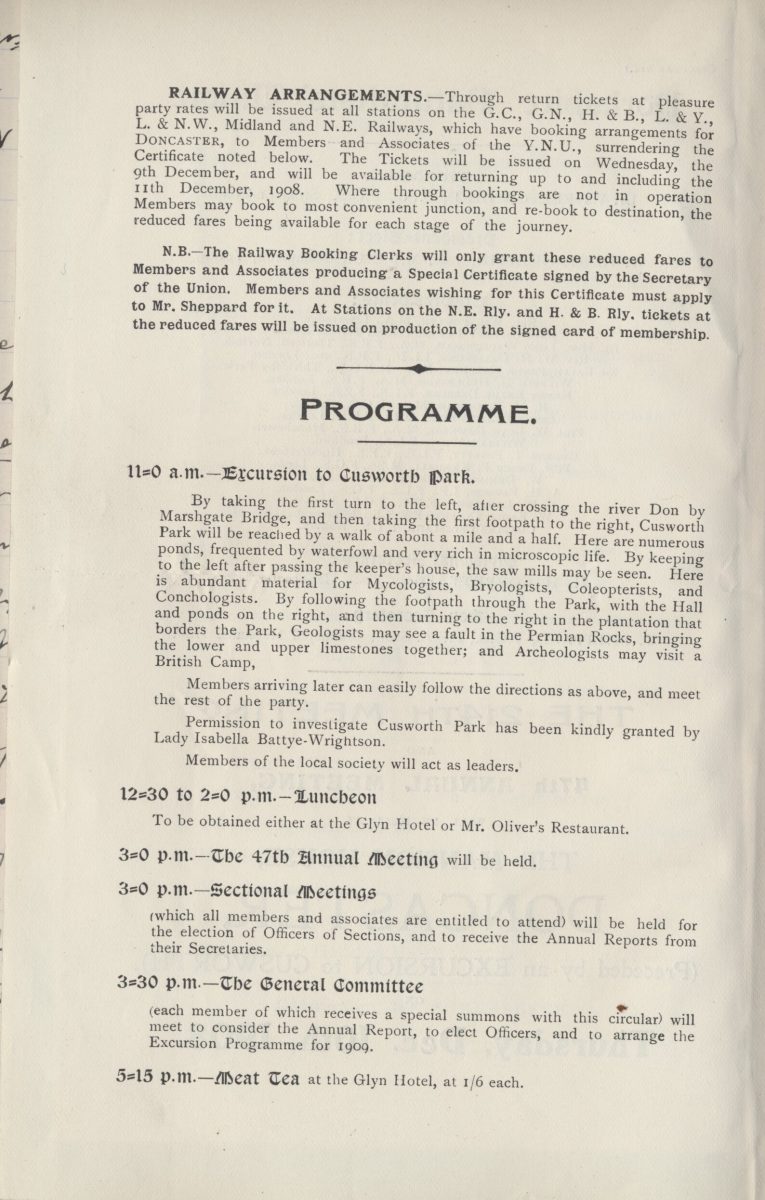


Jan 13th, 1909
Committee Meeting held at 22 Christ Church Rd.
Present – H. H. Corbett (President), Mrs. Corbett, Miss Cook, Messrs. Stiles, Bisat, & Watson.
The minutes of the last meeting were read & confirmed.
The Secretary reported that he had by letter expressed the thanks of the committee to the Doncaster Orchestral Society for their programme of music at the Conversazione.
The following were passed for memberships.
Dr. & Mrs. Stevenson, Messrs. F. Deighton, F. W. Lord, & (blank) Foster
Mr. Bisat suggested that the next conversazione be held at the beginning of the Winter Session.
Signed Halliwell Thomson
Jan 27th, 1909
An Ordinary Meeting of the Society was held at the guild Hall (County Court Room)
Present – Mr. H. H. Corbett (President), & about 47 members & visitors.
A lecture was delivered by Mr. T. Sheppard, F.G.S. of Hull on “Prehistoric Man in Yorkshire.”
The following report is taken from the “Doncaster Gazette.”
[a newspaper cutting is pasted into the minute book at this point.]
Prehistoric Man
“Prehistoric Man in Yorkshire” was the subject of a limelight lecture given by Mr. T. Sheppard, F.G.S., in the County Court Room, Guild Hall, on Wednesday evening, under the auspices of the Doncaster Scientific Society. Dr. Corbett presided over a fair gathering of members.
The lecturer stated that while the prehistoric man of Holderness engaged in agriculture and hunting, those inhabiting the Yorkshire wolds were more warlike. Attention was drawn to the earthworks constructed by these early inhabitants of Britain, which even to-day, with modern appliances, would not be erected without a certain amount of labour.
The prehistoric man also displayed considerable military skill. A fine example of one of these earthworks existed at Danes’ Dyke, near Bridlington. Dyke, the lecturer explained, was not in this instance the name of a ravine, but of the embankment, and the destination Danes’. Dyke was bestowed upon the site through the ignorance of later dwellers in the neighbourhood, who attributed things for the presence of which they could not account to the Danes, just as in the West Riding His Satanic Majesty was mentioned as the author of numerous things whose origins was unknown to most people.
[end of cutting]
A hearty vote of thanks, passed on the motion of the President, seconded by Mr. Stiles.
The following were elected as members.
Dr. & Mrs. Stevenson, Mr. F. Deighton, Mr. F. W. Lor, & Mr. Foster.
Signed H. H. Corbett 10.2.09
Feb 10th, 1909
An Ordinary Meeting of the Society was held in the County Court Room, Guild Hall
Present – Mr. H. H. Corbett (President) in the chair, & some 40 members.
The minutes of the previous meeting were read & confirmed.
The following members made reports.
Mr. M. H. Stiles – of the Rainfall for the year 1908 & also of the month of January.
Mr. Thrupp – of the finding of Fissidens exilis moss at Scawthorpe.
The President – of birds for the museum
Viz. Hooper Swan (from Sandall), Red breasted merganser (from Misson), & a Bittern (from Tickhill)
Mr. F. J. Clarke then delivered his lecture on “Doncaster & its neighbourhood in ancient times.” This was illustrated by lantern slides.
The “Gazette” report is as follows.
[a newspaper cutting is pasted into the minute book at this point]
Doncaster Scientific Society
At the ordinary meeting of the Doncaster Scientific Society at the Guild Hall, on Wednesday, Mr. F. J. Clarke delivered an interesting lecture on “Doncaster and its neighbourhood in ancient times.” By means of a large number of excellent slides, Mr. Clarke described his subject in a very lucid manner. It is a fact that half the people in Doncaster know none pr very little of the history of the district they live in, and the interesting town Doncaster was in ancient times, and it is to these that Mr. Clarke’s lecture most appeals. He has spared much time and energy in the collection of his information, which forms a most interesting lecture. Slides were shown of the ancient castle at Conisbro’, and all the most historic buildings of the town and neighbourhood.
The lecturer was heartily thanked at the close.
[end of cutting]
This interesting lecture was followed by a discussion in which the President, Mr. Stiles, & Mr. Jordan took part.
On the motion of Mr. Stiles, seconded by Mr. Jordan, a warm vote of thanks was passed to Mr. Clarke.
Signed H. H. Corbett 24.2.09
A Committee Meeting held following the above meeting.
Present – The President, Mrs. Corbett, Miss Cooke, Messrs. Stiles, Phillips, Golledge, Jordan, & Bisat.
The following were proposed for membership.
Mr. C. C. Ann (Burghwallis Hall), & Mr. H. R. Jackson (Hall Cross)
Signed H. H. Corbett 10.3.09
Feb 24th, 1909
An Ordinary Meeting of the Society was held in the County Court Room, Guild Hall
Present – The President & about 24 members.
The minutes of the previous meeting were read & confirmed.
The following were elected as members.
Mr. C. C. Ann & Mr. H. R. Jackson
Recorders Reports
Mr. Stiles stated that the Rainfall for January 0.68 & for Feby to date 0.35
The President reported the finding of a live migratory locust in the heart of a cauliflower, and the locus was exhibited to the meeting.
Mr. Moor reported the gift of Magnesium Limestone fossils to the Museum by Mr. Culpin, & the loan of Permian fossils by Mr. Bisat (Jnr)
Mr. Culpin then delivered a lecture on the “Marine bands in the Yorkshire Coalfield”. This proved exceedingly interesting & was listened to with close attention.
The following report is taken from the “Gazette”.
[a large newspaper cutting is pasted into the minute book at this point]
Doncaster Scientific Society
Lecture by Mr. H. Culpin
Discovery at Brodsworth
The monthly meeting of the Doncaster Scientific Society was held in the Old County Court Room on Wednesday evening, when Mr. H. Culpin, by means of lantern illustrations, gave a lecture on “Marine bands in the Yorkshire Coalfield.” Dr. Corbett presided, and there was a fair attendance of members.
The lecturer, who delt with his subject in a masterly fashion, in the course of his remarks said that one of the many interesting features found in the coalfields was that the fossils’ shells grouped themselves in two classes, one of which was undoubtedly marine, and the other fresh water. The two types never occurred together.
Dealing with recent work at Brodsworth, he said the site selected for the shaft was near the head of one of the charming little valleys which form a feature in the scenery of the Permian rocks of South Yorkshire. The sinking began at 122 ft. above ordnance datum in about two feet of soil and sub-spoil, and then passed through the middle marls, which were 78ft. thick. Below these marls the lower Permian limestone proved to be only 110ft. thick, or about half its normal thickness in the district. At its base the limestone yielded a plentiful supply of the fossils characteristic of the bottom bed, but it rested immediately upon the coal measures, without any sign of the quicksand or the lower Permian marls which were found elsewhere.
The level at which the coal measures were entered upon was about 270ft. above the Ackworth Rock, and probably at least 200 feet below the horizon of the Houghton Common rock. There was consequently no opportunity for verifying the Posidonomya bed below the latter rock at Frickley Hall. The Shafton coal was reached at a depth of 653ft., being 463ft. below the base of the Permian. The Melton Field or Wath Wood seam was proved at 128ft, and the Barnsley coal at 1,767 feet. The thickness, therefore, of the coal measures to the top of the Barnsley coal was 1,577 feet.
The search at Brodsworth for marine bands disclosed four such bands, and a fifth had since been seen in the adjacent sinking at Bentley. The highest of these bands was above the Shafton coal, and was found in a blue fucoid-marked shale. Fish remains and traces of a few plants were also found. The second marine band was found above the Melton field or Woolley Edge rock. It was apparently about 15ft. thick, and its base was 705ft. above the Barnsley coal. Its presence in the sinking was first indicated by blue shales with fucoid markings. At the base was a hard limestone band full of fossils.
This bed, including the limestone band, is the most important one of the series above the Barnsley coal, and is considered to be the same as a marine band found 630 feet above the top hard coal at the Mansfield Colliery. Mansfield is about 30 miles south of Brodsworth, from which it will be seen that marine bands have an important bearing on the correlation of the coal yielding rocks in the widely separated areas.
As seen at Brodsworth and subsequently at Bentley, this band was so markedly different to the eye and touch and its contents from the usual measures that it must form a good datum line for future borings and sinkings in the concealed portion of the coalfield.
The third band seen at Brodsworth was about midway between the principal band and the Barnsley coal, and had since been proved at Bentley above a similar coal 3ft. 8in. thick.
The fourth band was passed through at rather mor than 100ft. above the Barnsley coal, and its nature suggested that the marine conditions and the freshwater conditions were in close contact at the time the muds containing creatures were deposited. The fourth Brodsworth band was not seen at Bentley, but there was an intermediate one with Lingula Mytiloides and fish remains about 90ft. below the principal marine band.
What he had seen indicated that the line of demarcation between the sea and the freshwater lakes and marshes of the coal formation period could not have been very pronounced. He proceeded to point out the depths at which marine shells found in the coal measures most likely lived below sea level, and the use of marine bands and freshwater shells for identifying horizons in the coal measures.
In view of the work by Dr. Wheelton Hind and Mr. J. T. Stobbs on the marine bands in the coal measures of North Staffordshire, there was a temptation to draw parallels between the other Yorkshire marine bands and those set forth by them. Whether this can be usefully done or not is questionable but it is remarkable that they give five marine bands between the 10ft. and the lower limit of Anthracomya Phillipsi, and that five such bands have been found at Brodsworth and Bentley between the Barnsley coal and the Anthracomya Phillipsi beds, which were proved at Brodsworth below the Ackworth rock.
At the close a hearty vote of thanks was accorded the lecturer.
[end of paper cutting]
The President, Messrs. Phillips, Foster, Stiles, & Watson took part in the discussion.
A cordial vote of thanks was passed to the lecturer on the proposition of the President, seconded by Mr. Stiles.
Signed H. H. Corbett 10.3.09
March 10th, 1909
An Ordinary Meeting of the Society was held in the County Court Room, Guild Hall
Present – Dr. Corbett, (President) & about 50 members & visitors.
The minutes of the previous meeting were read & confirmed.
There were no recorders reports.
Miss Nodes then read a useful paper on “Sense Training” which was listened to with considerable interest.
The following report is taken from the “Gazette”.
[a newspaper cutting is pasted into the minute book at this point]
Doncaster Scientific Society
Lecture on “Sense Training.”
Dr. Corbett presided at a meeting of the above Society, held at the Guild Hall on Wednesday evening.
Miss M. Nodes, B.A., headmistress of the Girls’ High School, read a paper on “Sense Training”, in the course of which she claimed that sense training was the foundation on which all future knowledge depended, whether in the field of science, literature or art.
Miss Nodes proceeded to deal at some length with the physiological basis of sensation. Much had been said and written on the impossibility of improving the natural capabilities, but experience showed that much could be done. Although we might not all be capable of becoming Beethoven’s and Raphael’s, yet we could all do something to train the sense organs by exercise, and to render them much more valuable than they were.
Miss Nodes quoted passages from English poets to show that they derived definite images from every sense, even the sense of taste, smell and touch. Dealing with the methods of sense training, she showed how few got the “sense-exercise” they might out of a country walk, and recommended the training of the senses by observation of natural objects, and of men and their manners.
She also dealt with the functions of the senses in inciting their possessors to right action, and said that the most important result of the sense-training was the acquisition of correct habits. In conclusion the lecturer quoted the lines of Pope :-
Something there is more needful than expense,
And something previous e’en to taste – ‘tis sense;
Good sense which only is the gift of Heaven,
And though no science, fairly worth the seven.
On the motion of the Chairman, seconded by Mrs. McKenzie, a hearty note of thanks was passed to Miss Nodes.
[end of paper cutting]
A discussion followed in which the President, Miss Cooke, Miss Breeze, Messrs. Thrupp, Phillips, Culpin, Kirby, & Watson took part. A vote of thanks was passed on the motion pf the President, seconded by Mrs. Mackenzie.
Signed H. H. Corbett 24.3.09
A Committee Meeting held at the close of the ordinary meeting.
Present – The President, Mrs. Corbett, Miss Cooke, Messrs. Stiles, Bisat, Golledge, Kirby, Phillips & Watson.
Miss Lynd, Dr. C. L. Corbett & Dr. Law were nominated for membership
Signed H. H. Corbett 30.3.09
March 24th, 1909
An Ordinary Meeting of the Society was held in the County Court Room, Guild Hall
Present – Dr. Corbett, (President) & about 33 members & visitors.
The minutes of the previous meeting were read & confirmed.
The following were elected as members,
Miss Lynd, Dr. C. L. Corbett & Dr. Law
Recorders reports
Mr. H. S. Burdett exhibited & described a 2 ¾ inch transit instrument (by Dolland) which was to be mounted & fixed on Messrs. Burdett & Sons new premises in French Gate.
The President exhibited a specimen of the flea of the mole. This is the largest known to science.
He also reported that some Roman [pottery fragments, a curiously carved stone (date unknown) & a small glass bottle (Romam) of about 1 ½ oz capacity had been found in excavating foundations for Messrs. Burdett’s’ premises in Frenchgate.
Mr. M. H. Stiles then delivered an interesting lecture on “Leaf Structures”, this being illustrated by some 40 lantern slides, prepared by the author.
The lecturer, in his opening remarks, alluded to the diagnostic value of the variations in the microscopic structure of leaves, enabling adulteration or substitution to be readily detected, when the specific characteristics of those used in medicine had been studied.
Mr. Stiles more particularly instanced the substitution of an unknown leaf for that of the true Belladonna, a sophistication which had recently occurred on the London market; & he enumerated the special distinction of each so that they could be easily recognised.
The leading microscopic characters of the stalk & the blade were described, special attention was devoted to the variations in the shape & size of the cells of the epidermis, stomata, raphides, hairs, etc.
Mr. Stiles also gave a description of Chlorophyl & the dissociation of Carbonic acid in the presence of sunlight.
The President added a few remarks on the subject at the request of Mr. Stiles.
A hearty vote of thanks was passed on the motion of the Secretary, seconded by Mr. Thrupp
Signed H. H. Corbett 21.4.09
March 30th, 1909
A Committee Meeting held at 22 Christ Church Road
Present – Dr. Corbett (President), & Mrs. Corbett, Messrs. Stiles, Bisat, Phillips, Golledge, Watson & Miss Cooke.
The minutes of the last meeting were read & confirmed
The following were suggested as officers for the ensuing year.
President – Rev. H. Thomas, proposed by Mr. Stiles, seconded by Mr. Golledge
Vice Presidents (two vacancies) – Messrs. Corbett, Stiles, Culpin, & Jordan (to be balloted for)
Committee (three vacancies) – the two unelected nominees for Vice Presidency & Messrs., Kirk & Watson (to be balloted for)
Secretary & Treasurer – Mr. G. W. Phillips
Assistant do. – Mrs. Corbett or Mr. T. C. Thrupp
Recorders
Archaeology – Messrs. H. H. Corbett & A. Jordan
Botany – Mr. H. H. Corbett, Miss Breeze, Mr. Thrupp
Geology – H. Culpin, H. J. Foster
Microscopy – Stiles, & Bisat
Photography – F. A. Jordan & J. Beetham
Physics – T. Cuttriss, E. Watson, Miss Cooke
Zoology – Messrs. H. H. Corbett, J. Beetham, G. W. Phillips, E Tomkinson
Museum – Mr. E. Moor
Museum representatives – Messes. H. H. Corbett, Greenslade, Stiles, Cuttriss, & Culpin.
The following dates & places were suggested for Summer Excursions.
1909
May 20 (Thurs) – Frodingham
May 27 (Th. Evg.) – Edlington Wood
May 31 (Mon) – Askern for Shirley Pool
June 10 (Thurs) – Langsett
June 12 (Sat) – Medge Hall & Thorne Moor
June 17 (Thurs Evg.) – Rossington
June 24 (Thurs) – Bawtry & Finningley
July 3 (Sat) – Wharncliffe Crags
July 8 (Thurs Evg.) – Cusworth
July 15 (Thurs) – Owston Ferry
July 17 (Sat) – Kirk Smeaton
July 22 (Thurs Evg.) – Sandall Beat & Wheatley Wood
It was agreed that beyond the full issue of the Summer programme, notices by post card of the various excursions be only sent to those members who formally desire them.
Mr. Phillips made the suggestion that the papers contributed to the Society be printed.
No decision was come to.
Miss Florence York & Mr. A. Sheard were nominated for membership.
Signed H. H. Corbett 26.4.09
March 19th, 1909
A Committee Meeting held at 22 Christ Church Road
Present – Mr. Stiles in the chair, Miss Cooke, Messrs. Bisat, Greenslade, Golledge, Jordan, Kirby & Watson.
The chairman stated purpose of the meeting – that of tangibly recognising Mrs. Corbett’s valuable services, and by so doing, indirectly appreciating at the same time Dr. Corbett’s long & invaluable help & connection with the Society.
It was agreed unanimously that the members be circulated & subscriptions requested for a presentation fund.
A circular was drafted & approved. Subscriptions asked for by the 3rd Apl. & another meeting to be called for the 6th
Mr. Bisat kindly offered to do the printing & provide paper etc. free [of charge].
Signed M. H. Stiles, chairman April 10/09
April 6th, 1909
A Committee Meeting held at 22 Christ Church Road
Present – Mr. Stiles (in the chair), Miss Cooke, Messrs. Bisat, Greenslade, Golledge, Phillips & Watson.
Minutes of the previous meeting read & confirmed.
The various members of the committee reported subscriptions received for the Corbett presentation fund – these to date amounting to £11 odd.
It was decided to send a reminder to members non-contributing & who may have overlooked the matter. Date 14th inst. To be given as that which the fund was to be closed.
The Secretary instructed to inform Mrs. Corbett & to ask her to suggest a suitable present
The next committee meeting was fixed for the 14th inst. At 9 pm.
Signed M. H. Stiles, chairman Apl 14/09
April 14th, 1909
A Committee Meeting held at 22 Christ Church Road
Present – Mr. Stiles (in the chair), Messrs. Bisat, Jordan, Golledge, Phillips & Watson.
Minutes of the previous meeting read & confirmed.
The Secretary reported receipt of £12:15:0 to date for the Corbett presentation fund.
He also stated that Dr. & Mrs. Corbett’s choice of present was a Roll Top desk & books.
Mr. Bisat was asked & kindly undertook to purchase both desk & books, after consulting with Doctor & Mrs. Corbett
Mr. Stiles was requested to make the presentation, others speaking subsequently if they desired.
Major Anne of Burghwallis Hall was nominated as member of the Society.
Signed M. H. Stiles, chairman Apl 26/09
April 21st, 1909
An Ordinary Meeting was held in the County Court Room, Guild Hall
Present – Dr. H. H. Corbett (President) and some 26 members
The minutes of the previous meeting were read & passed.
The following were elected as members
Miss F. York, Major Anne, & Mr. A Sheard.
Recorders Reports
Mr. Stiles stated that Anthrax spleen had been submitted to him by a local Vet. Surgeon & that he had made a permanent preparation of the Anthrax bacillus.
Dr. Cath. L. Corbett the read an interesting paper on “Air & Ventilation”
The essayist spoke of the benefits derivable from fresh air & the advisability of accustoming the body to it. One’s power of bearing comparatively cold air was much weakened by the use of heavy clothing, the breathing of vitiated air, & generally by debility.
The advantages of sunlight & fresh air in rooms were not sufficiently considered by architects & builders. The principal sources of vitiated air in rooms were the inhabitants themselves, exhaling CO2 & organic matter.
Dr. Corbett referred to the usual allowance of 3000 eft per hour per person to keep the air of a room fresh & gave 24 sq. in. per person as the necessary window opening for air passing at the rate of 5ft. per sec.
Some useful information & suggestions were then given as to school ventilation & the clothing of children to ensure the benefits of fresh air.
The following members took part in the subsequent discussion.
Rev. H Thomas, Messrs. Stiles, Phillips, Jordan, Watson, & the President.
Mr. T. C. Thrupp contributed a paper on “A gathering on Mnium undulatum,” one of the 620 mosses found in this country.
The writer stated that this, with over 460 capsules, has been found near Haywards Heath in Sussex. Specimens having 9 or 10 capsules were passed round to the members & an instance was given of last year’s plant with 11 setae the capsules having rotted.
Coloured drawings of capsules were exhibited, & 2 other mosses usually producing one capsule were shown for comparative purposes.
The President & Mr. Stiles discussed the paper.
Both contributors re[plied to the debate.
Votes of thanks to C. L. Corbett & Mr. T. C. Thrupp were passed on the motion of the Secretary, seconded by Mr. Jordan.
Signed Halliwell Thomas.
26th April, 1909
Special Committee Meeting held at 22 Christ Church Road at 8 pm
Present – Mr. Stiles (in the chair), Messrs. Bisat, Golledge, Phillips, & Watson
The minutes of the previous meeting were read & confirmed.
The Secretary reported that the Corbett presentation fund amounted to £23:8;6 subject to expenses.
Mr. Bisat [reported] that the Desk had been ordered & the books obtained
It was decided to devote any additional subscriptions, or balance, to the purchase of further books, this being left in the hands of Mr. Bisat & the Secretary.
Signed Halliwell Thomas.
26th April, 1909
Special Committee Meeting held at 22 Christ Church Road at 8.30 pm
Present – Dr. H. H. Corbett (chair) Messrs. Stiles, Bisat, Golledge, Phillips, Kirby, & Watson
The minutes of the meeting held 30th March were read & confirmed.
The draft report & statement of Accts. For the Session 1908/9 were submitted; & approved on the motion of Mr. Stiles, seconded by Mr. Bisat.
Mr. Stiles proposed & Mr. Bisat seconded,
That cheques on the Society’s Banking Acct be drawn by the Treasure for the time being, & also that the amount due to the treasurer at the end of the year (Apl 1909) be paid out of the Bank Balance.
Signed Halliwell Thomas
Doncaster Scientific Society
Annual Statement of Accounts
Session 1908/9
| Receipts | Payments | ||
| 1908 May 1st | 1908 | ||
| Balance cash in bank £19.14.9 | Printing & Stationery | ||
| Less due to treasurer £5.15.11 | 13 18 10 | Henderson £1.12.0 & £2.6.2 | 3 18 2 |
| Bisat S. G. | 2 1 8 | ||
| Subscriptions | |||
| 1906/7 – 7 @ 3/6 | 1 4 6 | Hire of room for meetings | |
| 1907/8 – 21 @ 3/6 | 3 13 6 | Corp of Doncaster 12/- & 21/- | 1 13 0 |
| 1908/9 – 129 @ 3/6 | 22 11 6 | Barton paid for attendance | 5 0 |
| 1909/10 – 3 @ 3/6 | 10 6 | Moat D. Lawton 4 nights @ 7/6 | 1 10 0 |
| Bant interest | 7 7 | Y.N.U. subscription 5/ Levy 12/6 | 17 6 |
| Royal Soc. Protection Birds | 5 0 | ||
| Rev Lin Hotel Thorne | 2 6 | ||
| Conversazione | |||
| Expenses 14.7.0 | |||
| Rects 3.14.6 | 10 12 6 | ||
| Also audited by F. G. Clarke | |||
| Envelopes 6d papers 10d (per Sec) | 1 4 | ||
| Subscriptions unpaid | Stamps & envelopes | 5 7 6 | |
| 1907/8 – 4 = £0-14-0 | Do. & Tel. | 7 6 | |
| 1908/9 – 18 = £3-3-0 | Medge Hall excursion | 2 6 | |
| £3 17 0 | |||
| Cash in bank – Apl / 08 | |||
| Less due to treasurer | 15 0 2 | ||
| 42 6 5 | 42 6 5 |
Examined & found correct J. W. Hainsworth 27 April 1909
May 28th, 1909
Annual General Meeting held at the County Court Room, Guild Hall
Present – Dr. H. H. Corbett (President) & 40 members
The minutes of the previous Annual Meeting were taken as read & signed.
Report
Ladies & Gentlemen,
The Committee have pleasure in submitting the following report for the year 1908/9
The Summer excursions (excluding those connected with the Y.N.U.) were nine in number.
The first took place on Thursday Evening 28th May & was attended by 9 members & 2 visitors. The walk was from Conisbro’ Station to Sprotbro’ & home. The members interested themselves in Botany, Zoology & Geology.
A visit was paid to Hatfield Moor & Warping Ponds on the 8th June, when some 30 members & visitors were present. The following report is taken from the “Gazette.”
[a newspaper cutting is pasted into the minute book at this point]
Doncaster Scientific Society
Excursion to Hatfield Moor & Sandtoft
The members and friends of this society, to the number of about thirty, journeyed by either road or rail to Hatfield Moor on Whit Monday for the purpose of investigating a bit of country that is little known to the majority of Doncastrians.
Those of the party who went by train arrived at Medge Hall Station at about one o’clock, and walked across the very flat country to Sandtoft, noting on the way the more interesting and rare plants. Of these Barbarea dumetorum var diversifolius are particularly characteristic of low-lying and peaty land.
Arriving at Sandtoft , the Warping Pond was visited, and found to exemplify well the lecture delivered to the society during the past session by Dr. Smith on marsh and water plants. [no record of this lecture in the minute book]
From the margin of the pond, going towards the deep water, the following series of plants were found: Reeds, rushes and sedges; Ranunculus floribundus and Lemma trisula; Polygonum amphibium and finally, in about 10 feet of water, true floating plants, such as Hydrocharis.
By the edge of the moor another section of the party was met. These had cycled early in the day, and had spent a profitable time studying the birds of the district. They had been fortunate in finding several (not nests, for no nests whatever is made by these birds) eggs of the night-jar, and some excellent photographs of these were taken.
Meanwhile, the entomologists were contending with cold winds and little sunshine, and consequently they had but little to report of insects seen or captured. Larvae of odonestic potaloria. Lasiocampa quercus and telthia potatoria were found, and in peaty pools on the moor a few typical moorland beetles were seen, among which hydroporus gyllenhalii is a new record for the district.
One member of this section, who knows the moor thoroughly, had found the beautiful flowers of the cranberry (Schollera oxycoccos). This plant is now very rare here, but on the evidence of the deeper layers of the peat, it was formerly abundant, stems, leaves, and even fruit being found in great quantities,
A very enjoyable and instructive day was ended by a well served tea at ‘The Reindeer’, Sandtoft and the return journey home was made memorable by the discovery at Medge Hall station that the train by which the travelers intended to get home, only run on Saturdays. However, the station master came to the rescue and stopped an excursion train from Cleethorpes, which a somewhat crowded, but otherwise satisfactory return was made.
[end of cutting]
The third excursion took place on Thursday evening, June 11th, from Balby to ‘Tween Woodlane. Ten members joined in this.
On Saturday 20th June, (by kind permission of Mr. W. Bunting) some 16 members & 3 friends visited the Wadworth Colliery. The machinery & screening arrangements at the pit head were shown by Mr. Bunting & Mr. Shore. Fifteen of the party were then afforded the exceptional opportunity of seeing the underground working. Mr. Bunting acted as conductor & explained the process of Coal mining. His arrangements for the safety & pleasure of the party were excellent. The members were subsequently very kindly entertained to tea by Mr. & Mrs. Bunting & Mr. Mrs. Shore. A vote of thanks was passed for their generous hospitality.
The fifth excursion took place on Thursday evening of the 25th June, from Arksey to Moor Turn & then to Wheatley. There were 8 members present.
The Y.N.U. paid a visit to Hampole on Thursday the 9th July & this was included as one of the Society’s summer excursions. Ten of our members took part.
An excursion had been arranged with the Goole Society to Medge Hall & Thorne Moor the date being the 11th July. Owing to the bad weather this had to be abandoned at the last moment.
The following outing (fixed for Thursday 23rd July) to Bawtry, Misson, Biningley was also abandoned, in consequence of the smallness of the party who turned up at the station. Those present, 3 members & 2 visitors, proceeded to Rossington instead.
The 9th & last excursion to Askern to meet the Halifax Society, took place on Saturday the 25th July. There were only 5 members present.
Most of the work done & observations made during the various excursions have been reported to the Society at their meeting held on the 28th October last.
As will be noted, the attendance at the various outings have not been good, but some excuse is perhaps to be found in the fact that the weather throughout the summer was either wet or uncertain, thus affecting the arrangements of members.
The attendances averaged 12.3, the detailed figures being
Officers 5.4. members 4.3 and visitors 2.5
The members present on Thursdays averaged 7.5, on Saturdays 12.0, Whit Monday 30 and Evenings 9.7
In all, 31 members have taken part in one or other of the excursions.
If the Field Meetings have not been altogether successful, the committee think they have reason to congratulate the society upon an excellent Winter Programme, carried through, under the Presidency of Dr. H. H. Corbett. The subjects chosen & the methods in which they were dealt with gave great satisfaction.
The chief feature of the session was the Conversazione, which was held on the 10th December last, in conjunction with the Annual Meeting of the Yorkshire Naturalists’ Union. Our own members did not , however, attend in any great numbers, there being only 83. The attendance in all amounted to about 279, 52 being members & associates of the Union, 32 helpers & musicians, & the remainder ordinary visitors.
The principal items of the joint gatherings were an excursion in the morning to Cusworth Park, the sectional & general meetings of the Union in the Afternoon, the Presidential Address by Dr. Wheeton Hind on “The present condition of the geology of the Carboniferous rocks of Great Britain” and exhibits by members of the society in the evening. Our President welcomed the Union on behalf of the Society.
There were ten ordinary meetings held during the winter. At these, the average attendance was 38.3, or 3 more than last winter. The programme was as under:
1908
Oct 21 – “The Natural History of Rossington Golf Links” H. H. Corbett
Oct 28 – Recorders reports & exhibits (with lantern illustrations)
Nov 11 – “Cuttle Fish & Shell Building” E. Moor
Nov 25 – “River Pollution & Purification” J. Corbett of Salford
Dec 11 – Conversazione (in conjunction with Y.N.U. annual meeting)
1909
Jan 27 – “Prehistoric Man in Yorkshire” T. Sheppard F.G.S.
Feb 10 – “Marine Bands in the Yorkshire Coalfield” H. Culpin
Feb 24 – “Doncaster & its Neighbourhood in Ancient Times” (with lantern) F, J. Clarke
Mar 10 – “Sense Training” Miss Nodes B.A.
Mar 24 – “Lead Structure” (with lantern) M. H. Stiles
Apr 21 – Short Essays
The various recorders of the Society report as follows:
[a part of a newspaper cutting is pasted in the minute book at this point]
Archaeology
Owing to the numerous excavations that have been going on during the past year in connection with the Marshgate Bridge, The G,C. Avoiding Line, etc., there have been several “finds” of archaeological interest, and most of them have been acquired for the museum. Among the more important are stone lead-lined coffin (Roman) from the G.C. Line. Unfortunately, this was very much broken by the steam navvy.
Cinerary urn (Roman) from the same place, with burnt human bones and other objects. Iron centre-boss of shield (Saxon?) from the same place. Urn (Roman), much broken, but now restored, from French Gate. Large earthen vase bottle (Roman) from French Gate, Coin, first brass of the Emperor Vespasian, in good condition, from French Gate. Fragment of stone coffin lid (13th century?), from French Gate. Besides the above, several fragments of Roman pottery and a small glass bottle, probably of Roman age, have been found.
The total result of the year’s collecting is a good addition to the archaeological material for our long hoped for museum.
Botany
There is very little to report in this section. Working field botanists seem to be difficult to find in Doncaster, and consequently our local flora is little recorded. The only addition to the local list, so far as I know, is Juncus compressus L., which was found at Skellow on the occasion of the Y.N.U. excursion there.
Microscopical Section
Although no striking results have been obtained in this department during the past session, much useful work has been done. At the Y.N.U. excursion in June last, the two were recorders present. And obtained gatherings from various points on the Skellow Brook, from Skelbrook down to Adwick. The diatom flora contained in these was subsequently worked out, and a report thereon included in the account of the excursion published in the “Naturalist.”
The microscopes played an important part in the conversazione given by the Society at the annual meeting of the Y.N.U. Twenty five instruments were staged, and the exhibits were the most varied and extensive shown for many years.
Two papers relating to microscopy were given during the session, one by Mr. Stiles on “Leaf Structure, “ the other by Mr. Thrupp on “Mnium Undulatum,” a moss attaining its higher development in the South of England.
In connection with a recent outbreak of anthrax at Thorne, one of their recorders was furnished with a specimen of the spleen from the affected animal, and was able to successfully demonstrate the presence of the bacillus causing the disease. The section cordially welcomes a new recruit in the person of Mr. Thrupp.
Physics
In this section there is little To add to the information already furnished at the meeting of the 28th October last.
Subjects in the branches of both physics and engineering chemistry have had their share in the winter’s programme. An excellent lecture was given by Mr. J. Corbett on “River pollution and purification,” and more recently , a useful and interesting paper on “Air and Ventilation” was contributed by Dr. C. L. Corbett.
[end of paper cutting]
In the section of Physics, Mr. Stiles contributed the figures of Rainfall for the year ending 31st December 1908, as under.
Rainfall Wet days Largest daily fall Day of month
Jany 1.03 9 0.32 28
Feby 1.75 13 0.33 16
March 2.86 19 0.95 25
April 2.29 18 0.66 28
May 2.14 14 0.53 3
June 1.21 6 0.36 16
July 3.31 14 0.62 8
Augst 1.93 14 0.56 20
Sept 1.52 18 0.44 3
Oct 0.64 14 0.15 26
Nov 0.75 13 0.18 21
Dec 1.50 16 0.51 15
Total 20.93 168
[another part of the above paper cutting is inserted into the minute book at this point]
Zoology – Entomology
In this section there have been a considerable number of interesting additions to our local species during the past session, and specimens of the added species have been preserved for the local collection.
Zoology
The summer migrants were very late in arriving. Jackdaws were noted as building open nests in trees, which is an unusual occurrence. The breeding in the district of kingfisher, nightjar, nuthatch, great spotted woodpecker, tree creeper, gold-crested wren. The occurrence in the district of forked-tailed petrel in October, 1908, bitten on the 4th January, 1909, red-breasted mergansers during January, 1909, hooper swans in December, 1908.
Museum
Number of times open since April, 1908, 50
Average attendance 42.4
Total attendance 2,122
Number of men and boys 1,382
Number of women and girls 740
As reported in previous years, the same causes are in operation, in causing a fluctuating number of visitors, viz., performances being held in the great hall. There has been a small increase in the number of adult visitors, but juveniles are still in the majority.
We had a record attendance in October last, viz., 525, nearly double that of any previous month, and this seems curious, weeing that on the 22nd of that month the Museum had to be closed on account of the Roman Catholic bazaar. The zoological specimens seem to attract most attention.
Inquiries have been made for the bittern and northern diver, and kingfisher; also numerous inquiries for the horse trough found in Baxter Gate, and the cinerary urn.
[end of this section of the paper cutting]
The numerical strength of the Society is now 150. There have been 22 resignations & 21 accessions in the way of new members.
The Statement of Accounts for the 12 months is given herewith [see p.p.154 & 155]
The foregoing Report (which was read by the Secretary) was adopted on the motion of Mr. Jordan, seconded by Mr. Hanson.
On the conclusion of this part of the business Mr. Stiles said….
[another part of the newspaper cutting has been inserted here]
Mr. Stiles said that before they proceeded with the remaining part of the business, he had an extremely pleasant duty to perform. The committee had asked him to present to Dr. and Mrs. Corbett a slight memento of their connection with the Society since they had been in Doncaster.
Some little time ago, owing in a very great measure to the suggestion of their friend, Mr. Bisat, it was decided that before Dr, Corbett retired from the presidency, some slight recognition should be made of the great work he and Mrs. Corbett had done during the time they had been connected with the Society.
A fair sum was collected and practically every member who regularly attended the meetings of the Society had contributed to this fund. With the money, they hac been able to purchase two presents – one a roll-top desk chosen by Mrs., Corbett, and the other a set of books chosen by Dr. Corbett, they had not the roll-top desk here, but by the kindness of Mr. Bisat, they had a sketch of it.
It was not for him to enlarge upon the services that Dr. and Mrs. Corbett had rendered to that society. For a very considerable period Dr. Corbett had been – he might say without fear of contradiction – the leading member of the Scientific Society. He was recognised throughout the whole of Yorkshire as a worthy representative of modern science, especially the natural history portion.
Dr, Corbett first came to Doncaster in the year 1888. Shortly after his arrival, he bewailed the non-existence of a scientific society. The Doncaster Scientific Society had then been established eleven years, but it had gone on very quietly, and Dr. Corbett wrote to one of the papers stating what an advantage it would be to Doncaster to have a scientific society.
He (the speaker) was at that time secretary of the society, and his attention being called to the letter, he sought out Dr. Corbett, and put the matter before him. He at once consented to become a member, and on the 30th October, 1889, he was elected a member. He read his first paper a fortnight after his election. He (the speaker) further found that Dr. Corbett took the chair for the first time on April 30th, 1890. He was elected a member of the committee on October 15th, 1890, and became president in October 1892. Thus they would see that his promotion from an ordinary member to president was very rapid.
On his (the speaker’s) retirement from the post of hon. Secretary and treasurer, Dr. Corbett most willingly came forward in 1895, and since then they knew how the Society had prospered. The membership had increased by leaps and bounds. When Dr. Corbett first joined it was about forty, and now it was a hundred and fifty, and they had sections dealing with every branch of natural science, and extremely good work was done in connection with each section. Thus, they would ee that in Dr Corbett’s hands the Society had considerably improved. In Mrs. Corbett, the doctor had had a most willing help-meet. Without her he (the speaker) did not know how Dr, Corbett would have got through his work.
In conclusion, he expressed the hope that Dr, Corbett and Mrs. Corbett would be long spared to make use of the presents which they made them that night, and that they would never regret their connection with the Doncaster Scientific Society. Mr. R. Watson also referred in complimentary terms to Dr. and Mrs. Corbett’s services to the Society. Mr. Bisat alluded to the fact that Dr. and Mrs. Corbett had always provided the committee with a room in which to hold their meetings.
Dr. Corbett, in acknowledging the gifts, said that neither he, nor his wife, had any idea that anything was on the tapis, until Mr. Watson came in and told them he was going to give them two black marks for not attending the last two committee meetings, of which they did not know. When he (the speaker) knew of the presentation he was very pleased, for when everyone had worked for years in connection with any object, he did not like to find that his work was not appreciated. On looking over some of the old minute books, he was pleased to find that the society had not flagged during the time that he and Mrs. Corbett had been associated with it.
When they joined, the membership was forty of fifty and in six years it had doubled, until it now stood at 150. That was, he thought, very satisfactory for a town of the size of Doncaster. In 1897 it was very interesting to find that the Doncaster Corporation promised the Society the use of the Old Free Library for a museum, and some cases to contain the specimens. The Scientific Society thanked the Corporation for that, but where were they now? Surely the mills of the gods grind slowly!
(Laughter)
If their new secretary held office for another fourteen years, he might see a public museum for Doncaster. By the time another fourteen years had gone, he would probably ne beginning to be a little decrepit, but if his health and strength lasted an abnormal period, he would still expect to go out and to use those books – five volumes of the Rev, W, Fowler’s “Coleoptera of the British Islands” – which he had long wished for, as it was the best work on British Coleoptera. There was only one thing that he felt a little sorry about, and that was that he feared Mrs. Corbett would sit at the roll-top desk morning, noon, and night. She was always doing useful work – if not for the scientific Society, it was for the National Society for the Prevention of Cruelty to Children.
The Rev. Halliwell Thomas congratulated the committee on their appropriate choice of presents.
[end on the paper cutting]
The election of officers for 1909/10 was then proceeded with, the following being appointed.
President – Rev. H. Thomas
Vice Presidents – Dr. Corbett & Mr. Stiles
Committee – Messrs. Jordan, Culpin & Watson
Sec. & Treasurer – Mr. G. W. Phillips
Assistant Secretaries – Mrs. Corbett & Mr. Thrupp
Recorders elected were as under
Archaeology – A, Jordan & H. H. Corbett
Botany – H. H. Corbett, Miss Breeze, T. C. Thrupp
Geology – H. Culpin & H. J. Foster
Microscopy – Mr. Stiles, G. B. Bisat & T. C. Thrupp
Photography – F. A. Jordan & J. Beetham
Physics – T. Cuttriss, Miss Cooke, R. Watson
Zoology – H. H. Corbett, G, W. Phillips, J. Beetham & E. Jenkinson
Museum – E. Moor
The meeting closed with the usual vote of thanks to officers.
Signed Halliwell Thomas
[a newspaper cutting was pasted in the minute book at this point]
(Leader taken from the Doncaster Gazette)
Notes by the Way
A Local Naturalist
The man to solitude accustom’d long,
Perceives in everything that lives a tongue;
Have speech for him, and understood with case,
After long drought, when rains abundant fall,
He hears the herbs and flowers rejoicing all;
Knows what the freshness of their hue implies –
How glad they catch the largess of the skies,
But, with precision nicer still, the mind
He scans of every locomotive kind;
Birds of all feather, beasts of every name,
That serve mankind, or shun them – wild or tame;
The looks and gestures of their griefs and fears
Have spells them true, by intuitions light,
And needs no glossary to set him right.
These lines of Cowper were brought to mind on Wednesday night when testimony was being paid, at the meeting of the Doncaster Scientific Society, to Dr. Corbett’s work on behalf of the Society in the field of Natural History.
As a member of the medical profession, the worthy Doctor has, of necessity, to be a town dweller. But his heart is at all times in the country-side. It is in the so-called “solitudes” of the open country that he finds the best companionship. He misses no opportunity of getting into close touch with Mother Nature, and of studying the pages of the ample Book that she spreads wide open for all who have the mind to read.
One does not doubt for a moment that the companionship of a tree or a plant has afforded him many a afternoon’s pleasure. It is so with all true naturalists, and Dr. Corbett is a naturalist of the truest order. The work that he has done for the Doncaster Scientific Society, particularly in his own special field of science, has been a work of love – done, we may be sure, with no expectation of any other reward than the work itself yields. But it is a good thing, none the less, that such an ardent worker in the cause of scientific research should be offered some tangible proof of the appreciation of his felloe-members of the services he has rendered to the cause they all have at heart. And such proof was forthcoming on Wednesday night, when the Doctor was presented with a set of books precious as rubies in his eyes, as a mark of recognition, not merely of his services as a scientist, but also of his services in an administrative capacity. The services of Mrs. Corbett in the administrative field of work were also recognised in a tangible way. It was a very pleasant little ceremony.
The feelings of the members towards the pair of enthusiastic workers in the drudgery department of the Society’s operations were admirably expressed by Mr. Stiles, and endorsed by Mr. Watson and Mr. Bisat. It is impossible to measure the value to such a Society of such a man as Dr. Corbett – a fact that was properly emphasised in the speeches. That the recipients of the Society’s mark of recognition were delighted with the little surprise that had been sprung upon them was abundantly evident.
In honouring Dr. Corbett and his wife in this way, the members of the Society have honoured themselves.
[end of cutting]
[A new handwriting commences, perhaps Mr. George William Phillips, Secretary]
May 5th, 1909
Committee Meeting held at 13 Albion Place
Present.
Rev. H. Thomas, President, in the chair
Mrs. Corbett, Miss Cooke
Messrs. Stiles, Corbett, Watson, Thrupp, & Phillips
Minutes
The minutes of the previous two meetings (26 April) were read & confirmed.
Members in arrears
It was reported that 4 members were two years in arrears with their subscriptions, & it was decided “that Messrs. Claxton & Childs be written to & that Messrs. Robinson & Dixon be struck off”, on the motion of Mr. Watson, seconded by Mr. Styles.
Summer Prog.
The Summer Programme as proposed on 30th March was adopted, on the motion of Dr. Corbett, seconded by Mr. Styles.
Also that Notices by post of each excursion be only sent to those members who desired them [this sentence crossed out, and initialed G.W.P.]
Signed H. H. Corbett 24.8.09
24 August 1909
Committee Meeting held at 9 Priory Place at 8.30pm
Present – Mr. H. H. Corbett (in the chair) & Messrs. Bisat, Watson, Greenslade, Golledge, Thrupp & Phillips.
The minutes of the previous meeting were read and confirmed
On the occasion of the funeral of the late Mt. T Cuttriss. A wreath was forwarded from the Society. This action was approved on the motion of Mr. Watson, seconded by Mr. Bisat.
Mt. Watson proposed, Mr. Greenslade seconded & it was unanimously decided that Mr., Kirby be elected to fill the place on committee left vacant y the sad death of Mr. T. Cuttriss.
It was decided to hold the conversazione on the opening date of the Winter Session. Rev. Father Cutler (or failing him, Mr. Benney of Bradford) to be the lecturer.
The following dates were fixed 14 & 27 Oct., 10 & 24 Nov., 8 Dec., 26 Jan., 9 & 23 Feb., 9 & 16 Mar., 143 & 27 April.
Lecturers suggested. President, Misses Corbett & Popplewell, Messrs. Bellamy, Beetham, Parkin, Patten, Bennly, Clive, Foster, & Thrupp.
It was decided that the Room for the Winter Session be the Old Couty Court Room, Guild Hall, & that the Corporation be asked to improve the ventilation thereof. Proposed by Dr. Corbett, seconded by Mr. Greenslade.
Mr. Watson presented the following Balance Sheet of the Corbett Presentation Fund.
| By Subscriptions | By Payments | ||
| 1909 May | |||
| To subscriptions received | 13 16 0 | Mr. Bisat Desk & Coleoptera | 9 7 5 |
| From members of the | P. Pitchforth Engraving | 7 0 | |
| Don. Sci. Soc | J. Abdy’s a/c | 2 6 | |
| City Jewelry | 2 17 6 | ||
| Secretary Postage etc. | 10 10 | ||
| Balance paid towards | |||
| Magnifying Glass | 10 9 | ||
| 13 16 0 | 13 16 0 |
Mr. Greenslade proposed, Mr. Golledge seconded & it was decided that the above Balance Sheet be adopted & placed in the minutes.
Signed Helliwell Thomas
20 September 1909
Committee Meeting held at 60 Hall Gate.
Present – Rev. H. Thomas (Pres.) in the chair, Mrs. Corbett , Miss Cooke, Messrs. H. H. Corbett, Bisat, Thrupp, Stiles, Watson, Kirby, Golledge, & Phillips.
The minutes of the previous meeting were read & confirmed.
Mr. J. R. Bradshaw, Mr. & Mrs. Phillips were nominated for membership.
The following were added to the committee to form a Conversazione committee.
Mrs. Thomas, Mrs. Culpin, Mrs. Cuttriss
Messrs. F. A. Jordan, Vaughan, Moor, Winter, Raynor, Beetham, Tomkinson, Bunting, Foster, E. Phillips, & Hand. Mrs. McKenzie, Misses. Breeze, Beetham, Davis, Nodest, Windle.
Several suggestions for exhibits were made which appear in the Minutes of the Conversazione Meeting.
Signed H. H. Corbett 11.10.09
23 September 1909 at 8.30pm
Conversazione Committee Meeting held at 9 Priory Place.
Present – Rev. H. Thomas (Pres.) in the chair, Misses Breeze, Beetham, Cooke, Davies & Nodes, Mrs. Corbett, Messrs. Corbett, Moor, Thrupp, Stiles, Bunting, Vaughan, Kirby, Greenslade, & Phillips.
The minutes of the previous meeting were read & confirmed.
The following suggestions were made.
Botany – Collection of wild flowers, seeds, fruits, & fungi. The latter to be arranged by W. N. Cheeseman F.L.S. of Selby. Miss Ross of Wadworth be asked to help in the collection.
Geology – be left in the hands of Messrs. Culpin , Foster & Golledge.
Microscopy – be left in the hands of Messrs. Stiles & Bisat.
Photography – Mr. Woodhouse be asked to lend stereoscopes. Mr. Stiles proposed that each side of the Lantern Slide Frames (holding 40) be filled by one person & offered to be responsible for one side.
Physics – Record of Local Rainfall, Mr. Stiles. Record of Local Temperature, Mrs. Burdett & Phillips. Record of Barometer, Mr. Logan.
Zoology – Casses of insects, Dr. Corbett & Mr. Tomkins.
It was reported that Major Anne offers to entertain the lecturer.
It was suggested that Mr. Greenslade be asked to type the labels, and to arrange a musical programme from 7 to 8.30.
The refreshments were left in the hands of Mrs. Corbett and the ladies of the committee.
Mr. Greenslade proposed that & Mr. Vaughan seconded that advertisements of the soiree be put in the Local News Columns of the Doncaster Chronicle & Doncaster Gazette. After a discussion, this was carried.
Signed H. H. Corbett 11.10.09
October 11 1909
Committee Meeting held at 60 Hall Gate on Monday 11 October 1909 at 8.30pm.
Present – Dr. H. H. Corbett in the chair. Mrs. Corbett, Messrs. Bisat, Watson, Golledge, Stiles, Thrupp & Phillips.
The minutes of the previous meeting were read & confirmed.
W. R. Clive of Bentley & Mr. Bales of the Grammar School were nominated for membership.
It was agreed that the Lanternist for the coming Session be F. Moat & be paid not more than 7/6 per evening.
A copy of the Winter Programme was presented & approved
Col: Somerville being suggested to fill one of the Short Essay Evenings on The Waste of Daylight.
Signed Halliwell Thomas
October 11 1909
Conversazione Committee Meeting held at 60 Hall Gate on Monday 11 October 1909 at 8.40pm.
Present – Dr. H. H. Corbett in the chair. Mrs. Corbett, Misses Nodes, & Beetham, Messrs. Bisat, Beetham, Foster, Thomas, Golledge, Watson, Stiles, Thrupp & Phillips.
The minutes of the previous meeting were read & confirmed.
The programme for the Conversazione on 16th Oct. was drawn up & approved.
It was agreed that the staircase etc. of the Mansion House be decorated with plants as on the previous occasion.
October 14, 1909
Annual Conversazione held in the Mansion House on the 14th October 1909.
The proceedings were as indicated on the attached Programme*
The attendance was The President, D.S.S. members
Tickets paid for adult: (blank) Children (blank)
Complimentary Tickets (blank)
Helpers (blank)
Members of Orchestral Society
[See small black notebook]
[* A programme for the Annual Conversazione is pasted into the minute book at this point. To scan this programme is not possible without risking damaging the minute book]
Programme – Front cover
Doncaster Scientific Society
President: Rev. H. Thomas
Annual Conversazione
In the Mansion House
By kind permission of the Mayor (Mr. Councilor Bennett), and the Mansion House Committee.
Thursday 14th October 1909
Time Table
Exhibition (in the Banqueting room) 7.0 to 8.30
Orchestral Music 7.0 to 8.30
Lecture (in the Ball room) 8.30
Refreshments after the lecture
Exhibition (in the Banqueting room) open till 10.30
Lecture by The Rev. Father Butler, S.J.
On “Taming of Garden Birds and Squirrels”
Illustrated by Lantern
Page 2 & 3
Programme of Exhibits
In the Banqueting Room
BOTANY– Table A
| Miss Beetham | Flowers from the Town Moor |
| Collected by Members of the Society | Freshly gathered Flowers, Fruits, Seeds and Fungi |
Microscopy – Tables B, D and E
| 1 | Mr. Golledge | Group of Diatoms – St. Peter |
| 2 | Scientific Society | Leaf of Floating Plant |
| 3 | Mr. Bagshaw | Philodina Roseola |
| 4 | Mr. J. Hirst | Polycystina (arranged) |
| 5 | Mr. F. A. Jordan | Foot of Spider |
| 6 | Mr. W. T. Jackson | Star Fish (Asterina) |
| 7 | Mr. M. H. Stiles | Volvox Globator (living) |
| 8 | Mr. M. H. Stiles | Heliopelta and Arachnoidiscus |
| 9 | Mr. Bellamy | Section of Maple |
| 10 | Mr. H. J. Sharp | Eggs of Parasites of Birds |
| 11 | Mr. W. Cuttriss | Section of Rattan Cane |
| 12 | Dr. Chambers | Section of Scalp |
| 13 | Mr. Geo. Winter | Actinosphoerium Eichornii |
| 14 | Mr. Geo. Winter | Leaf of Deutzia |
| 15 | Dr. Stevenson | Section of Skin (human) |
| 16 | Dr. W. R. Wilson | Hydra Fusca |
| 17 | Miss Faunt | Foraminifera (Bantry Bay) |
| 18 | Mr. Tonkinson | Scale of Eel (Polarised Light) |
| 19 | Mr. B. G. Bisat | Fossil Diatoms (Borostelck) |
| 20 | Mr. Greenslade | Proboscis of Epistalis |
| 21 | Dr. Corbett | Museum Beetle, showing Life History |
| 22 | Miss Cooke | Section of Echinus Spine |
| 23 | Mr. W. Roberts | Microphotograph |
| 24 | Mr. Whittingham | Tree Fungus |
| 25 | Mr. Thrupp | Moss Capsules (Mnium Undulatum) |
Table E will be set apart for a large display of Microscopes and Apparatus by Messrs. W. Watson & Sons, of London, under the charge of Mr. Wilfrid Watson Baker: This will include
A Waterhouse Museum Microscope
Two H Edinburgh Student’s Binocular Microscope
Fram Microscope
Praxis Microscope
Royal Microscope with new form joint and substage
Circuit Stage Van Heurck Microscope
New Immersion Paraboloid
LANTERN SLIDES (Illuminated) – Table C
Lantern slides of Natural History and Scientific Subjects, etc.
Mr. J. Beetham
Mr. H. V. Corbett
Mr. M. H. Stiles
Mr. G. W. Phillips
Mr. H. Baron
Mr. T. C. Thrupp
Mr. F. A. Jordan
Mr. T. W. Woodhouse – Cabinet Stereoscope
Mr. H. J. Sharp – Cabinet Stereoscope
GEOLOGY – Table E
Fossils from the Local Coal Measures, exhibiting a series of Fossils from the base of the Permian Rocks to the Millstone Grit
Mr. H. Culpin
Mr. H. T. Foster
Mr. G. W. Golledge
Rear page
PHYSICS
| Mr. M. H. Stiles | Local Rainfall Chart |
| Mr. H. S. Burdett | Local Temperature Chart |
| Mr. Logan | Barometric Charts |
| Miss Cooke | Deposits of Silver and Copper on Glass from their compounds by reduction by a sugar, etc. |
| Ditto | Lead Tree |
| Ditto | Silver Tree |
| Ditto | Deposit of Mercury on Gold from its compound by contact with iron |
| Ditto | How Photographic Paper is made |
| Ditto | Colour Change of Mercury Iodide |
| Ditto | Colour Change of Cobalt Nitrate |
ZOOLOGY
| Mr. H. H. Corbett | Local Coleoptera |
| Local Aculeate Hymenoptera | |
| Living Opossum | |
| Mr. J. Beetham | Adder and Grass Snake |
MUSIC
(Kindly contributed by Members of the Doncaster Orchestral Society, and arranged by Mr. G. H. Greenslade)
- Song without words – Mendelssohn
- Narcissus
- Moraima
- Selection – “Romeo and Juliet” – Gounod
- Overture – “King Stephen” – Beethoven
Conductor : Mr. T. W. Woodhouse.
Oct 27, 1909
Ordinary Meeting held in the New Science Room, Guild Hall Yard on Wednesday 27th October 1909 at 8.0 pm
Present – Rev. H. Thomas, President, in the chair & 44 members & friends.
The minutes of the previous meeting were read & confirmed.
The following were elected as members
Mr. & Mrs. E. Phillips, Mr. J. R. Bradshaw, & Mr. R. Clive
The President gave his introductory address.
The following report is taken from the ‘Chronicle.’
[a newspaper cutting is pasted into the minute book at this point]
Doncaster Scientific Society
A Lecture on Norway
The first ordinary meeting of the session was held in the Science Room, Guild Hall Yard, on Wednesday last.
The President, the Rev. Halliwell Thomas, gave his introductory address before a good muster of members and friends, and a lecture describing three weeks’ visit to Norway.
The address dealt with the question of methods of scientific study in view of the recent accumulation of new facts and principles in all departments of exact knowledge. Referring to Comte’s classification of sciences as an alleged help towards the acquirement of encyclopedic information and as suggesting a correct logic of investigation, the lecturer quoted a portion of Gargantua’s letter of advice to Pantagruel from Rabelais, in which four centuries ago the vanity of aiming at too wide a range of acquisition was satirized.
If it was absurd to aim at becoming “an Abyss of Science” in the sixteenth century , every decade since had increased that absurdity. The fabric of science is certain to be raised higher in the future by ever-increasing intensity of specialization. This is not saying that there is no excuse for the large class of persons who have no ability or taste for specialization, who are disciples rather than masters who with open minds receive thankfully what exact investigation brings to light and who revere the verified results of science as sure and lofty and profitable truth. This class stands far behind that of investigators who arrive at original results, but it is honourable and needful in its own place.
The Norway portion of the lecture, which was illustrated by coloured lantern views, described briefly portions of the scenery of Norway, and commented on the appearance, character, institutions, and economic position of the people. Notice was taken of the probability of the rapid destruction of the loveliest parts of the scenery of the country through the introduction of chemical manufacturers favoured by the use of electricity derived from the innumerable magnificent waterfalls. For the behoof of the Chemical members particularly, reference was made to the new process of extracting nitrous oxide from atmospheric air as exemplified in the extensive works at Odda.
A discussion followed in which Miss Lynd, Dr. H. H. Corbett, and Mr. M. H. Stiles took part. A vote of thanks, proposed by Mr. M. H. Stiles, was given to the lecturer.
[end of paper cutting]
A discussion followed in which Miss Lynd, Dr. H. H. Corbett & Mr. Stiles took part. A vote of thanks to the President was proposed by Dr. Corbett, seconded by Mr. Stiles.
Signed Halliwell Thomas.
Nov 10th 1909
Ordinary Meeting held at the County Court Room, Guild Hall, on Wednesday 10 November 1909 at 8 o’clock.
Present – Rev. H. Thomas (President) in the chair & 25 members & friends
The minutes of the previous meeting were read & confirmed
Recorders Reports
Botany
Mr. T. C, Thrupp recorded the finding of a rare moss ‘Tortula Cernua’ within 4 miles of Doncaster. The only previous record of this in the British Isles was by G. Webster at Barwick, Yorks in 1900.
Zoology
Dr. Corbett recorded the occurrence of the Glossy Ibis. Shot at Misson 28 Oct ’09. It has only been recorded 5 times previously in the County. And a cream coloured variety of the House Sparrow, Shot at Cusworth.
Also the taking of a December Moth on 10 Nov. 1909
The Y.N.U. excursion in S.W. Yorks: was discussed & two places suggested. Roche Abbey or Martinbeck Wood.
Mr. E. Phillips then delivered a most interesting lecture on ‘Fish & Fishing.’
The following report is from the Chronicle
[a newspaper cutting is pasted into the minute book at this point]
Scientific Society and Angling
At the monthly meeting of the Scientific Society on Wednesday, at the Guild Hall, the president, the Rev. H. Thomas in the chair, an interesting lecture, “Fish and Fishing,” was given by E. Phillips editor of the “Doncaster Chronicle.”
Mr. Phillips for over an hour talked to his hearers on the different classes of fish found within the British Isles, their life, their migration, their feeding peculiarities, and their diverse ways of reproducing their species.
He broadly classed the fish of Great Britain into two distinct families, the first being game fish, comprising salmon, trout, and char, all of which he illustrated from his own personal experience; the second classification being that of the coarse species, including pike, perch, tench, carp, bream, roach, dudgeon, barbel, grayling, eel, rudd, and others.
In particular Mr. Phillips dealt with the problems of the salmon, its migration from our coasts and its return for the spawning season. He threw some light on the oft disputed question as to whether or not salmon feed in fresh water.
Perhaps equally interesting was his life story of the eel, the mystery of which was only solved five or six years ago by a scientific commission sent out by the Danish Government. Contrary to other species, the eel goes down to the sea to lay its eggs, and later, the young to the number of millions, find their way up our rivers in the form of elvers. The whole process is more or less shrouded in mystery. We know that the eel finds its way to the North Sea, and that the act of spawning takes place at a depth of 500 fathoms in the ocean, but where the young are born, or how they leave the parent, is an unsolved mystery, as is also the destination of the parent itself, for there is nothing more certain than the fact that having gone down to the sea to reproduce its kind, the parent eel is never seen again by mortal eyes.
At the close of the lecture there was an interesting discussion, and it was considerably turned ten before the meeting dispersed, with the request that Mr. Phillips at some future time should give another lecture.
[end of cutting]
A discussion followed which Messrs. Corbett, Stiles, Watson, Vaughan, Kirby, Phillips, H. V. Corbett & the president took part. A hearty vote of thanks proposed by Dr. Corbett, seconded by the secretary, was accorded to the lecturer.
Signed Halliwell Thomas.
Nov 10th, 1909
Committee Meeting held in the County Court Room 10th November 1909 at 10.05 pm
Present _ Rev. H. Thomas, (president) in the chair, Miss Cooke, Mrs. Corbett, Messrs., Stiles, Corbett, Thrupp, Watson, Kirby, Bisat, & Phillips.
The only business transacted was the approval of the nomination of Rev. Percy Jones for membership.
Signed Halliwell Thomas
Nov 24th 1909
Ordinary Meeting held at the New Science Room, Guild Hall Yard, on Wednesday 24 November 1909 at 8 pm.
Present – Rev. H. Thomas in the chair & 35 members & friends
The minutes of the previous meeting were read & confirmed
Reports
Archaeology
Mr. A. Jordan exhibited a stone, found (blank) which was shaped like a hammer but had no sign of human agency about it.
Geology
Mr. W. Bunting exhibited a piece of (blank) rock showing the fossil remains of a compound animal ‘Fenistrella’ found in the Edlington sinking, at a depth of (blank).
Physics
Mr. M. H. Stiles stated that the rainfall for November to date was only .07” as against .75” & 2.8” for the two preceding years. The totals for the year being 20.05”
20.93 for 1908
25.81 for 1907
It was decided that a note concerning a microscope objective missing after the 1908 Conversazione be inserted in the notice of the next meeting sent to members.
Rev. Percy Jones was duly elected a member of the society
Mr. S. E. Evans, M.A. then read a short paper on “A few notes from a bird-lovers Diary”
The accompanying report is taken out of the Doncaster Chronicle.
[a newspaper cutting is pasted into the minute book at this point]
Doncaster Scientific Society
The Singing Habits of Birds
An ordinary meeting was held in the New Science Room, Guild Hall Yard, on Wednesday last week at 8 pm, with the president (the Rev. Halliwell Thomas) in the hair. Those present listened with interest to two short papers.
A few notes from a bird lover’s diary, by S. E. Evans, M.A., and the proposed boundaries of the Doncaster district for the museum and other purposes by Dr. H. H. Corbett.
At the commencement of his paper Mr. Evans said that the reading of Gilbert White’s famous letters first turned his attention to taking notes. He then read short extracts from his diary with supplementary remarks concerning:
Wren, singing to all points of the compass; hedge sparrows, singing in pairs; pied wagtail, singing from branch of a tree; great tit, imitating various other birds; nightingales singing oftener in daytime than night; the silent flight of the owls and the nesting habits of tawny, barn, and long-eared owls; the magnificent soaring powers of the buzzard, which will ascend in a graceful spiral without any visible movement of the wings; old superstitions regarding the goat-sucker or fern-owl (nightjar), and the confusion between kingfisher and dipper, in an old book in his possession.
[end of paper cutting]
A discussion followed, in which Messrs. Corbett, Eagles, Phillips, and Thrupp took part.
Dr. H. H. Corbett then read a paper on ‘The proposed boundaries of the Doncaster district for Museum & other purposes.’
The following account is taken from the ‘Doncaster Chronicle’
[a newspaper cutting is pasted into the minute book at this point]
Doncaster Scientific Society
Proposed area for the Doncaster Museum
A meeting of the Doncaster Scientific Society was held in the New Science Room, Guild Hall Yard, on Wednesday evening, under the chairmanship of the Rev. H. Thomas.
Mr. S. E. Evens, M.A., gave an instructive paper on “A few notes for a bird lovers diary.” A discussion followed, after which
Dr, H. H. Corbett read a paper on “The proposed boundaries of the Doncaster district for the Museum and other purposes.” He commenced his remarks with the statement that during the period of his residence in Doncaster, which extended over more than twenty years, he had collected specimens of various kinds. Now that a museum for Doncaster was likely to become an accomplished fact, the question arose as to whether or not the collections should be limited to local specimens.
If the county boundaries were to be observed for this purpose, the glossy ibis which he fortunately secured a few weeks ago near mission, would have to be taken from the local museum and sent to Nottingham. Doncaster, however, was some distance from the centre of the county.
Some suggested that the boundary should be fixed midway between Doncaster and surrounding towns which had museums There were several reasons why this plan was not satisfactory. They hoped that before long many towns which had not museums would see the error of their ways and follow Doncaster’s example, and in that case the boundaries would have to be altered. Again, in the district between Hull and Nottingham, museums were very scarce. Another objection to this proposal was that many museums were not local in character.
In conclusion, the speaker pointed to the absurdity of adopting the county boundary as the line of demarcation, because to the south-west of Doncaster it was very irregular. Another suggested boundary was that of an imaginary circular boundary had its drawbacks. With strict boundaries, some exceedingly absurd difficulties might arise.
It was hoped that the Doncaster Museum might prove highly beneficial to the neighbourhood.
[end of paper cutting]
Messrs. Bunting, Culpin, Eagles, Evans, Jordan, Phillips & Stiles spoke in the subsequent discussion. A hearty vote of thanks to the authors of the papers was proposed by the President & seconded by Mr. Watson.
Signed Halliwell Thomas.
Nov 10th, 1909
Committee Meeting held in the County Court Room 10th November 1909 at 10.05 pm
Present _ Rev. H. Thomas, (president) in the chair, Miss Cooke, Mrs. Corbett, Messrs., Stiles, Corbett, Thrupp, Watson, Kirby, Bisat, & Phillips.
The only business transacted was the approval of the nomination of Rev. Percy Jones for membership.
Signed Halliwell Thomas
Dec 8th, 1909
Ordinary Meeting held at the Old County Court Room, Guild Hall, on Wednesday 8th December 1909 at 8 pm.
Present – Rev. H. Thomas in the chair & 39 members & friends
The minutes of the previous meeting were read & confirmed
There were no Recorder’s Reports
Prof: C. J. Patten of Sheffield University gave an interesting lecture on “A Naturist’s Tour to the Far West.”
The accompanying report is taken from the ‘Doncaster Chronicle’
[a newspaper cutting is pasted into the minute book at this point]
Doncaster Scientific Society
Professor C. J. Patten, Scd.,F,R.A.I., of Sheffield University, was the lecturer at the meeting of the Doncaster Scientific Society on Wednesday evening. The subject was “A Naturalist’s Tour of the Far West.”
There were several beautiful limelight views shown, which added much cleanness to the subject. Mr. Patten described a voyage taken by himself across the Atlantic Ocean and Canada, in all a distance of about 12,000 miles.
Ho touched upon various animal and bird life. As illustrative of what he saw whilst crossing the Atlantic, he showed various views of the fulmar petrel, the stormy petrel, and the great shearwater; also special photos of the Skua, dolphins, porpoises, and ordinary and white whales, whilst he also saw several icebergs.
Going across country by rail there were several of the larger birds of prey, now almost extinct in our own isles. Among the large carnivora he observed four wolves, and further cited some interesting incidents regarding the black bear. This animal, he said, was used by the Hudson Bay Company’s trappers to keep Indians away from the huts from stealing skins.
Mention was also made upon prairie wolves, the marmet, the gophus, and the ground squirrel of chipmonk. Special illustrations of the golden eagle amid the rocky mountains were also given, and the beauty of the glaciers in contrast with the boundless prairie, made the lecture a most interesting one.
Mr. Patten touched upon such places as Stanley Park, Vancouver, and British Columbia, much of which is forest, and an illustration of the famous cedar tree, with such an enormous trunk that I was possible for a motor car to drive through. Several views were also shown of reserves of Red Indians, and also the types of these people. There was one ruby topaz humming bird seen near Toronto that was specially interesting, in that it was not thought that the creature existed so far away in the cold parts of the earth.
[end of paper cutting]
A hearty vote of thanks to the lecturer was passed on the motion of Dr. Corbett, seconded by the Hon: Secretary.
Signed H. H. Corbett V. P. 26. 1. 10
Dec 8th, 1909
Committee Meeting held in the County Court Room 8th December 1909 at the conclusion of the Ordinary Meeting.
Present :- Rev. H. Thomas in the chair, Miss Cooke, Mrs. Corbett, & Messrs. Corbett, Golledge, Phillips, Stiles, & Thrupp.
The only business transacted was the approval of the nomination of Miss Bone for membership.
Signed Halliwell Thomas
Jan 24th, 1910
Committee Meeting held at 60 Hall Gate on 24th January, 1910 at 8.15pm
Present :- Rev. H. Thomas in the chair, Messrs. Bisat, Golledge, & Stiles and the Hon. Ass Secs. Mrs. Corbett & Mr. Thrupp.
The minutes of the previous 3 Committee Meetings (p.p. 172, 180, 186) were read & confirmed.
It was reported that two tickets for the Annual Conversazione of the Sheffield Naruralists’ Club had been forwarded to the society but no delegates were appointed.
It was resolved that ‘The Naturalist’ be not taken in unless it be sent free to the society as one of the affiliated Societies of the Y.N.U.
Correspondence from the Rev. Father Butler was read to the meeting. It was unanimously agreed that a P.O. for 15/- in payment of his expenses on the occasion of his lecture at the Conversazione be forwarded to The Rev. Father Butler on the motion of Mr. Stiles, seconded by Mr. Bisat.
It was resolved that no notice be taken of a circular received from the Hellenic Society in connection with the formation of a ‘Society for the promotion of Roman Studies’
Signed Helliwell Thomas
Jan 26th, 1910
Ordinary Meeting held at the New Science Room, Guild Hall Yard, on Wednesday 26th January 1910 at 8 pm.
Present – Dr. H. H. Corbett in the chair & 25 members & friends
The minutes of the previous meeting were read & confirmed
Miss Bone was duly elected a member of the society.
Recorders Reports
Botany.
Dr. C. L. Corbett recorded the flowering of a buttercup on 5th January.
Geology
Mr. H. T. Foster exhibited stalactites taken from the roof of the Duncil Seam in Bentley Colliery, 1902 feet below the surface & stated that they grow at the rate of 1” per week.
Physics
Mr. Stiles presented a report of the local rainfall for 1909, a copy of which is pasted in [the minute book and reproduced below]
Doncaster Rainfall 1909
| Month | 1908 | Fall | Number of wet days | Largest daily fall | Day of month |
| January | 1.03 | .68 | 15 | .24 | 14 |
| February | 1.75 | .44 | 7 | .20 | 10 |
| March | 2.86 | 2.75 | 22 | 1.02 | 6 |
| April | 2.29 | 1.39 | 12 | .54 | 19 |
| May | 2.14 | 1.69 | 12 | .64 | 25 |
| June | 1.21 | 2.91 | 15 | .82 | 24 |
| July | 3.31 | 3.58 | 14 | .67 | 27 |
| August | 1.93 | 2.82 | 13 | 1.21 | 17 |
| September | 1.52 | 1.75 | 19 | .46 | 23 |
| October | 0.64 | 1.97 | 20 | .41 | 3 |
| November | 0.75 | .21 | 8 | .08 | 28 |
| December | 1.50 | 4.76 | 24 | .93 | 21 |
| Total | 20.93 | 24.95 | 181 | ||
| Average for 1901-1909 | 22.5 inches | ||||
| Average for 1891-1900 | 23.4 inches | ||||
Dr. H. H. Corbett made a few remarks concerning the Daylight Comet now visible & the following members said that they had seen it
Miss Cooke, Mrs. Golledge, Messrs. Eagles, Golledge, & Stiles.
Mr. H. T. Foster delivered his lecture on ‘The Coal Measure Rocks’ with the assistance of numerous lantern slides.
The following report is from the Doncaster Chronicle of Feb. 4th
[a newspaper cutting is pasted into the minute book at this point]
Doncaster Scientific Society
This society re-opened its winter session on the 20th ult., in the new Science Room, Guild Hall Yard, when a lecture on “The Coal Measure Rocks” was delivered by Mr. H. T. Foster.
In the absence of the president, the chair was taken by Dr. H. H. Corbett, Vice-President.
Aided by lantern illustrations, the lecturer explained in detail the conditions of deposition of sediment carried by running water into lakes or the sea. The sandstones and shales of the coal measure period are similar to the modern deposits, and the lecturer outlined the conditions which must have prevailed to give seams of coal interbedded with sedimentary rocks, having a thickness of several thousands of feet. Lastly, the changes which have taken place since the deposition were described, accounting for the division of the original “Coal Measure Area” into the coalfields of the present day.
A discussion followed, in which the chairman, and Messrs. Culpin, Stiles, Thrupp & Thomlinson took part. Mr. Foster was warmly complimented on his interesting and instructive paper.
[end of paper cutting]
A discussion followed in which the Chairman, Messrs. Culpin, Stiles, Thrupp, & Tomlinson took part. Mr. Foster being warmly complimented on his interesting & instructive paper.
Signed Halliwell Thomas
Feb 9th, 1910
Ordinary Meeting held in the County Court Room, Guild Hall, on Wednesday 29th February 1910 at 8 o’clock
Present – Rev. H. Thomas (President) in the chair & 35 members & friends
The minutes of the previous meeting were read & confirmed
A vote of thanks was passed to Mr. H. T. Foster for his lecture on 26th Jan 1910 on the motion of Dr. Corbett, seconded by Mr. Stiles. This was omitted at the last meeting owing to the chilly atmosphere of the room.
Recorders Reports
Museum
Mr. Moor reported that 2 fossil Ammonites had been received from Mr. (blank)
Mr. H. S. Burdett then gave his lecture on ‘The Setting & use of the Transit Instrument’
He briefly described the construction of the instrument and explained the imperfection which occur in its manufacture.
The lecturer stated that to set the instrument it was necessary to determine a plane passing through it, the Poles of the Earth, and the Zenith.
At the time the author set his own instrument, it could not be set directly by observing the transits of certain stars, local astronomical time Government Time as supplied to a Provincial town being unreliable.
A special method was used by which it was set roughly by local government time and the transits of several fixed stars were taken on several consecutive evenings to determine the ‘Rate’ of the clock used. The rate of a clock is the amount it loses in 24 hours.
In explaining the final setting it was supposed that the instrument had been placed within its plane of swing pointing to the left of the North Pole. Then, any star between that Pole & the Zenith would transit late and any star south of the zenith would transit early. The Clock ‘rate’ being known the error in times of transit would shew how the plane of swing of the instrument was situated, and by spherical trigonometry the actual displacement could be calculated. The lecturer then dealt with the errors which arise in the setting & shewed how to eliminate them.
In conclusion he explained the value of the instrument as a time recorder and showed that it served as a practical basis upon which has been built the whole fabric of mathematical astronomy.
A discussion followed in which Messrs. Foster, Stiles, Watson, & the President took part. A hearty vote of thanks proposed by Dr. Corbett & seconded by Mr. Watson was accorded to Mr. H. S. Burdett for his excellent lecture.
Signed Halliwell Thomas
(Report from Don: Gazette)
[a newspaper cutting s pasted into the minute book at this point]
Scientific Society
A meeting of the Doncaster Scientific Society was held at the Old County Court Room, Guild Hall, on Wednesday Evening, the Rev. H. Thomas (president) presiding. Mr. H. S. Burdett gave a most instructive and interesting lecture on “The Setting and Use of the Transit Instrument.”
In the paper the author described the use of the Transit Instrument, explained how the instrument was set, how its various errors were eliminated, and the fundamental uses of the instrument, which were as follows:
Obtaining correct time from celestial bodies, obtaining positions of various celestial bodies, and setting of other various astronomical instruments, the Transit Circle at Greenwich supplying the time acknowledged over all the world.
The Chairman asked when the Museum was to open, and Dr. Corbet replied that he expected about Easter. Mr. Burdett was heartily thanked at the close.
[end of newspaper cutting]
Feb 23rd, 1910
Ordinary Meeting held in the County Court Room, Guild Hall, on Wednesday 23rd February 1910 at 8 pm.
Present – Rev. H. Thomas (President) in the chair & 43 members & friends
The minutes of the previous meeting were read & confirmed
There were no recorder’s reports
Mr. J. F. Turner gave his lecture on ‘The Smaller British Mammals’ and had a fine series of lantern slides, several skins & a few to illustrate his remarks.
During the evening he dealt with the mammals from the Fox & Badger to the smallest British Quadruped, the Pigmy Shrew. He explained the habits & characteristics of each animal and shewed how the different species could be distinguished from each other.
The full list dealt with was as follows
Wild Cat, *Fox, Marten, Polecat, *Stoat, *Weasel, *Otter, *Badger, *Mole, *Hedgehog, *Common Shrew, Water Shrew, Pigmy Shrew, Black Rat, *Brown Rat, *Common Mouse, *Wood Mouse, Harvest Mouse, *Water Vole, *Field Vole, *Bank Vole, Orkney Vole, *Dormouse, *Squirrel, *Hare, *Rabbit.
Dr. Corbett & the Hon. Secretary spoke in the subsequent discussion. A hearty vote of thanks to the author of the paper was carried unanimously on the motion of the Hon. Secretary, seconded by Mr. H. V. Corbett.
Signed Halliwell Thomas
Feb 23rd, 1910
Committee Meeting held at conclusion of the above meeting.
Present – Rev. H. Thomas (President), Mrs. Corbett, Miss Cooke & Messrs. Bisat, Corbett, Golledge, Stiles, Thrupp & the Hon. Secretary.
The nomination of Mr. S. Bunting for membership was approved.
Mar 9th, 1910
Committee Meeting held in the County Court Room, Guild Hall, on Wednesday 9th March 1910 at 8 pm.
Present – Rev. H. Thomas (President) in the chair & 33 members & friends
The minutes of the previous meeting were read & confirmed.
Recorder’s Reports
Physics
Mr. Watson presented the following Rainfall Report taken by Mr. Kirby
| Station | Rainfall in inches | No. of days on which rain fell | Max on any one day |
| Sewage Works, Doncaster | 1.84 | 21 | .33 on 20th |
| Thrybergh | 2.1 | 24 | .41 on 20th |
| Firsby | 2.26 | 24 | .41 on 20th |
Museum
Mr. Moor reported the acquisition of an old hand loom stocking weaver & a very large West Indian Star Fish, ‘Pentaceros Reticularis’.
Mr. S. Bunting was fully elected a member.
Miss C. L. Corbett, M.B. Vic. then gave her lecture on ‘Ten days in the Alps’.
She described her walk which started from Sion in the Rhone Valley at an altitude of 2,000 feet & followed the Borgne (a tributary of the Rhone) to its source at a height of 10,000 feet.
The lecture was illustrated by almost 50 lantern slide including a fine series prepared by the lecturer, in colours, of flowers observed, and others of scenic and geological interest.
Some remarkable columns surrounded by large stones were described & it was shewn how the stones preserved the columns from erosion whilst the remainder of the valley was worn away by the action of water.
The following flowers were described:-
(blank)
An interesting discussion followed in which Miss Cooke, the President, Messrs. Stiles, Thrupp, & Watson took part. A hearty vote of thanks to the lecturer was moved by Miss Phillips & seconded by Mrs. Golledge.
Signed Halliwell Thomas.
[a newspaper cutting is pasted into the minute book at this point]
10 Days Alpine Visit
Lecture by a Doncaster Botanist
As briefly stated in our last issue, a most interesting lecture was given by Miss C. L. Corbett, M.B., Vic., to the members of the Doncaster Naturalist Society last week, on the most notable flowers picked during a ten days’ visit to the Alps and the southern part of Switzerland. To-day we give extracts from the paper :-
The lecturer said the walk began at Sion in the Rhone Valley at an altitude of about 1,700 feet, a little lower than the top of Kinder Scout. The Rhone Valley is here running roughly westwards. The walk was due south and continuously upwards along one of the southern tributaries called the Borgne, up into the mountains around the glaciers at its source. The first night was spent at Evolena, a village on the Borgne, at an altitude of 4, 721 feet (Ben Nevis 14,406 feet).
In the flat basin of the Rhone, the meadows besides the road were very gay with flowers, but those noticed were chiefly flowers well-known in England, though not all very common as wild flowers. Centaursa cyanris, cicorium intybus, adonis autumnalis, a species of relphinium, and lychnis githago were seen in great abundance.
Mounting up the steep side of the Rhone Valley into the tributary Borgne valley, the marshy banks were dotted with parnassia palustris. Campanula glomerata was seen here and there in the fields, and campanula trachelium was abundant.
Further on flowers became more noticeable that are unknown in England. Near a place called Useigne, a large pale yellow sage, salvia glutinosa, with sticky flowers, and a very fierce dour was abundant. The large deep-purple corolla of Salvia pratensis was also seen scattered over the hill side.
At Useigne are some celebrated earth pillars, tall conical spikes of solidified glacial deposit, each crowned with a large stone which had formed the pillar by preserving that column of earth when the rest of the valley suffered glacial denudation.
Between Useigne and Evolena polygonatum multiflorum, in berry, was seen growing by the road-side, and a digitalis lutea, which is about as tall as D. purpureum, but smaller and delicately formed pale yellow bells. Around Evolena the fields were full of colctucum autumnale.
From Evolena to Arolla, (4,000 to 6,000 feet), the flowers became more definitely alpine. Blue alpine gentians were dotted among the grass. In the woods were seen the large silky pale blue bells of Campanula barbata. On the hill sides were deep crimson dots of dianthus carthusianorum, and large pink flowers of dianthus sylvestris.
Arolla is a little village at the foot of the glacia, and is 6,00 feet in altitude. It consists of three white hotels and a small group of brown chalets. The pine woods around are rich in flowers. There are shrubs of a small wild Rhododendron, and ferrugineum, bearing loose panicles of red flowers, and gentiana purpureum with a clustered head of dark-red purple flowers, each as big as a fox-glove bell, and there are all green spikes of veratrium album. Purple monkshood grows there, and still
more abundantly a large yellow variety, aconitum lycoctonum. There is a handsome thistle Cirsium spinossissimum consisting of a closely packed mass of 15-20 heads surrounded by a cup 4-6 inches in diameter of pale yellow-green opinons divided leaves.
Among the rocks in the valley are masses of yellow, and many varieties of white, saxifrage, purple alpine toadflax, little blue bells of campanula pusilla, rich scarlet stars of sempervivum aracharoidum, and pink cushions of silene acaulis.
Rare flowers were found high up on the passes above, as the lovely dryascoctopala, looking like a group of wild roses growing close to the ground, and one green slope high up on the mountains side was dotted all over with edelweiss.
The lecture was illustrated with lantern slides. A discussion followed, and a hearty vote of thanks was accorded Miss Corbett.
[end of newspaper cutting]
Mar 16th, 1910
Ordinary Meeting held in the County Court Room, Guild Hall, on Wednesday 16th March 1910 at 8 pm.
Present – Rev. H. Thomas (President) in the chair & 27 members & friends
The minutes of the previous meeting were read & confirmed.
Recorder’s Reports
Geology
Mr. Foster gave an interesting report in connection with an excavation for a sewage tank at the Bentley Colliery Village.
The excavation is 21 feet in depth and is made in loose sand and gravel containing water. During the early part of the work the pump used for unwatering the excavation was too small, and could barely deal with the water under ordinary conditions. The pumpmen noticed that the volume of water flowing into the excavation increased considerably at uniform intervals of about twelve hours.
The surface level is five feet above the level of the water in the Don at Long Sandal, the highest point in the river at which ordinary tides are noticed.
As the loose sand and gravel are heavily watered, and probably stretch in continuous beds to the river, two miles away, it was suggested that the increased volume of water was due to the tides, the effect being noticed uniformly one and a half hours behind the time of high tide at Hull.
Physics
Mr. Watson exhibited some examples of gas pipes which had been fused away by an electric arc caused by the return current leaking away from the tram rails.
The examples were a piece of house service pipe & a piece of a cast iron main 3” diam. with 3/8” thickness of metal.
The hole in this latter case was about 2” x 1”. He drew a distinction between the fusing away by an electric arc & the pitting of the pipes due to electrolysis.
The first short essay was read by Mr. H. V. Corbett on ‘Note on Wild Bird Protection’. He traced the history of the subject as follows :-
Game Laws of William I
Charta Foreste of Henry III
Universal Bird Protection under Henry VIII
Acts for the destruction of corn-eating birds 1633 & 1566
Game Laws of William IV
Act for Preservation of Seabirds 1869
Acts for Bird Protection 1872 & 1876
The Act now in force 1880
Additional Acts 1894 & 1896
He also gave a synopsis of the present act & mentioned three reasons for protection.
1. Sentimental
2. Scientific
3. Economic
The latter containing problems for scientists.
A discussion followed in which Mrs. McKenzie, Mrs. Golledge, The President, Messrs. Stiles & Turner took part.
The second Essay was one on ‘Priestly’ by Miss Popplewell which was read by Mrs. McKenzie owing to the authors unavoidable absence.
Priestley’s birth at Field head near Leeds in 1733 & his education were referred to & his life was briefly sketched. In his days the existence of a substance called Phogiston was assumed in all combustible bodies & that the residue left after the combustion was supposed to be a constituent of the original substance. It was thought that Phogiston was identical with the inflammable gas which had been previously prepared by Cavendish.
Priestly’s experiments to find out the nature of this gas were described & allusion was made to his celebrated discovery of oxygen.
This paper was discussed by Mrs. Golledge, The President, & Mr. Watson who also replied on behalf of Miss Popplewell.
The 3rd Essay was by Mr. J. Beetham on ‘Some Winter Bird Visitors’ in which he Shewed that a large number of birds visited our shores to escape the severity of the North European Winter.
He described the Scandinavian Thrushes, Redwing’ &’Fieldfare’ & gave his earliest dates for their appearance. He mentioned the Hoodie, Grey or Royston Crow & described an encounter between one of these birds & a Kestrel in which the Hawk got the worst of it (as usual). He also spoke of the Golden Plover, Bittern, & Glossy Ibis. This last named being a rare & accidental visitor.
The author emphasised the difference to the local Avi-fauna, that the drainage of the Carrs in the South of Doncaster, had made. At one time, numbers of Goose, Pochard, Pintail, Golden Eye, Gadwall, Tufted Duck, Scaup, Widgeon, & the following Grebes, Great Crested, Eared & red Necked, were to be found, but which are rarely come across now-a-days
Messrs. H. V. Corbett & Turner took part in the subsequent discussion. A hearty vote of thanks to the members who had prepared the papers was proposed on the motion of Mr. Stiles, seconded by Mr. Kirby.
Signed Halliwell Thomas.
Apr13th, 1910
Ordinary Meeting held in the County Court Room, Guild Hall, on Wednesday 13th April 1910 at 8 pm.
Present – Rev. H. Thomas (President) in the chair & 32 members & friends
The minutes of the previous meeting were read & confirmed. Arising out of them, Mr. Stiles mentioned the case of a chemist being prosecuted for giving away (not selling) poisoned grain to be used on land against birds.
Recorders Reports
Museum
Mr. Moore reported the acquisition of several obsolete Firearms and Stafford Lustre Ware etc. from Mr. (blank)
Zoology
Mr. Phillips reported that 2
Common Scoters (males) had been seen (Mr. Mr. J. Beetham himself) resting, during migration on Hatfield Warping Pond on 28 March 1910
Astronomy
Mr. Stiles reported that Juniper was now in a favourably position for observation
Mr. T. C. Thrupp then gave his lecture on ‘The Life History & Structure of some Local Mosses.’
The lecture was well illustrated by lantern slides, many of them coloured, mostly prepared by the lecturer.
The accompanying account is taken from the Doncaster Chronicle of 15 April 1910
[a newspaper cutting is posted into the minute book at this point]
Doncaster Scientific Society
Mr. T. C. Thrupp read a very interesting paper on “The life history and structure of some local mosses” at the scientific Society’s meeting, held in the Guild Hall on Wednesday evening.
Mr. Thrupp is practically the only member of the Society who make a special study of mosses. The first half of the paper was devoted to the life history of “Funaria hygrometrica,” a moss growing abundantly on some cinder heaps at Levitt Hagg. The life history was traced through all its stages from the spore to the fully developed plant with a capsule.
In the second part of the paper the lecturer described some of the representative species. At the close discussion was entered into by the President, Dr. Corbett, Mr. M. H. Stiles, and Mr. G. W. Phillips. Votes of thanks were afterwards proposed by the Re, H. Thomas, seconded by Mr. Ferguson.
An excellent set of lantern slides, taken from actual photographs, were thrown on the screen. Mr. Moate operated the lantern.
[end of cutting]
The full list of the mosses dealt with is as follows :-
Polytrichum aloides
Polytrichum juniperinum
Polytrichum attenuatum
Polytrichum commune
Catherinea Undulata
Tethrapis Pelucida
Dicranum Scoparium
Ceratodon Purpureus
Tortula Muralis
Tortula Ruralis
Tortula Cernua
Minium Undulatum
Thudium Tameriscifolium
Stereodon Cupresssiforme
14 in number
A discussion followed in which the President, Messrs. Corbett, Stiles, Phillips, took part.
A hearty vote of thanks proposed by the President (Rev. H. Thomas) & seconded by Mr. W. Ferguson was accorded to the lecturer.
Apr 25th, 1910
Committee Meeting held 25th April 1910 at 55 Hall Gate at 8.15 pm.
Present – Rev. H. Thomas (in the chair), Mrs. Corbett. & Messrs. Bisat, Corbett, Greenslade, Stiles, Thrupp, Watson, & Phillips,
Minutes of previous meeting (24/11/10) were read & confirmed.
It was resolved that the Society contribute 10/-6 per year to the funds of the Y.N.U. (exclusive of the Poll Tax) & so receive the Naturalist free.
It was directed that ‘Paper sent by an American to the Society to be printed’ be returned.
A letter from the Town Clerk concerning the County Court Room & regretting that the Corporation would not see their way to improve the Ventilation thereof, was read.
The nomination of Mr. G. L. Sutcliffe for membership was approved.
It was decided to place the dates of election against the names of the Past Presidents & that Mr. Hainsworth be asked to audit the Society acts.
Doncaster Scientific Society
Annual Statement of Accounts, Session 1909-10
| Receipts | £ s d | Payments | £ s d |
| 1909 May 1st | 1909 | ||
| Balance. | April 09 to April 10 | ||
| Cash in Bank £20-2-4 | 15 2 4 | Printing & stationary | 3 19 8 |
| Less to Treasurer £5-0-0 | Henderson | 2 12 0 | |
| Bisat | 1 13 0 | ||
| Subscriptions | |||
| 1908-09 – 9 @ 3/6 | 1 11 6 | Don. Corporation | |
| 1909-10 – 105 @ 3/6 | 18 7 6 | Hire of room for meeting | 1 13 0 |
| 1910-11 – 3 @ 3/6 | 10 6 | Mrs. Burdett for Mr. Burdett | 5 0 |
| Moat as lanternist | 2 14 0 | ||
| Y.N.U. subscription & levy | 1 2 3 | ||
| Conversazione | 5 7 6 | ||
| Expenses – £11-5-0 | |||
| Receipts – £5-7-6 | |||
| Baxter wreath for late Mr. T Cuttriss | 10 6 | ||
| Rev. H. Thomas Exp for slides | 6 4 | ||
| Rev. Father Butler travel Exp | 15 0 | ||
| Sundry Expenses per Mrs. Corbett | |||
| Subscriptions unpaid | Summer Excursions | ||
| 1908-09 | Game Keeper etc. | 3 6 | |
| 4 @ 3/6 = 14-0 | |||
| 1909-10 | Froggett Lantern slide frames | 14 0 | |
| 31 @ 3/6 = £5-8-6 | M. H. Stiles & Sons | 3 3 | |
| Total = £6-2-6 | |||
| Stamps & envelopes | 4 8 1 | ||
| Balance in Bank £15-15-11 | |||
| Less due to treasurer £5-1-7 | 10 14 4 | ||
| 35 18 5 | 35 18 5 |
Examined & found correct J. W. Hainsworth 12 May 1910
Apr 27th, 1910
Annual General Meeting was held in the county Court Room, Guild Hall, on Wednesday 27th April 1910 at 8 pm.
Present – (blank) in the chair (blank) members & friends.
The Minutes of the previous General Meeting were (blank)
Report
Ladies & Gentlemen
The Committee have pleasure in submitting the following Report for the year 1909-10.
The Summer Excursions arranged were 12 in number.
First. Thursday 20th May
When 5 officers, 4 members & 1 visitor took train to Frodingham & walked to the Gull Ponds near there. They noted the extraordinary abundance of the larvae of Arctia Caja, that the Brown-headed Gulls were less numerous owing probably to the drainage of the ponds; Shell duck were in considerable numbers. Also noted Teal, Shoveler, a nest of the later being found & photographed.
Second. Thursday evening 27th May
5 Officers & 3 member had a walk from Balby to Edlington Wood. The work most being done on this occasion by the botanists.
Third. Whit Monday 31st May
Attendance 6 officers, 4 members & 10 visitors. Askern to Shirley Pool.
Some cycled there but majority took train to Adwick le Street, walked thence to Burgwallis Hall, where they made the acquaintance of the Rev. Father Butler (the lecturer at the ensuing Conversazione). Shirley Pool was visited & then on to Askern. The most notable find being the rediscovery of a rare dragonfly, Libellula Fulva in its old haunts by Dr. Corbett.
Fourth. Thursday 10th June
It was attended by 5 officers, 5 members & 2 visitors
To Langsett
Fifth Saturday 12th June
8 officers, 3 members & 3 visitors took train to Thorne & walked to Thorne Moor, a place of interest to Botanists & Zoologists chiefly, but on this occasion no discoveries of note were made. Members had the opportunity of examining a small plant, the Lesser Sundew, which captures small insects.
Sixth. Thursday 17 June
Attended by 4 officers & 7 members. To Owston Ferry. The party trained to Haxey & walked alongside Drain & on to Owston Hall, where they were kindly entertained to tea by Mrs. Bletcher.
The church was inspected, Stock Doves being found breeding in the Tower & numbers of Bees (apparently Hive-bees) found in the roof of the Tower
Seventh. Thursday 24th June
To Bawtry & Finningley had to be abandoned owing to the bad weather.
Eighth. Saturday 3rs July
Attended by 5 officers, 1 member & 1 visitor. To Wharncliffe Craggs.
By kind permission the party were enabled to wonder a little wider than ordinary visitors are.
Ninth. Thursday evening 8th July
Attended by 5 officers & 5 members.
Met at Marsh Gate Mill Bridge & walked to Cusworth Park which was explored with Lady Isabella-Battie Wrightson’s kind permission.
Tenth. Thursday evening 15th July
Attended by 5 officers, 7 members & 2 visitors.
The Rossington Golf Links were visited, Botany & Zoology were the two best presented sections as the country was most suited to them.
Eleventh. Saturday 17th July,
Attended by 6 officers, 2 members & 1 visitor
To Kirk Smeaton. Some cycled & the remainder trained to Askern & walked to Kirk Smeaton via Norton. A pleasant time was spent there & the party walked back to Norton.
Twelfth. Thursday evening 22nd July
Attended by 2 offices, I member & 1 visitor.
To Wheatly Wood & Sandal Beat. Met at Avenue Road train terminus & walked thro’ the woods.
The attendance at the rambles has not been as good as previous years & the excursions can only be described as pleasant but eventful.
The average attendances are as follows.
| 1909 | 1908 | 1907 | |
| Offices | 5.1 | 5.4 | 5.8 |
| Members | 3.8 | 4.3 | 4.5 |
| Visitors | 2.7 | 2.5 | 4.7 |
| On Bank Holiday | 20 | 30 | 19 |
| On Thursdays | 11 | 7.5 | 13 |
| On Evenings | 9 | 9.7 | 17.5 |
| On Saturdays | 10 | 12 | 15.6 |
| Number of members who took part in one or other of the excursions | 28 | 31 | 42 |
Regarding the Winter Session.
The committee can however congratulate the society upon the quality of the lectures & the possession of several promising members. Seven lecturing or giving papers for the first time.
The subjects chosen were varied. Three of them, Fishes, Mammals, & Mosses have not previously been brought before the Society for some time.
This session was started on 14th October with the Annual Conversazione, which in itself was very successful, but, whether this practice will be continued or not, will receive the careful consideration of your committee.
The attendance 205 & representatives of six kindred societies attended.
The Ordinary Meetings were arranged & were carried thro’ under the Presidency of Rev. H. Thomas. Six of them being illustrated by the Lantern.
[14 Oct. – The taming of garden birds & squirrels, Rev. Father Butler]
27 Oct. – Presidential Address on Norway, Rev. H. Thomas
10 Nov. – Fish & Fishing, Mr. E. Phillips
24 Nov. – Short Papers
1. Notes from a bird lovers diary, Mr. S. E. Evans
2. The Proposed boundaries of the district for Museum & other purposes, Dr. H. H. Corbett
8 Dec. – A Naturalists Tour to the Far West, Prof. C. J. Patten
26 Jan. – The Coal Measure Rocks, Mr. H. T. Foster
9 Feb. – The Setting & Use of the Transit Instrument, Mr. H. S. Burdett
23 Feb. – The Smaller British Mammals, Mr. J. F. Turner
9 Mar. – Ten Days in the Alps, Miss C. L. Corbett
16 Mar. – Short Papers
1. Notes on Wild Bird Protection by H. V. Corbett
2. Priestly by Miss Popplewell
3. Some Winter Bird Visitors by J. Beetham
13 Apr. – Life History and Structure of some Local Mosses, T. C. Thrupp.
Concerning the work of the year, the various recorders report as follows:-
Archaeology
Dr. Corbett writes “Notwithstanding the (blank), extensive excavations that have been carried out in different parts of the Town during the past year, but little of archaeological interest has come to light.
In the garden of the old Vicarage some alterations to the main sewer produced a nice 17th century “Tyg” or Loving Cup of dark-brown glazed earthen-ware and a few fragments of 13th or 14th century pottery.
During excavations for Mr. Burdett’s new shop in Frenchgate, half of a stone Piscina, probably 14th century, was found & also a very interesting glass bottle of Roman age.
Besides the above, a few coins have been found, but none of these are of special interest.”
Botany
Mr. T. C. Thrupp writes “That out of a list of 73 species & varieties of Mosses found in the district, he has personally found the following:-
Catherinea Undulata, Polytrichum aloides, P. Piliferum, P. Juniperinum, P. Formosum, P. Commune, Ceratodon Purpureus, Dicrenella Heteromalla, D. Rufescens, Fissidens Exiles, Grimnea Pulinata, Tortula Aloides, T. Muralis, T. Subulata, T. Cernia (the only previous record of this moss in the British Isles was at Barwick in Yorks in 1900), Barbula Rigidula, Encalypta Vulgaris, Funaria Hygromtrica, Anlacomnium Androgynum, Wevera Mutans var. Longiseta, Bryum Inclinatum. B. Uliginosum, B. Argentium, Minum Horsum, Fontinalis Antipyretica, Brachythecium Rutabulum, Eurhymechium Confertum, Hypnum Cupressiforme.”
Geology
Mr. H. T. Foster writes “There is little definite information to record in this section.
Some fine Sandstone escarpments in the Millstone Grit Series can be seen at Langsett & a good opportunity is afforded of tracing the collecting grounds of the Langsett & Midhope Reservoirs.
Thorne Moor has a special interest for geologists in that the low lying tract of Peat may illustrate one stage in the conditions required for the formation of a seam of coal & an approximate estimation of the time required to produce a bed of Peat 5 feet in thickness would be of value in this connection.
The escarpment at Wharncliffe is one of the finest examples I the Country & well worth repeated visits.
The geological work done in this district is naturally more or less closely connected with mining. Much has been done during the year towards corelating the coal seams & the Marine beds in the coalfield. Several shafts * boreholes are being put down which will give useful information.
The colliery workings have proved that the general direction of the dip corresponds with that proved in other parts of the coalfield. i.e. about N.70.E with an inclination of 1 in 25. The important faults in the district will be proved in a few years & information obtained which will help towards determining the easterly boundary of our coalfield.”
Microscopy
Mr. Stiles writes “Comparatively little new work has been done in this section during the period under review. A revision of the records of the Alga-Flora of the Doncaster Division of the West Riding was rendered necessary owing to your senior recorder having been invited by the Sheffield University Authorities to contribute a report on this special branch of work for inclusion in the Handbook to be published by the University in connection with the forthcoming visit of the British Association to Sheffield during the coming Summer.
A detailed account of this work is deferred until after the publication of the Handbook referred to.”
Physics
Mr. Stiles presents the accompanying report of the Rainfall in Doncaster during 1909. The report was presented in an Ordinary Meeting 26th January 1910 & is posted on page 189 [of the minute book].
Zoology (Invertebrates)
Dr. Corbett writes “The very cold & wet summer of last year was as bad for entomological work as it could be. Both Spring & Autumn larvae were abundant among the lepidoptera, but any work amongst the Coleoptera & Hymenoptera was hopeless. The most interesting additions to the local insect fauna discovered during the year were the small beetle ‘Microglossa Nidicola’ which was found in Sand Martins nests at Rossington by Mr. Phillips & the somewhat rare but destructive weevil ‘Chorhyncus Scalrovus’. Neither of these species had previously been found in the district, The rediscovery of ‘Libellula Fulva’ (an uncommon Dragonfly) at Askern is another interesting record.”
Zoology (Vertebrates)
Messrs. Beetham & Phillips write “The arrival of our summer migrants was as follows :-
April 12 – Sand Martin
April 17 – Swallow, Willow Warbler, Yellow Wagtail
April 19 – Tree Pipit
April 21 – Redstart
April 22 – Wheatear
April 25 – Chiffchaff
April 26 – House Martin, Whinchat, Swift, & Whitethroat
April 28 – Landrail, Nightingale, Cuckoo, Sedge Warbler, & Blackcap
May 1 – Turtle Dove
May 4 – Nightjar
May 6 – Reed Warbler
May 11 – Wood Warbler
May 13 – Spotted Flycatcher
Winter Migrants first seen :-
Oct 20 – Fieldfare
Oct 27 – Redwing
Nov 19 – Hooded Crow
Landrails are still decreasing & amongst the birds increasing are Rooks, Starlings (which occupy all eligible breeding holes they can find), Jackdaws, Turtle Doves, & Nightingales (this latter, however, being absent from Edlington & Wadworth Woods).
On 12th September a male Scoter was injured by flying against the telegraph wires & was picked up near the Race Course.
On 28th October a Glossy Ibis
was shot on the Misson Marshes.
Both the above are now in the Doncaster Museum.
During the Winter, several examples of the following were shot near Doncaster :-
Shoveller, Widgeon, Scaup, Tufted Duck, Teal, Woodcock, & Jack Snipe.
Museum
Owing to the Museum being now under the Doncaster Corporation’s management no further reports are necessary.
The numerical strength of your Society is now 136. There have been 12 resignations & 8 new members,
The Statement pf Accounts for the 12 months previous is given herewith (pp. 206 & 207)
The foregoing report was adopted & the accounts passed subject to audit, on the motion of Mr. Stiles, seconded by Mr. Kirby.
The officers for the coming year 1910-11 were then elected as follows :-
President – Mr. F. O. Kirby
Vice Presidents – Rev. H. Thomas, & Mr. G. W. Golledge
Committee – Mrs. Corbett, Miss Cooke, & Mr. G. W. Phillips
Hon. Sec. & Treas. – Mr. G. H. Greenslade
Ass. Sec – Mr. T. C. Thrupp
Sectional Recorders
Archaeology – Messrs. A. Jordan & H. H. Corbett
Astronomy – Messrs. W. Cuttriss & H. Burdett
Botany – Misses Beetham & Breeze, Messrs. H. H. Corbett & T. C. Thrupp
Geology – Messrs. H. Culpin & H. T. Foster
Microscopy – Messrs. G. B. Bisat, M. H. Stiles, T. C. Thrupp
Photography – Miss Cooke, Messrs. F. O. Kirby & R. Watson
Physics – Miss Cooke, Messrs. F. O. Kirby, & R. Warson
Zoology – H. H. & H. V. Corbett, J. Beetham, & G. W. Phillips
It was decided that the dates of election be put after the names of the Past Presidents of the Society.
The meeting closed with the usual votes of thanks to all retiring officers.
Jun 26th, 1910
Committee Meeting at Dr. Corbett’s Priory Place
Present – The President, Dr. Corbett, Rev. H. Thomas & the Secretaries.
The following new members passed the committee :-
Messrs. Bales, Henderson, Mr. & Mrs. Spurge, Mr. & Mrs. & Miss Cooper, Mrs. Vaughan, Miss Addie, Cr. Glover, Mr. Pickering. Mr. Sutcliffe, Mr. Dawson
The matter of the Winter Programme was briefly discussed & names of persons likely to contribute papers suggested.
Signed F. Oscar Kirby.
July 9th, 1910
General Meeting, Bentley Colliery Saturday 9th July 1910
Present – The President & 23 members & visitors
The candidates for admission to the society whose names were passed by the committee on the 26th June were declared elected.
Signed F. Oscar Kirby
Sept 2nd, 1910
Committee Meeting, 22 Christ Church Road, 2nd Sep. 1910
Present – F. O. Kirby, President, Messrs. R. Watson, M. H. Stiles, & Dr. Corbett.
The minutes of the previous meeting were read & confirmed.
The draft programme for the Winter Session was submitted and approved.
After due discussion it was resolved
1. To engage Mr. Kraus Neild, F.R.A.S. of London to give a public lecture in the Guild hall.
2. That the subject of the lecture be “The Sun”
3. That his renumeration be half fee. Viz: £1-11-6 & 3rd class fare £1-5-11, Total £2-17-6
4. To invite Mr. W. H. Pickering, H.M. Chief I. of Mines to give the lecture on the occasion of the Conversazione.
5. That the Old County Court Room be engaged for the coming Session
Signed F. Oscar Kirby 28.IX.1910
Sept 28th, 1910
Committee Meeting, 22 Christ Church Road, 28th Sep. 1910
Present – The President in the chair. There were also present, Dr. Corbett. Mr. Stiles, Mr. Bisat, & the secretaries
The minutes of the previous meeting were read & confirmed.
The proof of the Winter Programme was read & subjected to slight alterations after which it was adopted & ordered to be printed.
The seat on the committee rendered vacant by the retirement of Mr. G. Phillips was filled by the unanimous election of Miss Popplewell, B. Sc. And the Secretary was also instructed to act in the event of receiving the resignation of the Ex-President who has left the district.
The sum of £5-1-7 being due to the late Secretary, authority was given for the Payment og that amount.
Kraus Nield’s lecture
Resolved
1. That the prices of admission be 1/- & 6d. to non-members of the Society
2. That schools be admitted to 1/- seats at half price
3. That the lecture be not less than one hour nor more than one and a half hour in duration
4. That poster, handbills, circulars & newspaper advertisements be amongst the means of advertising. Mr. Stiles suggesting a limit of 30/- for the foregoing purposes.
5. That the President take every opportunity at general meeting of soliciting the assistance of members in securing a good audience.
Conversazione
Resolved
1. If possible that the date be the 23rd March
2. That efforts be made to secure some new features
New Members
The names of the following persons were submitted for membership & approved :-
Dr. Langley, The Mount, Thorne Road
Miss Manchester, 4 St. Mary’s Road.
Miss Atkinson, Inst. For Deaf.
It was decided to invite Dr. Templeton & W. E. Sanderson to become members
Signed F. Oscar Kirby 21.XI.1910
October 19th, 1910
The first meeting of the Society for the Winter Session 1910-11 was held in the Science Room, Guildhall, on Wednesday the 19th Oct.
There were present the President for the year, Mr. F. O. Kirby, in the chair, eight members of Committee and about 16 members.
The following names were submitted to the ballot & declared duly elected :-
Miss Atkinson, Miss Manchester, Dr. Templeton, Dr. Langley, & W. E. Sanderson, Mus. Bac.
Mr. Stiles presented to the Society a reprint of his paper read before the British Association at Sheffield on the Algae & Diatomaceae of the District.
The President then delivered his Presidential Address on ‘Archaeological Engineering’ which, obviously the result of thoughtful research, was deservedly listened to with keen interest & pleasure.
Messrs. Rayner, Eagles, Watson, & Foster took part in the subsequent discussion. A cordial vote of thanks was accorded the President on the motion of Mr. Rayner, seconded by Mr. Eagles.
A resume of the President’s lecture is taken from the local press follows.
[a newspaper cutting is pasted into the minute book at this point]
Scientific Society
The winter session of this society opened on Wednesday evening, when there was a fair attendance of members to hear the presidential address by. Mr. F. O. Kirby, M. Sc. With the aid of a blackboard and some lantern slides the President discoursed in an informing and at the same time interesting and occasionally humorous manner on “Archeological Engineering.”
First of all, he went back to the origins and development of arithmetical science in the East, dealt with the progress made in abstract geometry and mathematics by the Greeks, and showed how the theories of the European philosophers were brough into contact with the practical developments in engineering made by the Egyptians, through the conquests of Alexander the Great.
With the settlement of the Greeks in Alexandria, he showed, commenced the scientific development of mechanical appliances, and with the studies of Archimedes came the birth of modern engineering.
Going back to the beginnings of engineering on its practical and constructive side, Mr. Kirby dealt with the way in which the huge manual operations of the Egyptians in particular, and notably the building of the pyramids, were carried out, and went on to mention Xerxes’ bridge over the Hellespont and his Mount Athos Canal, and the great aqueducts built by the Romans, as making the stages of progress in early engineering.
He concluded with a reference to Vitruvius, whose writings contained the earliest examples of specifications, and who insisted on the necessary correlation of practice and theory in engineering.
The paper was listened to with appreciation and a short discussion followed.
The Society has an interesting programme for the winter session. Next Month Mr. H. Kraus Nield, F.R.A.S. is to lecture publicly in the Guild Hall on “The Sun,” and at the annual conversazione in the spring a lecture to be given by Mr. W. H. Pickering entitled “Some casual notes on mining in India,”
Other lectures promised are on Beetles by Dr. Corbett, “East Yorkshire, a study in local geography” by Mr. F. Sheppard, F.G.S. (editor of “The Naturalist”), one by Mr. D. Knoop, lecturer in Economics at Sheffield University, “Our Local Limestone Rocks” by Mr. H. Culpin, and “The Relation of Science to Music” by Mr. W. E. Sanderson, Mus. Bac.
[end of cutting]
Oct 19th, 1910
Committee meeting
Present.
The President, in the chair, Miss Cooke, Fr. Corbett, Messrs. Golledge, Watson, Stiles
Mrs. Pickering & Miss Hirst, candidates for membership, duly passed the committee.
It was resolved to change the date of Mr. Knoop’s lecture from February 8th to Feb. 1st
Signed F. Oscar Kirby.
Oct 26th, 1910
The second meeting of the session was held in the Science Room on Wednesday the 26th October, the President, Mr. Kirby, in the chair & there were about 50 members present.
The minutes of the previous meeting were read & confirmed.
Mrs. Pickering & Miss Hirst were voted for & elected.
Dr. Corbett produced dried & mounted specimens of somewhat rare plants. Locally, viz:-
1. Bog asphodel (Narthecium ossifragum)
2. Birds nest orchis (Neottia nidus avis)
3. Marsh Vetchling (Lathyrus palustris)
Mr. E. Phillips gave a lecture on “Some Wild Animals I have met”, a summary of which, cut from the Doncaster Chronicle, is appended.
[a newspaper cutting is pasted into the minute book at this point]
Scientific Society
The Wild Animals of England
The lecturer at the Scientific Society’s meeting held at the Guild Hall on Wednesday night, was Mr. E. Phillips, and his subject was the wild animals of England.
Mr. F. O. Kirby president was in the chair, and in the introductory business, specimens of rare plants found in the Doncaster area were submitted by Dr. Corbett.
Mr. Phillips dealt with the wild animals of the fields and woods and the moors, including the fox, the stag, the badger, the otter, and others, and gave a slight sketch of their life and habitats, not as viewed by the naturalist in the study, but by the open-air sportsman.
Dealing with the stag, Mr. Phillips, while not arguing that the practice of hunting tame stags was entirely free from cruelty, thought the charge had been overdone by sentimentalists. Where a stag or a fox or an otter knew it was being hunted to the death there were cases where the creature had been mastered by its fear and sustained injury in its attempt to elude its pursuers, but in tame stag hunting the creatures were so valuable that all care was taken of them, and at the end of the hunt they were carried home again in safety. After a dew such experiences a stag came to realise the situation, and when it had had enough of a spanking run across country it would end the chase by the simple expedient of backing up against a wall and keeping the hounds at bay until they were whipped off by the huntsman.
The cunning of the fox and the remarkable shifts he adopts to throw his pursuers off the track were dealt with, and in this connection the lecturer showed how by the fact of the badger often living in the same earth as the fox he met the end intended for Reynard. Startled by the hounds, the unlucky badger dashed into the open and was killed, but his end was not so tame as that of a fox in similar conditions, and many a fine hound had been savagely mauled by the death grip of a badger.
The life of the otter, the creature’s habits at home and his demeanour when hunted, were shown, and Mr. Phillips, as a practical angler, gave it as his deliberate conviction that the charge against the otter of living on salmon and trout was not proven. He had seen many otters after pike and eels, and it was a fact that in confinement the otter showed a preference for coarse fish over game fish.
The ferret – which Mr. Phillips described as a loveable little beast when you got to know him – the weasel, a charming creature at play on a sunny day, and the stoat, were described, the latter creature being in Mr. Phillip’s opinion the most bloodthirsty creature alive. His ferocity, his lust for slaughter, his cleverness in hunting by scent, and the instinct of preservation which impels him to migrate to fresh quarters when one place becomes too hot for him, were enlarged upon.
Finally, there were a few words about the rat, a creature said to be aa numerous in England as human beings and to account for a million pounds of damage per annum. And a creature which, said the lecturer, had several good points, not the least being the fact that he was the greatest scavenger we had that he cleared away tons of festering refuse.
At the end there was a discussion, and the ethics of sport were touched upon, and the cruelty or otherwise of hunting was debated.
The meeting closed with the election of two new member and the customary vote of thanks.
[end of cutting]
A discussion followed in which Messrs. Vaughan, Hanson, Greenslade, & Dr. Corbett took part. On the motion of Mr. Watson, a hearty vote of thanks was accorded to Mr. Phillips.
Signed F. Oscar Kirby 9-11-10
Nov 9th, 1910
An Ordinary meeting of the Society was held in te Science Room.
The minutes of the previous meeting were read & confirmed.
Mis Cooke, B.Sc. read a paper on “The Influence of Faraday on Modern Physics” and Miss Popplewell read a paper on “Logarithms”.
A discussion followed, the President, Messrs. Culpin, Eagles, Stiles taking part. A vote of thanks was accorded the readers of the papers.
About 40 members were present
Details of Rainfall as recorded by Mr. Stiles were submitted & are appended :-
Jan – 2.03
Feb – 1.67
Mar – .47
Apr – 1.95
May – 1.94
Jun – 2.52
Jul – 3.82
Aug – 2.89
Sep – .24
Oct – 2.42
Total for year – 19.95
Rainfall
1907 – 25.81
1908 – 20.93
1909 – 24.95
1910 – 19.95
Nov. 9th, 1910
Committee meeting
Present : The President, Misses Cooke, Popplewell, Messrs. Stiles & Mrs. Corbett
Correspondence having reference to the use of the Mansion House for the Conversazione was read.
It was decided to visit Edlington on a Saturday to be arranged subsequently.
Signed F. Oscar Kirby 21.XI.1910
Nov. 23rd, 1910
A meeting of the Society was held in the Guild Hall when Mr. H. Klaus Nield, F.R.G.S. of London, gave an illustrated lecture on “The Sun.”
There was a fair attendance of (30) members and visitors in spite of the very adverse conditions that prevailed.
In the unavoidable absence of the president through illness, Dr. Corbett occupied the chair & introduced the lecturer who treated his subject in an interesting & popular manner.
The venture entails a slight monetary loss upon the Society.
The actual number of members present was 30. The receipts were, by sale of tickets, £2.18.0
The expenditure was as follows :-
| Receipts | £ s. d. | Expenditure | £ s. d. |
| Lecturer’s fee & fare | 1 17 6 | ||
| Sale of Tickets | 2 18 0 | Hire of Hall | 1 1 0 |
| Chronicle, advt. handbills | 1 3 0 | ||
| Gazette, advt. | 9 0 | ||
| Loss suffered on night | 3 10 0 | Bisat, bills | 12 6 |
| Postage | 5 0 | ||
| 6 8 0 | 6 8 0 |
Miss Crow, M.A. was balloted for and elected.
Signed F. Oscar Kirby 7. XII 1910
Dec 7th, 1910
An Ordinary Meeting of the Society was held in the Science Room, the President, Mr. Kirby, presiding, & about 50 members & visitors were present.
The minutes of the previous meeting were read & confirmed.
Mr. Stiles reported his record of rainfall for November showing a fall of 3.1 [inches].
He further announced finding an interesting diatom, Navicula alpina, at Martin Beck Wood.
Dr. Corbett then delivered a most interesting lecture on “Beetles in General, and the Whirligig Beetle in Particular.”
The lecturer gave a brief summary of types of insects & their distinguishing characteristics. He then proceeded to describe various beetles, specimens of which were handed round while lantern slides were also used to make clear the lecturer’s meaning.
The latter portion of the lecture was devoted to describing the structure & habits of the Whirligig.
A discussion followed in which the President, Mr. Stiles, & Mr. Turner took part.
On the motion of Mr. Spurge, seconded by Mr. Hamson, a cordial vote of thanks as accorded the lecturer
Jan 25th, 1911
An Ordinary Meeting of the Society was held in the Science Room, the ex-President, Mr. Corbett, occupying the chair in the unavoidable absence of the President.
There was a very large attendance of members & visitors, the room being quite full.
The lecturer was Mr. T. Sheppard, F.G.S. Curator of the Municipal Museum, Hull & in view of this fact, not time was devoted to minutes of sectional reports.
Mr. Sheppard lectured on “East Yorkshire: a study in local geography.”
He dealt in a popular manner with coast and inland denudation showing something of the use made of the debris, notably in the case of Sunk Island in the River Humber.
He gave evidence of the encroachment of the sea on the Holderness coast to the extent of 7 feet a year & referred to the flow of the tide from North to South round the coast.
He stated that some of the streets of Hull, now far from the river, were in recent times on the bank of the Humber.
Numerous slides were shown illustrating the lecture including maps & charts of surpassing interest dating from early times.
Mr. Watson put a question as to the feasibility of coast protection & in reply, Mr. Sheppard stated the cost would be greater than the land is worth.
On the motion of Mr. F. J. Clark a vote of thanks was accorded to the lecturer.
Feb 1st, 1911
At an Ordinary meeting of the Society, Mr. D. Knoop, M.D. Lecturer in Economics in the University of Sheffield, delivered a most instructive lecture on “Industrial Efficiency.”
Mr. Knoop having to catch a train, it was decided to postpone Recorder’s reports and minutes.
The Lecturer stated that technical skill & Commercial skill were the fundamentals of industrial efficiency. Technical skill means new machines, new methods. English manufacturers were too conservative, & relied too much upon precedent. They only keep up to date by employing an adequate staff of engineers & chemists to carry out inventions & do original research work.
Inventions were the outcome of patient effort & not the result of sudden inspiration. Efficiency of labour depended upon the physical, mental and moral efficiency of the worker & these qualities were in their turn modified by or dependent upon the environment of home & workshop.
He advocated increasing the intelligence of the worker by education. He spoke of the relative output of the worker under long hours & short of the relation of labour to capital, of standardizing outputs, of financial efficiency, of proper systems of accounts, ^ he laid great stress upon the need of a strong reserve fund in order to lay down new plant to meet new needs.
An excellent discussion followed, those taking part being Messrs. Hanson, C. Culpin, Spurge, Burdett, Boyes, Milnes, J. w. Brewer & the President.
On the motion of Mr. Philpotts, seconded by Mr. Stiles, a cordial vote of thanks was accorded the lecturer.
About 40 members were present.
Signed F. Oscar Kirby.
Feb 1st , 1911
A committee meeting was held after the lecture when the following names were passed :-
Messrs. J. S. Partington, H. Park, & C. H. Lanfear.
Signed F. Oscar Kirby
Feb 21st, 1911 [this appears to be out of place in the minute book]
Committee Meeting, 22 Christ Church Road
Present – Messrs. Kirby (chairman), Watson, Stiles, Golledge, V. Corbett, Greenslade & Miss Popplewell.
Resolved
1. to change date of the Conversazione from the 23rd March to the 30th & the Sec. was directed to announce the changes in the local press. Resolved to invite all Recorders of Sections to join the Committee for the Conversazione, also Misses Nodes, Ross, Davis, Lind, Crow, & Messrs. Pickering, Beeton, Bunting, Crow, W. Cuttriss, G. W. Phillips, & G. O. Sutcliffe with power to add.
2. That Mrs. Cuttriss be invited to take charge of the refreshments & that Mrs. McKenzie & Miss Popplewell be asked to assist & that they have power to add.
3. That Messrs. Stiles, Beetham, Clarke, Elwiss, Woodhouse, & Sutcliffe be asked to arrange an exhibit of slides.
4. That Miss Cooke be invited to produce some popular chemical experiments.
5. That Miss Popplewell & Mr. Watson be asked to demonstrate “Sensitive Flames”.
6. That efforts be made to obtain an exhibit of electricity & also the evolution of the electric lamp.
7. That Mr. E. Phillips be asked to be responsible for fresh water fish.
8. That Charts, maps, & prints of local interest be obtained if possible.
9. That Mr. Pickering be offered a table for exhibits
10. That Dr. Corbett be asked for loan of local Roman pottery recently found in French Gate.
11. That Mr. Stiles be asked to provide live objects for the microscope which may be found locally
12. On the motion of Mr. Culpin, it was resolved to empower the Physics section to spend up to the sum of 30/-
Mr. Kirby had a letter from the town Clerk with reference to the excavation of the earth works at Cusworth & Bentley, the matter having been referred to the Scientific Society from the Museum Committee.
It was resolved on the motion of Mr. Culpin to appoint a small sub-committee, with power to add, to go into the matter & report to the General Committee. The sub-committee appointed were Messrs. Culpin, Corbett, & Jordan.
Mr. Culpin brought up a suggestion that the Societies of Sheffield, York, & Doncaster should arrange a joint meeting at some convenient centre, during the summer.
An invitation from the York Society to join them in a special excursion to Bempton Cliffs was also received.
The next meeting was fixed for Tuesday March 7th at 22 Ch. Ch. Rd. at 8.30.
Signed F. Oscar Kirby.
Feb 15th, 1911
An Ordinary Meeting of the Society was held in the Science Room, Mr. Kirby, the President, occupying the chair.
About 80 members & visitors were present, a special invitation having been issued to the Doncaster Art Club.
Mr. W. A. Bennett, Art Master at Ackworth School, delivered an interesting & instructive lecture on “The Poet Painters.”
The lecturer dealt with Turner, Crane, Morris, Ford Madox, Brown, Blake, and Rossetti. He gave a short biography of each & an analysis of each painter’s mind & methods. By means of the lantern, a portrait of each artist was shown, typical examples of his works were illustrated & these in turn were illuminated by appropriate quotations from the poetry or writings of the artist.
On the motion of Alderman J. F. Clark, a vote of thanks and appreciation was accorded to Mr. Bennett.
Mr. Wright. Mr. Bingham & Mr. Greenslade also spoke.
Signed F. Oscar Kirby/ 22.II.1911
Feb 22nd, 1911
An Ordinary Meeting of the Society was held in the Science Room; the President, Mr. Kirby, occupied the chair, and about 50 members were present.
A vote of sympathy was passed with Mr. Geo. Bisat on the death of his father, all members upstanding.
On calling for reports from recorders of sections, Mr. Stiles gave the rainfall for Doncaster for 1910 as follows :-
| Month | Rainfall | Wet Days | Largest Rainfall | Day of month |
| January | 2.03 | 19 | .48 | 23 |
| February | 1.67 | 21 | .32 | 20 |
| March | .47 | 8 | .23 | 8 |
| April | 1.95 | 15 | ,56 | 16 |
| May | 1.94 | 22 | .32 | 11 |
| June | 2.52 | 12 | .83 | 25 |
| July | 3.82 | 16 | 1.09 | 5 |
| August | 3.00 | 19 | .77 | 15 |
| September | .24 | 7 | .11 | 11 |
| October | 2.15 | 15 | .53 | 11 |
| November | 3.19 | 16 | 1.01 | 27 |
| December | 3.17 | 22 | .85 | 1 |
| 26.15 | 192 |
| Year | Rainfall | Wet days |
| Jan 1911 | 1.06 | 10 |
| Jan 1910 | 2.03 | 19 |
| Jan 1909 | .68 | 15 |
| Jan 1908 | 1.03 | 9 |
| Jan 1907 | .72 | 7 |
Mr. Culpin then delivered a thoughtful lecture on “Our Local Limestone Rocks.”
The facts of the lecture were the results of Mr. Culpin’s personal research & observations.
A synopsis culled from the local press is appended.
[a newspaper cutting is pasted into the minute book at this point]
Local Limestone
Interesting Lecture by Doncaster Geologist
“Our Local Limestone Rocks” was the subject of a highly interesting and instructive lecture given by Mr. H. Culpin before the members of the Doncaster Scientific Society on Wednesday night. The President (Mr. F. O. Kirby) was in the chair, and there was a fair attendance.
Mr. Culpin, who occupies a position of recognized authority with regard to the geology of the Doncaster District, dealt with the Permian Limestones found in that district from every aspect, dwelling on their interest for lover of scenery, the student of natural history, the admirer of noble architecture, the practical man concerned with the arts and manufactures, and the chemist and physicist.
Many passages in the lecture , which was, by the way, illustrated by some fine limelight views, showed what a service has been rendered to the geologist by the exploiters of the mineral wealth in this district, through the way in which the geological strata have been pieced, fossils thrown out, and other channels of investigation opened up in the course of the colliery borings and sinkings, and the excavation for new railway lines.
Mr. Culpin devoted an interesting section of the lecture to the lessons which had been learnt by the geologists from the sinkings and borings around Doncaster, showing how a scientific generalization had been falsified by the discoveries made at Brodsworth and Bentley.
Another interesting Point had reference to the unreliability of the water supply in the limestone districts, owing to the peculiar formation of the rock, and Mr. Culpin said that the same cause was probably at the root of the water troubles which have been experienced in sinking the local collieries.
The beautiful scenery of the limestone districts was touched on, and the enquirer of the future may learn with interest from the record of Mr. Culpin’s paper that the Doncaster district once had claim to picturesqueness.
The lecturer dealt with the numerous industrial products which are drawn from the magnesian limestone, and with respect to its use for building purposes, he touched upon its variable wearing qualities, which have produced such disagreeable results at the Houses of Parliament and, nearer home, at the present Doncaster Parish Church.
The lecture was heard throughout with manifest appreciation, and was followed by a brisk discussion. The Chairman produced visible evidence of the hardness of the water from the local limestones, and Mr. M. H. Stiles spoke ruefully of the difficulty which those responsible for the fabric of the Parish Church had experienced in obtaining stone large enough to repair the ravages worked during the past fifty years on the Foreman Chapel and other parts of that building.
The meeting closed with a hearty vote of thanks to the lecturer.
[end of paper cutting]
[a second newspaper cutting is inserted into the minute book after the above]
Local Limestone Rocks.
Mr. H. Culpin, who is an authority upon the geology of the Doncaster district, was the lecturer at the Doncaster Scientific Society’s meeting on Wednesday night, his subject being “Our Local Limestone Rocks.”
Mr. F. O. Kirby presided, and at the outset a vote of sympathy was passed with Mr. G. Bisat, a member of the Committee, on the death of his father.
The lecture, which was finely illustrated with limelight lantern slides, was of an interesting character. Mr. Culpin dealt with the limestone rocks chiefly between Doncaster and Conisboro’ and also referred to those lying on the coal measures around the various pits.
Photographs of beautiful fossils – plant, animal and fish – found at Bentley, Edlington and other pits, were thrown on the screen. Referring to the geology of the local coal measures, the lecturer said it was remarkable that in the upper marl they got a persistent bed, about 18 feet thick, of alabaster, one of the most lovely rocks to be found anywhere.
In the Brodsworth sinkings the lower limestone, the normal thickness of which was 230 feet, was 110 feet, while at Bently, 2 ½ miles away. It was of normal thiclness,
A peculiarity about the magnesian limestone, such as was found in this district, was that the rock did not break off straight, so that it was impossible to tell where water might come from, and therefore one of the most difficult to sink through.
The lecturer went on to deal with the uses to which magnesian limestone could be put, such as building material, the manufacture of lime, and also for the lining of receptacles for the refinement of steel.
An interesting discussion followed, and the lecturer was cordially thanked.
[end of cutting]
March 8th, 1911
An Ordinary Meeting of the Society was held in the Science Room, Mr. F. O. Kirby presiding & about 40 members were present.
On the president calling for reports from recorders of sections, Dr. Corbett spoke of the finding of Roman remains at the Drill Hall. Out of the broken pieces found at this place he had built up four vases & vessels, all of which were deposited in the Municipal Museum. Bones of a small breed of Ox, sheep or goat & horse, were also found.
In excavating for the new Palace Theatre, remains of an interesting character were being turned up. They included pottery badly broken & of inferior workmanship compared with the Roman period referred to. It was thought the excavation cut across the old Town ditch.
Under the heading of Botany, Dr. Corbett produced a specimen of hellebore found at Conisbro’ Castle & gave a more interesting lecturette on this plant.
Mr. Culpin reported that the Upper Permian Marls are visible at Conisbro’ & that the Marine Bands are reached at Edlington Colliery.
Mr. Phillips reported that while on an engine he had seen four swans flying in the same direction as the train was travelling & that the speed of the birds must have been between 50 to 60 miles an hour.
Mr. W. Cuttriss read a paper on ‘The Newtonian Telescope’, describing its parts & uses & showing in detail how the speculum of such a telescope is made, materials required & method of procedure. Reflecting telescopes, unlike refracting telescopes, require no correction for colour dispersion; they are much more easily corrected for spherical aberration & they are easier & cheaper to make.
Mr. F. A Parkin read a paper on “Some Alpine Plants.” He referred to the beauty, abundance, conspicuous colouring & small size of Alpine Flora. He showed that owing to climate conditions, the vital Processes of plants in the Alps must be crowded into a very small space of time.
They mostly have thick underground stems or roots bearing a store of food; they are always in danger of being dried up by sun & wind & hence they adapt a low stature, rosette arrangements of leaves of a succulent nature & further protect themselves by strong development of hairs.
Mr. Parkin described the Edelweiss & also gave an interesting epitome of the uses to which plants found in the Alps are put to in the British Pharmacopeia.
Signed F. Oscar Kirby.
7 March 1911 [sic]
Committee Meeting 22 Christ Church Rd.
Present – Mr. Kirby in the chair, Messrs. Watson, Corbett, V. Corbett, Stiles, Golledge, Bisat, Beetham, Mrs. McKenzie, Misses Nodes, Davis, Lynd, Cooke, Crow.
Mrs. McKenzie & Mrs. Cuttriss undertook to be responsible for refreshments.
Various objects for exhibition under the microscope were sugges5ted & it was eventually decided to leave the matter with Messrs. Stiles, Bisat, & Golledge.
Miss Crow consented to assist in the Archeology Section.
It was decided to ask for specimens of plants, dried & fresh, for exhibition & to ask the Grammar School & Municipal High School to assist in this work, & further, to ask the Natural History Club at the Grammar School to help the Zoology Section.
Mr. Culpin suggested a collection of plants illustrative of the limestone area, Trias, Boglands, Coal Measures.
Miss Cooke undertook to demonstrate certain experiments in Physics.
Signed F. Oscar Kirby
[a large newspaper cutting is pasted on to the following page in the minute book]
Science and Music.
Interesting Lecture By Mr. W. E. Sanderson, Mus. Bac.
Mr. Wilfred E. Sanderson, the well known organist of the Doncaster Parish Church, read a most interesting paper before the members of the local Scientific Society, at the Guild Hall on Wednesday evening.
It was entitled “The Relation of Science to Music.” There was a large attendance, the audience comprising many members of the Doncaster Operatic Society.
Mr. F. O. Kirby (president) was in the chair, and welcomed Mr. Sanderson, remarking he was sure they would have a most interesting paper.
Mr. Sanderson said the science of sound, and the science of musical sounds, might be treated as two separate things. He would endeavour to interest them in the question of science in its relation to the production of sound through the medium of instruments of a mechanical nature, and the most wonderful of all instruments, the human voice.
Musical sounds possessed three different qualities
1. Loudness
2. Pitch
3. Quality of timbre
The first depended upon the amount of energy expended, the second upon the number of vibrations that the sounding body made in a given time, the third upon overtones or harmonics.
Mr. Sanderson then passed to the more generally interesting consideration of the application to musical instruments of the principles of sound production, with a short study of two or three household instruments, dealing firstly with a stringed instrument, secondly with the organ, and lastly with the human voice.
He showed that most of our more important modern musical instruments are allied to their mode of sound production to one of those he had mentioned, viz. strings or organ pipes.
Instruments more or less corresponding to our modern fiddle had, he said, been in use from early times, and their origin had been the subject of much speculation. The Violin, as we had it now, was supposed to have been invented in the 16th century.
As to the organ, the first idea of a wind instrument was doubtless suggested to man by the passing breezes as they struck against the open ends of broken reeds, and the fact that reeds of different lengths emitted sounds varying in pitch may have further suggested that if placed in a particular order they would produce an agreeable succession of sounds.
Organs were in common use in the Spanish churches (450 A.D.), though for many centuries later they were regarded as profane instruments by the Romish and Greek priests. In the 7th century Pope Vitalian at Rome introduced the organ to assist congregational singing, and its use then soon spread to France and England. By the end of the 9th century several organs existed in English churches, the pipes being made of copper or brass.
Dealing at some length with the tubular pneumatic action of organs, Mr. Sanderson described the effects of the modern development of Barker’s invention. He also explained that the harmonic pipes, and the sound production in organ pipes.
The Voice
Coming next to the human voice he said the history or origin of speech of the singing voice was practically beyond our ken. The conditions necessary to the existence of speech arose with articulation, and it was intelligence that had converted the vocal instrument into the speaking and singing instrument.
Correct intonation depended upon the innate musical ear. Respiration had a great deal to do with voice production, and the vocal instrument was unlike any other instrument, but it most nearly approached a reed instrument. The vocal cords of a man were about seven-twelfths of an inch in length, and those of a boy, before his voice broke, or of a woman about five-twelfths of an inch in length.
The difference in length of vocal cords accounted for the difference in pitch of the singing and speaking voice of the two sexes. It was not so between tenor and bass, or contralto and soprano; vocal cords might be as long in tenor as in bass, which showed what an important part the resonator played in the timbre or quality of the voice as well.
Musical notes were comprised between 27 and 4,000 vibrations per second. The ear was the guiding sense for correct modulation of the loudness and pitch of the voice, and the sense of hearing was the primary incitation to the voice. This accounted for the fact that children who had learnt to speak, and suffered in early voice with ear disease, lost the use of their vocal instrument.
The intellect could very considerably influence the distribution of the tone of voice, and it was here when the voice trainer found his real work. The art of voice production made a tremendous call upon the mental powers of the student; in fact, it was not too much to say that given equal natural conditions in two men the one who could bring the greater mental effort to bear upon the work would considerably outshine the other.
The Pharynx, the soft palate, the hard palate, the nasal organs, and the sinuses of the head acted very certainly as resonators, and as well trained singers felt vibration in these parts very distinctly. In cases where all these resonating chambers exactly fulfilled their mission, we had the perfect voice.
We have very few really born great singers. Most students in singing lacked one or more of the qualities or the power to put them to use. He doubted whether many in the room that night realised the numerous conditions that must necessarily go to make the perfect singing voice, in addition to the resonating parts he had just spoken of, there were, to name a few :-
1. Perfect control of breath.
2. The exact correct approximation of the vocal cords.
3. Phonation (correct emission of vocal sounds).
He was now talking of voice production pure and simple, which was an essential and preliminary study to the art of singing. By singing was meant, of course, the application of the produced voice to the interpretation of songs and all word applied music.
It was not his province in that paper to speak of the things that go to make the singer, such as temperament, atmosphere, presence, expression, etc. Enough had been said to show the futility of attempting to improve the voice by studies in singing when the study of voice production had not been dealt with or touched upon. Yet if they were to ask him if it was necessary that a student in voice production should understand all the anatomical and scientific aspects of the voice he should unhesitatingly say “No”; in fact, the less he or she knew the better.
Concluding, Mr. Sanderson dealt with the importance of the training of the brain influences in singing and explained nasal resonances, nasal tone, and the action of the soft palate, also head sinuses.
At the conclusion of the paper a number of questions were asked and replied to by Mr. Sanderson, and the thanks of the audience were voiced to him by the President, by Mr. Greenslade and others, the hope being expressed that this although the first time would be by no means the last upon which he would entertain the Society.
Mar 22nd, 1911
Committee meeting, Science Room
Present – Mr. Kirby, in the chair, Misses Popplewell, Cooke, Messrs. Warson, Culpin, Stiles, Golledge.
Minor details bearing upon the Conversazione were discussed & the Secretary was instructed.
Resolved that the President should be responsible for the vote of thanks to Mr. Pickering at the Mansion House & that the Secretary should propose the vote of thanks to the Mayor & Mansion House Committee.
Resolved that the date of the Annual Meeting be changed from the 26th April to the 5th
Signed F. Oscar Kirby 3.IV.11
3rd April 1911
Committee Meeting, 22 Christ Church Rd.
Present – Mr. Kirby, presiding, Misses Popplewell, Cook, & Breeze, Messrs. Watson, Stiles, Bisat, Corbett, Golledge & V. Corbett
The minutes of the previous meeting were read & confirmed.
Messrs. Perkins & Wilde passed the committee.
Resolved that the Secretary send formal letters of thanks to those who had lent exhibits & otherwise helped at the Conversazione.
The Sec. presented draft statement of accounts [ These were incomplete by reason of the alteration of date of meeting.
Resolved that the various accounts be paid; also that Mr. Knoops fare to & from Sheffield be sent to him.
Dr. Corbett proposed & Miss Cooke seconded, that Miss Nodes be invited to accept office of President for the coming year. This was varied unanimously.
5th April 1911
Annual General Meeting
Annual Report
The Committee in presenting this report for 1910-11 have much pleasure in recording a year of pleasant work and progress. The interests of members have been fairly well sustained, and the excursions & meetings have been marked by thoughtful investigations and debates.
The summer excursions were twelve in number, seven of these being afternoon excursions & five evening. The programme bore a note requesting Recorders to attend as many meetings as possible, not only to record, but more particularly to lead their respective sections, & to place their knowledge at the disposal of the general members.
The thanks of the committee are tendered to those who responded to this invitation, their expert guidance & lecturettes being much appreciated by those who heard them, adding as they did, greatly to the purposefulness & value of the excursion.
Your committee, however, feel that much is left to be desired, that the tendency if too often, on the part of many who join in the outings, an aimless ramble. The committee desire to see each one, excursion & individual sharing in it, imbued with more specific objectives; that the outings should be taken seriously as an integral part of the Society’s work.
Perhaps it may be permissible to suggest that the natural history I all its branches of a small but clearly defined area would afford matter for prolonged study, for many excursions, collective or individual, & that the result of such observations would prove of surpassing interest for an evening or two of the winter session & so afford an object lesson of what could be done by united effort acting upon a well thought-out scheme of work.
The Whit Monday excursion was to Thorne, Fishlake & Stainforth.
Present five Recorders, I member, 8 visitors.
Nothing of note was reported.
The visit to Cantley was distinguished by visitors from York Society.
There were 14 Officers & Recorders & 11 visitors.
The visit to Lindholme [8th June in programme] was a very enjoyable one in spite of adverse weather conditions. Visitors were entertained to tea & an interesting paper was read.
The ragwort was found to be covered with caterpillars. No white sparrows were seen, though much time & diligent effort were expended with that object.
[See below for newspaper report of visit]
For Austerfield to Finningley, [23rd June in programme] there were five members & one visitor.
74 kinds of flowering plants were found, including
Hottonia – Water Violet
Lusula conglomerata – Field rush
Orchis mascula – Early purple or meadow orchis
Ranunculus goodronii – Water crowfoot
Lathyrus palustris – Blue Marsh Vetchling. Very rare – found for the first time in Nottinghamshire on this date by Dr. Corbett.
During the visit to Marin Beck Wood, [14th July in Programme] Mr. H. M. Stiles took sample of water amongst which he found a diatom new to the district, Navicula alpina.
[See below for newspaper report of visit]
On the 23rd June, the excursion was to Thrybergh & the Reservoir.
The party was led by the President [F. O. Kirby] who also entertained the visitors to tea.
There were present six officers & committee, 14 members & two visitors.
The outing was described as a most delightful one.
The evening walk to Edlington (9th June)
Present 9 officers, 7 members & 7 visitors
Yielded 76 different flowering plants amongst which were four curious varieties of common plants & one new one to the neighbourhood. Viz.
Neottia nidus avis – Bird’s nest orchis.
The last previous record of this plant was at Roche Abbey in 1841. The specimen was found by Mr. Vincent Corbett on the 9th June 1910.
Askern, Burghwallis, etc. 16th June 1910
There were present, 9 officers & committee, four members, & 3 visitors = 16
86 specimens of flowering plants were gathered, including
Geranicum pyrenaicum – Perennial Doves’ foot cranesbill
The visit to Wentbridge [28th May in Programme} attracted seven members & one visitor.
70 kinds of flowering plants were found, including
Anthyllis vulneraria – Kidney vetch
Arabis hirsuta – Hairy wall cress
[the following list is in a different, very neat, handwriting]
Astragalus glycyphyllos – Sweet milk vetch
Cardamine Amana – Slender yellow trefoil
Cerastium arvense – Field mouse-ear chick weed
Geum rivale – Water Avens
Helianthemum vulgare – Rock rose
Reseda lutea – Rocket yellow-weed
Scandix Pecten veneris – Shepherd’s needle
Trifolium filiforme – Slender yellow trefoil
Viola reichenbachiana
Sanguisorba officinalis – Great Burnet
Bentley Colliery [9th July in Programme]
[see below for newspaper report]
The Programme of Summer Excursions 1910 is as follows :-
[ here a page from a member’s card is pated into the minute book]
Summer Excursions
Whit Monday, May 16th – Day Excursion to Thorne, Fishlake and Stainforth
Afternoon Excursions
Saturday, May 28th – Wentbridge
Thursday, June 2nd – Austerfield and Finningley
Saturday, June 11th – Blyth and Scooby
Saturday, June 18th – Lindholme
Thursday, June 23rd – Thrybergh Reservoir
Saturday, July 9th – Bently Colliery
Thursday, July 14th – Martin Beck Wood, situated between Rossington and Tickhill
Evening Excursions (Thursdays)
May 19th – Cantley and Wilsic
June 16th – Conisbrough and Edlington
July 7th – Shirley Pool, via Askern
July 21st – Arksey to Broad Turn
The Programme of Winter Lectures is as follows :-
[ here a page from a member’s card is pated into the minute book]
Winter Programme
1910
Oct 19 – Presidential Address – F. O. Kirby, M.Sc.
Oct 26 – “Some Wild Animals I have met” – E. Phillips (Editor, Doncaster Chronicle).
Nov 9 – “The influence of Faraday on Modern Physics” – Miss Cooke, B.Sc.
“Logarithms” – Miss Popplewell, B.Sc.
Nov 23 – A Public Lecture in the Guild Hall “The Sun” – H. Kraus Nield, F.R.A.S.
Dec 7 – “On Beetles in General, and the Whirligig Beetle in Particular” – Dr. Corbett
1911
Jan 25 – “East Yorkshire: a Study in Local Geography” – T. Sheppard, F.G.S., F.S.A. (Scot.) (Editor of “The Naturalist”)
Feb 8 – Lecture by D. Knoop, M.A. (Lecturer in Economics, Sheffield University)
Feb 15 – “The Poet Painters” – W. A. Bennett (Art Master, Ackworth Schools)
Feb 22 – “Our Local Limestone Rocks” – H. Culpin
Mar 8 – “The Relation of Science to Music” – Wilfred E, Sanderson, Mus. Bac. (Organist, Doncaster Parish Church)
Mar 22 – Annual Conversazione. Lecture by W. H. Pickering, (H.M. Chief Inspector of Mines)
April 5 – Short Essays – W. Curtiss
“Some Alpine Flowers” – A. Parkin
April 26 – Annual Meeting
It will be observed that in one or two cases the lectures have diverged from the various phases of science with the Society usually concerns itself. The lectures throughout have proved excellent & in every instant was worthy of much larger audience than listened to them. The attempt to attract an audience for a public lecture on “The Sun” by Mr. Kraus Nield, proved a failure financially. The night, however, was such as to keep people at home. The attendance generally have been gratifying, the average being 64
The Conversazione was held in the Mansion House on Thursday 30th April, when 195 members & friends attended. The exhibits were good. Those attracting attention particularly were the
Physics Section under Miss Cooke & Mr. Watson,
Wireless Telegraphy, in charge of Mr. Rayner & Mr. Parkins,
an excellent collection of articles illustrative of Indian Life & craftsmanship lent by Mr. & Mrs. Pickering,
16 microscopes under Messrs. Stiles, Bisat, Golledge, Winter.
Geology (Mr. Culpin
Botany (Dr. Corbett
And a particularly interesting collection of Roman & other pottery found on the site of a new theatre in Silver Street.
Mr. Pickering lectured on Mining in India, Mr. Kirby presiding & a cordial vote of thanks was passed to him & also to the Mansion House Committee.
[a copy of the Programme for the Annual Conversazione (1911) is pasted into the minute book at this point].
Newspaper Cuttings
The Isle of Lindholme
Its Legendary Lore
The Home of Piebald Sparrows
A Weird and Romantic Region
On Saturday last, The Scientific Society visited the Isle of Lindholme, situated about ten miles east of Doncaster, when, in spite of most unpropitious weather, 26 members and visitors were present and spent a delightful and profitable afternoon.
The district affords full scope for every section of the Society, and while some good work was done, nothing new was recorded. The visitors were entertained to tea, Mrs. G. Pye presiding, after which a short paper, compiled by Mr. W. Dawson, was read as follows :-
“The name ‘Lindholme’ has been accorded various derivations, that generally accepted being from Lind, a lathe, and Holm, a hill, implying a hill in a lathe. Another supposed derivation is from Lind, mittis, and Holm, insula: i.e. ‘Merciful Island’: while a third is from Lind and Holm, meaning ‘Healthy Island.’
Lindholme itself stands on a sand island of about 84 acres, in the midst of about 4.500 acres of heather, under which is peat of various depths up to 20 feet, From levels taken some years ago, there is little doubt that the thickness of peat was then from tree to five feet more than at the present.
Can you account for this change?
The peat is of commercial value. The upper portion is cut, stacked to dry, and in due course taken to the factory on the Moor, where it is milled and then made up into bundles for stable litter. The lower layers, containing a greater percentage of carbon, are pressed into blocks and used for duel; and the British Peat Moss Co., who work it, practice what they preach by using it in their engines.
The growing portion of peat is composed almost entirely of sphagnum palustra, and the surface is almost entirely covered with erica vulgaris, and andromeda polyfolia. It vegetates very rapidly, and is supposed to add three inches of growth each year. It is antiputrescent, and almost imperishable. If a turf be cut from almost any depth, and then placed in a favourable situation, it will at once sprout – showing that life has been retained in the roots or spores for an indefinite period.
A Thorne writer in 1829 refers to the use of peat and its composition, and proves it to contain coal gas, ‘giving a white clear flame,’ tar, and ammoniacal liquor. He also writes of its antiseptic qualities which are so great that animal as well as vegetable substances may remain for years in it without undergoing putrefaction. The water also possesses this antiseptic quality, which probably accounts for the antipathy of frogs and toads to the ditches, and the comparative absence of microscopic life. Though it is the colour of strong tea, the peat cutters are said to drink it with impunity, if not relish.
Prior to the reclamation of the land by the Dutchman, Vermuyden, in the early part of the 16th century, Lindholme was an Island of sand in the centre of miles of quaking bog, and the entrance to it was known to few, and even then could only be used at certain times. According to Matthew of Paris, Axholme, and also (one assumes) Lindholme, was inaccessible to an army 1n 1174, and, thinking of the Norman Conquest a hundred years earlier, it is not difficult to people the island with political refugees, nor to imagine the doughty deeds of a local Hereward the Wake. Indeed, a modern writer of fiction has let his imagination run riot, and given us the result in a story entitled ‘The MS, in a Red Box.’
“That the flooding of the area is of recent date is manifest from the wood everywhere laid prostrate under the morass. How and by what means was the flooding brought about? Pryme say: ‘in cutting a drain, were found old trees, squared and cut rails, bars, and old links of chain; but that which is most observable is that the bottom of the river is in some place in ridge and furrow, manifesting thereby that it had been ploughed and tilled in former days.”
Boulders and gravels afford indication of the action and effect of the ice-age in keeping with the geological evidence existing nearer Doncaster.
“The isolation and solitariness of Lindholme rendered it an ideal resort for a recluse, as well as a place round which might centre legends and superstitions; and William, or more commonly Billy, of Lindholme, living some time in the 16th century, appears as the concrete personality round which these had circulated. By the common folk, he was supposed to be in league with infernal spirits; by some he was esteemed a hermit; by others a madman. Anything not otherwise explainable is at once attributed to Billy and his imps.
About a quarter of a mile north-west of the Hall is to be seen a graveled road about half a mile long, the original use of which is not apparent, as it starts from nowhere and has no objective. According to folk-lore, this was constructed by Billy , who agreed with a stranger to build a road wherever he wished as fast as a horse could gallop, the terms being that the visitor should not look round. The start was made only a short way when curiosity overcame discretion, and he looked round. He saw hundreds of imps in red jackets making the road with miraculous speed. On the stranger exclaiming ‘ God speed your work,’ the imps vanished and the work stopped.
Another local superstition is that only white sparrows are to be found in the island. It is a fact that piebald sparrows are often seen. Billy, when a boy, was desirous of attending Wroot Feast, but had orders to stay at home and tent sparrows from the corn. He, however, astonished his parents by going to the feast. When they met him and rated him for neglect of duty, he explained that the corn was safe, for he had collected all the sparrows round the place into a barn. On returning from the feast a considerable number of sparrows were found dead in the barn, and the remainder had turned white from fright.
Parts of a human skeleton are still kept at Lindholme and shown as parts of ‘Billy,’ whose bones where found under a huge hearth-stone. The legend is that Billy, in anticipation of death, dug a large hole before the fire with a view to comfort here-after, and propped up the hearth-stone. When he felt that his time had come, he crept into the hole and pulled away the supports of the stone so that it entombed him.
Part of the moors has been made into workable agricultural land by cart warping the warp for which was obtained from what is known as the warping pit, covering an area of about 18 acres, at the bottom of which is supposed to be the engine and machinery used for hauling the warp. During the excavation, bones, antlers, a battle-axe, and an old flint were found.
A few black game are to be found about Lindholme, especially on the Wroot side, and an experiment of rearing grouse has been tried. A clutch was hatched under a common hen, but all these, with the exception of one cock bird, died – evidently a case of survival of the fittest. He was endowed with illimitable courage and would attack anything that came his way. He knew nothing of the meaning of Nemesis, He flew at a motor-car, he flew at a retriever dog, who promptly retrieved the bird to his master, who I am glad to say, as promptly set him free to wander alone in an Eveless paradise. Other birds that may be seen are woodpeckers, owls, kites, hawks, bitterns, herons, teal, goatsuckers, pheasants, and partridges.
Zoologist may find the viper, grass snake and lizard; while amongst the common wild Mammalia they may find a specimen of the wild cat. A domestic member of that species recently produced a kitten with all the characteristics of the wild variety.
Of the trees, the birch appears to be indigenous, possibly also the oak, hazel and thorn. How the sweet-scented gale comes is a mystery; possibly like the mare’s-tail, it is a survivor from another age. I find it described as ‘Myrica,’ a kindred species to the North American candleberry, and widely distributed through peaty uplands of the palearctic world. Its leaves and berries are dotted with resinous oil drops, which have a most agreeable fragrance, and formerly also gave it a most extensive and varied range of uses in the domestic economy of the Scottish Highlands and other northern countries for bed, candles, hops, etc.
The problem left you to think out is whether there has been going in our own day a miniature coal era such as in another age would have formed one of those streaks of coal commonly cut through in sinking a shaft.
On the motion of the President (Mr. F. O. Kirby) Mr. Dawson was thanked for his paper, as were also all who had contributed to the pleasure of the excursion. Mr. Dawson then resumed his leadership of the party, and investigations were continued till 7.30, when the return journey was commenced.
[end of cutting]
[Another newspaper cutting that references the Lindholme excursion]
The Lore of Lindholme
Scientific Society’s Visit
Despite the weather, last Saturday’s outing of the Doncaster Scientific Society to Lindholme was one of the happiest and most interesting of the summer series. A party of nearly twenty drove by coach, and in defiance of the rain half-a-dozen or so went by cycle. Undoubtedly more would have gone awheel, but the tremendous rainbust between one and two o’clock checked the enthusiasm of all but a very few to whom the discomforts oa a sloppy road are a mere incident of no particular moment.
As soon as Sandall was passed it was seen that there had been no rain. The road was hard and dry, and a few on the coach who had abandoned the cycle trip at the last moment, were full of regrets at the opportunity they had missed of a spanking run with the wind behind them. But later, their hearts rose with thankfulness, for a second downpour came on about going home time, and while the cyclist had to face it and a head wind as well, the coach party were dry and snug in their sheltered seats.
The outing to Lindholme was planned by Mr. Greenslade, the secretary, on the invitation of Messrs. J. Dawson and Sons, who act as agents for the estate. Lindholme is a piece of territory quite alien to the surrounding country, as it was spatchcocked into a neighbourhood with which it seems to have no community of interest. It is an estate five or six miles broad, owned by Lord Allerton and Sir John Birken, and the greater part of it is moorland, with a piece of cleared and cultivated land in the centre, in which stands the ancient Hall. It has been a residence for centuries, and probably some sort of a monastery
or hermitage, and tradition and folk lore tell quaint stories of a former owner known as “Lindholme Billy.”
Peat is cut and marketed on an extensive scale, but for the rest of the estate is, to all intents and purposes, uncultivated, and it is the home of more rare beasts and birds than could be found collected in any similar area in any part of the country. The viper is particularly common, and as it is the only poisonous snake we have in this kingdom considerable interest is taken in it – although that did not deter young Mr. Dawson once shooting three in ten minutes on the principle, as the American said of the Indians, that the only good snake is a dead snake.
The estate lies beyond Hatfield Woodhouse, off the beaten track, quite isolated, and its extent may be gauged from the fact that after leaving the highway the party drove for two miles down a private road before they reached the clearing in which the Hall stands. Thet were welcomed by Mr. Dawson and his daughter, Mrs. Pye, and after a ramble on the peat lands they had tea on the lawn. Then there was a bit of speech making, during which thanks were expressed to Mr. W. Dawson, who had acted as cicerone, to Mrs. Pye, and to Mr. Greenslade. After replying, Mr. Greenslade read an interesting paper on Lindholme.
Following upon this there was a further ramble, this time through the woods, when many strange birds were put up, and after this it was time to make the journey home. It was a happy feature of the day that the rain kept off until time for leaving for Doncaster, and it didn’t matter much then – except for the cyclists, who, however, had plenty of sympathy to sweeten their unfortunate lot.
[A newspaper cutting is posted in the minute book regarding another excursion]
Visit to Bently Colliery
The members of Doncaster Scientific Society mustered in good numbers on Saturday afternoon for a visit of inspection to Bentley Colliery. Headed by the President (Mr. F. O. Kirby), the scientists, who included several ladies, travelled by tramcar to Bentley, and were there taken under the wing of Mr. Foster, the chief engineer at the colliery, who had kindly consented to act as their guide.
First of all, the members passed through the colliery village, where houses are being put up by the hundred to accommodate the subterranean toilers. Nice, well-built houses they are, and some members who ventured within doors found the interiors to be bright and of comfortable appearance.
A short walk across the fields brought the party to the colliery, and the afternoon was fully occupied by a tour of inspection of the many interesting features of this up-to-date pit. Th fact that the colliery had only a day or two previously ben the scene of a serious mishap, lent special interest to the inspection of the winding machinery, and the visitors gathered round eagerly while Mr. Foster explained the working of the almost infallible brake, the unexpected failure of which was the cause of the cage falling and “making hay” of the pit bottom on Thursday.
Later on, they were allowed to peep into the smith’s shop, where the “King’s patent” apparatus, whose break-down at the critical moment was another contributing cause of the accident, was awaiting repair. Further signs of a serious mishap were found in the broken lengths of steel rope which hung loosely from the temporary pit-bank and lay about in the colliery yard.
The visitors received from their guide full explanations of the chemical water softening plant by means of which the hard water is rendered fit for use in the boilers. The boilers themselves were inspected, and Mr. Foster showed how, by grouping these near the power houses, lengthy steam pipes were obviated and consequently loss of energy avoided. The lofty and splendidly appointed power-house came in for general admiration, with its immensely powerful electrical plant. Those of the party who wished received a striking personal demonstration of the efficiency of the fans by means of which the underground workers are supplied with a constant supply of fresh air.
The permanent pit bank in course of erection was noticed, in which the fero-concrete system of construction is being employed, and the screens in temporary use, as well as the permanent screens with their under-running railway sidings, were visited in their turn. A visit to the lamp-room, where the members were shown how a miner’s lamp is not only cleaned but lighted by electricity, was followed by a run across to the brickworks, where the Company have a considerable minor industry going on, making bricks for the new village as well as for the lining of the pit shafts and roads.
After tea, which was provided at the colliery offices, by the courtesy of the manager, Mr. R. Clive, the more enthusiastic scientists were at liberty to inspect fossil plants to be found on the colliery spoil bank, and a pleasant afternoon’s outing finished with a walk through Doncaster Lane to the tramway terminus.
[end of cutting]
[Another newspaper cutting pasted into the minute book refers to an excursion]
Doncaster Scientific Society
Martin Beck Wood was visited by this society on Thursday last. The wood is little known to the majority of local nature lovers, being some distance from a main road, and further being strictly preserved by the owner, Mr. B. I. Whitaker, of Hesley Hall, who kindly granted permission for the visit.
Its chief interest, from a naturalist’s point of view, lies in the fact that although situated bout 1,000 ft above sea level, and on the dry gravelly soil, characteristic of the district around Rossington and Bawtry, yet its surface is distinctly peaty and supports a vegetation typical of a peat-moor. This was soon noticed by the investigators on Thursday.
Immediately on entering the wood, the soft, springy turf told of a peat soil, and soon characteristic plants were in evidence. Among these were several species rarely found in the Doncaster district. The beautiful Bog bean (Menyanthes trifoliata) was abundant, though unfortunately not in flower. The water crow foots (Ranunculus lenormandi and R. godronii) dotted the ditches with their white star-like blossoms; While in open grassy places the lovely yellow spikes of the Bog asphodel (Narthecium ossifragum) made a fine show. Many other bog-land plants of more general distribution were noted, among which may be mentioned Marsh cingfoil (Potentilla palustre), Valerian (Valeriana officinalis), pincus Pemfreocarpus, Sastroea spinulosa, etc.
A very pleasant ramble and a good tea at Rossington were enjoyed by the twelve members who took part.
[end of cutting]
[Another newspaper cutting pasted into the minute book refers to an excursion]
From Shirley Pool to Bentley Colliery
The Doncaster Scientific Society Have had two outings since our last issue – one last Thursday evening to Shirley Pool, a fine sheet of water on Major Anne’s estate near Burgwallis, and one on Saturday afternoon to Bentley Colliery.
The visit to Shirley Pool was in part spoilt by the sodden nature of the ground after the recent heavy rains, but the visitors were able to see the extent of the lake and go botanizing in the adjoining woods. Satur ……..
[end of cutting saved in minute book]
Committee Meeting 22 Christ Church Road March – 1911
Present – Mr. Kirby, presiding, Messrs. Watson, Stiles, Bisat, Golledge, Misses Cook & Popplewell
The minutes of the previous meeting were read & confirmed.
Messrs. Perkins & R. A. Wilde passed the committee as new members.
Resolved to send formal letters of thanks to those who had lent exhibits or helped in other ways at the Conversazione.
Resolved that Mr. Knoop’s railway fare be sent him.
Dr. Corbett proposed that Miss Nodes, B.A. be invited to become President for the ensuing year, this was seconded by Miss Cooke – carried unanimously
Signed Frances M. Nodes 9.5.11
April 5th 1911
The Annual General Meeting was held in the Science Room on the 5th April
Mr. Kirby presided & there were about 20 members present.
The minutes of the last annual meeting were taken as read.
The Secretary read the report for the year.
The Balance Sheet could not be presented owing to change of date for the meeting .
Mr. Watson proposed that the accounts should be presented to the committee for the Society – carried.
Dr. Corbett proposed Miss Nodes, B.A. as President for the ensuing year – this was seconded by Miss Cooke & carried unanimously.
Mr. Kirby was elected a Vice-president & a vote of thanks was accorded to him for his conduct in the chair.
The Hon. Members were re-elected.
Mr. Greenslade consented to act as Secretary temporarily.
Committee Meeting 22 Christ Church Road March – 1911
Present – Mr. Kirby, presiding, Messrs. Watson, Stiles, Bisat, Golledge, Misses Cook & Popplewell
The minutes of the previous meeting were read & confirmed.
Messrs. Perkins & R. A. Wilde passed the committee as new members.
Resolved to send formal letters of thanks to those who had lent exhibits or helped in other ways at the Conversazione.
Resolved that Mr. Knoop’s railway fare be sent him.
Dr. Corbett proposed that Miss Nodes, B.A. be invited to become President for the ensuing year, this was seconded by Miss Cooke – carried unanimously
Signed Frances M. Nodes 9.5.11
May 9th, 1911
Committee Meeting at Priory Place
Present – Miss Nodes, presiding, Mrs. Corbett, Miss Popplewell, Miss Cooke.
The minutes of the previous meeting were read & confirmed
Resolved
1. That there be no excursion arranged for Whit Monday.
2. That the Summer Programme be 3 Saturday afternoon excursions, 3 Thursday afternoon excursions & 4 evening ones.
The afternoon excursions were as follows :-
Saturday, May 27th Hooton Pagnell
Thursday, June 15th Langsett Reservoir
Saturday, June 17th Laughton
Thursday, June 29th Roche Abbey
Saturday, July 15th Edlington
Thursday July 20th Ranskill
The Secretary was instructed to arrange an excursion to York if possible.
The Evening Excursions were :-
Thursday, May 25th Rossington
Thursday June 8th Cusworth
Thursday, July 6th Kirk Sandal
Miss Cooke proposed Miss Agnes Hale as a member of the Society
The Secretary presented the accounts & Balance Sheet for the year & these were duly checked by the President & Mr. Stiles
Signed F. M. Nodes 25-9-11
Sep 25th, 1911
Committee Meeting held at 9 Priory Place
Present – Miss Nodes, (President) in the chair, Miss Popplewell, Miss Cooke, Dr. Templeton & Messrs. Watson, Kirby, & Greenslade & Mr. & Mrs. Corbett
The minutes of the last committee meeting were read & confirmed
The programme for the Winter Session 1911-12 was drafted & the filling up of vacant dates was left in the hands of the secretaries.
Mr. Greenslade, having expressed a wish to resign the secretaryship & Mr. Corbett having offered to undertake the duties; it was proposed by the President, seconded by Mr. Watson & carried. That Mr. & Mrs. Corbett be the secretaries of the Society
A notification of the change to be sent to every member.
The following names were passed for membership. viz. Messrs. Philpotts & Senior.
Signed F. M. Nodes Dec. 11.1911
Winter Session 1911-12
The first ordinary meeting of the Society was held in the Science Room, Guild Hall Yard, on Wednesday Oct. 11th, 1911
Present – Miss Nodes (President) in the chair, about 50 members & visitors.
The following new members were elected, viz. Messrs. Perkin, Wild, & Senior.
A vote of thanks was passed to Mr. Greenslade for his work for the Society, as Secretary.
Miss Nodes delivered the Presidential Address on “The Science of Education”
The following is a summary of her lecture.
The Science of Education
The question whether there is such a science, is one of wide spread interest. It arises from the apparent chaos in our educational system, & a strong desire to secure national efficiency.
The subject matter of education is the study of the child, but the complicity of child-nature renders the subject difficult. Yet since the problem has presented itself in every age, & to every nation, it’s reasonable to expect that some general principles will have been established which have stood the test of time.
The Greek & Roman ideals can hardly be surpassed; the earnest endeavour of the Jesuit’s & other educational reformers to adapt the method of teaching to the pupil have borne fruit in many of the common educational practices of the present day; The autobiographies of great men & women give us some insight into the effects of education on individual minds; all these furnish data for the foundation of a science of education.
Nor is the necessary experiment for the testing of these principles lacking. Much educational experiment is being carried on with as much accuracy & thoroughness as experiment in other sciences, & valuable conclusions are being arrived at which should be of the greatest service to those engaged in the art of teaching.
The educational theorist whose views are based on his psychological knowledge must work hand in hand with the practical teacher whose views are based on his observations in the school room & from this collaboration a science of education will be worked out.
In the subsequent discussion Miss Frost, Mrs. McKenzie, Messrs. Vaughan, & Greenslade & Drs. Templeton, Stevenson & Corbett took part.
A vote of thanks to the lecturer closed the meeting.
Signed F. M. Nodes
September 25th, 1911
Committee Meeting, New Science Room 25.9.11
The following names were passed for membership :-
Messrs. Brown, Ridge & Mr. & Mrs. Drury
Signed F. M. Nodes
November 1st, 1911
An Ordinary Meeting of the Society was held in the New Science Room on Wednesday Nov. 1st 1911.
Present – Miss Nodes (President) in the chair & 40 members & visitors.
The minutes of the last ordinary meeting were read & confirmed
Sectional Reports
Geology
Mr. Culpin showed some fossil corals from the limestone of Nidderdale.
Physics
Mr. Stiles reported on rainfall etc.
Dr. Langley read on “The Principles of Heredity”.
The lecturer, who showed himself, not only a master of his subject, but also well able to render it clear to the uninitiated from the opening to the close.
The following synopsis is from the “Gazette” (3.11.11)
[a newspaper cutting is pated into the minute book at this point]
“Principles of Heredity.”
Dr. G. J. Langley read a paper on the above subject before the members of the Doncaster Scientific Society on Wednesday evening. Miss F. M. Nodes was in the chair.
Dr. Langley traced the scientific study of heredity from the time of Charles Darwin, and showed how, given the unicellular organism plus life, the rest of the Universe could be evolved in countless ages by the results of variation and environment.
He went on to give instances of these two latter factors and discussed the principle of natural solution and the vexed question of non-transmission of acquired characteristics.
Dr. Langley went closely into the technical considerations of the subject and devoted an interesting section of his paper to the question “Is nature cruel?”
He dealt with the question of inheritance of consumption and other infective diseases, mental defects, criminal tendencies and alcoholism. Turning from the defective to the mentally superior, he referred to the inheritance of genius, and said he wondered how many had considered the question of the House of Peers from a scientific point of view and applied to the vexed question the recognised laws of heredity.
He believed he was right in saying that among the members of the Upper House a first class expert on almost any subject could be found among the Peers.
The lecture was illustrated by diagrams, and produced an interesting discussion at the close.
[end of cutting]
A discussion followed the lecture in which Messrs. Greenslade & H. V. Corbett took part.
A vote of thanks to Dr. Langley was proposed by Mr. Greenslade, seconded by Miss Cooke & carried unanimously.
The following new members were elected :-
Mrs. Drury & Messrs. Brown, Drury & Ridge.
November 1st, 1911
Committee Meeting
The following names were passed foe election :-
Misses Cook. Hudson, Chandlen & Williams.
Signed F. M. Nodes
Nov. 15th, 1911
An Ordinary Meeting of the Society was held in the New Science Room on Wednesday Nov. 15st 1911.
Present – Miss Nodes (President) in the chair & 50 members & visitors.
The minutes of the last ordinary meeting were read & confirmed
Mr. Stiles delivered a lecture on “A holiday in Belgium”
The lecture was illustrated by numerous excellent slides, architectural, geological, & scenic. They were in great part from the camera of the lecturer.
Messrs. Culpin & Greenslade, thanking Mr. Stiles, described his treatment of the subject in some detail.
Ballott of new members.
The Misses Cook, Hudson, Shandlon & Williams were elected.
Signed F. M. Nodes Nov. 29. 1911
Nov. 29th, 1911
An Ordinary Meeting of the Society was held in the New Science Room, Guild Hall Yard, on Wednesday Nov. 29th 1911.
Present – Miss Nodes (President) in the chair & 27 members & visitors.
The minutes of the last ordinary meeting were read & confirmed
Sectional Reports
Microscopy
Mr. Stiles recorded the discovery, on some meal used for food for dogs, a small pinky salmon coloured fungus. This he submitted to Mr. Crowland, who announced that it was a species of mould new to Britain.
Physics
Mr. Stiles gave some rainfall figures for the past session. The local fall for November was 2.86 inches, & also drew the attention of members to some of the very interesting astronomical phenomena now visible. Saturn & Mars are both in good positions for observation & the formers position shows the ring particularly well. The Great Nebula of Orion is also a fine object now.
Mr. Stiles offered to let members see these and other heavenly bodies on suitable evenings by means of his telescope.
Zoology
Mr. Corbett reported the discovery in Doncaster of a beetle of the genus Bruchus, or some closely allied genus, which had been compared with the long series in the Hope Museum, Oxford & in the Natural Collection at South Kensington & was not to be found in either.
Mr. Culpin delivered a short lecture on “The Calculation of Chanes”
The lecture was illustrated by graphs, calculated tables & tallis of actual experiment. The comparative results of the two latter being very close.
Mr. Greenslase read a short essay on “Helen Keller,” giving a biographical sketch of this wonderful woman, with extracts from her own writing showing how the conception of ideas was gradually acquired despite the fact that she was blind & deaf.
A short discussion followed & both lecturers were thanked by unanimous vote.
New member elected. Mrs. Brummer
Signed F. M. Nodes Dec.13.1911
Dec 11th, 1911
Committee Meeting held at 9 Priory Place
Present – Miss Nodes (President) in the chair. Mrs., Corbett. Misses Popplewell & Cooke & Messrs. Stiles, Golledge, & Corbett, Hon. Sec.
The minutes of the last committee meeting were read & confirmed.
In reference to the forthcoming Annual Meeting of the Y.N.U. It was resolved to endeavor at the next meeting to get delegates to attend.
Miss Nodes offered to write to the mayor asking leave for the Society to hold its Soiree at the Mansion House.
Mr. Stiles offered to see Mr. H. Sharp to try to make arrangements for a lecture for the Soiree.
Signed M. H. Stiles Jan 3.1912
Dec 13th , 1911
An Ordinary Meeting of the Society was held in the New Science Room, Guild Hall Yard, on Wednesday Dec 13th, 1911.
Present – Miss Nodes (President) in the chair & 40 members & visitors.
The minutes of the last ordinary meeting were read & confirmed
A lecture on “Haunts & Homes of English Birds” was delivered by A. Whtaker of Barnsley.
The lecture, which was illustrated by numerous slides, chiefly made by the lecturer, was of great interest to nature lovers in general & ornithologists in particular. It showed an intimate knowledge, acquired at first hand in the fields, of the breeding habits of many of our native birds.
The avifauna of Rivers, Marshes, Heaths, Woodlands, & Sea Coasts were described & the characteristic species of each habitat were shown together with their means of protection as shown by the similarity of both sitting birds & their eggs to their environment.
A discussion followed the lecture, in which Messrs. Stiles, Vaughan, Evans, Beetham, & Corbett took part, & a vote of thanks to the lecturer concluded the meeting.
The following new members were elected.
Miss Jennings & Mr. King.
Jan 3rd, 1912
A Committee Meeting was held at 9 Priory Place on Wednesday Jan 3rd, 1912
Present – Mr. Stiles in the chair, Mrs. Corbett & Messrs. Bisat, & Corbett.
The minutes of the last committee meeting were read & confirmed.
It was resolved that the lecture at the next conversazione be on “The Eden of the Eastern Wave” by T, Gough, Esq. Headmaster of Retford School.
Signed F. M. Nodes Jan 26th, 1912
Jan 17th, 1912
An Ordinary Meeting of the Society was held in the New Science Room, Guild Hall Yard, on Wednesday Jan 17th, 1912.
Present – Miss Nodes (President) in the chair, & 40 members & visitors.
A lecture on “Recent Progress In Forestry,” was delivered by S. Margerison of Leeds.
The lecture, which was illustrated by numerous lantern pictures gave an account of the progress of scientific forestry in all quarters of the world.
It was shown that much had been done to improve the timber producing capabilities of the land in many countries, but on the other hand, the stocking waste , dur to fire, indiscriminate felling & insect & fungoid pests was still a great evil.
Coming to our own country. The lecturer showed that much uncultivated land, even at high altitudes, will grow good timber & that much remains to be done before forestry in Britain is all that it should be/
Unfortunately, Mr. Margerison was obliged to leave Doncaster at 9.30 pm & this not only hurried the lecture but curtailed discussion.
A vote of thanks, proposed by Mr. Culpin, & seconded by Mr. Corbett, concluded the meeting.
Signed F. M. Nodes Jan 31st 1912
Jan 26th, 1912
A committee Meeting was held at 9 Priory Place
Present – Miss Nodes (President) in the chair, Mrs. Corbett, Misses Cooke, & Popplewell & Messrs. Bisat, & Corbett.
The minutes of the last committee meeting were read & confirmed.
The following names were added to the Soiree committee :-
Dr. Langley, Mrs. C. C. Anne, Miss V. Ross, & Miss Windle.
The Secretary was requested to write to Mr. G. Winter asking him to come to the Soiree & assist with the microscopes.
It was proposed by Mrs. Corbett, seconded by Miss Cooke & carried. That members be charged 6d. each for attending the soiree, the money to be taken at the door.
It was resolved that Mr. Peake of Hall Gate be asked to lend a Piano.
Signed F. M. Nodes Mar 5. 1912
A meeting of the Soiree Committee was held at 9 Prior Place on Monday Jan 29th 1912
Present – Miss Nodes (President) in the chair, Mrs. McKenzie, Mrs. Corbett, Misses Popplewell, Cooke, Crow, Dr Langley, & Messrs. Bisat, Fish, Bunting, & Corbett.
The following offers & suggestions for exhibits were made :-
Herbarium, Mr. C. Fish
Diagrams illustrative of economic entomology, Mr. Fish
Bacteriological apparatus, Dr. Langley
Objects from Cylon to be borrowed from Mrs. Strickland, Miss Clark & Rend. J. E. Prince
Messrs. A & F. A. Jordan to be seen re Archaeology & Photography
Signed M. H. Stiles.
Feb 23rd, 1912
A meeting of the Soiree Committee was held at 9 Prior Place on Monday
Present – Mr. Stiles in the chair, Mrs. Corbett & Mrs. McKenzie, Miss Crow, Messrs. Bisat, Bunting, & Corbett.
The minutes of the last meeting were read & confirmed.
The following articles were offered for use at the Soiree :-
Glass case for valuables, Mr. Bisat
P…., Mr. Stiles
1 microscope, Mr. Stiles
Lantern slides, Architectural, Mr. Stiles
Constituents of Milk, Mr. Stiles
Meteorological charts, etc. Mr. Stiles
Clothes horses, Mrs. McKenzie
Clothes horses, Miss Crow
Davey Lamps, Mr. Bunting
Archaeological exhibits, Mr. Anne
Archaeological exhibits, Mr. Jordan
Archaeological exhibits, Mr. Corbett
Mr. Kirby to be called to get frames made for entomological diagrams.
Signed Arthur Crow
A Committee Meeting was held at 9 Priory Place on March 5th, 1912
Present – Miss Nodes (Prest.) in the chair, Mrs. Corbett, Miss Popplewell & Messrs. Golledge & Corbett
The minutes of the last meeting were passed
Miss Cock was nominated for membership
A discussion on the subject of lecture for the next meeting (Dr, English being unable to keep his engagement) resulted in many names being suggested. The secretary to try to fill the evening from them.
Signed F. M. Nodes 25.III.12
.
Feb 14th, 1912
An Ordinary Meeting of the Society was held in the new Science Room, Guild Hall Yard, on Wednesday, Feb 14th, 1912
Present – Miss Nodes (President) in the chair & about 35 members & visitor.
Mr. Evans delivered a lecture, illustrated by lantern pictures, entitled “A Talk about Birds”
Most of the slides were reproductions of the beautiful plates in Lord Selford’s great Monograph on British Birds.
Mr. Evans described the chief peculiarities of the different species illustrated, & from his wide knowledge & experience of our native birds he gave much original information, especially with regard to those kinds that frequent our own district.
The lecture was listened to with much interest & a hearty vote of thanks was passed to the lecturer.
Signed F. M. Nodes 13.iii. 12
March 13th, 1912
An Ordinary Meeting of the Society was held in the new Science Room, Guild Hall Yard, on Wednesday, March 13th, 1912
Present – Miss Nodes (President) in the chair & about 27 members & visitor.
The minutes of the last meeting were read & confirmed.
Miss Cock was elected a member of the Society.
As Dr. English was unable to deliver his promised lecture on “The Isle of Axholme”, the secretary lectured on “The Coltsfoot.”
The reason why the compositae were such a successful group of plants were described, & the special modifications adopted by the Coltsfoot to suit its chosen environment were emphasised.
A discussion, in which Mrs. Golledge, Miss Nodes, & Messrs. Stiles, Golledge, King, & Greenslade took part, followed the lecture & a vote of thanks to the lecturer terminated the meeting.
Signed F. M. Nodes Mar 27, 1912
March 27th, 1912
An Ordinary Meeting of the Society was held in the new Science Room, Guild Hall Yard, on Wednesday, March 27th, 1912
Present – Miss Nodes (President) in the chair & about 40 members & visitor.
The minutes of the last meeting were read & confirmed.
Mr. Bayles delivered a lecture on “The History of Castle Building in England.”
The lecture, which was illustrated by lantern slides, reviewed the gradual development of Castles, from the early earth works, through the Roman period with its numerous ‘Motte & Bailey’ fortresses, to the later time of decline as exemplified by Tattershall Castle. Many of the examples described were in our own district, Laughton, Tickhill, & Conisbro’ all being utilized.
A good discussion followed in which Messrs. Corbett Jnr., Sutcliffe, Vaughan, Culpin, & Watson took part.
It was suggested that during the summer the castles of Tickhill & Conisbro’ should be visited by the society under the leadership of Mr. Bayles.
A vote of thanks to the lecturer was carried unanimously, on the proposition of the President.
Signed G. W. Golledge Oct 9th, 1912
March 25th, 1912
A Committee Meeting was held at 9 Priory Place on Monday March 25th, 1912
Present – Misses Nodes, Popplewell, Cooke & Messrs. Stiles, Kirby, Bisat & Mr. & Mrs. Corbett
The minutes of the last meeting were confirmed.
The following suggestions for officers next year were made :-
President, Mr. Golledge
Vice Presidents, Miss Nodes & Mr. Stiles
Committee, Misses Cooke & Popplewell, Messrs. Bisat, Evans, Bunting, Vaughan, & Dr. Langley.
March 25th, 1912
A Committee Meeting was held at 9 Priory Place on Monday March 25th, 1912
Present – Misses Nodes, Popplewell, Cooke & Messrs. Stiles, Kirby, Bisat & Mr. & Mrs. Corbett
The minutes of the last meeting were confirmed.
The following suggestions for officers next year were made :-
President, Mr. Golledge
Vice Presidents, Miss Nodes & Mr. Stiles
Committee, Misses Cooke & Popplewell, Messrs. Bisat, Evans, Bunting, Vaughan, & Dr. Langley.
Doncaster Scientific Society
Annual Statement of Accounts
Session 1911-12
| Receipts | £ s d. | Payments | £ s d. |
| Balance from 1910/11 | 7 2 10 | Printing & stationary | 5 14 9 |
| Bisat £2 8 2 | |||
| Subscriptions | Henderson £3 6 3 | ||
| 1909-10 (3) | 10 6 | Drawing pins 4d. | |
| 1910-11 (12) | 2 2 0 | ||
| 1911-12 (104) | 18 4 0 | Lantern expenses | 18 6 |
| 1912-13 (3) | 10 6 | Whitaker 3/-6 | |
| Margarison 15/- | |||
| Bank Interest | 3 4 | ||
| Hire of Room Don. Corp. | 16 0 | ||
| Note. | Attendance at Guild Hall | 5 0 | |
| Subscriptions due but unpaid | |||
| 1910-11 (12) 2 2 0 | Plants for Soiree 1911 – Wright | 10 0 | |
| 1911-12 (43) 7 10 0 | Stamps | ||
| 9 12 0 | Conversazione | 6 16 6 | |
| Subs to Y.N.U. | 1 3 2 | ||
| Cash in bank April 1912 | |||
| Less amount due Treasurer | 4 3 7 | ||
| 28 13 2 | 28 13 2 |
Examined & found correct 23 April 1912 signed J. Hainsworth
Annual Report for the year 1911-12
Ladies & Gentlemen
Your committee in presenting their report of the work of the society during the past summer & winter sessions regret that it must be recorded that at both the excursions & lectures there has been a decrease in attendance as compared with past years, & further, there has been a lack of interest on the part of members generally.
Of course, there are numerous individual exceptions to this, especially among the senior members of the society, some of whom have continued their loyal support, but on the whole there has been a decided slump.
Perhaps no department shows this more than the sectional reports. Some years ago, various sections were formed, and leaders or recorders were created for each section. These latter were expected to attend all meetings possible & give their help & advice to other members who were interested in the particular sections that they represented. At the winter meetings, they were to give reports of anything interesting that occurred from time to time in connection with their section.
Theses sectional reports used to be forthcoming at nearly all meetings. During the past session they have been as follows :-
Archaeology, one report.
Botany, none
Geology, two
Microscopy, one
Physics, three
Zoology, two
A lamentably poor record!
Will members please note this regrettable state of affairs, & endeavour, during the next year, to take a more active interest.
The summer excursions according to the programme were nine, but on one occasion there was no attendance, & on another 3 members met at the appointed time & place, but finding no others, they returned. At the seven excursions that fid some off, there were, inclusive of visitors, 20, 7, 9, 9 15, 8, & 22 persons present, averaging 12,8.
The sectional recorders who attended the excursions have been 8 out of 15. The total number of members who have attended any excursion is only 28, of whom 11 e=were officers & 17 ordinary members.
But little in the way of “finds” resulted from the excursions, perhaps the most important was the discovery of a fine “quern” of probably Romano-British date. This is now in the Beechfield Museum.
The winter session was carried out as per programme, except that Dr. English was unable to keep his engagement & a substitute had to be found. The subjects treated were varied & the lecturer’s manner of treating them were good. Indeed, it is doubtful whether a better winter programme was ever placed before your society. Despite this, there has been a very poor attendance at the meetings. The average, including of visitors, being only about 35 as compared with 64 last year.
The work done by the various sections during the year has, as usual, been good in some cases & absent in others. The only sections that have sent in reports are :-
Archaeology
The numerous excavations in the town have unearthed some interesting relics of its past inhabitants. The most fruitful source of such material being at the old offices of Messrs. Baxter, Loxley & Somerville in 55 High Street. Here were found Pottery.
Roman – inclusive of some fine Samian ware.
Medieval – numerous fragments & one large jug.
Various objects including some Saxon brooches, a Roman key, & others.
Botany
The remarkably hot & fry summer had a marked effect on vegetation. The summer flowers were soon over & the plants dried up, so that the appearance of the country in August was such as it actually presents in October.
Microscopy
The workers (?) in this section regret that they have practically nothing to record. Some unfinished diatomaceous material from Roche Abbey is still in hand, but the results are not yet ready for publication. It is hoped that a report may be ready for the early part of next session.
Physics
Mr. Stiles furnished the appended rainfall record for each month from 1911 to April 21st 1912. [see below]
Zoology
This is the only section that furnishes a real live report.
Messrs. Beetham & H. V. Corbett in the vertebrate’s section.
Mammals
Young Water Voles 15.6.11
Badger – Wasps nests dug out at Shirley Pool
Birds – Arrival of spring migrants
April 2nd – Wheatear
April 16th – Yellow Wagtail
April 17th – Sand Martin
April 20th – Swallow, Willow Warbler (14th H.V.C,)
April 24th – Chiffchaff (17th H.V.C.)
April 27th – Cuckoo
April 30th – Tree Pipit
May 7th – Sedge Warbler, Whinchat, Wood Warbler
May 9th – Swift, Whitethroat, Nightingale
May 12th – Nightjar, Reed Warbler, Turtle Dove
May 15th – Blackcap, Corncrake, (13th H.V.C.), House Martin H.V.C.
Mat 19th – Spotted Flycatcher
May 22nd – Grasshopper Warbler
Arrival of Winter Migrants
Oct 17th – Hooded Crow (7th H.V.C.)
Oct 23rd – Fieldfare
Oct 24th – Redwing (6th H.V.C.)
Miscellaneous notes on birds. By H.V.C.
Jackdaw – Spring plumage & cries, going in & out of mating sites 22.2.12
– Young flying 15.5.11
Skylark – eggs 13.5.11
Magpie – nest 14.4.11
House Martin – at nests 7.10.11
Lapwing – Spring Cry 25.2.12
Corncrake – very plentiful in 1911
Rook – nesting 22.2.12
House Sparrow – young chirping 18.4.11
Starling – young flying 14.5.11
Song Thrush – Shells of H. aspersa & H. nemoralis on “thrush stones” 15.6.11
– Eggs 24.4.11, young 1.5.11
– Nest on ground on side of dry ditch 13.5.11
Little Auk – Blaxton 3.2.12, Armthorpe 12.2.12
Blackbird – eggs 26.3.11
– Pied variety, Cantley 2.4.11
Yellow Hammer – song 13.2.11
Carrion Crow – Sitting 19.4.11
Chaffinch – sings 25.2.12
Blackheaded Gull – winter plumage, Sprotbro’ 9.3.11
– Summer plumage 6.4.12
Heron – passed over Shirley Pool every morning at 7am & returned 5pm 23.8 to 9.9.11
By J. Beetham
Swift – six seen on 11.9.11
Wild Geese – in some numbers last fortnight in Sept.
Golden Plovers – small flock 11.10.11
Swallows – 2 seen flying S.W. 14.10.11
Amphibia
Frog – Mass of spawn 6ft. square, Wheatley 26.3.11
– Tadpoles swarming on a dead dog (Limnaea stagnalis also feeding on same) Scawthorpe 15.6.11
Fishes
Roach – large shoals in shallow water at Broad Turn, basking in sun 27.7.11
Pike – many small 6” to 1 ft. & some larger basking at Broad Turn 27.7.11
Invertebrate Zoology
Insects
From a collector’s point of view, 1911 was very bad. Insects of all orders, with the exception of wasps, being few in numbers. An account of the more interesting species noted in this district will be found in the August Report of the Y.N.U. Entomological Section.
Numerically, your society keeps well up. During the past year there have been 15 resignations of membership, 20 additions. This leaves the total number on the rolls 152.
Doncaster Rainfall 1911
| Month | Rainfall | Wet Days | Largest Daily fall | Day of month |
| January | 1.06 | 10 | .32 | 2 |
| February | .77 | 12 | .18 | 23 |
| March | 1.23 | 18 | .21 | 13 |
| April | .88 | 11 | .22 | 25 |
| May | .52 | 5 | .27 | 26 |
| June | 3.63 | 12 | 1.85 | 24 |
| July | .26 | 4 | .10 | 29 |
| August | 2.09 | 15 | .90 | 27 |
| September | 2.13 | 12 | .40 | 26 |
| October | 2.33 | 19 | .42 | 21 |
| November | 2.88 | 22 | .52 | 11 |
| December | 3.94 | 27 | .57 | 13 |
| 21.72 | 167 | |||
| 1912 | ||||
| January | 3.83 | 20 | .83 | 6 |
| February | 1.16 | 18 | .19 | 8 |
| March | 2.63 | 23 | .39 | 4 |
| April to 21st | .20 | 5 | .11 | 9 |
Records by M. H. Stiles.
April 22nd, 1912
Committee meeting held at 9 Priory Place.
Present – Mr. Watson in the chair, Messrs. Golledge, Bisat, Stiles, Mr. & Mrs. Corbett
The minutes of the last meeting were read & passed for confirmation then entered in this book.
The Statement of Accounts was read & passed for presentation at the Annual Meeting
Signed G. W. Golledge
April 22nd, 1912
Committee meeting held at 9 Priory Place.
Present – Mr. Watson in the chair, Misses Nodes & Cooke, Messrs. Bisat, Stiles, Evans, Dr, Langley, Mr. & Mrs. Corbett
The minutes of the last meeting were read & confirmed
The programme of Summer Excursions was discussed & the paces & dates suggested were adopted as per printed card overleaf.
It was proposed that some details of the objects of interest etc. at places to be visited be printed with the summer programme.
Signed G. W. Golledge June 14th, 1912
[a section of the members card for 1912 Summer Excursions is pasted into the minute book at this point]
Summer Excursion 1912
Afternoon Excursions
Thursday, June 6th – Haxey
The district has not been visited by the Society. It is full of interest to archaeologists and Naturalists. Many water-fowl and warblers breed by the drain sides, and the beautiful dragon-fly, Calopteryx virgo, is abundant. Numerous interesting and rare plants are also to be found. Dr. English, who knows the district well, has kindly offered to act as guide.
Saturday, June 22nd – Blyth
The fine Norman Church, the old tournament ground, and other objects of archaeological interest may be seen. Naturalists will find the river Ryton to contain many zoological and botanical treasures.
Thursday, June 27th – Conisbro’.
The Castle will be visited and Mr. Bales will describe the structure and history of the ruins. The Edlington Fault, exposed in some new railway excavations, will be described by Mr. Culpin. The party will then follow the Don Valley to Balby. The nightingale will probably be heard.
Thursday, July 11th – Askern
This is one of the excursions of the Yorkshire Naturalists’ Union, and full details will be supplied to members some time before the date of the ramble.
Saturday, July 20th – Tickhill to Conisbro’.
The Castles will be visited at both places and Mr. Bales will again act as guide.
Thursday, July 25th – Hemsworth for Ryhill.
This is a conjoined meeting with the Barnsley Society. Ryhill Reservoir and the district are very beautiful, and many rare and local insects and plants are to be found there.
Evening Rambles
Thursday, June 13th – Rossington
Thursday, June 20th – Carcroft to Bentley
Thursday, July 18th – Tickhill to Rossington
Note. – Notices of each Excursion with details of time, place of meeting, etc. will only be forwarded by post to those members of the Society who fill in and return the accompanying Post Card.
Recorders of Sections are especially requested to attend as many Excursions as possible, not only “to record,” but more particularly in order to place their expert knowledge at the disposal of the general members.
[end of members card]
May 14th, 1912
A Committee Meeting was held at 9 Priory Place
Present – Mr. Golledge (President) in the chair, Miss Cooke, Mrs. Corbett, & Mr. Corbett
The minutes of the last meeting were read & confirmed
The following nominations for membership were passed :-
Misses Connold, Henderson, & Hawthorn, Dr. Crow & Messrs. Crow & Halke
Signed G. W. Golledge, Sept 18th, 1912
Oct 19th, 1912
A Committee Meeting was held at 9 Priory Place
Present – Mr. Golledge (President) in the chair, Miss Nodes, & Messrs. Stiles, Watson, Bisat, & Corbett
The minutes of the last meeting were read & confirmed
The following names were passed for membership.
Mrs. Warde-Aldam, Misses Berry, & Mardok, Messrs. Gray & Alport.
The following names were suggested as possible contributors to the winter lecture list.
Messrs. Stather, Peacock, Benny, Weston, Cheeseman, Senior & Culpin.
Signed G. W. Golledge Oct 1st, 1912
Oct 9th, 912
The first Ordinary Meeting of the Winter Session 1912-13 was held in the New Science Roo, Guild Hall, on Wednesday Oct 9th, 1912
Present – Mr. Golledge (President) in the chair, and about 90 members & visitors.
The minutes of the last meeting were read & confirmed.
The following new members were elected, viz.
Mrs. Warde-Aldam, the Misses J. Berry, & E. Fanet, & Messrs. Alport, Marlbrough, & Grey.
Sectional Reports
Photography
Mr. Moate exhibited photos of details of carvings in the Chapel in Conisbro’ Castle ; & views of Ryhill Reservoir. These were photos taken at Conisbro’ & Ryhill on the occasion of the societies visits during the past summer.
Zoology
Mr. Moate exhibited a piece of leather showing the scar of an old wound which had been ??tured (?)
Mr. Golledge then gave his presidential address on “Some Yorkshire Abbeys.”
The more interesting features, historical, architectural, & legendary of the Abbey of Selby, York, Riveaux, Easby, Whitby, Jervaux, Kirkstall, & Egglestone.
Kirkham were discussed & the whole subject was illustrated by a series of beautiful slides, for the loan of which the lecturer tendered his thanks to Messrs., Stiles, F. J. Clark, G. H. Golledge, Sutcliffe.
Messrs. Leggett, Corbett, Greenslade, & Stiles took part in the discussion that followed the lecture & the President was heartily thanked & congratulated for having attracted the largest audience that had assembled at an ordinary meeting for some years.
Signed G. W. Golledge 23 October 1912
Oct 1st, 1912
Committee Meeting held at 9 Prior place
Present – Mr. Golledge (President) Mrs. Corbett (asst. Sec.) Mr. Corbett (Hon. Sec.)
The following were nominated for membership :-
Mr. & Mrs. A. Liversidge, Miss G. Faunt, & Mr. Marlbrough.
Signed G. W. Golledge Jeny. 9th, 1913
Oct 23rd , 912
An Ordinary Meeting of the Winter Session 1912-13 was held in the New Science Roo, Guild Hall, on Wednesday Oct 23rd, 1912
Present – Mr. Golledge (President) in the chair, and about 26 members & visitors.
The minutes of the last meeting were read & confirmed.
The following new members were elected :-
Mr. & Mrs. Liversedge, Mr. & Mrs. Norman, Mr. & Mrs. Whitehead.
Sectional Reports
Botany
Mr. Corbett exhibited & described the fruit of the Hornbeam. The specimens had been gathered at Wilby nr. Cantley, where is a remarkably large tree of this species.
Geology
Mr. Culpin reported the finding of Anthracomya phillipsi a lamellibranch characteristic of the Upper Coal Measure, at a place between Conisbro’ & Clifton; and between Hemsworth & Ackworth Moor Top*
Mr. Bayford delivered a lecture on “Insects peculiar to Flour Mills.”
The lecturer had devoted much time & study of the subject, which is one of much economic importance. Several species of insects have been accidentally introduced with foreign grain & have adapted themselves to their new & artificial surroundings so well as to become serious pests to the millers.
As an example, a small moth, Ephestia kuehniella, was mentioned. Only a few years ago, this species was introduced & now it not only is so abundant as to destroy much flour, but its cocoons often choke up the mill machinery. The lecturer had, this year, discovered a hymenopterous parasite of the moth, & if this insect can adapt to mill life it may serve as a check on the ravages of the moth. Many species of beetles were described which are only found in mills.
Specimines of the various insects mentioned in the lecture were exhibited, among them was the very rare beetle Blaps mucronata.
A vote of thanks to the lecturer was carried unanimously.
Signed G. W. Golledge
Note * He also reported that in the gravel pit at Askern, a section exposes a fault bringing the Bunter to the level of the Upper Magnesian Limestone. The wall is nearly vertical.
Nov 6th, 1912
An Ordinary Meeting of the Society was held in the Nes Science Room, Guild Hall on Wednesday November 6th, 1912
Present – Mr. Golledge ([president) in the chair, & 50 members & visitors.
New Members – Mr. & Mrs. Baller were elected.
Sectional Reports
Archaeology
Mr. Jordan recorded the finding of Neolithic flints on the Race Course & at Rose Hill.
Physics
Mr. Stiles recorded the remarkable rainfall of the past year.
Zoology
Mr. Corbett exhibited & described specimines of Neritina fluviatilis from Wheatley Fishponds. This species is new to the district.
Mr. Cheesman of Selby delivered a lecture on Mycetozoa.
The following is a synopsis of the lecture , which was illustrated by means of diagrams, specimens & microscope slides.
After Mr. Cheesman had replied to several questions, a hearty vote of thanks was accorded to him.
Geology
Mr. Golledge exhibited a boulder of Carboniferous Limestone & having on it scratches. The specimen was fro Filey.
[pasted onto three pages of the minute book is an original manuscript of Mr. Cheesman’s]
“These minute organisms seem to occupy an intermediate position in the world of life and have been claimed successfully by botanists and zoologists as subjects with the scope of work of each.
Certainly in the early stages of the organisms’ career, active movement takes place similar to that in the Flagallatae and in the second stage a pulsating and rhythmical movement is observed unlike any of the phenomena of either plants or animals, but in the adult or mature stage the organisms settle down into forms which are not unlike some of the higher fungi.
Mycetozoa are found on decaying wood and vegetable matter in moist places in all parts of the world from torrid to frigid zones and it is somewhat remarkable that no microscopic differences are noticed on the ornamentation of the spores, on design of the interior framework of the capsule in species grown in extremes of latitude and temperature.
Of their distribution in time whatever is known. Their particles are so small and delicate that it is no wonder they have never been traced or have left their memorials in the rocks for the investigation of the geologist.
The adult stage of a Mycetozoon is usually a minute capsule about the size of a small mustard seed either stalked or sessile, containing the spores intermixed with which are threads of a more or less elastic character which strengthen the capsule and facilitate in the dispersion of the spores.
On maturity the phorangium, as the capsule is called, bursts an disperses the spores which after a few hours in moisture break open and liberate from each an amoeba-like body soon acquiring a phagellum with which it propels itself through the water with a waltzing movement, taking up for its sustenance bacteria and the products of decomposition by means of pseudopodia as the prolongations of its substance are called.
After a while, it becomes quiescent and divides into two and this process of bipartition continues for some days, then these particles, which are apparently only specs of jelly, unite into a slimy mass and spread over the decaying wood for several inches, known as the plasmodium stage.
As this plasmodium increases, by the absorption of nutrient matter, a remarkable network of veins dispeen to form in which a circulation of liquids takes place, flowing for about ninety seconds outward, then a few seconds pause, and then a flow inward for about sixty seconds. This rhythmic flow has the effect of bringing nourishing material to all parts of the plasmodium and causing it to be continually creeping forward in search of food.
The colour of the plasmodium is often brilliant, although white and yellow are most prevalent, some are pink, crimson, violet, green and various intermediate shades.
When, in this stage, if overtaken by drought or unfavourable weather, it passes into a dormant state and dries up into a horny substance called a sclerotium, and so remains until moisture or favourable weather arrives, when it again proceeds on its glowing movement.
It may continue on this jelly-like condition for days or months, but when it has ingested sufficient food material, it creeps into small semiglobular particles, a stalk is formed, and the pantile of slimy mass rises to the top in little pinhead like bodies. Then the interior is changed into a framework called the capillitium, and lastly the spores are formed for producing the next generation.
The capillitium, when examined under the microscope, is very beautiful and varied in structure. The spores also are ornamented with external sculpture, almost rivaling the diatoms in beauty. The capillitium differs in different genera, and classification is often based on this structure.
The lecturer, by means of diagrams, gave examples of some of the various forms of capillitia and spore ornamentation, – also some of the leading features of classification.
A collection of mounted specimens and active plasmodia were on view and a number of objects shown under microscopes brought by some of the members.
The total number of known Mycetozoa in the world is about 320 species, of which about 180 are British.
Mr. Cheesman, in conclusion said there was very little to record about their economic importance ad not a single species could add to the welfare or injury of mankind in any way, yet the study of the life-history of these plant-animals was so fascinating, and the spore sculpture and capillitium designs, as revealed by the microscope, so beautiful, that he was led to assent that the Mycetozoa often charms to the naturalist unsurpassed by any other group of organisms.”
Signed G. W. Golledge Nov 20th, 1912
Nov. 20th, 1912
An Ordinary Meeting of the Society was held in the New Science Room, Guild Hall, 0n Wednesday Nov, 20th 1912
Present – Mr. Golledge (President) in the chair & about 80 members & visitors.
Sectional Reports
Photography
Mr. Morte exhibited some photographs of the “fault” in the gravel pit at Askern.
Dr. Langley delivered a lecture on “Evolution”.
The lecturer dealt with some of the sociological aspects of evolution in modern life & showed how heredity & environment affected all areas of society. The evil effects of restriction of births in the more affluent classes, while the submerged tenth still increase rapidly; the question of woman place in the body politic; the superiority of the aristocracy of birth to the masses & other subjects caused much diversity of view in the audience & consequently one of the liveliest discussions that the society has heard followed.
Those who took part in the debate were Mrs. Hutson, Mrs. Golledge, Miss Lynd, Mr. Culpin, Mr. Hutson, Mr. F. J. Clark. Mr. Jordan. Mr. Kirby & ????
Signed G. E. Golledge Dec. 4th, 1912
Dec. 4th, 1912
An Ordinary Meeting of the Society was held in the New Science Room, Guild Hall, 0n Wednesday Dec. 4th, 1912
Present – Mr. Golledge (President) in the chair & about 50 members & visitors.
Sectional Reports
Archaeology
The recorders read a letter from Prof. W. Boyd Dawkins, stating that some bones found in the Askern Earthworks, on the occasion of the Y.N.U. visit on July 11th, were those of Bos longifrons, the Short-horn-ox introduced into Britain by the Basque people of the Neolithic epoch.
Botany
The secretary drew attention to a pamphlet presented by the author, Rev. E. A. Woodruffe-Peacock, on “Frequency in Floral Analyss”
Mr. Watson delivered a lecture, illustrated by the lantern, on “The Colour Constituents of Light.”
“He said light, like radiant heat, & activism, was a physical manifestation of a species of energy given off by matter. Matter, probably of all kinds & at all times, emits energy which passes in straight lines by wave-like disturbances of the all pervading ether of space.
These disturbances or waves can be reflected, refracted, absorbed, or transmitted according to the media. Waves of light, heat, & active energy are infinitesimally short , varying in length as between themselves.
The light waves very from .75u to .35u (u = .001mm), & in between these lengths are found waves or radiation which yield the well known colours or bands of colours, red, orange, yellow, green, blue, indigo, & violet.
White light is the result of the simultaneous impact of these colours, or certain of them, on the retina of the eye. White light once obtained can be split up or dispersed as shown by spectrum analysis. Slides were shown illustrating this.
The lecturer then dealt with the solar spectrum with its visible & invisible areas, viz.
1. The infra-red, or thermal & non luminous region,
2. The visible, or luminous & slightly thermal region
3. The ultra–viz let or chemical region.
These regions in both solar & artificial light were diagrammatically shown on the screen.
The lecturer then referred to the Physiological & mental effects caused by energy derived from these three regions, dealing more particularly with the colour waves. Slides were shown illustrating the proportions of various colours present in the Sun’s light & also in different types of artificial light sources – and also their effects in giving colour to objects with which we are surrounded.
Passing from solar & ordinary artificial light which gave what is known as continuous spectra when examined by the spectroscope, the lecturer spoke of discontinuous or live spectra – those obtained from luminous elementary & other gasses, & a number of slides of gasses such as hydrogen, oxygen, nitrogen. Argon, neon, etc. were shown in illustration.
The lecture closed with a slide showing how the live spectra of a gas in a stellar or some heavenly body is employed in estimating its velocity of movement through space.
In the discussion Mrs. Burman (?), Miss Cooke, & Messrs. Stiles, Kirby, & Culpin, took part. A vote of thanks on the proposition of Mr. Greenslade, seconded by Miss Cooke, was accorded to the lecturer.
Signed G. M. Golledge December 18th 1912
Dec. 4th, 1912
Committee Meeting
Mrs. E??? Cuck nominated
Signed G. W. Golledge Jan 9th, 1913
Jan. 9th, 1913
A Committee Meeting was held at 9 Prior Place on Thursday January 9th 1913
Present – Mr. Golledge (President) in the chair, Mrs. Corbett, Dr, Langley, & Messrs. Bisat, Stiles, & Corbett.
A letter from K.H. Culpin thanking the Society for their sympathy, was read.
Dr. L. Anderson & Mr. M???? attended to urge the claims of “Health Week” on the Society
The President, Hon. Sec. & Mrs. Pickering were elected to the Health Week Committee.
It was resolved that the Hon. Sec. hold no meetings during Health Week.
Mr. Vaughan was elected to fill the vacancy on the Sci. Soc. Committee, caused by the death of Mr. Culpin.
It was resolved that the meeting fixed for April 9th be postponed to April 16th, & that subject to permission being obtained, it be held at Beechfield.
Signed G. W. Golledge April 16th, 1913
[ a blank page in the minute book]
Jan. 27th, 1913
An Ordinary Meeting of the Society was held at the New Science Room, Guild Hall on Wednesday 27.1.13
Present – Mr. Golledge (President) in the chair * 37 members & visitors.
On the proposition of the President, a vote of condolences with the family of the late Mr. Culpin, was passed. The members all standing.
The subject of Health Week was brought before the members & the Society was requested to do all that it could to further the success of the week.
Sectional Reports
Archaeology
Mr. Kirby explained that he had been mistaken in supposing that it was “The Old Angel” at which C. Dickens & W. Collius stayed while in Doncaster. The present hotel was then open.
Botany
Mr. Corbett drew attention to the remarkably early appearance of Spring flowers * mentioned the following :-
Helleborus viridis (6.1.13)
H. foetidus (7.1.13)
Daphne laureola (7.1.13)
Mercurialis perennis (7.1.13)
Mr. Senior then delivered a lecture on G. F. Watts [no details provided]
[two blank pages follow in the minute book]
Feb. 12th, 1913
An Ordinary Meeting of the Society was held at the New Science Room, Guild Hall on Wednesday Feb 12th, 1913
Present – Mr. Golledge (President) in the chair & 45 members & visitors.
The Rev. T. Gough, B.Sc. of Retford delivered a lecture on “Ceylon, the Eden of the Eastern Wave.”
The lecture was a continuation of one given at the last Convesazione of the Society, was illustrated by numerous beautiful slides & was replete with interest. The botany, both pure & economic of the plants cultivated in the island was described, the coca Palm being treated in great detail.
Tea, coffee, Rubber & other products were also mentioned & the audience showed by their applause that they had greatly enjoyed the evening.
The following new members were elected :-
Miss Snowden & Messrs. Carr, Lee & Stainton.
Signed G. W. Golledge.
March 12, 1913
Mar. 12th, 1913
An Ordinary Meeting of the Society was held at the New Science Room, Guild Hall on Wednesday Mar. 12th, 1913
Present – Mr. Golledge (President) in the chair & about 50 members & visitors.
The minutes of the last meeting were read & confirmed.
Mrs. Greenslade was elected to membership.
A lecture on “Canals & Canal Folk” was delivered by the Rev, F. Fowkes of Leeds
The lecture, which was profusely illustrated by lantern views, dealt with the history of canals from ancient Babylon to the present day.
The great canal systems of modern times.
The important events in inland water conveyance due to locks, inclined planes, lifts, aqueducts, etc.
Suggestions for further development & improvements
The different types of barges
The characteristics of the “floating population”
The difficulty of education for canal children
The work of the canal mission etc.
The lecture was much enjoyed & the lecturer was heartily thanked.
Signed G. E. Golledge
March 26th 1913
Mar. 26th, 1913
An Ordinary Meeting of the Society was held at the New Science Room, Guild Hall on Wednesday Mar. 26th, 1913
Present – Mr. Golledge (President) in the chair & about 40 members & visitors.
The minutes of the last meeting were read & confirmed.
Mr. Stiles gave a lecture, illustrated by lantern diagrams & pictures, on “Photo-Micrography in Natural Colours.”
[no details & one and a half empty pages followed]
Apr 16th, 1913
A Committee Meeting was held at 9 Priory Place on Wednesday April 16th, 1913
Present – Mr. Golledge (President) in the chair. Mrs Corbett, Miss Cooke, & Messrs. Watson, Kirby, Greenslade, Vaughan, & Corbett.
It was resolved that as the Mayor’s banquet was fixed for Wednesday the 23rd. inst. The next meeting of the Society be held o Thursday the 24th at Beechfield.
That the Annual General Meeting be held on Wednesday the 30th April
The following nominations for membership were passed :-
Messrs. H. O. Brown & T. H. Johnson
Signed G. W. Golledge
April 28th, 1913
Apr. 24th, 1913
An Ordinary Meeting of the Society was held at the Beechfield on Thursday Apr. 24th, 1913
Present – Mr. Golledge (President) in the chair & about 80 members & visitors.
The minutes of the last meeting were read & confirmed.
Sectional Reports
Zoology
The arrival of summer migrants was noted by H. H. Corbett as follows :-
Swallow, 16.4
Willow Warbler, 16.4
Chiffchaff, 17.4
Yellow Wagtail, 23.4
Blackcap, 24.4
Mr. Fergason recorded :-
Cuckoo, Martin, Sand Martin between 16th & 24th
Mr. Corbett delivered a lecture on “Recent Archaeological finds in Doncaster.”
[no details provided]
Signed Arthur Crow.
Apr 28th, 1913
A Committee Meeting was held at 9 Priory Place on Monday April 28th, 1913
Present – Mr. Golledge (President) in the chair. Messrs. Stiles, Kirby, Watson, Bisat, & Corbett.
The minutes of the previous meeting were read & confirmed.
The following suggestions for officers for the coming year 1913-14 were made :-
President – A. Crow
Vice President – Messrs., Golledge & Watson
Committee – Dr. Langley, & Messrs. Kirby, Vaughan, Greenslade & Baker
Hon. Sec. – H. H. Corbett
Ass. Hon. Sec. – Mrs. Corbett
Sectional Recorders.
Archaeology – A. Crow
Botany – Mrs. Baker
Geology – S. Baker
Microscopy –
Photography – F. Moate, F. A. Jordan
Zoology – E. Stainton
Signed Arthur Crow
[a blank page follows]
Doncaster Scientific Society
Annual Statement of Accounts
Session 1912-13
| Receipts | £ s d | Payments | £ s d |
| Cash in Bank April 1912 | Stamps etc. | 5 19 6 | |
| Less amount due Treasurer | 4 3 7 | Printing & Stationery | |
| Henderson | 3 10 6 | ||
| Subscriptions | Hill | 6 0 | |
| 1910-11 (5) | 17 6 | Bisat | 2 17 3 |
| 1911-12 (23) | 4 0 | ||
| 1912-13 (114) | 19 19 0 | Lantern | 2 5 0 |
| 1913-14 (10) | 1 15 0 | ||
| 2 resignation fees (2/6) | 5 0 | Lecturer’s expenses | |
| Bank interest | 2 10 | Bayford | 2 8 |
| Fowkes | 1 6 0 | ||
| Note – Subs due, not paid | |||
| 1911-12 (10) | Hire of Room | 1 16 0 | |
| 1912-13 (40) | Attendance (care) | 5 0 | |
| £8 15 0 | |||
| Subs to other Societies | 1 8 10 | ||
| Baxter (wreath) | 10 6 | ||
| Cash in Bank April 1913 | 7 7 6 | ||
| Cash in Hand | 3 8 8 | ||
| 31 3 5 | 31 3 5 |
Examined & found correct, J. W. Hainsworth, 29 April 1913
April 30, 1913
Annual General Meeting
Ladies & Gentlemen
Your committee in presenting this, the record of the thirty third year of your Society, feel that although looking back on its somewhat long history, there is evidence of a steady though varying growth of its activities, yet, when they consider the great increase in the population of our town & district during this period, & especially during the last decade, the growth of the Society & its utility, is not what they would like to see.
When your present secretary first undertook his duties in 1896, the membership was about 60. This number had increased by 1906 to 164. Since then, notwithstanding the great increase in the population of the district, there has been no increase in our membership. Indeed, at the present time, it is only 161. It will be the earnest endeavour of your committee to try to so improve the scope of their work as to make a good increase during the next year.
They would, at the same time, work to impress upon the members the fact that the health of the Society depends upon the interest & co-operation of its individual members & that they should, one & all, help to make the Doncaster Scientific Society worthy, both numerically & intellectually, of the important part of South Yorkshire that it serves.
The Summer Programme contained six afternoon excursions & three evening rambles.
The first of these, to Haxey, was cancelled in consequence of the wet weather.
The second, an evening ramble to Rossington, 6 members went
The third, an evening ramble from Carcroft to Bently, drew 10 members & visitors. Many interesting water-side plants were seen & the beautiful larvae of the Mullein Moth were abundant. The Motte & bailey at Bentley were examined.
The fourth, an afternoon excursion to Blyth brought out 7 members & 3 visitors,
The firth to Conisbro’ had 13 members & 3 visitors. Mr. Bales gave an interesting field lecture on the Castle & Mr. Culpin on the section exposed in the new railway between Conisbro’ & Clifton.
The sixth, to Askern for Shirley Pool with the Y.N.U. Eight members joined the excursion., a full account of which appeared in “The Naturalist”
The seventh, an evening ramble from Tickhill to Rossington only brought out 6 members.
The eighth, Tickhill to Conisbro’ had 3 participants.
The ninth. To Ryhill in conjunction with the Barnsley Society, drew 5 members & 1 visitor. The excursion was of much interest to Botanists & Entomologists. Several species of plant & insect being seen that were new to members.
Some excuse may be made for the bad attendance at excursions when we remember what the summer was like. But still an average of 8, inclusive of visitors, shows lack of interest.
The Winter Session has been more encouraging. The lectures have been varied & many of them of great interest. The average attendance has been 52, & had it not been for two occasions when the weather conditions were extremely adverse, and the members present only 25 & 38, a much better average would have been made.
Another matter for congratulation in the Winter Session, was the greater number of members who have taken part in the discussions than has been the case for some years.
Probably, in no year of the Sociaties history, has there been a greater change in the membership. Twenty four members having left, while thirty new ones have joined.
The reports to hand from the recorders of the various sections, show some interesting work done & observations made in different scientific direction. They are as follows :-
Archaeology – Prehistoric
Mr. Jordan reports that he has kept a watch on the Town Moor during the alterations to the Race Course & has been rewarded by finding :-
A flake of black flint with a fine cutting edge, near the stands.
A circular disc of blue flint 1 ¼ inch diameter, chipped nearly all round the edge. This form of implement is frequently found in British internments.
A flake of Chirt
On the removal of the turf on the far side of the common, bear the Sandal Beat Road, were seen clear signs of the ancient mode of Terrace farming, as carried out at Haxey today.
Archaeology – Historic
Much interesting material has been brought to light by several excavations for new buildings in the Toan. These consist of Roman Pottery, including some fin Samian Ware, Broaches & Key & the bones of animals used for food.
Archaeology – Medieval
Pottery in large quantities at the corner of High Street & St. Sepulchergate.
Botany
This section has not been very active. Miss Ross has recorded many rare & local plants, perhaps the most interesting of these is Littorella lacustris which was found in abundance at Ryhill
Geology
Mr. Golledge reports :- I have very little to record on the geology of the district, as the matter was chiefly in the hands of the late Henry Culpin.
However, I will briefly mention that on June 27th, a visit was paid to Edlington to see the fault exposed in the new railway cutting, which was very marled, & en route home a portion of the fault was seen near the surface of a field at Warmsworth, this was an undisturbed grass close.
On July 11th, 1912, a party from Doncaster joined the Y.N.U. at Askern, & there examined the pit-tip at the colliery. Several fossils were obtained, vegetable remains being most plentiful, with a few fragments of fish from the Coal Measures.
Mr. Culpin pointed out in a siding, the Upper Permian Limestone faulted against the Lower.
A visit was next made to the Clay Pit where Middle Marls with bands of Gypsum were seen.
Some of the party visited the Gravel Pit at the Mount, where Permian Limestone gravel was seen lying upon a bed of sand in fine gravel.
[the next two pages are left blank. However, two pages of a handwritten report are pasted there]
Microscopy Section Report 1912-13
Apart from the work done in connection with the Y.N.U. visit to Shirley Pool, near Askern in July last, there is not much to record in this section.
Still, the Shirley Pool visit well repaid us & we were enabled to do very useful work on the occasion. A full report pf which appeared in the Naturalist of August 1912.
It was the first time for many years on which the Pond Life had been systematically examined & the results were very gratifying.
Nearly 60 species of varieties of Diatoms were recorded; several rare Rotifers, Fresh Water Sponge in abundance & an alga, Aphanothece prasima, which was not included in West’s ago Flora of Yorkshire. This occurred in bright green masses floating on the surface of the water.
During the winter, one of your recorders has been working on a new process of Colour Photography, more especially in connection with microscopy. The results were embodied in a paper successfully given before this Society and were distinctly encouraging. The process is simple & has a future of great promise.
[another handwritten report was included in the next two pages of the minute book]
Report on Rainfall 1912
As will be noted from the details sent herewith, the year 1912 was an unusually wet one, the total rainfall – 31.72” – exceeded the average of the past 35 years by about 7 inches.
By dissecting the records, some interesting figures are furnished thus :-
First 4 months – 7.82 inches
Second 4 moths – 16.17 inches
Last 4 months – 7.7 inches
The rainfall of the middle period, therefore, exceeded in amount that of the other two taken together.
The wettest month was August – 5.18”
The largest No. of rainy days (25) occurred in June
The wettest day of the year was May 22 (your recorder’s birthday)
Doncaster Rainfall 1912
| Month | Rainfall | No. of wet days | Largest daily rainfall | Day of week |
| January | 3.83 | 20 | .83 | 6 |
| February | 1.16 | 18 | .19 | 8 |
| March | 2.63 | 23 | .39 | 4 |
| April | .20 | 5 | .11 | 9 |
| May | 3.31 | 13 | 1.12 | 22 |
| June | 3.65 | 25 | .68 | 4 |
| July | 4.03 | 15 | ,96 | 27 |
| August | 5.18 | 22 | ,81 | 26 |
| September | 1.14 | 8 | .49 | 29 |
| October | 2.38 | 13 | .87 | 26 |
| November | 2.23 | 13 | .81 | 28 |
| December | 1.98 | 18 | .65 | 11 |
| 31.72 | 193 | |||
| 1911 | 21.72 | 167 | ||
| 1910 | 26.15 | 192 | ||
| 1909 | 24.95 | 189 | ||
| 1908 | 20.93 | 168 | ||
| 1907 | 25.81 | 181 |
Zoology – Invertebrate
There is not much to report in this section. The cold wet summer rendered the observation of insects a matter of difficulty, & species usually conspicuous & abundant were rare or altogether absent.
Notwithstanding this, your recorder was able to add four species of Coleoptera to the Yorkshire list. These are :-
Helochares punctatus, Sharp. Found at Thorne Moor
Hydrophis elongatus, Schell. Also found at Thorne Moor
Trichopteryx bevinae, Mitz. A very minute species found at Sandal Beat
Silvanus undentatus, found under bark at Sandal Beat.
I am glad to find that we have among our new members a worker among the local Mollusca in Mr. Stainton. He has already added an interesting species to the local list, namely Neritina fluviatilis from Wheatley Ponds.
Zoology – Vertebrates
[a sheet of loose A4 paper contained in page 348 of Minute Book 5.]
Doncaster Scientific Society
Zoology
Report for Year 1912
Summer Migrants – dates of arrivals
30 March – Wheatear
17 April – Sand Martin
18 April – Willow Warbler
19 April – House Martin, Cuckoo
21 April – Nightingale, Redstart
28 April – Swallow, Swift, Tree Pipit
1 May – Reed Warbler, Whitethroat, & Turtle Dove
6 May – Nightjar, Yellow Wagtail
9 May – Whinchat
12 May – Blackcap
15 May – Sedge Warbler, Spotted Flycatcher
20 May – Corn-Crake
Singed J. Beetham

Archar.
Corbett reported on finds of Roman pottery at Drill Hall & on site of New Theatre. Course at the latter place.
17th Century
Site of Palace Theatre that of Old Town Ditch
Botany
Corbett – early spring flower
1st it is nowhere truly wild – Hellebore. Always found near old buildings. Strong poison – used by Monks & Nuns.
Interesting in early spring – no strong colours, tepals outside green as leaves, some ?unctions – nectaries stigma ripe before stamins to assist cross fertilization
Probable possible to self fertilize
Root full of starch
Culpin – Geology
Upper Permian Marls visible at Conisbro’ – Marine bands may be seen at Edlington
Zoo Phillips
Saw 4 swans – going 60 miles an hour estimated speed of swans 50 to 60 miles per hour
[end of minute Book 5.]